
Two Cursor Workflows That Cut Most of Your AI Coding Errors
Pair test-driven development, where you define expected inputs and outputs before the function exists, with a memory bank of context files the agent reads first, and Cursor stops breaking working code while it fixes other things.

Developers who spent the last two months pasting error messages back into Cursor are solving the wrong problem, and most of them already know what the real problem is.
I am Madhuranjan Kumar, and I want to make a case that will bother some people. Most of the horror stories about AI coding agents producing spaghetti code, overwriting working features, and getting stuck in fix-fail loops are not model failures. They are workflow failures. The agent was never told what success looks like, and it has no memory of the decisions made two sessions ago. When you understand those two root causes, the fix becomes obvious, and it does not require a smarter model.
This matters for anyone building with AI, not just engineers with a decade of software experience. Small business owners, solo consultants, and marketing teams are increasingly building tools themselves with help from agents like Cursor. If they blame the AI every time the loop starts, they will keep hitting the same wall. If they understand the two structural causes, they can fix them in an afternoon.
Cursor is not broken, your instructions are
The most common complaint in AI coding communities is some version of this: I asked Cursor to build a feature and it worked, then I asked it to add another feature and the first one broke. That is not an AI limitation. That is an agent operating without any contract about what it is and is not allowed to touch.
When you describe a feature in plain language and let the agent implement it without constraints, the agent chooses how to implement it. Those choices are usually reasonable. But the next time you ask for something, the agent makes more choices, and now two sets of choices interact. If they conflict, one or both features break. The agent did not do anything wrong. It did exactly what it was asked. The problem is that the instructions contained no information about what passing looks like and no guardrails about what must not change.
Software engineers learned this lesson a generation ago. The practice of writing tests before writing code came from the observation that working as intended is not a definition of done. A test is a machine-readable specification. It says: given this input, produce this output. Every time the code changes, the test re-verifies that contract. If the contract breaks, the test fails immediately. That immediacy is the whole point.
When you run that same discipline inside an AI agent, the benefits multiply. The agent can run the test itself. You are no longer required to verify its work manually. You are not in the loop at all for the function-level iteration.
Most developers who have used Cursor for more than a few weeks have experienced the error messenger role firsthand. The agent writes a function. It fails. You paste the error back. The agent makes a fix. That fix touches something adjacent. Now a second thing is broken. You paste that error. The agent patches the second thing and introduces a third problem. You keep going for an hour with no net progress. That loop happens precisely because there is no verifiable definition of done that the agent can check on its own, and no memory of what the surrounding code is supposed to preserve.
The people who complain loudest about Cursor being unreliable are the same people who hand it a vague feature description and expect it to know which existing behavior is sacred. The model has no way to know. It was not given a test that would catch a regression, and it was not given a memory that records what was already working. Blaming the model for that gap is like blaming a contractor for ignoring a building code you forgot to give them.
Test-driven development is a correctness guarantee, not a developer ritual
Test-driven development has a reputation for being something principled engineers care about and everyone else skips. That reputation holds when humans write all the code, because writing a test before the function exists feels like delay rather than progress. With an AI agent, that calculation reverses entirely.
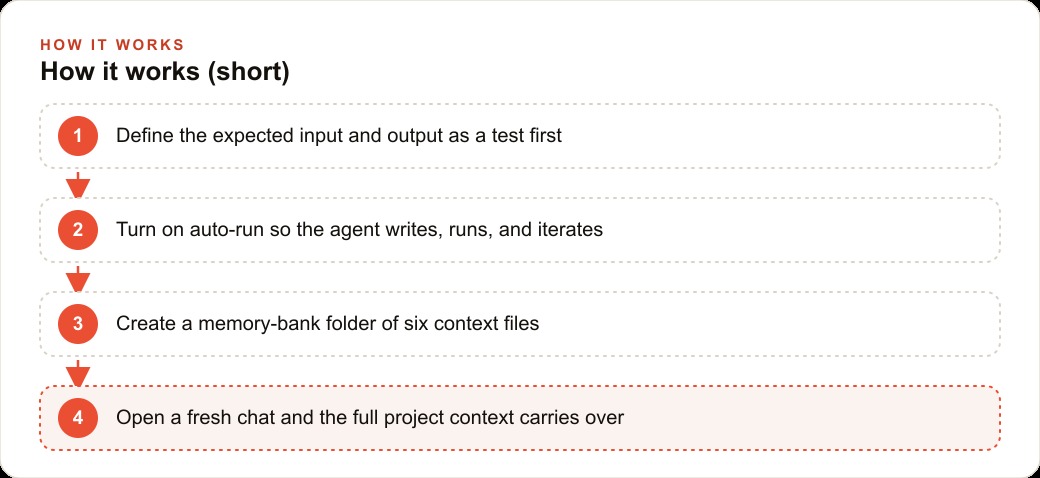
When an agent writes a function, the time cost of writing the test drops to nearly zero. You describe the expected behavior. The agent writes the test. The agent writes the implementation. The agent runs the test, reads the result, and tries again if it failed. Your involvement is writing the specification and reviewing the final output. The agent handles every iteration in between.
The specific setup in Cursor is turning on auto-run mode, sometimes called yolo mode. With that setting on, the agent does not pause after each attempt and hand control back to you. It writes a test, runs it, reads the failure, adjusts the implementation, runs the test again, and continues until the suite is green or it has exhausted reasonable approaches. A prompt that works well: ask Cursor to write a function that converts a JSON-like string into readable JSON, first writing a test with a concrete input and expected output, then implementing the function, then running the tests and iterating until all pass. The concrete example is the critical detail. A vague description produces a vague implementation. A real input and a real expected output anchor the agent on the actual target.
During the iteration, the agent discovers edge cases that neither you nor it anticipated. It handles a trailing comma that breaks the naive implementation. It catches a nested structure the first version missed. It adds a null check for an empty input. None of those things required your attention. They required test failures, which the agent generated and resolved on its own. The output is not just a working function. It is a function with tests that prove it works for the cases you specified, and those tests protect the behavior against every future change to the codebase.
This is the correctness guarantee. Not a ceremony. Not a best practice invented by consultants. A mechanical check that runs in milliseconds and confirms whether the behavior you specified is still present. For any business using AI-built tools to process billing data, scheduling logic, or customer records, that mechanical check is the difference between software you can trust and software that fails quietly for weeks before someone notices. A business generating leads through Facebook and Instagram campaigns needs its intake forms to store records correctly. A test on the form handler catches a broken field before a campaign goes live and wastes budget on leads that never reach the sales team.
The memory bank exists because agents have no recall and humans forgot to give them any
The second cause of the error loop is context collapse. You spend an afternoon deciding how the database schema should look, which library handles authentication, and why a certain approach was chosen over the obvious alternative. Those decisions are good. They are also invisible to the agent the next day.
When you open a new chat in Cursor, the agent reads the files visible in the editor and makes inferences. Sometimes those inferences match your decisions. Often they do not, because the decisions lived in conversation and not in the codebase. The agent picks the library you already ruled out. You explain why it does not fit. The agent adjusts. Two sessions later it picks the same library again. The context is gone every time you close the chat.
A memory bank fixes this by persisting the context the agent needs to build correctly. The pattern comes from Cline, an open-source coding agent that runs as a VS Code extension. The bank is a folder with six plain text files. One captures the project brief: what the project is and why it exists. One captures product context: the user experience goals and how the pieces connect. One captures active context: what is being worked on right now and what just changed. One captures system patterns: the architectural decisions and code conventions the project follows. One captures tech context: the exact stack, library versions, and environment constraints. One captures progress: what is working, what is left to do, and what is blocked.
Every file is plain text. What makes them powerful is that the agent reads them before doing anything else in a new session. It loads the memory bank, understands the project history, and builds on top of the existing decisions instead of making new ones that contradict them.
Cursor's custom mode feature makes this easy to set up without Cline. You paste the memory bank instructions into the custom mode configuration, name the mode, and the folder structure is created. The agent updates the relevant files as it works. The setup costs one session. The benefit compounds on every session after.
For teams working on existing codebases, the memory bank is especially valuable. Point the agent at a legacy project and ask it to generate the bank by reading the files. It synthesizes the implicit decisions encoded in the code and writes them out explicitly. That synthesis is useful on its own, because old code rarely documents why it was built the way it was. The resulting files make the codebase legible to the next agent and to the next human who inherits it.
Any business running customer-facing tools, whether that is a sales pipeline managed through a CRM system at /web-crm or a publishing workflow tied to an SEO content program, depends on software that keeps working as new features are added. The memory bank is what prevents new additions from breaking existing behavior, because the agent reads every prior decision before it writes the first line of new code.
Where the paste-error-back cycle actually starts
The paste-error-back cycle starts before the first error arrives. It starts the moment a task is given to the agent with no verifiable definition of done and no memory of the project's constraints. The first attempt produces something that almost works. The almost is where the loop begins.
Without tests, the only way to verify the output is manual inspection. Manual verification is slow and inconsistent. It depends on the developer remembering to check every edge case while already thinking about the next task. When the manual check finds a failure, the developer pastes the error. The agent makes a fix and may introduce a new failure. The developer pastes again. The cycle continues because there is no shared specification that both parties can check mechanically and quickly.
Without a memory bank, each cycle of the loop also risks introducing contradictions. The agent fixes the error using an approach that seemed reasonable given what it could see in that moment, but that approach may conflict with a decision from three weeks ago that exists only in someone's memory. The developer explains the conflict. The agent adjusts. The adjustment creates another edge case. The messenger role never ends because the underlying problem, missing context, was never addressed.
Both causes operate at the same time in most real development sessions, which is why the loop feels so hard to escape. Fixing just the tests helps considerably. Fixing just the memory bank helps considerably. Fixing both breaks the loop at its structural roots. The agent knows what success looks like, it can verify its own work, and it understands the constraints it operates inside. That is the environment where an agent makes consistent forward progress instead of oscillating between fixes and regressions.
The business impact is measurable. Any team that has handed off software to a developer who uses AI without discipline will recognize the symptoms: features that work in isolation but conflict with each other, bugs that come back after being fixed, a codebase that becomes harder to change with every new addition. These are not AI problems. They are structural problems that AI amplifies because the iteration speed is higher than any human can track without automated checks enforcing the rules.
The two habits that end the loop without needing a better model
The first habit is defining success before writing code. For any function with real logic, write a test that specifies the expected output for a given input. Turn on auto-run mode. Let the agent iterate to green. Do not review the implementation until the tests pass, because passing tests are more reliable than your manual inspection under time pressure. This habit eliminates the error messenger role entirely and lets the agent work autonomously on each function until the behavior is verified by a machine that runs faster and more consistently than any human reviewer.
The second habit is maintaining the memory bank after each session. At the end of a session, confirm that the active context file reflects what changed. If a new architectural decision was made, add a line to system patterns. If the stack changed, update the tech context file. Two minutes of maintenance pays back in every future session where the agent walks in knowing the full project history instead of making fresh assumptions that contradict last week's work.
A more advanced setup called cursor-memory-bank adds four operating modes built on top of the standard pattern. A VAN mode for orienting the agent on a new codebase. A planning mode for scoping work before starting. A creative mode for reasoning through design problems and debugging complex failures. A build mode for straightforward implementation. The creative mode is specifically useful when the agent is stuck in a loop it cannot solve by iterating. Instead of trying fix after fix, it stops and reasons through the most likely root causes before touching any code. That reasoning step catches a class of problems that automated test iteration alone cannot solve, because some bugs exist because the test itself was poorly specified, and catching that requires stepping back rather than pushing forward.
None of this requires a better model or a newer version of Cursor. The two habits work today with the tools already available. The error loop is not evidence that AI coding agents are immature. It is evidence that the workflow habits around them have not yet caught up to what the agents are capable of when given proper structure.
For anyone running digital operations that depend on AI-built tools, whether those tools support campaigns tracked through Google Ads or internal systems that need to keep working as the business scales, the quality of the software comes down to whether the builders had these habits. The ones who did deliver software that compounds in value over time. The ones who did not deliver loops.
That is exactly what we do at AI DOERS. Book a private 30-minute call with Madhuranjan Kumar and we will map the fastest path to it for your specific business.
Book your call →
Madhuranjan Kumar
Madhuranjan Kumar brings 20 years of performance-marketing experience and has managed over $200 million in Facebook ad spend for brands across the United States and beyond. His expertise spans the full modern marketing stack: Meta, Google Ads, TikTok, email automation, CRM, and the websites that hold it together. At AI DOERS he turns that track record into lead-generation systems for businesses across every industry.