
Two Builders, One Hour, One Phone: What a Vibe-Coding Race Teaches About Claude Code
A non-coder and a ten-year iOS engineer each built a Headspace-style meditation app in one hour from their phones using Claude Code, and the experience gap shrank to almost nothing because AI generated the code, art, voices, and music for both.

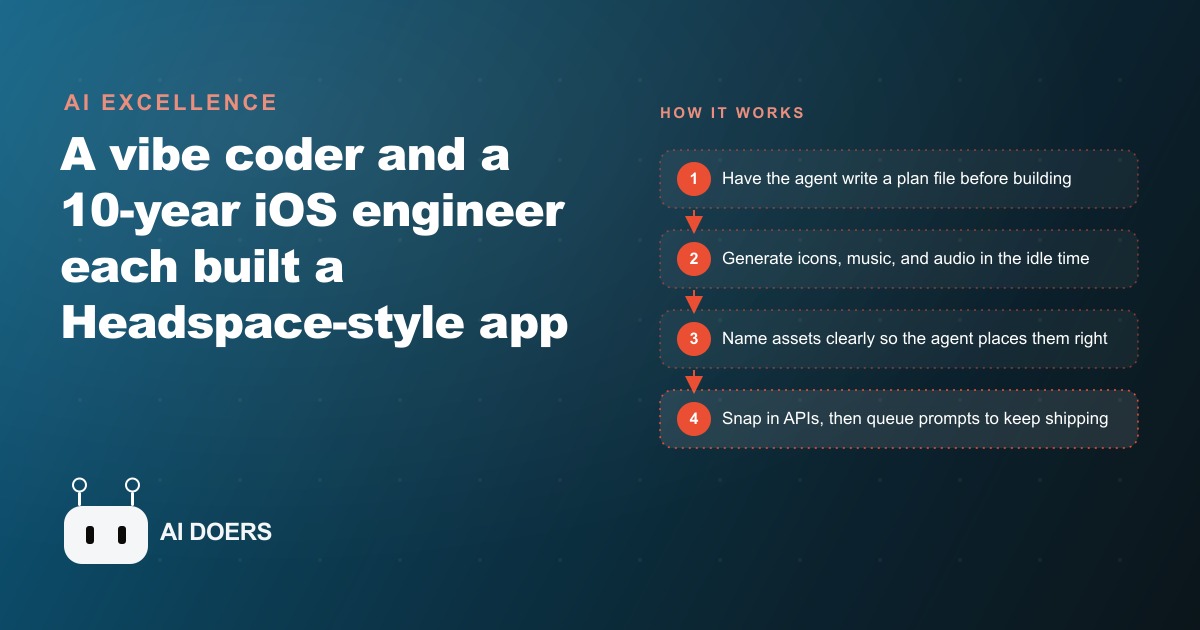
The experience gap between a developer and a complete beginner has effectively closed for most mobile app ideas, and experience now expresses itself almost entirely in planning rather than in code.
That is not a hopeful prediction. It is what happened when a self-described vibe coder with no coding experience and a 10-year iOS engineer sat down with nothing but their phones and one hour to build a Headspace-style meditation app. Both used Claude Code. Both started on Sonnet 4.5. One switched to Opus mid-build to push design quality. Headspace, the product they were replicating, generates over $300 million per year. Both builders produced something structurally comparable to it in 60 minutes. The gap between them showed up in exactly one place, and it was not syntax.
I am Madhuranjan Kumar, and the reason this race matters more than it appears to is what it reveals about where competence now lives in software development. If you expected the experienced engineer to dominate and the beginner to produce something embarrassingly basic, the actual result is more interesting and more instructive.
Ten years of iOS expertise shrank to one planning habit
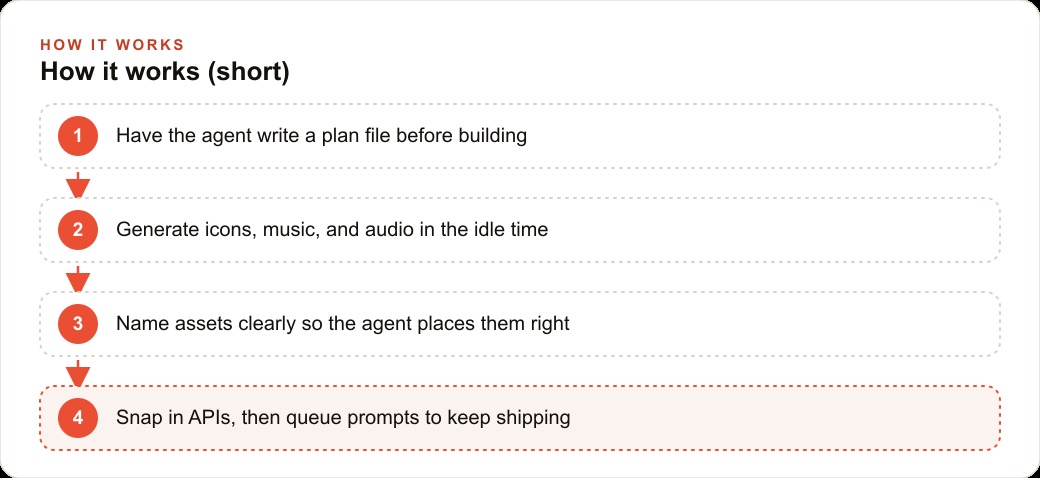
The most consequential move in the entire race was not a coding decision. It was the pro's choice, before writing a single line of code, to have the agent write a plan and spec to a file in the codebase. The plan described the app's mood system, the six emotional characters including Anxious Alex and Gloomy Gray, the questionnaire flow for each character, the tone of the guided advice, and the APIs that would power the audio and analysis. It was written in natural language by the agent, saved as a file in the project, and consulted repeatedly throughout the build by typing a short instruction to reference it.
That plan file is the equivalent of a cursor rules file, or any other specification document that gives a tool persistent memory of the intent behind the project. Without it, every new prompt has to re-establish context. With it, the agent knows the mood system on prompt one and still knows it on prompt twenty. The pro used this because ten years of building software taught him that the most expensive part of any project is the rework that happens when a tool or a team member loses track of the original intent. The beginner did not use it, because that lesson comes from experience rather than instinct.
The difference in the final outputs reflected this gap almost entirely at the level of coherence rather than technical capability. The experienced builder's app had a consistent internal logic: the mood characters were thematically connected, the questions for each one served the character's emotional profile, and the guidance the AI returned matched the tone. The beginner's app had comparable visual quality and comparable features, but some of the connections between elements felt more arbitrary, because without a plan file, the build direction shifted with each new prompt rather than staying anchored to a defined vision.
The lesson is not that beginners cannot build good apps. It is that the planning habit, the discipline of writing down what you are building and why before you start building it, is the experience advantage that survived the transition to AI-assisted development. Everything else flattened.
The real separator was the plan file, not the syntax
Let me be specific about what the beginner's output actually was, because it is important not to overstate the gap. Both builders produced working apps with multiple screens, a mood input system, AI-generated guidance, text-to-speech audio, custom icons, and background music. Both did this in 60 minutes from a phone. The code quality of the outputs was not meaningfully evaluable by either builder during the race; both were relying on the agent entirely for that. The visual polish was comparable because both builders were prompting the same model toward a meditation app aesthetic that Claude has clearly processed many times before.
The beginner's app looked like a meditation app. It functioned like one. A user encountering it would not immediately notice anything missing. The pro's app looked more considered at the component level, with transitions that felt intentional, a mood system that held together thematically, and a pulsing halo animation on the breathing exercise that the builder specifically requested by telling the agent to embody Apple Human Interface patterns with a calming breath-pacing visual. That level of prompt specificity comes from knowing what a polished meditation experience feels like from the inside.
Which is to say: the gap was in product taste and planning discipline, not in the ability to execute code. A beginner who has used 30 meditation apps and has strong instincts about what makes them feel right will produce a better output than an experienced developer who has never opened one. Technical experience without product taste does not help when the code is being written for you. Product taste without technical experience produces something close to the same result the experienced developer gets, minus the planning structure.
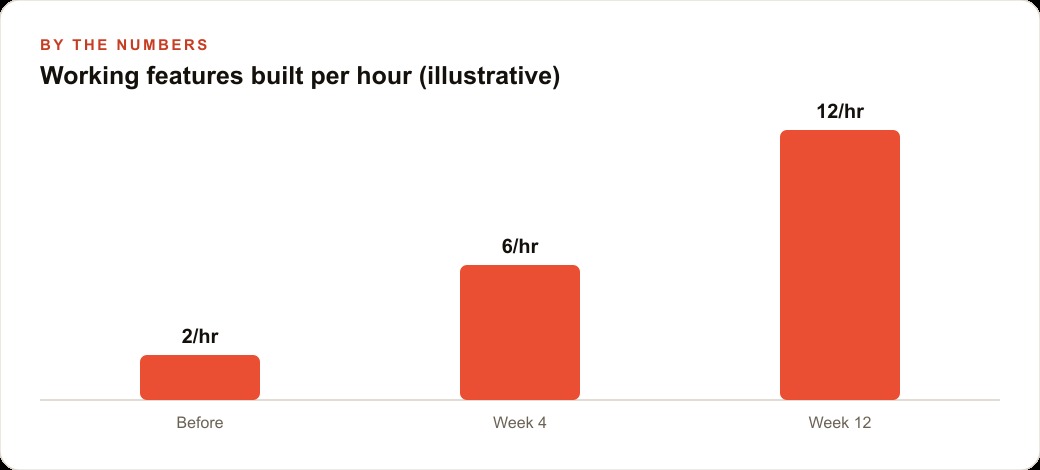
That realization is the more important one. Coding knowledge, once the bottleneck, is now provided. Planning knowledge and product instinct remain scarce. The race proved both claims simultaneously.
What experience still controls: the judgment calls on APIs and design
There are two areas where the experienced builder's background produced a materially better outcome, and neither involves writing code.
The first is API selection. The pro knew, without having to research it during the race, that an OpenAI image model produces transparent-background icons cleanly and that ElevenLabs text-to-speech produces a sufficiently calming voice for a meditation context. He knew those two APIs existed, what they were good at, and how to describe the integration to the agent in a way that would work on the first attempt. The beginner did not have that catalog of tool knowledge, which meant either guessing or spending time during the race researching options that the pro had already internalized.
This is the new form of technical advantage: knowing which APIs exist and what they are actually good at. Not knowing how to build a text-to-speech engine. Not knowing how to train an image model. Knowing which existing service to snap in for a given requirement, and being able to describe the integration clearly enough that the agent can execute it.
The second area is asset naming. The pro named every generated asset with a specific, descriptive filename before placing it in the project folder: logo, breathe-character, calm-background. When the agent placed those assets into the app, it knew from the filename what each one was and where it belonged. The beginner used more generic naming conventions and spent time during the race correcting placement errors that could have been avoided with clearer names upfront. Small discipline, large payoff over the course of a one-hour build where rework costs time you cannot recover.
These two skills, knowing which tools to snap in and naming assets clearly, are learnable in days rather than years. They are habits, not expertise. A motivated person who has built two or three apps using this pipeline will have internalized both of them by the third build. The experienced developer had them on day one because they came from years of managing development teams where both problems caused expensive mistakes.
Why this is a permanent shift, not a fluke
Some readers will note that one hour on a phone is an unusual constraint and that the results might not generalize to more typical development situations. That objection misses the point of the experiment. The constraint was designed to strip away every advantage except the ones that were genuinely durable. No laptop meant no advantage from keyboard shortcuts or a bigger screen. No extra time meant no advantage from being able to look things up or learn a new API during the build. One hour meant both builders were working entirely from knowledge they already had and instincts they had already developed.
In those conditions, a 10-year iOS engineer and a person who has never written code produced apps of comparable quality. That is the signal the race was designed to surface, and it showed up clearly.
The shift is permanent for the same reason that spreadsheets permanently shifted accounting. When a tool automates the most technically demanding part of a process, the value in the surrounding process concentrates in the parts the tool cannot do: judgment, taste, planning, and domain knowledge. Claude Code does not know that a meditation app needs a pulsing halo animation specifically, rather than a static circle or a progress bar, because it has observed thousands of hours of users responding better to the former. The person who knows that, from having used and built wellness apps, produces a better output with the same tool. The syntax advantage, which once converted into employment barriers, is gone.
For anyone building a business application, the practical consequence is direct. If you have an app idea that requires a branded experience tied to a specific methodology or framework you already know well, the build is now accessible at a fraction of the historical cost. What you ship next month using Claude Code from your phone competes with what a team took six months and a significant budget to build in 2022. Once that app is live, growing the user base through targeted digital advertising and keeping users engaged through CRM automation and lifecycle messaging are the next levers, and both are more tractable than they have ever been. The technical gate that kept most ideas from becoming products is not the constraint it was. The planning, the taste, and the judgment about what to build are the constraints now. Those are learnable, and unlike syntax, they compound directly into better products with every iteration.
That is exactly what we do at AI DOERS. Book a private 30-minute call with Madhuranjan Kumar and we will map the fastest path to it for your specific business.
Book your call →
Madhuranjan Kumar
Madhuranjan Kumar brings 20 years of performance-marketing experience and has managed over $200 million in Facebook ad spend for brands across the United States and beyond. His expertise spans the full modern marketing stack: Meta, Google Ads, TikTok, email automation, CRM, and the websites that hold it together. At AI DOERS he turns that track record into lead-generation systems for businesses across every industry.