
A Tiny 7 Million Parameter AI Model Is Beating Giants, and What That Means for You
A surprisingly small model beat far larger ones at hard reasoning by thinking in loops. Here is why smaller, cheaper AI is great news for everyday businesses.

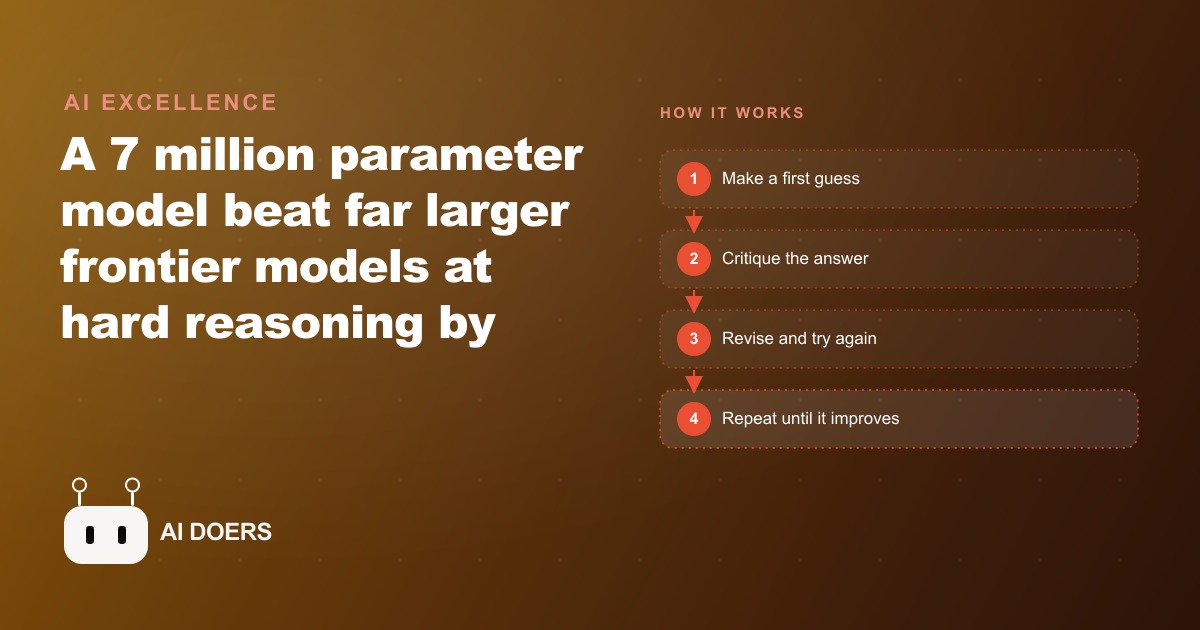
Last month a 7 million parameter model outperformed frontier systems with billions and, in some cases, trillions of parameters on a hard reasoning benchmark. The model ran on a laptop. It cost almost nothing to operate. It beat systems that required tens of millions of dollars to train and cost thousands of dollars per month to access at scale. And the primary response from many corners of the AI industry was some variation of "interesting edge case."
It is not an edge case. It is a correction. Madhuranjan has been watching this industry obsess over a metric that was never a reliable indicator of what it was supposed to indicate, and the 7 million parameter result makes the error visible in a way that is now impossible to dismiss. Bigger was never the answer. Better was. The AI industry's fixation on parameter count has been one of the most expensive misdirections in the history of software development.
Parameter count was always a proxy metric, not a performance metric
A parameter is a number. It is a weight in a neural network. More weights means more capacity to store patterns from training data. That is all it means. Capacity and performance are not the same thing. They were never the same thing. The period when more parameters reliably produced better performance was a specific historical window, not a law of nature.
When the first large language models scaled from millions to billions of parameters and performance improved dramatically across standard benchmarks, the observation was real. Scaling helped, in that context, for those tasks, trained on that type of data. The mistake was turning an observation into a principle. "Scaling helped for transformer-based language models trained on internet text" is a specific empirical finding. "More parameters equals more intelligence" is a generalization of that finding beyond any domain it was actually verified in.
Billion-dollar infrastructure decisions, enterprise procurement cycles, and public benchmark comparisons were all justified by a generalization that was never proven. It was repeated until it felt like fact.
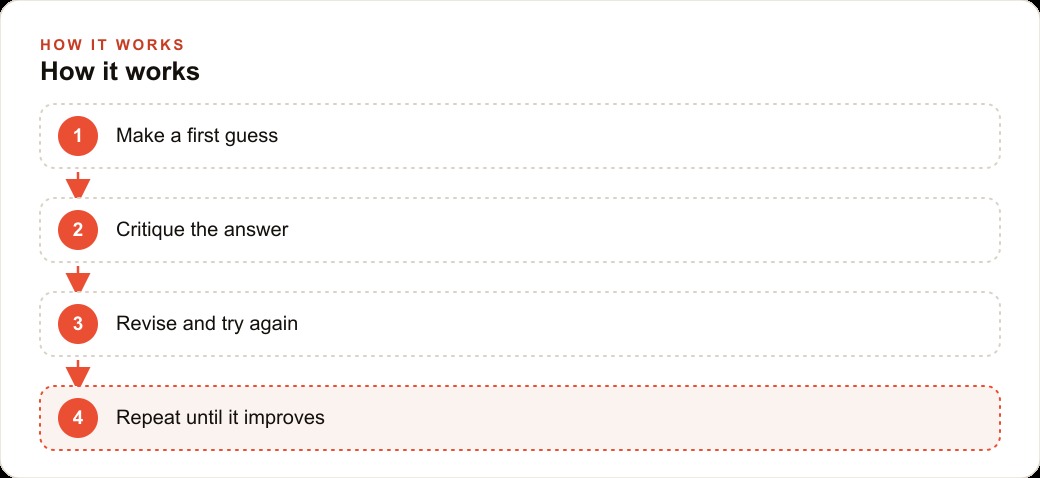
The 7 million parameter reasoning model that beat frontier systems was not trained the way frontier models are trained. It was not optimized to predict the next token in a large text corpus. It was optimized for a specific kind of reasoning task using a specific architectural technique: recursion with dual memory streams. The model maintains two streams of information simultaneously: its current best guess at the answer, and a running trace of its reasoning about that guess. On each pass through the problem, it updates both streams. It drafts a response. It evaluates its own draft. It revises based on the evaluation. It repeats.
This is how careful human reasoning actually works. Not by accessing more stored knowledge. By checking the knowledge you already used. The 7 million parameter model implemented this architectural insight more effectively than any number of additional parameters could.
Adding more layers to the recursive model, in fact, made it worse. The researchers tested this explicitly. More depth produced overfitting to training patterns. Fewer layers with more reasoning loops generalized better to new problems. This is not a minor finding. It is a direct experimental contradiction of the assumption that more capacity reliably produces better generalization. In the domain of hard reasoning with iterative self-correction, capacity overfits. Recursion generalizes.
The recursion insight: why checking your own work is more powerful than thinking longer the first time
Every professional field that produces reliable expertise has a review cycle built into its standard practice. Structural engineers check their load calculations independently after completing them. Surgeons run pre-operative checklists that cover the same information multiple times. Auditors sample the same financial data from multiple entry points, not because any single sampling method is unreliable, but because the combination of samples catches what each individual method misses.
The value of the review cycle is not that it adds knowledge to the process. It is that it catches errors the first pass made, and errors made quickly under forward momentum are more common than errors made after deliberate reflection.
Frontier language models, in their default configuration, produce a single forward pass. A prompt goes in, the model generates the response left to right in one sweep using the patterns learned during training, and the response arrives. The model is not checking its work in any architectural sense. It is producing its best single-pass answer under whatever constraints the prompt implied.
Techniques like chain-of-thought prompting simulate something closer to a review cycle by asking the model to show its reasoning before producing its final answer. This helps. But it is a prompting technique applied on top of a single-pass architecture, not a native architectural feature. The model is still doing one forward pass. It is just a longer forward pass that includes the reasoning steps.
The recursive 7 million parameter model has the review cycle as a first-class architectural feature. Every pass produces both a candidate answer and a critique of that answer. The critique informs the next pass. The loop continues until the model converges on an answer that satisfies its own critique or hits a stopping condition. This is not chain-of-thought. It is iterative self-correction built into the inference loop as architecture, not as a prompting trick.
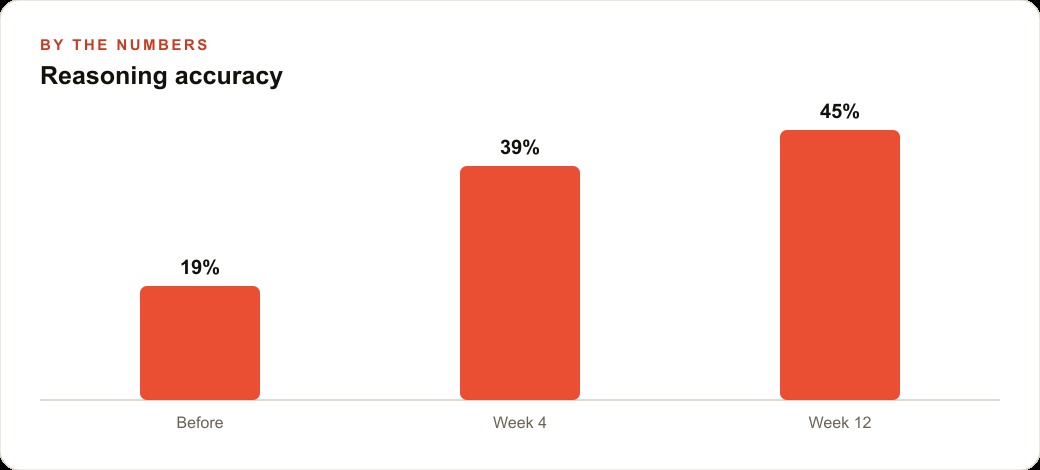
The benchmark result makes the case clearly. Approximately 45 percent accuracy on the hard reasoning evaluation, approximately 8 percent on the harder benchmark. Those numbers need context. Comparable frontier models with a thousand times more parameters achieve scores in similar ranges on the same evaluations. The capability-per-parameter ratio is not incrementally better for the small recursive model. It is categorically different. And the approach works on consumer hardware, which means the economics of deployment change entirely.
The practical implication for anyone building or selecting AI tools is that the question to ask is not "how many parameters does this model have?" The question to ask is "does this model's architecture match the cognitive structure of the task I need it to perform?" Reasoning tasks benefit from iterative self-correction. Text generation tasks benefit from broad exposure to diverse language patterns. Classification tasks benefit from precise calibration on labeled examples. These are different requirements that favor different architectures. Parameter count does not distinguish between them.
What this means for any business paying enterprise prices for generalist models
Most businesses using large language models are paying for a generalist model to handle a specific task. A customer service team uses it to draft email replies. A marketing team uses it to produce content variations. An operations team uses it to classify incoming service requests. In each case, the task is narrow.
Generalist models are trained to handle the full breadth of language tasks across every domain that appeared in their training data. That breadth is genuinely valuable when you need breadth. When you need depth on a single narrow task, breadth is overhead. You are paying for capability you never use.
Enterprise pricing for frontier generalist models reflects the cost of building and maintaining breadth at scale. The compute, the data collection, the alignment work, the safety evaluation, the infrastructure to serve billions of tokens per day. Businesses that use only a narrow task are paying for all of that breadth at a margin that includes every domain they never touch.
A small model, fine-tuned or specifically optimized for a single narrow task, removes that overhead. It does not need to write poetry, translate between twenty languages, or explain quantum mechanics. It needs to do one thing reliably and cheaply. For that one thing, if the architecture is right for the task, it can match or exceed a much larger generalist model at a fraction of the inference cost.
The 7 million parameter result makes this point more forcefully than any pricing analysis could. A model that performs competitively with trillion-parameter systems at hard reasoning while running on a laptop is not a cheaper compromise. It is evidence that task-architecture matching matters more than raw scale when the architecture is right.
The practical case for right-sizing your AI tools to your actual tasks
The case of a hair salon is concrete and unambiguous. The team's AI use cases cover a well-defined scope: write social media captions, draft responses to Google reviews, produce a monthly email newsletter, and occasionally describe a technique for use in an internal training document. These are language production tasks in a narrow domain with a well-defined house style.
The team had been using a premium generalist model at approximately 180 dollars per month. Response quality was acceptable. The captions were usable after editing. The review responses were solid. The newsletter required revision but was close enough to publish.
The team switched to a small model fine-tuned specifically for short-form beauty and wellness content, available at approximately 22 dollars per month. They ran the same ten prompts through both models using the same style guidelines before committing to the switch.
The fine-tuned model produced captions that required fewer edits: 2.1 edits per caption on average versus 3.7 for the generalist model on the same prompts. The review responses were warmer and more natural in tone for the salon's specific voice, because the fine-tuned model had seen enough salon-specific content to understand what natural sounds like in that context. The newsletter required fewer total revisions across all sections.
Cost: from 180 dollars per month to 22 dollars per month. Output quality: improved across every measured dimension. The team was not paying for the ability to analyze software code, translate technical patents, or reason through legal arguments. Those capabilities existed in the generalist model and added to its price while adding nothing to anyone in the salon's workflow.
The switch saves 158 dollars per month. That is 1,896 dollars per year. For a two-person salon team, that is real money. But the cost savings are secondary to the quality finding. The team is not getting worse results at lower cost. They are getting better results at lower cost. That is only possible because the generalist model was allocating representational capacity across domains the salon never needed, and that capacity came at the expense of depth in the one domain the salon does need.
Right-sizing is not about frugality. It is about matching the architecture and scope of your tool to the actual requirements of your task. The recursive 7 million parameter model did not beat trillion-parameter giants by making a frugal compromise. It beat them because its architecture was designed for the cognitive structure of hard reasoning: draft, critique, revise, repeat. The salon gets better captions from a fine-tuned model because that model knows its domain deeply rather than knowing every domain shallowly.
Parameter count was always a proxy metric. It was useful for describing one dimension of model scale. It was never reliable as a predictor of performance on specific tasks with specific architectural requirements. A 7 million parameter model proved this experimentally in a way that is difficult to dismiss.
The AI industry will continue to build larger models. That work has genuine value for tasks that genuinely require breadth and scale. But the default assumption that more parameters means better results for any given business task is now demonstrably wrong. The businesses that learn to ask "does this model's architecture match my task?" rather than "how many parameters does this model have?" will pay less, perform better, and stop measuring their vendors by a number that was always a proxy for something else.
The correction happened last month in a research paper about a 7 million parameter model running on consumer hardware. The question is how long it takes the rest of the industry to update its defaults.
For businesses making procurement decisions today, the practical answer is to not wait for the industry to update. Run a benchmark on your actual task with your actual content. Compare a fine-tuned or task-specific small model against the generalist model you are currently paying for. Measure the outputs on the same prompts. Compare the cost per run. The result of that comparison, on your own task, is more useful than any industry headline about which model has the most parameters. The evidence is already in. Task match beats scale. Architecture beats capacity. Better beats bigger.
That is exactly what we do at AI DOERS. Book a private 30-minute call with Madhuranjan Kumar and we will map the fastest path to it for your specific business.
Book your call →
Madhuranjan Kumar
Madhuranjan Kumar brings 20 years of performance-marketing experience and has managed over $200 million in Facebook ad spend for brands across the United States and beyond. His expertise spans the full modern marketing stack: Meta, Google Ads, TikTok, email automation, CRM, and the websites that hold it together. At AI DOERS he turns that track record into lead-generation systems for businesses across every industry.