
Three Ways to Make Money With AI Video in 2026, and When to Use Sora 2 vs Veo 3.1
AI video is finally good enough to sell, and the money is in three lanes: viral content, client work, and faceless YouTube. The real skill is matching the model to the job, Veo 3.1 for B-roll and ASMR, Sora 2 for product and UGC.

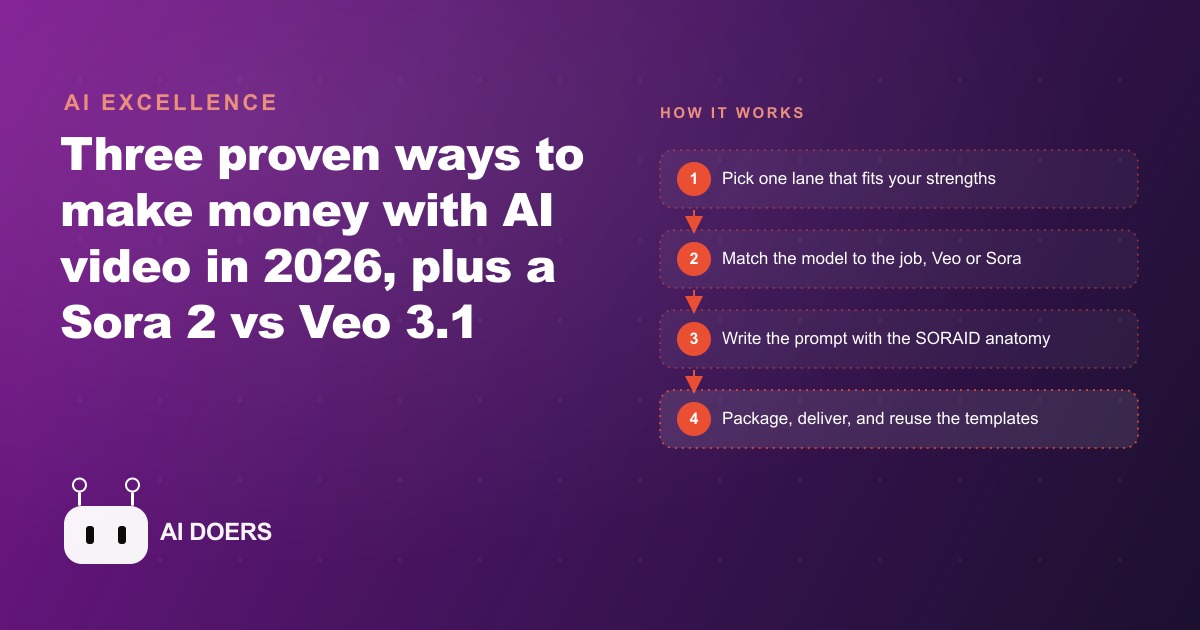
Most people who get serious about AI video in 2026 make the same mistake inside the first month. They try all three lanes at once: they post viral clips on TikTok, pitch a couple of brands for UGC work, and start a faceless YouTube channel on the side. Six weeks later they have three shallow experiments and no traction anywhere. The money in AI video is real, but it only finds people who go deep on one thing. That is the single most important idea in this entire piece, and everything else follows from it.
The three lanes exist and they all pay, but they reward different skills on different timelines and they punish you badly for splitting your attention between them. Understanding which lane fits you, and then matching the right model to the job inside that lane, is what separates the people making five figures a month from the people with an impressive tool stack and an empty bank account.
The three lanes, and why spreading across all of them kills you
The first lane is viral content. You build a recurring AI character, animate it consistently, post on short-form platforms, and monetize through revenue sharing and eventually brand deals. A character-based page that posts three times a day is running a media business, and the early creators who committed to specific characters a year ago are now pulling consistent brand fees just for keeping the character active. The character becomes a distribution channel, and distribution channels with audience are worth real money to brands. But this lane is slow to pay. Platform revenue share requires real volume, and brand deals only come once you have a track record. If you need income in the next 60 days, this is not your first move.
The second lane is client work: branded product demos, UGC-style testimonials, and short ad creatives that look like a real crew shot them. This is the fastest path to cash because you are selling a service rather than building an audience. A package of 20 clips a month at $500 to $1,000 per client has margins that are genuinely hard to find anywhere else in creative services, because your cost of production is a few dollars per clip and a few hours of prompt work. Two to four clients at $3,000 to $5,000 each clears $10,000 a month without a huge operation. The path from zero to $10k here is a matter of months, not years, if you can demonstrate quality and deliver reliably.
The third lane is faceless YouTube automation: AI narration over custom B-roll that matches every line of a script, assembled by a video agent that handles pacing, transitions, and audio. This lane has the best long-term upside of the three because the content earns passively once established, but it requires the most patience to monetize. Ad revenue thresholds take time to clear, and the channel has to earn enough watch hours before the algorithm starts distributing it. You are building a machine that runs without you, which is valuable, but the machine takes time to spin up.
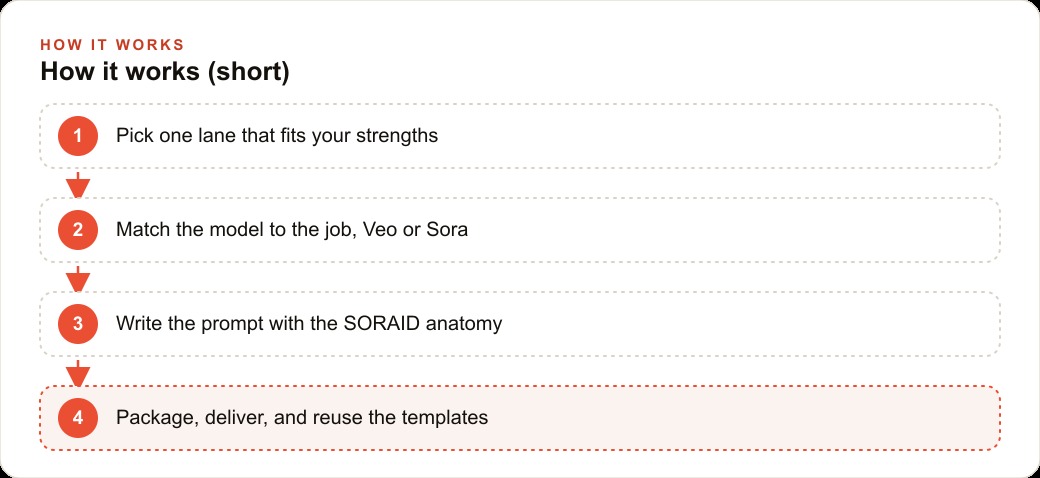
None of these lanes is wrong. All of them are genuinely paying people right now. The mistake is treating them as three parts of one strategy instead of three separate businesses. Each one needs a different skill, a different workflow, and a different growth loop. Pick the one that fits your timeline and your strengths and go deep on it for at least 90 days before considering a second.
Why the model you pick changes everything
Once you know your lane, the most consequential technical decision is which model you assign to which job. This is not a matter of preference. In head-to-head testing, the models have clear and consistent advantages over each other, and using the wrong one wastes generation cost and produces output that clients can tell is off even if they cannot say exactly why.
Veo 3.1 wins the viral content lane and the B-roll lane. Its decisive advantage is first-and-last-frame control: you can specify exactly what the opening frame looks like and exactly what the closing frame looks like, which means you can control camera motion with precision rather than hoping the model guesses right. For ASMR-style clips where a subtle camera push or a slow orbit around a subject is the entire point of the shot, that control is not a nice-to-have. It is the job. Veo also wins the long automation B-roll sequences for faceless YouTube because of a second, less obvious reason: Sora 2 blocks generation when it detects a person in the frame. Sora does this to prevent misuse, and it falls back to a still image rather than generating motion. For B-roll that includes a person walking through a scene, speaking, or interacting with an environment, Sora simply will not generate what you need. Veo will.
Sora 2 wins the client work lane consistently, specifically product ads and UGC testimonials. Its realism is grounded in physics in a way that Veo cannot yet match. The spray off a perfume bottle, the condensation on a cold can, the way a liquid moves when a container is lifted, all of it reads as genuinely filmed on Sora in a way that reads as generated on Veo. Product-focused brands notice this difference because they have seen hundreds of real product shots and their eye calibrates quickly to anything that looks wrong. When you are delivering ad creative to a brand that is about to spend real money running it, that difference in physical realism is the difference between a client who pays and a client who passes.
The rule is simple: Veo for movement-controlled shots and long B-roll with people, Sora for product physics and UGC authenticity. Learning to switch cleanly between them based on the job is the thing that makes your output consistently client-ready.
Prompting well is not optional
The model is only as good as the prompt, and most people prompt like they are searching Google. They write a scene in two sentences, get a mediocre result, and conclude the model is bad. The model is not bad. The prompt is incomplete.
The SORAID anatomy is the framework that fixes this. Every prompt should cover six things: the Subject, the Object or action happening in the scene, the Realm or setting, the Atmosphere you want the shot to carry emotionally, the Imaging or camera work (lens type, movement, angle), and the Details that make the shot specific rather than generic. A prompt that covers all six gives the model a complete brief. A prompt that covers two or three gives the model a guessing game.
The practical shortcut is to write a rough scene description in plain language and then have a language model expand it into a full SORAID prompt for you. This removes the blank-page problem entirely. You describe what you want, the language model structures the brief, and you paste the structured brief into Veo or Sora. The gap between your rough idea and a client-ready clip collapses significantly once you build this two-step habit into your workflow.
For recurring characters, the SORAID anatomy does additional work. When you generate a character image first and then animate it consistently across clips, the Subject field in every subsequent prompt anchors the character's appearance, maintaining continuity across dozens of clips without manual editing. Creators building character-based channels have turned this into a library of reusable character seeds that they mix with new scenes and settings. The character stays constant. The context around the character changes. That consistency is what builds audience recognition, which is ultimately what brand deals are purchasing when they pay for a character integration.
What this looks like for a real e-commerce business
Take a store selling a mid-range skincare product. The product manager knows the brand needs ad creative, needs a lot of it to run a proper testing cycle, and knows that finding winning creative is the hardest part of paid acquisition. Their current setup: they hire a freelancer, get eight clips a month, run them all at modest budget, find one or two that perform reasonably, and scale those. The problem is that eight variants is not enough to find a strong winner. The testing cycle is slow, the freelancer turnaround is days per clip, and the cost per clip leaves no room to experiment with wildly different angles.
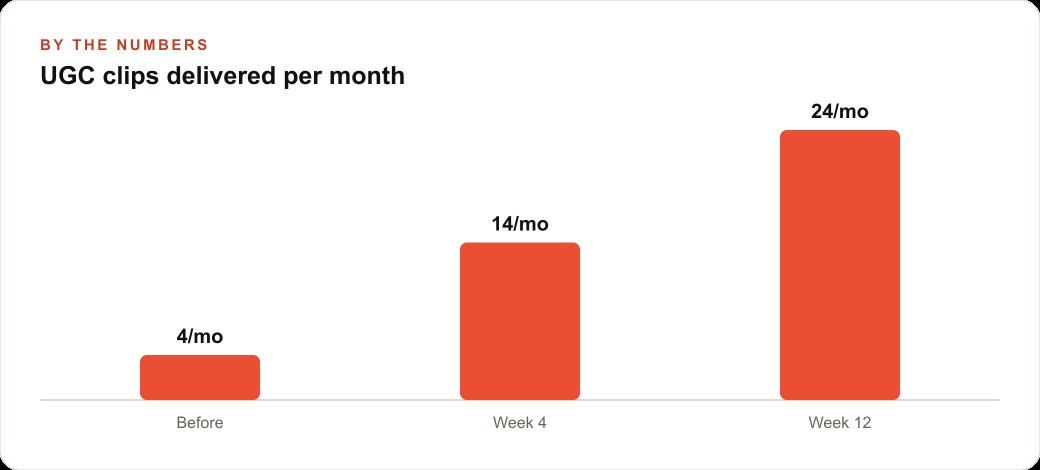
With AI video in the client lane, the production economics are reversed. Using Sora 2 for the UGC-style testimonials and the product physics shots, you can generate 20 clips a month at a fraction of the freelancer cost. The store now has 20 variants in the testing cycle instead of eight. They kill the losers fast at small daily budgets across Meta ads and Google ads, pour money into the two or three that convert, and get a clear signal in two weeks instead of a month. More variants, faster signals, lower cost per learning. The compounding effect on their ad efficiency is measurable and it shows up in the returns within the first month of testing.
For the B-roll on the product landing page and for any hero visuals in the SEO content supporting the store, you switch to Veo 3.1 for the controlled camera work. The ASMR-style texture shots of the product, the slow orbit around the packaging, the opening sequence where the camera glides toward the bottle. All of that requires the frame control that Veo offers. The store now has custom-generated B-roll that looks like it was shot in a studio, costs a few dollars to produce, and is unique to their brand rather than licensed from a stock library that competitors are also using.
The service provider on this engagement billed $3,500 for the month: a 20-clip UGC package plus B-roll for the landing page. Generation costs were under $50. That margin is the business model. At four clients structured this way, the monthly revenue is $14,000 with an overhead that is mostly time and a subscription to the generation tools. Nothing about that requires a studio, a camera, or a crew.
Systems are what the money is really buying
The gap between a hobbyist and someone billing $10,000 a month is not talent. It is systems. The professional has a prompt template library that reliably produces client-ready output. They have a delivery workflow that handles the handoff cleanly. They have a character seed library they can pull from rather than regenerating from scratch for every job. They have a testing framework that tells them which clips to kill and which to scale, the same kind of structured creative testing process we apply when running CRM-integrated campaigns for clients who want full-funnel visibility on their creative performance.
None of this is complicated in isolation. A prompt template is just a SORAID-structured prompt with blanks where the product-specific details go. A character seed is just a generated image saved with metadata describing the generation parameters. A testing framework is just a spreadsheet that tracks which clips ran at what budget and what they returned. But building these things and maintaining them takes discipline, and most people never get around to it because they are too busy generating clips to build the infrastructure that would let them generate clips at scale.
The hobbyist finishes a job and starts the next one from zero. The professional finishes a job and updates the library. That compounding is what allows the professional to take on more clients without proportionally more hours. It is also what allows the professional to go deep on one lane rather than spreading across all three, because the system handles the repetitive work and leaves the human attention for the decisions that actually require judgment.
The opportunity in AI video right now is real and it is early. The models have crossed the quality threshold where the output is genuinely usable, the platforms are still rewarding the format with organic reach, and the market for client services is not yet saturated with professionals who know what they are doing. That combination of conditions closes over time. The people who pick a lane, match the model to the job, prompt with structure, and build systems around their workflow right now are building a durable business. The people who dabble in all three are building a very expensive hobby.
That is exactly what we do at AI DOERS. Book a private 30-minute call with Madhuranjan Kumar and we will map the fastest path to it for your specific business.
Book your call →
Madhuranjan Kumar
Madhuranjan Kumar brings 20 years of performance-marketing experience and has managed over $200 million in Facebook ad spend for brands across the United States and beyond. His expertise spans the full modern marketing stack: Meta, Google Ads, TikTok, email automation, CRM, and the websites that hold it together. At AI DOERS he turns that track record into lead-generation systems for businesses across every industry.