
The White Collar Bloodbath Got Cancelled, and Here Is the Real Reason
The two loudest voices behind the AI-jobs-apocalypse walked it back because hiring is rising, not falling. The real bottleneck is not the model but that almost nobody knows how to use AI past simple chat, and most layoffs blamed on AI were overhiring corrections.

What got walked back?
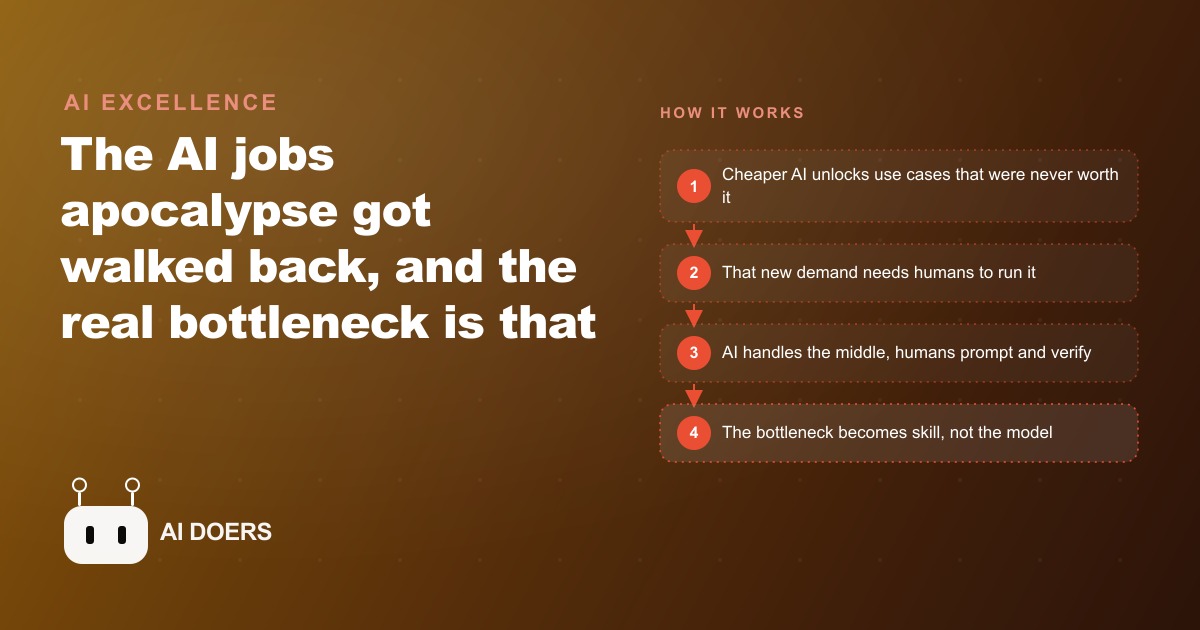
The predicted AI jobs apocalypse got quietly reversed by the very people who warned about it. For a year the story was a coming white collar bloodbath. Now the two loudest voices behind it are softening. Sam Altman has called his earlier warning about entry-level jobs pretty wrong, and Dario Amodei, who once said AI could eliminate half of white collar jobs, now suggests automation may actually expand the work people do. Goldman Sachs CEO David Solomon echoed the same surprise that the impact has been smaller than expected. The detail I find most telling is that Altman's own attempt to hand his Slack and email to AI failed, and he went back to answering manually. When the people building and selling the technology cannot make it stick on their own inbox, it is worth asking what is really happening.
How does the real picture actually work?
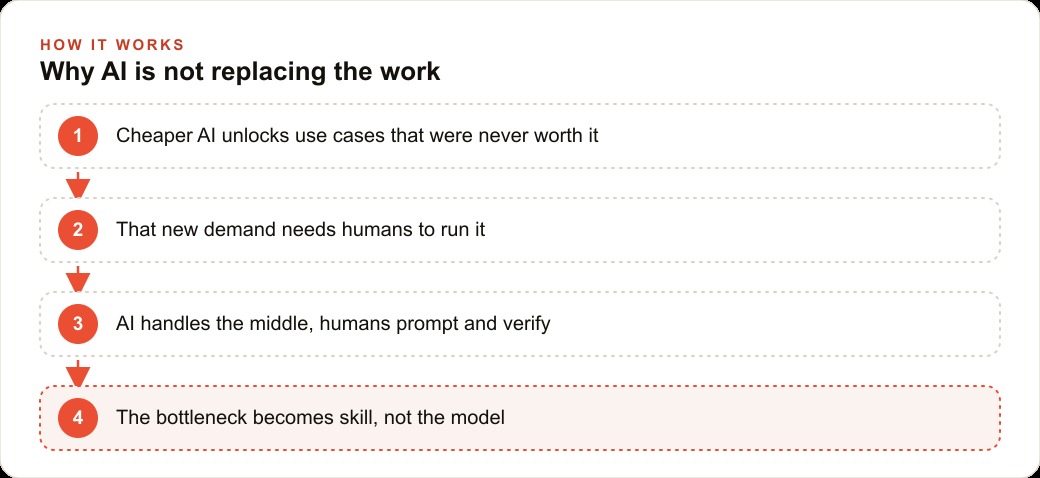
It works on two forces that pull against the apocalypse story. The first is that the layoffs were often misattributed. Companies that overhired during the zero-interest era found they did not need that many people for what they were actually building, and AI became a convenient scapegoat. When a company cut roughly half its staff and pointed at AI, or shed a large chunk of people and mostly stayed fine, the honest read is that those teams were bloated to begin with, not that AI replaced the work. One chief economist put it bluntly with zero evidence of AI-related job losses, while payroll data keeps trending up.
The second force is Jevons paradox. As a technology gets cheaper, you do not spend less on it, you spend more, because suddenly use cases that were never worth the cost become viable. AI is playing this out in real time. Cheaper intelligence unlocks more projects, and each one still needs humans to prompt, guide, and verify. That is why the AI spending boom is stoking employment rather than gutting it. The shape of the work matters too: AI is great at the middle of a task but still needs a human to set the goal up front and verify the result at the back. You cannot tell it to go build me a company and walk away.
Which businesses does this affect?
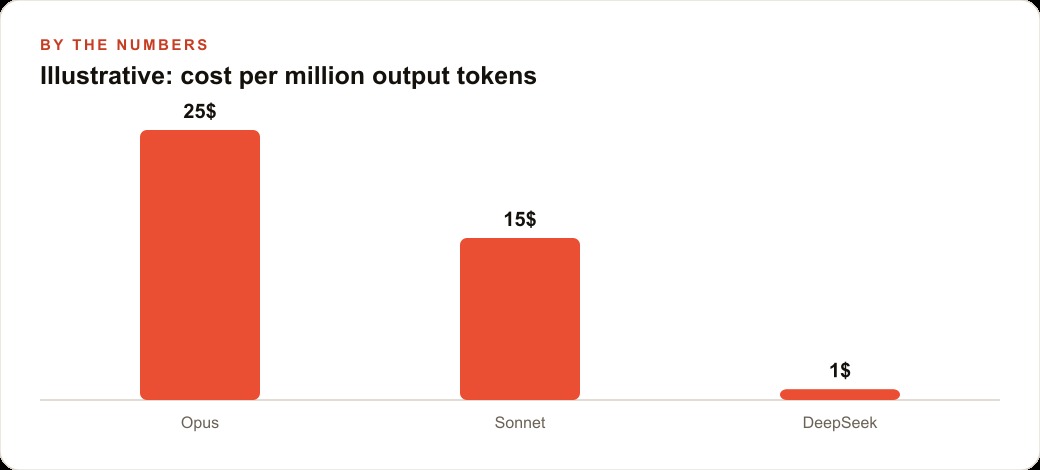
Every business hiring knowledge workers is affected, because the lesson is the same everywhere: do not fire your way into a hole. The AWS CEO called replacing junior staff with AI one of the dumbest ideas he had heard, because they are your cheapest, most AI-native employees and your future senior talent. Cost discipline matters too, but not the way people think. Uber burned its entire annual AI budget in four months and questioned the payoff. The fix is matching the model to the task. Frontier models like Opus run around 25 dollars per million output tokens, but most work does not need the frontier. A workhorse like Sonnet sits near 15 dollars, and cheaper options come in around 87 cents, covering the majority of real tasks without hurting output.
How would this play out for a marketing agency?
Picture a marketing agency feeling pressure to cut junior staff and lean on AI for content. This is exactly the trap to avoid. The junior strategists and copywriters are the cheapest, most AI-native people in the building, and they are who become the senior leads in a few years. The smarter play is to keep hiring and training them while making them the most AI-native team around. They use a workhorse model for the bulk of drafting and research, saving the expensive frontier model for the rare task that genuinely needs it, which keeps the token bill sane.
The agency should also notice where the real bottleneck moves. Shipping content is rarely the constraint anymore. Once you can produce a thousand assets, the wall becomes packaging, positioning, client strategy, and proving results, the parts that need human judgment and relationships. The agency that wins is not the one that fired everyone to save on salaries. It is the one whose people learned to use AI for the middle of the work while owning the strategy at the front and the quality at the back.
The most useful example to internalize is the software-factory idea. One builder spent around 1.3 million dollars in tokens in a month, not by writing work directly, but by building a system that produced it, and that system closed over 10,000 issues and 5,000 pull requests in a week. The leverage was in the framework, not the typing. For the agency, the parallel is to stop thinking of AI as a faster copywriter and start building repeatable systems: a research engine, a brief generator, a quality-check pass, all wired together. That is the real frontier almost nobody has reached yet, and it is where the few hundred people genuinely good at this are spending their time.
What should I actually do about it?
Match the model to the task and use workhorse models for routine work instead of defaulting to the frontier. Keep hiring and training junior people rather than trying to replace them with agents. Become the most AI-native person on your team, because the scarce resource is competence, not compute. Maybe a few hundred people worldwide push AI past simple chat into building real systems, and that gap is the whole opportunity. Remember too that shipping output is rarely the bottleneck, which is exactly why Anthropic and OpenAI are pouring billions into consulting arms to teach companies how to actually use this.
You can start closing that skill gap yourself today. If you would rather have someone help your team build real AI leverage and fix the packaging, marketing, and sales bottlenecks underneath it, that is the kind of thing worth talking through with an expert.
That is exactly what we do at AI DOERS. Book a private 30-minute call with Madhuranjan Kumar and we will map the fastest path to it for your specific business.
Book your call →
Madhuranjan Kumar
Madhuranjan Kumar brings 20 years of performance-marketing experience and has managed over $200 million in Facebook ad spend for brands across the United States and beyond. His expertise spans the full modern marketing stack: Meta, Google Ads, TikTok, email automation, CRM, and the websites that hold it together. At AI DOERS he turns that track record into lead-generation systems for businesses across every industry.