
The Week AI News Became a Fire Hose: What Actually Mattered
Image models, design tools, a major Nvidia conference, and a stack of new models all landed in one week. Here is what deserved attention and how to use it.

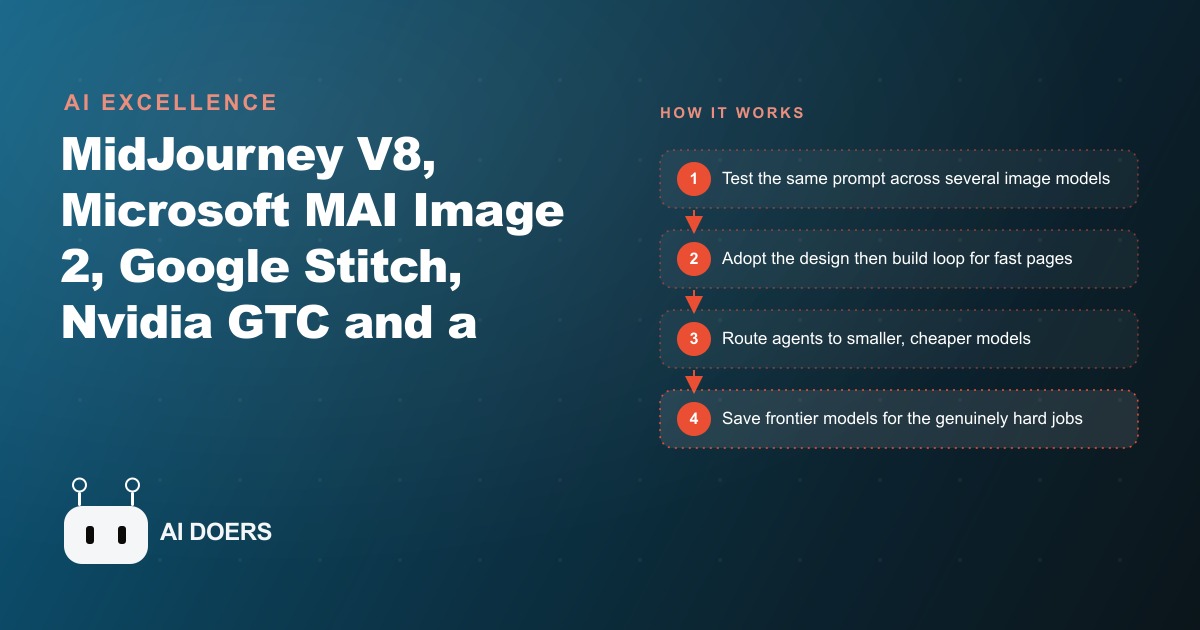
Seven major AI announcements landed in a single week and most of the conversation was about the wrong ones. I am Madhuranjan Kumar, and I follow this space closely because the tools that actually change how a business operates are rarely the ones generating the most noise. This past week was a clear example of that pattern: some of the loudest headlines pointed to incremental updates, while a few genuinely significant releases barely got covered. What follows is a breakdown of the ten things that actually mattered, what each one changes in practice, and a concrete example showing how the cumulative effect of adopting even two of them is already compressing work that used to take a full day into something that takes two hours.
MidJourney V8 Raised the Bar in Some Areas and Missed Badly on Others
MidJourney shipped version eight with three improvements worth noting: better instruction following, a personalization system that remembers your preferred style across sessions, and a new 2K high-definition rendering mode. The instruction-following upgrade is real. Prompts that previously needed multiple refinement cycles to get close to the intended result are landing closer on the first attempt, which reduces the back-and-forth cost for anyone using MidJourney as part of a regular creative workflow.
The problem is that the two capabilities most important for commercial work, accurate text rendering and realistic hand anatomy, still produce broken results in a meaningful share of cases. A menu board with readable prices, a product mockup with legible copy, a promotional banner with the headline spelled correctly: these are the images that make AI-generated visuals commercially useful, and MidJourney V8 still fails on them often enough to rule it out as a reliable production tool for those specific tasks. If you are using AI images for creative exploration, mood boards, or concept visualization, V8 is a genuine improvement. If you need images where text accuracy matters, the tests this week showed it is not yet the right first call.
Microsoft MAI Image 2 Now Ranks Third and Gets Text Rendering Right
The more significant image news this week came from a quieter release. Microsoft launched MAI Image 2 with minimal fanfare, and it placed third on the text-to-image arena rankings immediately after launch. In hands-on testing the results were striking precisely on the tasks where MidJourney stumbles. A fully detailed coffee shop menu board rendered with correct prices across every item. A transparent glass sneaker returned accurate material behavior and believable ambient lighting. Both of these are notoriously difficult for image generation, and MAI Image 2 handled them cleanly on the first attempt without any prompt engineering tricks.
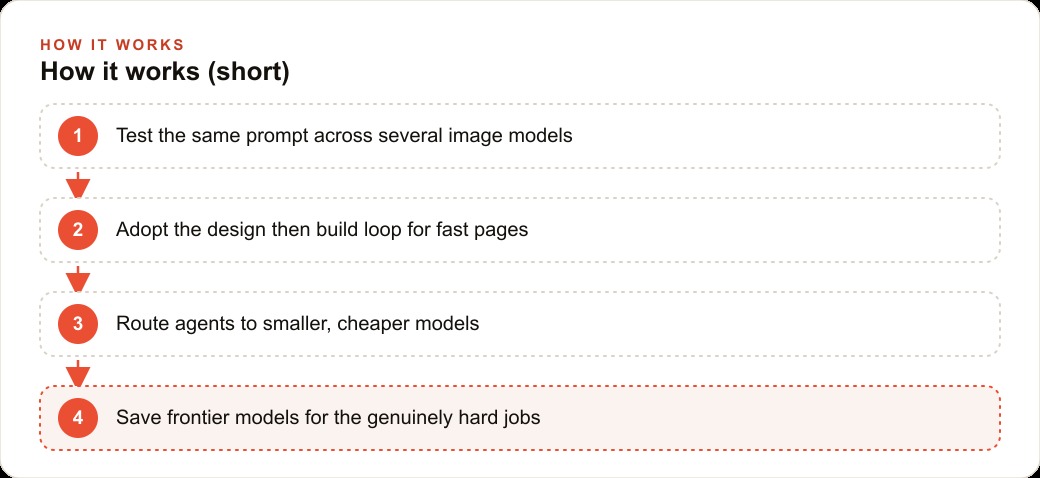
The practical implication for any business producing marketing materials, product visuals, or any graphic where text needs to be readable is that image model rankings shift quickly enough now that locking onto a single tool is no longer a rational default. The better habit is to maintain a short test list of two or three current models and run your standard prompt across all of them for each production job. MAI Image 2 belongs on that list immediately. It is available through Microsoft Copilot at no additional cost beyond what you are already paying, which makes adding it to the rotation a zero-cost decision.
Google Stitch Turns a Prompt Into a Design-Consistent Canvas
Google's Stitch product shipped an upgrade this week that moves it from a curiosity to a genuine production tool. The new feature is an AI native design canvas that takes a text prompt describing a page or site and returns a complete visual design. The part that makes it practically useful rather than just impressive is the design.md system: a markdown file that captures your aesthetic preferences and rules so every new screen you generate after the first automatically follows the same visual logic. You establish the brand direction once, approve the initial design, and every subsequent screen follows without additional instruction.
For a small business that needs to ship new landing pages regularly, this changes the economics of creative iteration. Rather than briefing a designer each time a new page concept is needed and waiting through revision cycles, the business owner can generate design-consistent layouts in Stitch, make small adjustments in the canvas, and move immediately to the build step. The design.md file is also a useful artifact in its own right: it functions as a documented style guide that keeps AI-generated content consistent with your brand even as team members or tools change over time.
AI Studio Closes the Loop Between Design and Working Code in One Session
The design-then-build loop became a single connected session this week. Gemini inside Google AI Studio can now take a screenshot of a Stitch design and return a working, animated website from a single prompt. The workflow is: design the page in Stitch, screenshot it, drag the image into AI Studio, write a short prompt describing what the page needs to do, and receive functional HTML and CSS in return. In the test cases documented publicly, the output was not a rough approximation requiring significant developer cleanup. It was a finished-looking, animated page that matched the design closely enough to ship or to hand off for minor polish.
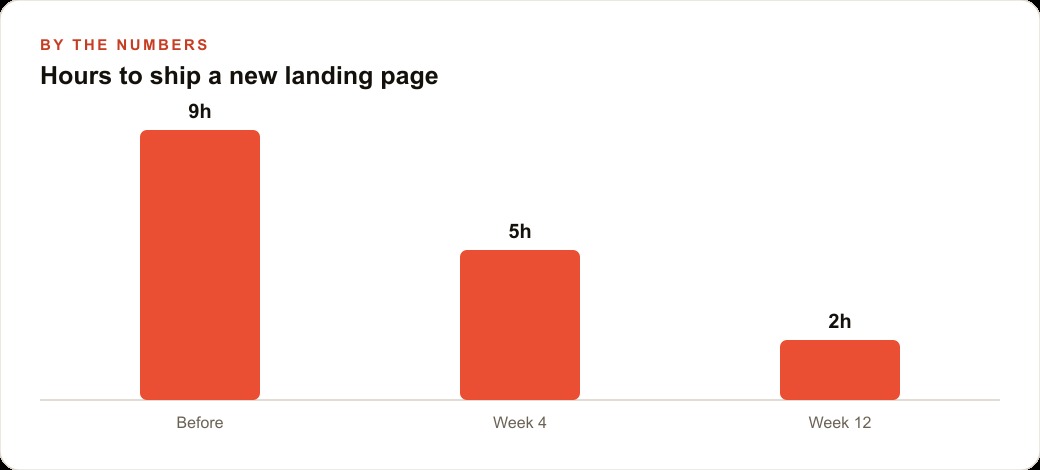
The business implication is worth naming with specific numbers. A landing page that currently requires a designer for layout, a developer for code, and a review cycle before it goes live takes nine hours of combined work in a typical small business setup. A team adopting the Stitch-to-AI-Studio workflow saw that number fall to five hours at week four once they had learned the prompting patterns, and to two hours at week twelve once the workflow was established. That is not a marginal improvement in speed. It changes what is economically feasible to test. When each new page costs two hours instead of nine, a team can test four variants in a month instead of one, and the improvement in conversion performance compounds directly from there.
For any business running Facebook and Instagram ad campaigns where the landing page is the conversion point, faster page production is one of the highest-leverage changes available. The ad spend has always been the variable cost. The page build has been the bottleneck limiting how many hypotheses the team can afford to test per month, and that bottleneck just got substantially smaller.
Gemini Personal Intelligence Is Now Free for US Users
Google began rolling out personal intelligence features to free users in the United States this week. Gemini can now reference your Gmail, Google Photos, and Google Calendar when answering questions, giving it access to your actual context rather than relying purely on general training. A free user can ask what happened with a specific client over the last six weeks and get an answer drawn from their real inbox rather than a generic suggestion.
This is a quiet change that will matter more over time than it does in a single week. An AI assistant with access to your own data is substantially more useful for daily business tasks than one without it, because most of the questions worth asking an assistant are about your specific situation rather than general knowledge. The free-tier rollout removes the last friction point for testing these features, and the applications are immediate: drafting follow-up emails with full conversation history in context, surfacing a specific commitment made to a vendor two months ago, reviewing what a particular week looked like across meetings and deadlines. These tasks now happen within an existing free account, with no additional cost or setup required.
Nvidia's $1 Trillion GPU Pipeline Is Based on Orders Already Placed
At Nvidia's GTC conference, Jensen Huang made a projection that generated significant headlines but was sometimes mischaracterized in coverage. The figure was not a forecast or an aspirational estimate about what customers might spend. Nvidia expects at least one trillion dollars in GPU sales through 2027 based on purchase orders that are already on the books. That distinction matters enormously for how to interpret the number.
Purchase orders are commitments, not intentions. The AI infrastructure underlying every model improvement and every new tool capability is funded by documented spending plans already in place across Nvidia's customer base. For any business owner making medium-term decisions about whether to invest time and resources into building AI-assisted workflows, this number is the clearest possible signal. The tool improvements are not going to slow down in the next two years. The compute being purchased today is what powers the models shipping over the next eighteen to twenty-four months. Decisions made now about which capabilities to build operational habits around will compound on top of infrastructure that is already contracted and being installed.
Nemo Claw Fixes the Top Complaint About Running Open Agents in Production
Nvidia also shipped Nemo Claw this week, wrapping the widely used OpenClaw agent framework with security and privacy layers and packaging the whole thing with a one-command install. OpenClaw has been a popular foundation for building business automation workflows, and the most consistent complaint from developers and business operators trying to run it in production environments has been that security configuration was too complex and too risky for organizations handling sensitive customer or financial data.
The one-command install is the critical detail in this release. Security improvements that require complex configuration from skilled engineers get skipped by exactly the organizations that need them most. Security improvements that deploy in a single command get broadly adopted because the effort required drops to match the willingness to act. Nemo Claw removes the barrier that kept many useful agent setups in the experimental tier, which is likely to accelerate production deployments over the next few months for businesses that were waiting on exactly this kind of assurance before committing.
GPT 5.4 Mini and Nano Are Purpose-Built for Background Agent Workflows
OpenAI released two new models this week, GPT 5.4 mini and GPT 5.4 nano, explicitly designed for agent workflows that run in the background rather than for interactive conversations. Both models are slightly less capable than the frontier model on complex reasoning tasks, but substantially faster and cheaper to run at scale. They are specifically pitched for the kind of automation that processes large volumes of routine tasks continuously, the type of background agent that accumulates significant token costs over a month of operation.
The business case for routing tasks to these models is concrete. If your current agent setup sends every task through the frontier model, the routine work such as classifying incoming customer messages, generating standard document summaries, extracting structured data from forms, or tagging content categories is costing significantly more than it needs to. Moving those tasks to a smaller, cheaper model while reserving the frontier model for decisions that genuinely require its best reasoning can reduce the monthly cost of background automation substantially without any reduction in output quality on the tasks where the cheaper model is sufficient. That saving grows as the volume of automated tasks grows, which means the routing discipline compounds over time.
For businesses that have started building Google Ads campaign automation or other recurring optimization tasks on top of AI models, this is a direct cost management opportunity that does not require any new capability, just a routing decision.
A One-Million Token Context Window Arrived in Claude's Mid-Tier Models
Anthropic opened a one-million token context window in Claude Opus 4.6 and the Sonnet tier this week. A million tokens is roughly equivalent to the text content of several long novels, or a complete software repository with all documentation included, held in a single active conversation without truncation.
For practical business use, this change addresses two specific limitations that previously required workarounds. First, large documents and complete data exports can now be pasted into a conversation and analyzed across the full set without hitting a context ceiling partway through. Second, long projects that previously required breaking work into multiple sessions and reconstructing context at the start of each new one can now run start-to-finish in a single session, with the model retaining everything from the beginning without needing summaries to bridge the gap. For anyone using AI-assisted analysis on large bodies of content, whether that is a full year of customer emails, a complete competitive research file, or a detailed campaign results export, this is a direct capability improvement that arrived without requiring a tier upgrade.
For businesses building SEO and organic search content at scale, the extended context means an entire content brief, competitive keyword set, and existing article archive can inform a single generation pass rather than requiring multiple constrained sessions.
Karpathy's Job Visualizer Names Which Roles Are Growing and Which Are Declining
Andrej Karpathy released a job market visualization tool this week that maps the real employment trajectory of different occupations in the context of AI adoption, drawing on actual labor market data rather than speculation. The pattern the visualizer reveals is consistent and specific: cashiers, data entry clerks, and routine office administrative roles are declining steadily, while electricians, plumbers, home care aides, and skilled tradespeople are growing in demand.
This is useful context for two planning decisions that are worth thinking through separately. For anyone making hiring or training investments, the data confirms what the underlying economics suggest: the skills being automated away are not being replaced by equivalent entry-level roles in comparable volume, while trade skills that require physical presence and applied judgment are experiencing genuine demand growth. The visual makes the divergence clearer than a table of statistics does because it shows the trajectory over time, not just a single snapshot.
For a business owner serving a trade or local service market, the combination of growing trade demand and almost entirely manual back-office operation is precisely the environment where a thoughtfully built system creates compounding competitive advantage. The trade skill is what the market is paying more for. The scheduling, invoicing, follow-up, and customer communication that surround it are still handled manually by most operators. A well-configured CRM and website stack that takes the routine administration off the plate of someone doing skilled trade work is not a technology experiment. It is an operational investment in the part of the business that is growing.
The productive response to a week this dense is not to attempt adopting every release at once. It is to identify the two or three shifts that directly reduce the cost or time of your highest-volume workflow and implement those first. The design-to-code loop is the largest single time compression available right now for any business producing web content regularly. The model routing change is the most immediate cost reduction for anyone already running background agents. Those two moves justify the week of noise on their own.
That is exactly what we do at AI DOERS. Book a private 30-minute call with Madhuranjan Kumar and we will map the fastest path to it for your specific business.
Book your call →
Madhuranjan Kumar
Madhuranjan Kumar brings 20 years of performance-marketing experience and has managed over $200 million in Facebook ad spend for brands across the United States and beyond. His expertise spans the full modern marketing stack: Meta, Google Ads, TikTok, email automation, CRM, and the websites that hold it together. At AI DOERS he turns that track record into lead-generation systems for businesses across every industry.