
The Voice AI Gold Rush: Three Offers That Actually Make Money
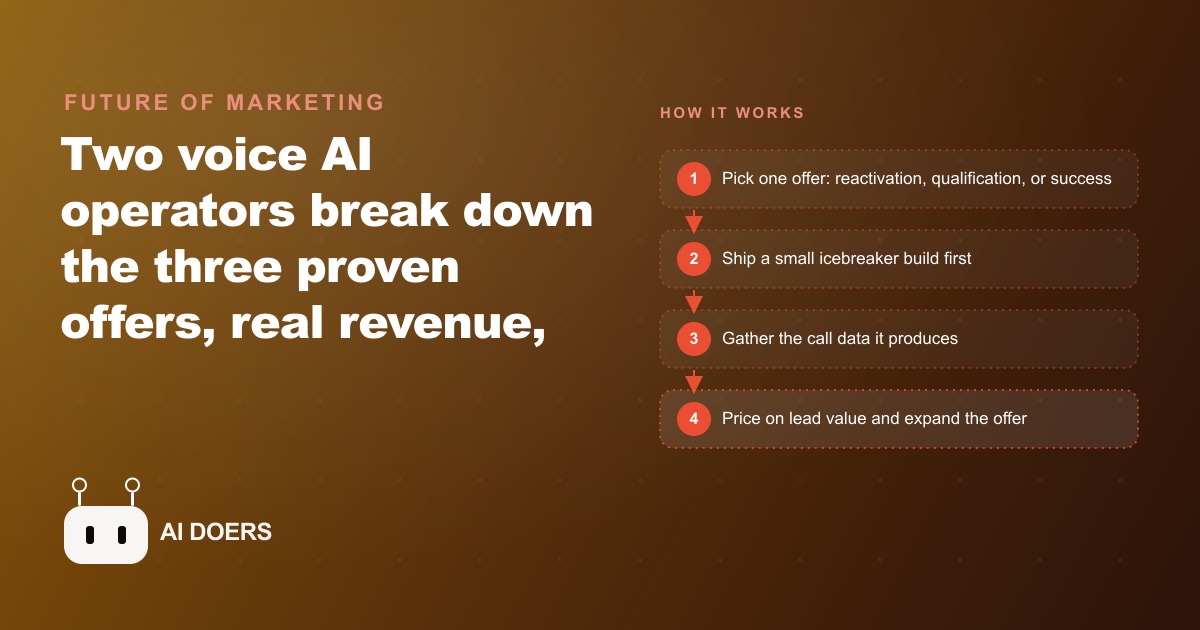
The three voice AI offers that consistently earn are lead reactivation, lead qualification, and customer success, and the way to start is a small icebreaker offer priced on lead value, built on just a voice platform, a tools platform, and a database.

Thirty-six thousand calls. Four thousand five hundred dollars in cost. A human team would have needed roughly 500 nine-hour days to complete them. A voice AI agent finished the work in about 30 days, and the leads it reached converted into approximately $754,000 in additional profit for a Fortune 200 company. That is not a proof of concept. That is a production campaign, and it ran on a stack of exactly three pieces.
I am Madhuranjan Kumar, and the reason I keep returning to voice AI as a topic is that the numbers from people who have actually shipped these systems are more concrete and more repeatable than almost anything else happening in the AI space right now. Two operators who have built and priced these systems professionally broke down the three offers that consistently work. What follows is a close reading of what they shared, why it holds up, and what it means for a local service business that is still answering the phone manually.
The missed call is the most expensive moment in any service business
The phone call is still the highest-converting touchpoint in local business. Not email. Not a retargeting ad. Not a chatbot. The call. When a person picks up the phone to inquire about a service, they are already deep into the decision process. They have done some research. They have a specific question or a specific concern. They are ready to talk to someone. The business that answers that call, immediately, with a coherent human-sounding voice, wins the conversation at a rate that no other channel matches.
The economics of the missed call have been measured repeatedly across industries. A fresh lead that goes to voicemail loses interest faster than most business owners assume. A callback that happens two hours later, even to a highly interested prospect, faces a dramatically lower close rate than one that happens within five minutes of the original inquiry. The speed-to-lead research is consistent: calling a fresh lead within five minutes can raise close likelihood by approximately 300 percent compared to calling within an hour. That figure appears repeatedly across studies of inbound lead conversion, and it holds across categories from home services to healthcare to real estate.
The problem is that the phone is the one channel most service businesses cannot staff around the clock without significant cost. A human receptionist works business hours. A human call team does not triple its size during a promotional spike. A follow-up caller cannot call 36,000 leads simultaneously. Voice AI addresses all three constraints at a cost that is a fraction of equivalent human staffing, and for the first time, it does it without the call sounding like a phone tree.
A lead that comes in through a Facebook or Instagram ad is already expensive to acquire. The cost per lead on a well-run campaign might be anywhere from $8 to $40 depending on the market and the offer. When that lead goes to voicemail because the front desk is with another client, the money spent acquiring the lead is effectively discarded. Voice AI closes that gap by making it structurally impossible for a new lead to go unanswered, regardless of the time of day or the volume of simultaneous inquiries.
Three offers where voice AI consistently creates real money
The operators who have built and priced these systems professionally have converged on three offer types that work reliably and that business owners can understand immediately. Each one solves a specific revenue problem, and each one has enough production data behind it to justify the price.
Lead reactivation is the first and, in terms of pure return on spend, the most powerful. Every service business has a database of leads that came in, were not closed, and have been sitting untouched since. These might be quote requests from 18 months ago, consultation inquiries that were never followed up on after the second touch, or applicants who expressed interest but went with a competitor. From the outside this list looks like dead weight. From a voice AI standpoint it is a revenue asset waiting to be dialed.
The production example that makes the math concrete: a Fortune 200 company where 8,000 people apply each month and the vast majority never receive a follow-up. A voice AI agent running a reactivation campaign made 36,000 calls at a cost of approximately $4,500 in API and platform fees. A human calling team doing the same work at a pace of 30 dials per nine-hour day would need roughly 500 days to complete it. The agent completed the campaign in about 30 days, working continuously, and the leads it reached converted into approximately $754,000 in additional profit from the reactivated pipeline. At that scale the ROI is not a percentage. It is a structural shift in how the business treats its historical lead database.
Lead qualification is the second offer, and speed is the critical variable. A fresh lead that comes from a paid ad, a search click, or an organic inquiry starts cooling the moment they submit the form. The first business to call them within the first few minutes wins the conversation the majority of the time. One voice AI qualification agent built for the real estate market answered inbound questions, qualified buyer intent, and booked viewing appointments autonomously. That one build was generating approximately $70,000 per month in booked pipeline from a workflow that required no human in the loop after initial setup.
Customer success is the third offer, framed in terms of savings rather than new revenue. An inbound voice agent that replaces a tangled multi-option phone menu with a single-prompt interaction reduces the time customers spend on hold, reduces the staff time consumed by repetitive calls, and reduces the error rate on call routing. One such build for a high-ticket retail company saved approximately $200,000 per year and returned 8,400 minutes of staff time per month. At a cost of a few hundred dollars per month in platform fees, the payback period on that investment was measured in weeks.
These three offers address three different failure modes in a typical local service business: revenue sitting untouched in the old lead database, revenue lost because new leads are not called fast enough, and cost created by an inefficient inbound phone system. Every business that has a phone that rings has at least two of those three problems active right now.
The stack is three pieces and the technical detail that makes or breaks the call
The whole infrastructure for any of these offers comes down to three components: a voice platform that handles the call audio and turn-taking, a tools platform that allows the agent to take actions during the call, and a database that holds the knowledge the agent draws on. Most people who want to build these systems stall for months choosing between platforms when the real skill is in shipping a small build, learning from actual calls, and iterating. The platform choice matters less than the pattern.
The one technical detail that separates a professional deployment from a demo that sounds good for 30 seconds is the knowledge retrieval approach. Default knowledge bases work by dumping the entire relevant content into the model's context at the beginning of a call. On short calls, this is fine. On calls that run longer than two minutes, the voice starts to sound robotic because the model is essentially reading from a static script rather than following a live conversation. The fix is a custom retrieval tool that returns only the two or three most relevant sentences for each question the caller asks. At each turn the agent calls the tool, gets a small, precise answer, and delivers it naturally. That pattern is what keeps a five-minute call sounding like a real conversation rather than an automated system.
The same principle applies to the spam filtering and retry logic that most beginners skip. Voice agents that call through numbers without checking for spam classification get ignored at high rates, especially on mobile. Calls that are flagged as potential spam by the carrier are answered at a fraction of the rate of clean numbers. Building spam filtering into the setup from day one, along with retry logic that pauses between attempts to the same number rather than calling repeatedly in quick succession, is what separates a campaign that generates responses from one that generates ignored calls and disengaged prospects.
The appointments those calls book feed directly into the business's scheduling and follow-up system. Every confirmed appointment should arrive in the CRM or booking platform automatically at the moment the call ends, with the caller's name, the service they enquired about, and the time they agreed to. That data handoff is what makes voice AI part of a real pipeline rather than a disconnected call center.
Where to start before this becomes as crowded as social media
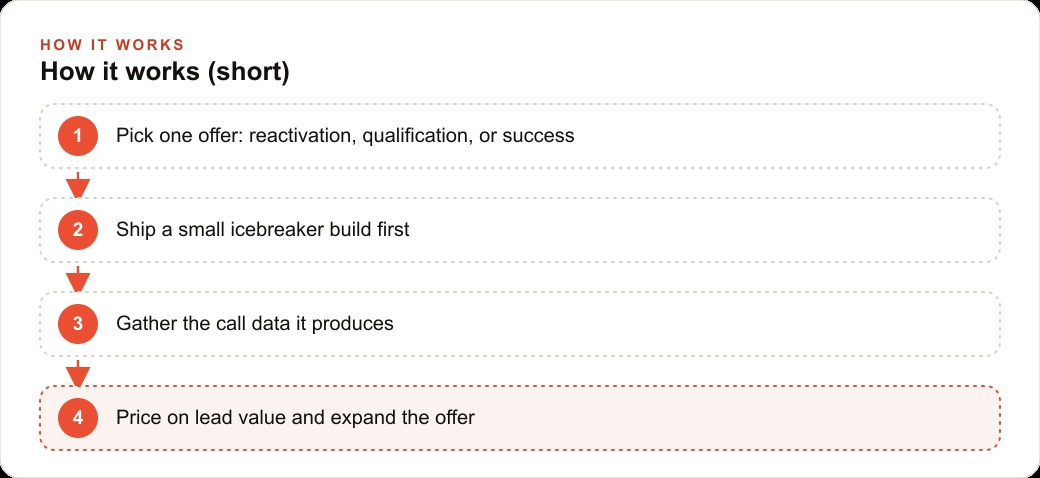
The operators who have built and priced these systems at scale share one consistent starting-point recommendation: do not sell the full system first. Lead with the smallest valuable build, a single function that solves one clear problem, and use the data that build produces to price the next engagement.
A concrete icebreaker for a pest control company: an after-hours receptionist that answers calls when the office is closed, captures the caller's name, address, and pest concern, and books them into the next available inspection slot. That is a single function. It requires a voice platform, a booking tool, and a simple knowledge base with the company's service menu and available slots. It can be built and deployed in a few days. It generates real call data from day one: who is calling, when, what they want, and how many convert to booked inspections.
With that data in hand, the pricing conversation for the next build changes entirely. The first build in this story was priced at $5,000 because there was no performance data to justify more. With production results showing conversion rates and revenue generated, the same work priced at $30,000 to $35,000 on the next engagement. The data is not a nice-to-have. It is the pricing asset that turns a modest first build into a well-priced recurring engagement.
For the pest control company, the natural next step after the after-hours agent is a lead reactivation campaign against every unconverted quote request from the past 18 months. The company prices that reactivation work on a share of closed revenue rather than a flat fee, so the cost is entirely variable and the company pays only when the agent delivers a booked job. At a close rate of 15 percent on reactivated leads and an average job value of $400, even 50 converted jobs from a 500-lead reactivation campaign returns $20,000 in closed revenue from a list the business had already written off.
The window for this is real but not permanent. Every month that more operators enter the space, the cost of acquiring clients increases and the novelty of the offer decreases. The businesses that move now get their first builds done at low cost, gather the data, and build the case studies that justify higher pricing later. The businesses that wait are not waiting for the technology to mature. The technology is already mature enough to run 36,000 calls in 30 days and return $754,000 in profit. They are waiting for competition to arrive, and competition in this space is arriving faster than it has in any prior AI application category.
The tool exists. The offers are proven. The stack is three pieces. The icebreaker is a single function that takes a few days to build. The only remaining question is whether to move now or move later, and the economics of the answer are not close.
That is exactly what we do at AI DOERS. Book a private 30-minute call with Madhuranjan Kumar and we will map the fastest path to it for your specific business.
Book your call →
Madhuranjan Kumar
Madhuranjan Kumar brings 20 years of performance-marketing experience and has managed over $200 million in Facebook ad spend for brands across the United States and beyond. His expertise spans the full modern marketing stack: Meta, Google Ads, TikTok, email automation, CRM, and the websites that hold it together. At AI DOERS he turns that track record into lead-generation systems for businesses across every industry.