
The Updated 2026 AI Skills Roadmap, From Basics To Boss Level
A practical 2026 AI skills roadmap that runs in three tiers, from prompting and a small mastered toolset, to running local agents, to building commercial agent pipelines. The point for a business owner is to learn these skills in the right order so AI actually saves you hours instead of adding noise.

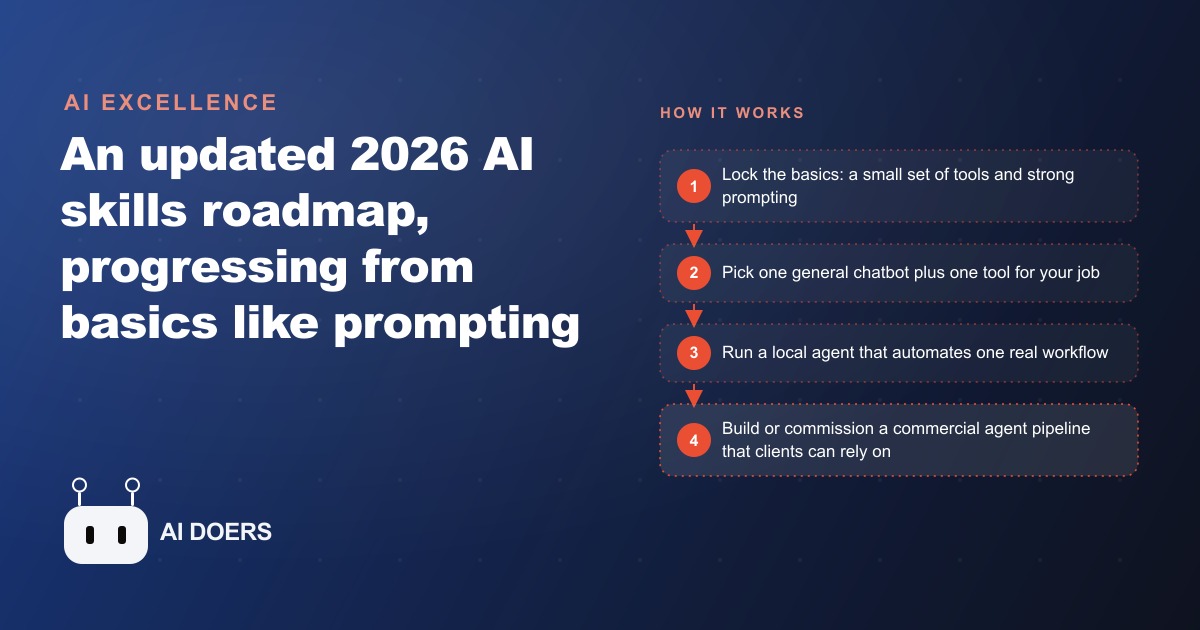
There is a version of the 2026 AI skills conversation that treats it as a checklist of tools to collect. That version is wrong, and it is why so many owners feel busier and no more capable after a year of trying AI. The more useful way to see the field is as a ladder, where each rung makes the next one easier, and where the point is not to know every tool but to build the few skills that actually move work off your plate. This piece takes that ladder apart, rung by rung, and looks at the logic that connects them.
The roadmap was rewritten only a few months after its first version, which tells you something on its own: the ground moves fast enough that a map goes stale in a single season. I am Madhuranjan Kumar, and the way I frame it for a business owner is simple. There are three tiers, basic, intermediate, and advanced, and you climb them in order. Skip a rung and the higher ones feel impossible. Take them in sequence and each one lands far more easily than it would have on its own.
The counterintuitive first rung: an investment thesis
The basics start somewhere that surprises people. Before prompting, before tools, the first skill is forming a deliberate thesis about AI in your own investments. The reason is not that you need to become a trader. It is that if you hold an ordinary index fund, you already carry heavy exposure to AI companies whether you planned it or not. A large slice of the market's value now sits in a handful of firms whose growth story is AI. So the skill is really awareness: deciding, on purpose, how much of that exposure you want, rather than holding it by accident.
I include this facet because it reframes the whole roadmap. AI is not only a set of tools you use, it is a force already shaping the value of what you own. An owner who understands that approaches the rest of the ladder differently, with a clearer sense of why any of this matters to the business and not just to the workflow.
The load-bearing skill: prompting
The second facet of the basics is prompting, and it is load-bearing because it underpins everything above it. Prompting is simply how you interact with any AI, so doing it well makes every later skill work better and doing it badly caps how far the rest can take you. The good news is that you do not need dozens of techniques. Learning two simple frameworks and using them consistently goes a remarkably long way. The owner who can write a clear, well-structured request gets usable output from the same model that frustrates someone who types a vague line and takes the first answer.
This is the rung most people skip, because it feels too basic to bother with. That is exactly the mistake. Every disappointing AI experience I hear about traces back to a weak prompt far more often than to a weak model. Spend the week getting genuinely good at this, and the rest of the climb gets cheaper.
The discipline of a small toolset
The third facet of the basics is restraint. The field ships something like ten notable releases a day, and chasing each one is a full-time job that produces nothing. The skill is picking a small core set of tools and mastering them deeply instead of sampling everything shallowly. A single general chatbot, Claude, ChatGPT, or Gemini, covers most needs for most people. It plans, drafts, generates media, and can even prototype simple apps. Around that core you add a research tool, a learning tool, and exactly one tool specific to your job.
That last slot is where the roadmap bends to fit the person. A marketer might drop an SEO tool into it, an engineer an AI coding tool, a service-business owner a scheduling and reviews tool. The industry only changes which tool fills the job-specific slot; the shape of the basics stays the same everywhere. Mastering four tools you actually use beats owning forty you barely open.
The shift from chatbot to agent
The intermediate tier introduces a genuinely different idea: the agent. An agent is a software system that pursues a goal and completes tasks for you, and the shift from a plain chatbot is subtle but large. With a chatbot you hold a conversation, turn by turn. With an agent you hand over an overarching goal, and it breaks that goal into steps and executes them. You stop being the one doing each step and become the one who defines the outcome.
The concrete step up on this rung is a local agent, one that lives and runs on your own machine. That locality is what enables the interesting automations, because the agent can reach into your real context, your calendar, your email, your team chat, your notes, and assemble something from all of it. The classic example is a daily digest: every morning the agent pulls tomorrow's schedule, the overnight messages, and the open items, and hands you one clean read instead of five apps to check. This is where AI stops being a thing you consult and starts being a thing that works while you do something else.
The open versus closed question
A facet worth pulling apart on its own is the choice between open and closed models, because it shapes cost and privacy at every tier. Closed models, the well-known chatbots, tend to be the most capable and the easiest to use, but you run them in someone else's cloud. Open models can be run yourself, which means lower cost at scale and real privacy when you self-host, at the price of setup effort and, historically, a capability gap. The important trend is that the gap is closing. For a growing set of tasks, an open model you run privately is now good enough, which matters enormously for any business handling sensitive data it would rather not send to the cloud.
You do not have to resolve this on day one. But knowing the axis exists changes how you plan, because it tells you that the private, low-cost option is becoming viable rather than staying a compromise.
The top of the ladder: pipelines and coding
The advanced tier is where skills become leverage other people can depend on. The first advanced facet is building commercial agent pipelines, systems stable and reliable enough that clients or a whole team can rely on them, not just clever one-off automations. Think reporting pipelines that assemble the same weekly read every week without fail, or onboarding agents that walk every new client through the same steps. The difference from an intermediate automation is reliability. A digest that breaks occasionally is fine for you; a pipeline a client depends on has to work every time.
At the very top sits AI coding, the boss-level unlock. Agentic engineering can build production-grade software at a fraction of the usual time and cost, which is why it is the most valuable rung. The honest catch is that it still requires you to actually know how to code, and that knowledge takes months to build, not days. This is the one rung you cannot fake your way onto, and pretending otherwise is how people waste the most time.
A worked example: walking a salon up the ladder
Consider a salon owner deciding where to spend their limited attention. I would not start them on investment theory in practice; I would start with prompting and one mastered chatbot, because that alone speeds the daily writing: replies to booking questions, social captions, and promo copy in the salon's own voice. Then one job-specific tool, which for a salon is usually the booking and reviews side, so the owner is not learning ten apps at once. That is the basics rung, and for many owners it is already most of the value.
At the intermediate rung, set up one local agent that runs a single morning workflow. It pulls tomorrow's appointments, flags the gaps in the schedule, lists clients due for a rebook based on their last visit, and drafts the reminder messages. Put illustrative numbers on it: if that routine saves 30 minutes a day and recovers even two lapsed clients a week at an average ticket of 60 dollars, that is roughly 2.5 hours a week returned and around 480 dollars a month in rebookings the salon was quietly losing. Those rebooking drafts land naturally in the CRM and website stack so follow-up sends itself, and the same content the owner learns to produce feeds SEO and organic search without extra work. Only if the salon grows into several locations does the advanced rung matter, where that morning routine becomes a proper pipeline assembling bookings, revenue, and review trends into one weekly read the owner can trust without checking by hand.
The facet most people get wrong: sequence over speed
If there is a single misunderstanding that wastes the most time on this roadmap, it is treating it as a race to the top rung. People hear that AI coding is the boss-level unlock and try to start there, or they hear that agents are powerful and skip straight to building one before they can write a decent prompt. The ladder does not punish ambition, but it does punish skipping, because each rung is built on the muscle memory of the one below it.
Consider why. A local agent is only as good as the instructions you give it, so an owner who never got fluent in prompting builds an agent that misfires constantly and concludes the technology does not work. A commercial pipeline is only reliable if you already understand how agents behave when they fail, so someone who skipped the intermediate rung builds something fragile and loses a client's trust when it breaks. And AI coding genuinely requires knowing how to code, which is months of real learning, so treating it as a shortcut produces software you cannot debug or maintain. Every skipped rung shows up later as a problem you could have avoided by climbing in order.
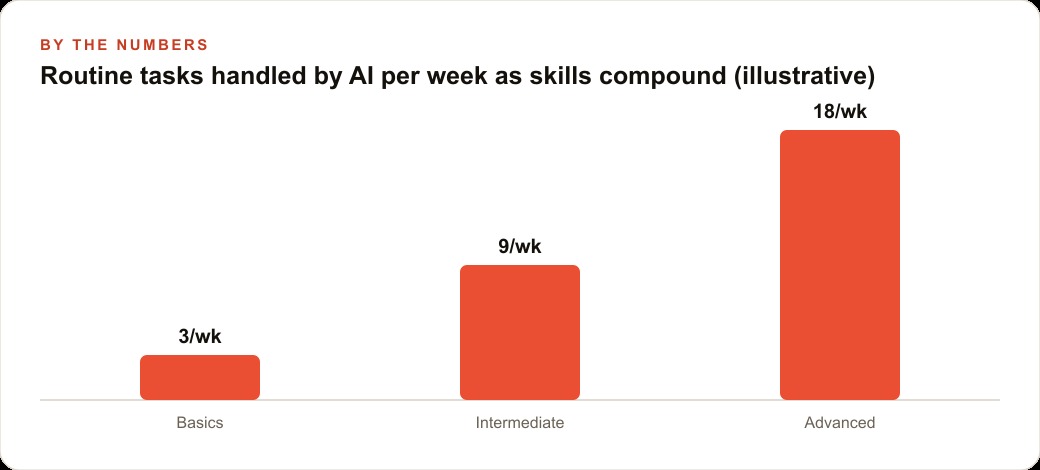
The reframe that helps is to stop measuring progress by how advanced the tool is and start measuring it by how much work it reliably takes off your plate. A perfectly mastered basic setup, one chatbot and one job-specific tool used fluently, moves more real work than a half-broken agent you built too early. Speed to the top is not the goal. Depth on each rung is, because depth is what makes the next rung cheap. The owner who spends a patient month per tier ends the year with compounding leverage, while the one who sprinted through ends it with a pile of tools they cannot quite trust. This is also why the roadmap is worth revisiting every few months rather than treating as a one-time checklist. The rungs stay in the same order, but what sits on each one shifts as tools improve, and the open-versus-closed balance in particular keeps moving. Climbing in order is a habit, not a single trip.
The rule the whole ladder teaches
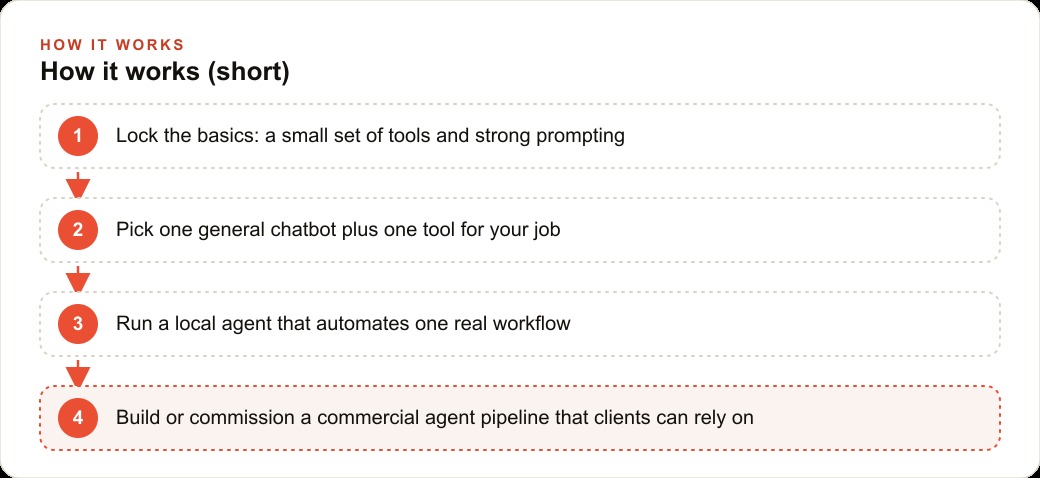
The through-line is discipline about order. Get genuinely good at prompting with one chatbot, add the single tool that matters most for your trade, and only then set up one local agent for one recurring workflow, and only that one, until it is reliable. Resist jumping straight to pipelines or learning to code, because those land far better once the lower rungs are solid. The roadmap is built so each step you take makes the next one cheaper, and the owners who respect that sequence get compounding returns while the ones who skip ahead get expensive confusion.
You can climb this yourself, and I would encourage any owner to lock the basics this week. If you would rather have someone map your business to the right rung, set up the local agent that automates your real workflow, and stand up a pipeline that keeps working, that is the kind of build I do for clients, and you can bring me in to handle it.
That is exactly what we do at AI DOERS. Book a private 30-minute call with Madhuranjan Kumar and we will map the fastest path to it for your specific business.
Book your call →
Madhuranjan Kumar
Madhuranjan Kumar brings 20 years of performance-marketing experience and has managed over $200 million in Facebook ad spend for brands across the United States and beyond. His expertise spans the full modern marketing stack: Meta, Google Ads, TikTok, email automation, CRM, and the websites that hold it together. At AI DOERS he turns that track record into lead-generation systems for businesses across every industry.