
The Three Skills Worth Learning In 2026: Finance, AI, And Business
The highest-leverage skills to learn in 2026 cluster into three areas: personal finance for stability, AI for building and integration opportunity, and business for turning skills into sustainable income.

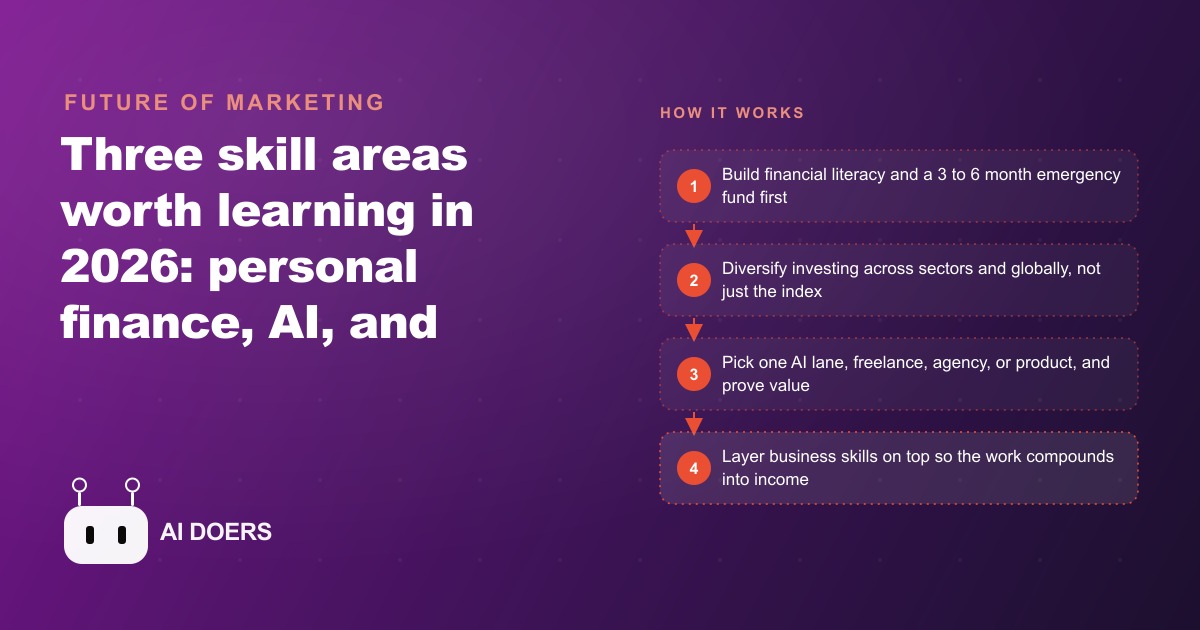
The people who are building resilient businesses in 2026 are not the ones predicting which AI company wins. They are the ones who built a financial floor first, proved an AI-based income stream second, and then added business structure on top of both.
The sequence matters as much as the individual skills. Building financial stability before attempting AI income prevents the common failure where financial pressure forces you to accept any client at any price rather than finding the right niche at sustainable rates. Proving an AI income stream before building business structure means the systems you build match the work you have actually done, not the work you imagined. And budgeting for the flat growth period before it arrives means a slow month in year one does not produce the conclusion that the approach is failing, when it is in fact behaving exactly as it should.
I am Madhuranjan Kumar, and this playbook applies whether you are building from scratch or layering AI income onto an existing service business. The five steps below are ordered by dependency, not by what feels most exciting first.
Build the financial floor before anything else, and treat the emergency fund as the prerequisite
Financial literacy is the base of everything else in this playbook, and it is almost never taught with the depth it deserves in formal education. The fundamentals, budgeting with real numbers, setting specific financial goals with timelines, understanding how credit affects your cost of borrowing, knowing what you owe in taxes and when, and having a basic functional understanding of how investments work, are the operating system of every sound financial decision that follows. A free course covering these fundamentals takes roughly 20 hours to complete. The return on those 20 hours compounds through every financial decision you make for the rest of your working life.
Within the financial floor, the emergency fund is not a comfortable extra that you build once the income is good. It is the prerequisite for doing the steps above it safely. The emergency fund is what gives you the psychological freedom to make calculated decisions in the AI and business layers without financial panic dictating the choice at the worst moment. Without it, every slow month in a new income stream feels like evidence of failure. With it, a slow month is just a slow month, and you have the runway to continue without making fear-driven decisions that undermine the longer plan.
The practical target is 3 to 6 months of total living expenses in a liquid account you do not touch except for a genuine emergency. Start with whatever you can set aside this month. The number does not have to be large to begin. Build toward the target as a background process while working on the steps that follow, but treat the fund as a real constraint: do not take financial risks in the upper layers that you cannot absorb if the emergency fund is not yet in place.
The deeper reason this step belongs first is that people without financial cushion consistently make worse decisions when things are slow. They take clients who are wrong for them. They accept pricing below what they need. They quit approaches that would have worked if they had stayed in them six months longer. The emergency fund is not just a savings account. It is the foundation of good decision-making under pressure, and its absence makes every other step more likely to fail.
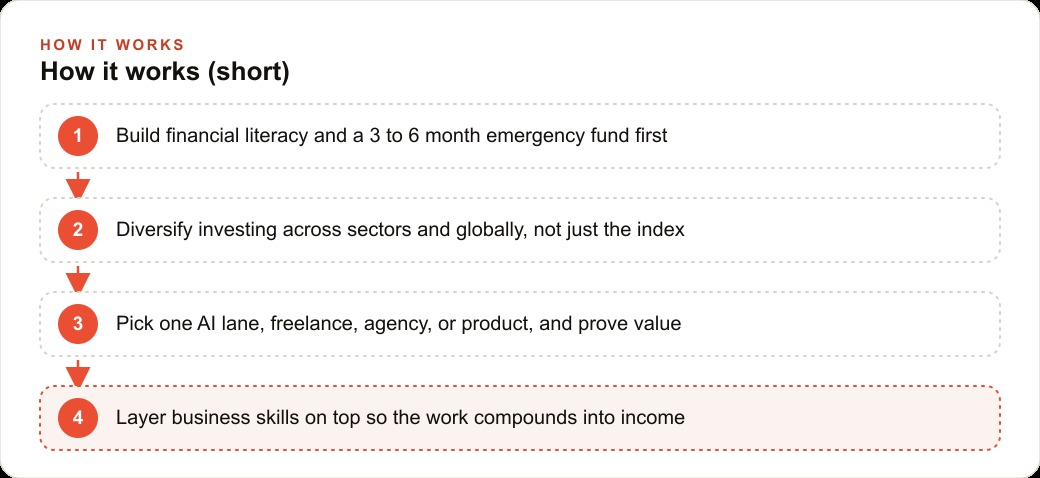
Diversify the investment portfolio before AI stocks quietly become most of it
Standard index fund investing is the right default for most people, but there is a specific structural risk in the current market that a standard index fund approach does not communicate clearly. A market-capitalization-weighted index fund is, by construction, most heavily weighted toward the companies with the largest market capitalizations. When a single sector reaches a high proportion of total market capitalization, an index fund weighted by market cap becomes a concentrated sector bet even if the investor never intended that exposure.
AI-adjacent technology companies now represent a substantial portion of the largest stock market indices by capitalization, at roughly 44 percent of the total capitalization of a major US index. Someone who believes they hold a diversified index portfolio may in fact carry meaningful concentration in a single theme without intending to. If that theme underperforms for any reason, the investor who thought they were diversified discovers they were not, through their portfolio rather than through a warning.
The hedge is not to avoid index funds. It is to understand what your index fund actually holds and to intentionally add exposure to sectors and geographies that the index underweights. Consumer staples, healthcare, energy, financials, and international equities are all underweighted relative to technology in a capitalization-weighted US index right now. Adding intentional exposure to those areas brings the actual portfolio closer to the genuine diversification you intended.
This step belongs early because investment decisions made without understanding the actual composition of your holdings are decisions made with incomplete information. The practical action is to pull up the sector breakdown of your primary index fund, check how much of that weight sits in technology and AI-adjacent companies, and compare it against a true global allocation. If technology is significantly above its natural weight in a global portfolio, adding positions in underrepresented areas brings the actual risk profile closer to the intended one. Rebalancing annually keeps the actual exposure close to the intended one over time.
Pick exactly one AI lane and prove it with a paying client before expanding
Three viable AI income lanes exist for someone starting without significant capital. AI freelancing, where you apply AI tools to solve specific problems for individual clients. An agency model, where you build systems around AI-assisted delivery and scale the freelance approach. And a software product, where AI is a core component of something you build once and sell repeatedly. All three are real paths with real income potential. None of them should be pursued in parallel in the early stages.
The reason to pick one lane and stay in it until you have at least one paying client is that the market pays for demonstrated competence at solving a specific problem, not for familiarity with many AI tools across many domains. A freelancer who can reliably help local service businesses produce a month of social media content in four hours using AI tools, and who has the client history to prove it, is worth more to the next prospective client than someone who has experimented with 15 different AI tools across 10 different categories without a single paying engagement to show for it.
The freelance lane is typically the right entry point because it generates revenue quickly, with low startup cost, and provides direct market feedback about which offers resonate. The first two paying clients teach you more about what the market values than any amount of advance research does. Pick the lane that attaches to skills you already have. If you have a background in writing, look for AI applications in content production. If you have a background in operations, look for AI applications in workflow automation. If you have a technical background, look for AI applications in custom tool building. The AI layer amplifies existing skills. It does not substitute for the requirement to bring real value to the client.
Prove the lane with a paying client before expanding. A paying client who came back and referred someone else is a more meaningful signal than 50 hours of self-directed learning. That signal is the foundation for every step above.
Layer in business structure once the AI income is proven, not before
Business structure, including formal entity registration, documented systems for delivering the service, and active management of legitimate business expenses to reduce taxable income, belongs after the income is proven rather than before it exists. Building structure around unproven revenue is building on assumptions. The first several clients teach you what the delivery process actually needs to contain, which is often quite different from what you would have designed in advance.
The tax benefit of business ownership is genuine and worth capturing. Legitimate business expenses reduce taxable income in ways a salaried income does not allow. Tool subscriptions, professional development, a portion of home office costs, and relevant equipment all qualify if the business is properly structured and the expenses are documented. The magnitude of the benefit scales with the income level, which is why it belongs in the layer after revenue exists rather than before it.
The more important business layer benefit is the shift from labor-dependent income to systems-dependent income. A service business where every deliverable requires your personal involvement every time is a high-paying job with the tax advantages of a business, but it is not yet an asset. The transition to systems-dependent income, where documented processes allow others to deliver the work or where the work scales without proportional time input, is what turns the income stream into something that builds toward durable value. That transition requires knowing what the delivery process actually looks like in practice, which you can only learn from real client work. Build the structure that fits the business you have actually built, not the business you imagined before you started.
Budget for the flat section of the growth curve so it does not feel like failure
Business income does not grow in a straight line from month one. It grows in an S-curve with a prolonged flat section at the beginning, a steep compounding section in the middle, and a leveling off at scale. The flat section is where almost everyone who quits, quits, and it is the section most frequently misread as evidence that the approach is fundamentally flawed.
The flat section is not evidence of failure. It is the normal cost of building reputation, refining the offer based on real market feedback, developing the referral network that eventually makes client acquisition nearly automatic, and reaching the skill level where delivery is fast and reliable enough to make the business genuinely competitive. Most solo AI businesses take 18 to 24 months to emerge from the flat section into compounding growth. The people who are still operating in month 24 are almost always the ones who budgeted for the flat section in advance and stayed in the game through it.
Budgeting for the flat section means setting your personal financial expectations to match what the business will realistically generate in its first 12 months, which is usually modest, and ensuring the emergency fund from the first step provides the buffer that makes those 12 months survivable without desperate pivoting. Use slow months as learning periods: review which clients renewed and which did not, which offers landed and which did not, which delivery steps consumed disproportionate time, and adjust the approach accordingly.
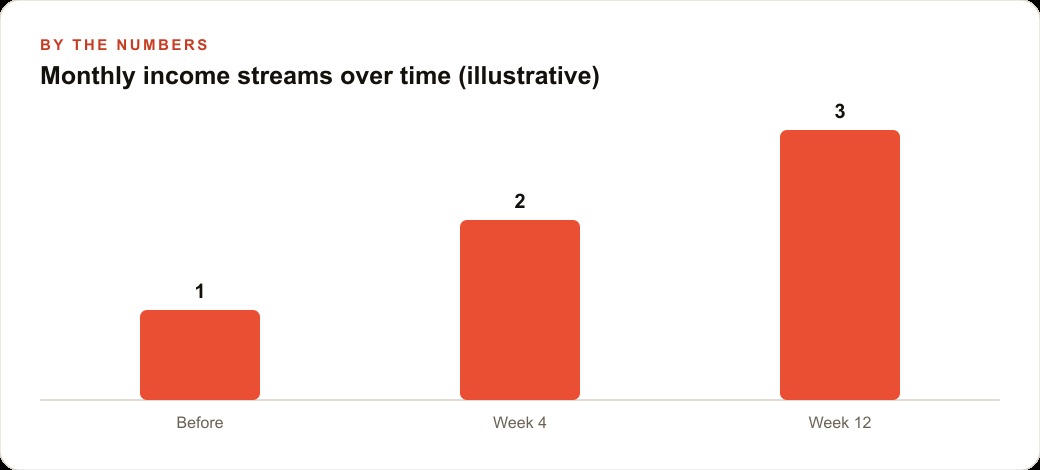
To illustrate how the full sequence plays out with concrete numbers, consider the path a salon owner took over 18 months applying all five steps in order. She started with a single chair generating roughly $3,800 per month in income, no savings buffer, and no other income source. During the first six months, she focused entirely on the financial floor: she built an emergency fund to $11,400, covering roughly 3 months of expenses, and completed a free financial literacy course that gave her clarity about the actual cost structure of her business and the tax treatment of legitimate expenses. During months 7 through 12, she picked one AI lane: she used AI tools to automate her booking confirmation and follow-up sequences, reducing appointment no-shows by a measurable margin and recovering 6 to 8 hours per week that had previously gone to manual reminder calls. She launched a small branded product line that reached $1,200 per month in sales by month 10. During months 13 through 18, she layered in business structure: formal registration, documented intake and follow-up systems, and active expense tracking that reduced her effective tax rate on business income. By month 18, total income ran at approximately $5,600 per month across three streams: $3,800 from chair services, $1,200 from product sales, and $600 per month in new client revenue generated by an AI-assisted referral program she had built and documented. The emergency fund remained intact throughout. The flat section during months 7 through 10, when the new income streams were just beginning and compounding had not yet appeared, felt slow but did not produce financial panic because the floor held.
The sequence, financial floor first, portfolio diversification second, one proven AI lane third, business structure fourth, and a budgeted flat period fifth, is the order that removes the largest sources of failure at each stage and creates the conditions for the next stage to succeed. Stay in the order and stay in the game long enough for the curve to compound.
That is exactly what we do at AI DOERS. Book a private 30-minute call with Madhuranjan Kumar and we will map the fastest path to it for your specific business.
Book your call →
Madhuranjan Kumar
Madhuranjan Kumar brings 20 years of performance-marketing experience and has managed over $200 million in Facebook ad spend for brands across the United States and beyond. His expertise spans the full modern marketing stack: Meta, Google Ads, TikTok, email automation, CRM, and the websites that hold it together. At AI DOERS he turns that track record into lead-generation systems for businesses across every industry.