
The SpaceX IPO Drama: Why a $2 Trillion Listing Comes Down to Voting Control
The SpaceX offering, listed as SpaceX AI and valued as high as 2 trillion dollars, is a fight over governance more than rockets. Its class B structure gives Musk 79 percent voting power on 42 percent equity, and the lesson for any founder is simple: control is a structure you set before you take outside money.

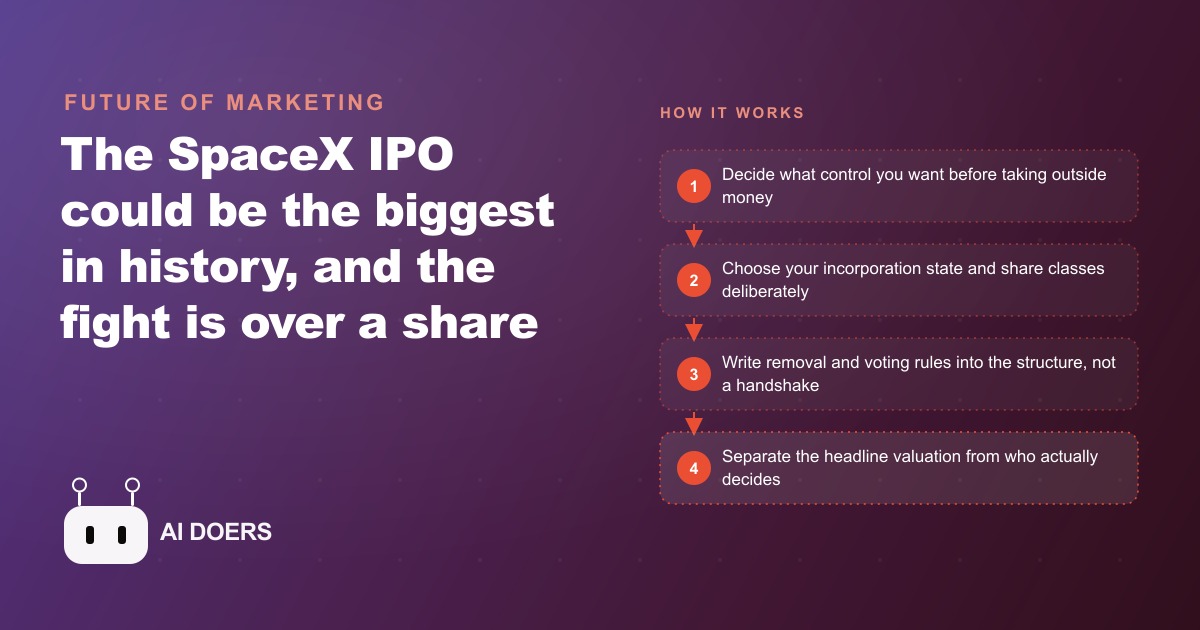
A valuation of 2 trillion dollars is large enough to be meaningless until you realize the entire argument about the SpaceX IPO is not about the number. It is about who controls the company after the money arrives.
The offering, technically structured as SpaceX AI and expected as soon as next month, would surpass Saudi Aramco's 2019 listing of approximately $29 billion by an order of magnitude. The governance structure it brings to market is designed to ensure that the scale of the money raised does not translate into commensurate outside influence over strategic decisions. Understanding how that structure works, and why it was built the way it was, is useful for any business owner who has ever taken outside money or considered it.
Equity and control are not the same number
The most important thing to understand about the SpaceX IPO structure is that ownership and control have been deliberately separated. The offering gives outside investors a real economic stake in a business generating roughly 17 billion dollars in annual revenue. What it does not give those investors is commensurate control over the company's strategic direction.
This separation is not an oversight. It is the lesson drawn from what happened to Tesla in a Delaware courtroom, and it is built into the SpaceX structure before any institutional investor can negotiate it away.
The principle is older than tech companies. Founders of media empires, family-owned conglomerates, and closely-held professional firms have used multi-class share structures for decades to take outside capital without surrendering operational control. What is new here is the scale at which SpaceX is applying it, and the explicitly adversarial governance language written into the structure, language shaped directly by a specific court case involving nine shares and a $56 billion pay package.
Madhuranjan Kumar keeps returning to this distinction with business owners who are thinking about taking on a partner or an investor for the first time. Equity is the economic participation in the business's future performance. Control is the ability to make the decisions that determine that future. The two can and should be separated deliberately, because conflating them is the mistake that leads to minority partners with strong opinions about hiring, pricing, and strategy having legal standing to obstruct the founder's judgment on all three.
The Delaware lesson: how one nine-share holder changed corporate governance
The backstory to the SpaceX structure is the Tesla pay package saga, the clearest recent example of how shareholder litigation in the wrong jurisdiction can override decisions that a company's board, its CEO, and a clear majority of its shareholders all agreed to.
Tesla shareholders approved a performance-based compensation package worth approximately $56 billion if aggressive milestones were hit, and nothing if they were not. The structure was unusual in scale but the logic was straightforward: enormous reward for delivering enormous, verifiable results. Shareholders voted to approve it at 73 percent support.
A Delaware court then voided the package after a challenge brought by a single shareholder who owned nine shares. The legal grounds involved procedural issues with how the package was presented, but the outcome was a judge overriding the decision of a board, a CEO, and nearly three quarters of the shareholder base based on a lawsuit filed by someone whose economic stake was negligible relative to the outcome.
Tesla held a second vote with fuller disclosure. The package passed again at 72 percent support. A revised and larger package passed later at 75 percent. At every stage, the clear majority of shareholders who owned meaningful stakes in the company backed the compensation structure. The court's intervention operated independently of those votes.
The lesson the company drew was jurisdictional. Delaware courts, which govern most US corporations by default because Delaware is the easiest state to incorporate in, will entertain challenges from shareholders with minimal stakes and apply their own judgment about corporate governance even when majority shareholders disagree. The solution was to leave Delaware. Tesla reincorporated in Texas, where SpaceX is also domiciled. New Texas laws, including a requirement that shareholders must own at least 3 percent of the company to bring a derivative lawsuit, make the low-stakes-challenger scenario structurally much harder to execute.
SpaceX is incorporating the lessons of that saga directly into its IPO structure, before any equivalent challenge can arise post-listing.
The class B firewall: 42 percent ownership, 79 percent votes
The specific mechanism the SpaceX structure uses is a two-class share system with a removal provision that makes the class B shares functionally a veto on CEO changes.
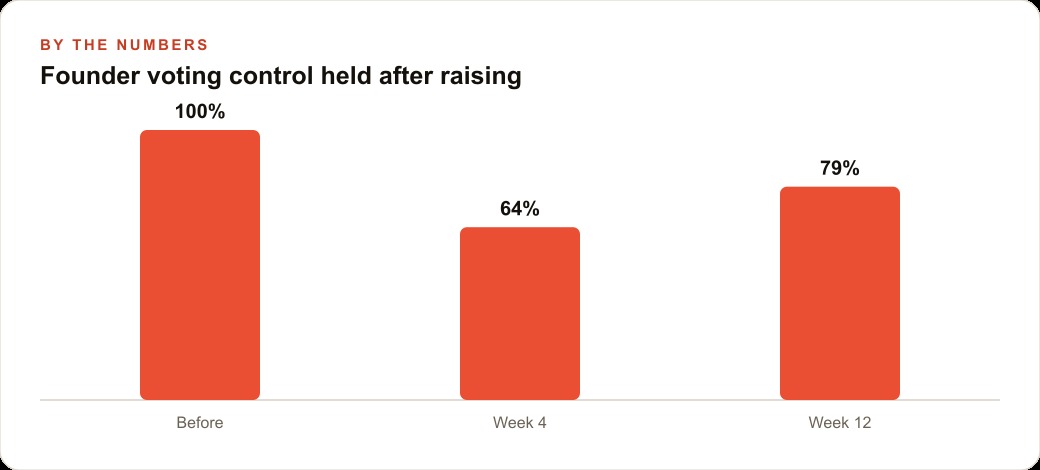
Class A shares are what outside investors receive. They carry economic participation: dividends and a share of any future liquidation value, along with some voting rights. Class B shares carry a dramatically higher voting weight per share. The result is that with 42 percent of the equity held in or associated with the founder's position, the voting power represented is approximately 79 percent of the total votes cast on any matter.
The specific clause that makes this more than just a weighted-vote structure is the removal provision: the CEO can only be removed by a vote of class B shareholders. In practical terms this means the founder cannot be forced out of the leadership position unless the class B shares vote for that removal, and the class B shares are not held by the pension funds, endowments, and institutional investors who are publicly opposing the structure.
This kind of protection would be almost irrelevant in a privately held company. You can write whatever governance rules you want in a private operating agreement, and outside investors who disagree can choose not to invest. The significance here is that SpaceX is applying this structure to one of the most widely held public companies in history, with a shareholder base that will include some of the largest institutional investors in the world, and those institutions are explicitly opposed to the structure but do not have the negotiating position to change it before the listing.
Pension funds with $1 trillion in assets, and why they are losing this fight
Three of the four largest US public pension funds are publicly opposing the SpaceX IPO governance structure. New York State's pension, New York City's pension, and CalPERS together manage well over a trillion dollars in assets. Their fiduciary mandates require them to advocate for governance structures that protect their beneficiaries' long-term interests, and they have consistently taken the position that dual-class share structures with heavily weighted founder votes create accountability gaps that increase long-term risk for outside shareholders.
They are losing this fight for a straightforward reason: they need the investment more than SpaceX needs their money. A company valued at 2 trillion dollars with the revenue trajectory, the market dominance, and the strategic position SpaceX holds does not need to accommodate the governance preferences of its institutional investors. It needs to convince the capital market to participate at the offered terms, and the offered terms reflect an enormous business with a compelling growth story that most large investors will participate in regardless of the governance structure.
The pension funds know this. Their public opposition is both a genuine fiduciary concern and a record-building exercise for future governance conversations. If the structure causes problems after listing, those institutions will be in a strong position to argue for reforms. If the company performs extremely well, the argument for protective governance structures becomes harder to make. The funds are playing a longer game than the immediate IPO window.
The business underneath: why Starlink makes the governance worth fighting over
The governance fight makes sense only if you understand the scale of the business being governed. SpaceX generated approximately 17 billion dollars in revenue in 2025. Starlink, the satellite internet service, accounts for roughly 11 billion of that and is growing at close to 50 percent annually. Launch services, running about 4.5 billion dollars across 165 Falcon 9 missions, represent more orbital launches than every other provider in the world combined, giving SpaceX approximately 85 percent of US orbital launch market share. Starshield, the classified government and defense work, adds approximately 2 billion dollars more.
The Colossus data centers, which tie into xAI training workloads and have reported agreements with companies including Anthropic for cloud computing capacity, add a forward-looking dimension that justifies the SpaceX AI framing of the offering. The company is not just a launch provider with a satellite internet business. It is positioning itself as infrastructure for the AI compute buildout, with the orbital launch capability to eventually place compute infrastructure in space if launch costs fall far enough.
Google's Project Suncatcher has modeled this possibility explicitly: AI data centers in orbit, powered by solar energy and cooled by the absence of atmosphere, made viable by the continuing decline in SpaceX launch costs, which have fallen toward $1,600 per kilogram and continue to decline with Starship scaling. Whether that specific vision materializes in the 2030s or not, the underlying dynamic is real: control of launch infrastructure gives SpaceX leverage over every technology trend that ultimately depends on orbital access.
That is what the governance fight is really about. The pension funds opposing the structure are not wrong that founder-control structures create accountability gaps. They are also not wrong that a company generating 17 billion and growing at this rate, operating with effectively no near-term competitive threat in launch services and a growing lead in satellite broadband, is a business whose governance decisions will compound in significance over the next two decades. Both things are true, and the structure SpaceX is bringing to market resolves the tension in favor of the founder, as the Delaware lesson suggested it needed to.
What a gym owner and a $2 trillion listing have in common
The principle that makes the SpaceX governance structure worth examining for any business owner is not its scale. It is its logic.
When a gym owner takes on an investor to fund a second location, the economics are incomparably smaller than a 2 trillion dollar IPO. The underlying question is identical: after the investor's money arrives, who makes the decisions that determine whether the business succeeds?
The mistake most small business owners make is treating equity and control as the same number. An investor who receives 40 percent of the equity in a second location assumes, in the absence of explicit documentation otherwise, that they have 40 percent of the say in how the business operates. That assumption leads to predictable conflicts: the investor wants to expand to a third location before the founder thinks the business is ready; the investor wants to hire a more experienced manager and reduce the founder's operational role; the investor wants to sell the whole operation in year four when the founder built the business planning to run it for twenty years.
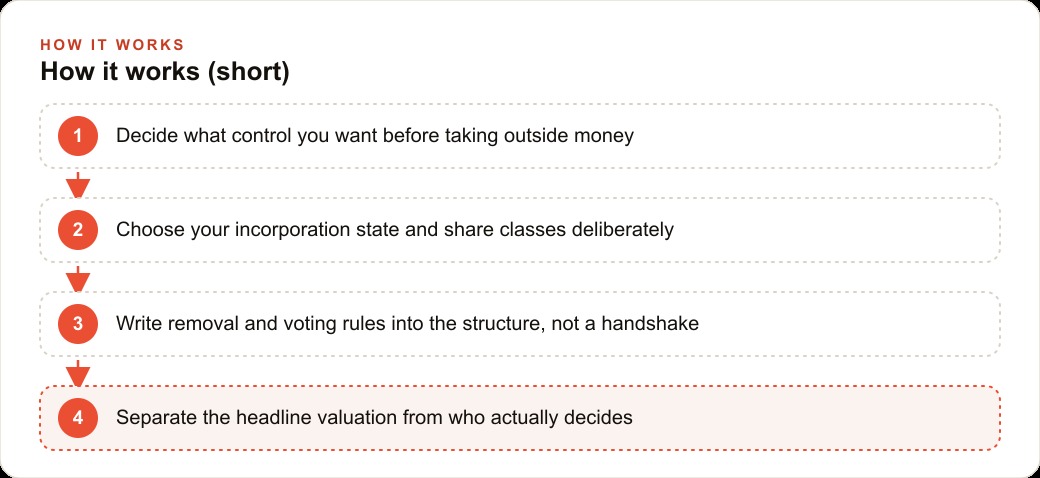
The SpaceX answer to this problem, adapted to a gym's scale, looks like this: give the investor a full economic share of the profits proportional to their equity stake, so their financial interests are well-served. Define their governance rights explicitly and narrowly in the operating agreement. They receive quarterly financial reports. They must approve any debt above a defined threshold. They have a specific right to participate in any sale decision. They do not have an ongoing say in staffing, programming, pricing, or day-to-day operations. That is not in their operating agreement, and what is not in the operating agreement does not exist as a governance right.
The removal and decision rules should be written with the same explicitness the SpaceX class B provision achieves. Who leads the business, and under what conditions can that change? What happens if the investor wants out before the founder does? What is the process for a third-party sale that the founder agrees to? None of these questions should be answered by silence or by a handshake. They should be answered in the document the attorney reviews before any money changes hands.
The governing jurisdiction question, the Texas-versus-Delaware choice at the SpaceX level, translates to choosing your state of incorporation and your arbitration clause deliberately. Most small business operating agreements default to the state where the business operates. That is usually fine. The question worth asking before signing is: how easy does our agreement make it for a minority partner to initiate a legal challenge that freezes operations, and is that the right default for this specific ownership structure?
Businesses investing in Facebook and Instagram ads or SEO and organic search to build their client base are building a marketing asset whose value compounds over time. The governance structure that protects the founder's ability to make long-term decisions about that asset is as much a part of the business's infrastructure as the customer acquisition channels themselves. The SpaceX IPO is a reminder, at extraordinary scale, that the document written before the first check arrives is the document that governs everything that comes after. Getting it right is the cheapest thing a founder can do for the long-term health of the business they are building. The class B firewall cost SpaceX nothing to design before the offering. A governance dispute after the fact would have cost far more.
That is exactly what we do at AI DOERS. Book a private 30-minute call with Madhuranjan Kumar and we will map the fastest path to it for your specific business.
Book your call →
Madhuranjan Kumar
Madhuranjan Kumar brings 20 years of performance-marketing experience and has managed over $200 million in Facebook ad spend for brands across the United States and beyond. His expertise spans the full modern marketing stack: Meta, Google Ads, TikTok, email automation, CRM, and the websites that hold it together. At AI DOERS he turns that track record into lead-generation systems for businesses across every industry.