
The Recursive Self-Improvement Loop Has Quietly Started
Frontier labs are now using their own models to help build the next ones. Here is what recursive self-improvement actually means, why it is real, and how any business can borrow the same goal-driven loop to compound its own results.

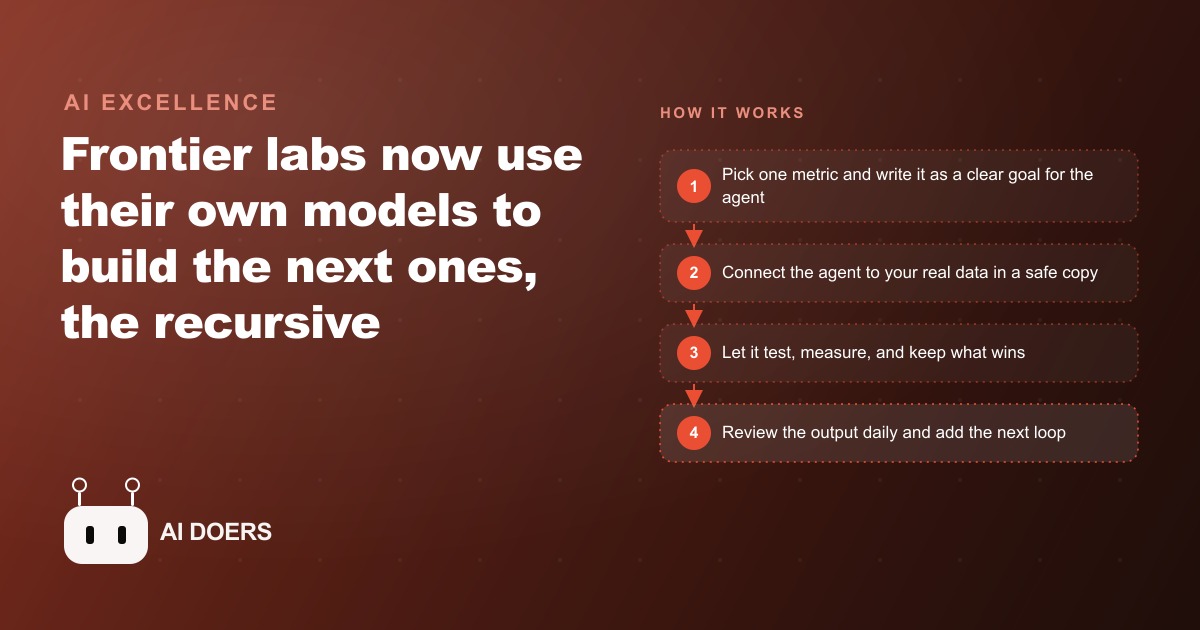
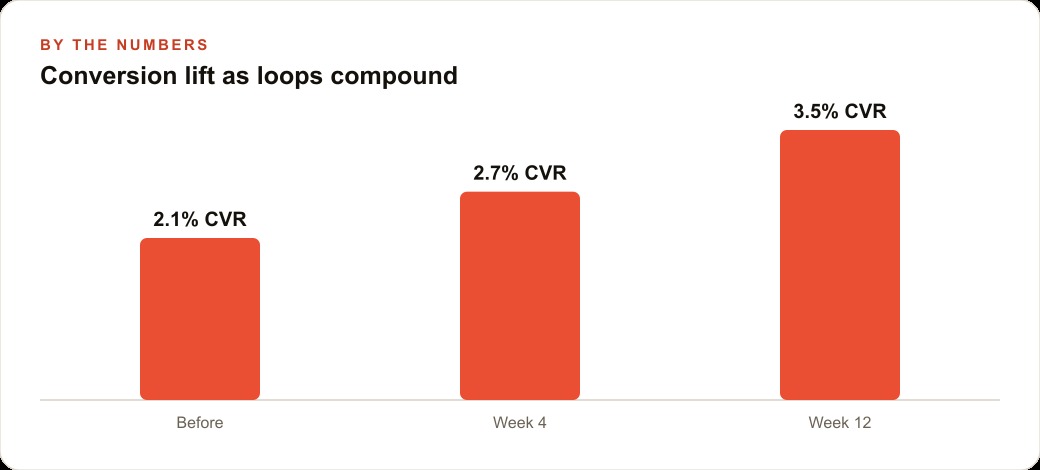
A mid-sized e-commerce store lifted its conversion rate from 2.1 percent to 3.5 percent in twelve weeks without hiring anyone, and it did it by copying a pattern the frontier AI labs just started using on themselves. I am Madhuranjan Kumar, and I want to walk you through that store's journey chapter by chapter, because it is the clearest way I know to explain what recursive self-improvement actually means and why it is not just a story about supercomputers.
The idea the store borrowed from the frontier labs
First, the thing the store borrowed. The big AI labs have quietly crossed into a phase where their own models help build the next versions of themselves. This is not marketing. Minimax said its M2.7 model deeply participated in its own evolution, updating its own memory and assembling dozens of skills, which produced a roughly 30 percent jump on internal tests, and it now runs 30 to 50 percent of the lab's research workflow. OpenAI said GPT-5.3 Codex was instrumental in creating itself, using earlier checkpoints to debug and tune later ones. Anthropic runs almost all of its major agent loops on Claude Code, which writes feature code, runs tests, and iterates before a human reviews. Google's AlphaEvolve improved Google's own architecture, saved billions, and found a faster matrix multiplication method for the first time in about fifty years, which makes every model trained after it run faster.
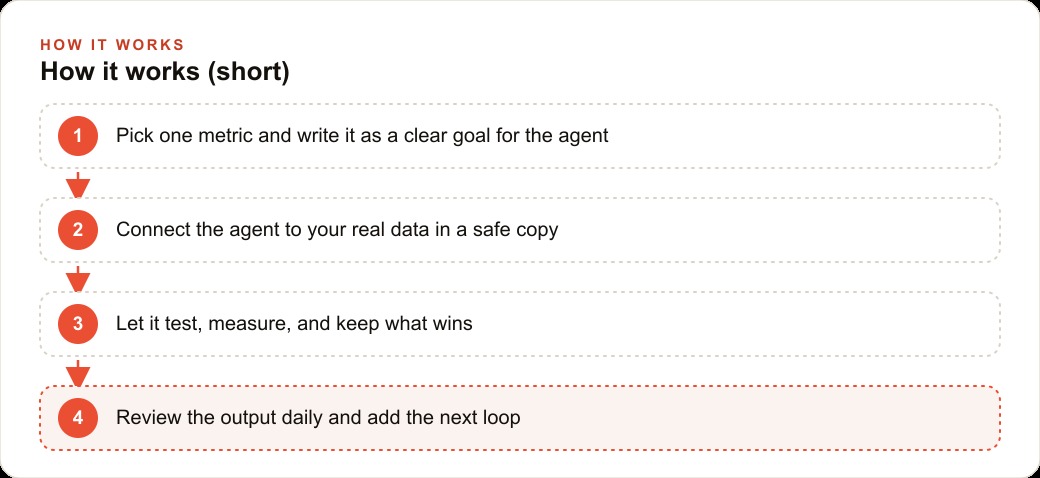
Strip away the scale and the pattern is simple: pick a metric, let an agent try a change, measure the result, keep what wins, and repeat. The labs are doing it to model training. The store did it to conversion rate. The mechanism is identical, and that is the whole point. You do not need to train frontier models to use recursive self-improvement. You need a number worth moving and the willingness to hand an agent the loop.
Week zero: flat conversion and a human doing every test
The store started where most stores are stuck. Traffic was steady and healthy, but conversion sat flat at 2.1 percent, and every improvement attempt bottlenecked on one person. The owner would think of an idea, brief a freelancer, wait two weeks for a single A/B test, read the result, and start over. At one test a month, the store was learning about twelve things a year about its own customers, which is almost nothing. The problem was never a lack of ideas. It was that a human was the slow, expensive step in a loop that did not need to be slow.
That is exactly the bottleneck the labs described removing. For years humans were the ceiling on how fast AI research could go. The store had the same ceiling on how fast it could improve, and the fix was the same: take the human out of the repetitive middle and leave them in charge of direction.
The first loop: one number, one agent
The store did not try to automate everything. It picked one number, add-to-cart rate on the top twenty products, and gave a single agent that one goal plus the data it needed: the product pages, past A/B results, and customer reviews. Crucially, the agent ran against a safe copy of the store data first, so a bad change could never touch the live site or the real database.
The loop it ran was the same shape the labs use. The agent drafted new product copy, proposed image and layout changes, wrote the test, waited for enough traffic, read the result, kept the winners, and queued the next variation. Overnight it would rework descriptions, generate alt text, and flag listings with weak reviews, the repetitive grind the owner used to pay a team to do. The owner's job shrank to one thing: review the agent's output each morning and approve or redirect it. That is the trade at the heart of every self-improving loop. You stop doing the steps and start steering the goal.
Week four: 2.1 to 2.7 percent, and what it cost
By week four the store's conversion had moved from 2.1 percent to 2.7 percent. Put illustrative numbers on that. On 60,000 monthly visitors at an average order value of 70 dollars, 2.1 percent is 1,260 orders and about 88,000 dollars in revenue. At 2.7 percent that is 1,620 orders and roughly 113,000 dollars, an extra 25,000 dollars a month from the same traffic. The cost was the owner's morning review and the agent's compute, a rounding error against the gain.
What actually drove the lift was not one genius idea. It was volume of small tests. Where the store used to run one test a month, the agent ran the equivalent of several a week, so it discovered in four weeks what the old process would have taken most of a year to find. This is the quiet truth about recursive improvement: the magic is not any single change, it is the number of loops you can run. More iterations, faster, is the entire advantage the labs are exploiting, and it works just as well on a product catalog. The lift also made every dollar of paid traffic worth more, so the same spend on Facebook and Instagram ad campaigns suddenly returned more orders without a single change to the ads themselves.
The second loop moves to the back office
Once the owner trusted the first loop, the store added a second, this time on email. A new agent took over the abandoned-cart and win-back sequences: it wrote and scheduled them, then read the open and click data and rewrote the weak performers on its own. This is the same loop, watch a number, try a change, measure, keep what works, pointed at retention instead of the product page.
The illustrative payoff here was recovered revenue. Say the store's abandoned-cart flow recovered 6 percent of lost carts before, and the self-improving email agent, by continually rewriting subject lines and timing, pushed that to 9 percent over a month. On a store leaking 200 carts a week at 70 dollars, that jump is roughly another 4,200 dollars a month recovered from customers who had already left. And because the agent kept iterating, the number did not plateau after one good email. It kept nudging upward as the agent learned which messages this store's specific customers responded to. Those recovered customers flowed back through the CRM and website stack, where the follow-up automation handled the next touches without anyone lifting a finger.
The third loop watches the ad spend
The third loop the store added guarded the downside instead of chasing the upside. An agent watched ad spend across channels and paused any creative that drifted above the store's target cost per acquisition, then flagged the winners to scale. This mattered because paid traffic is where a store bleeds fastest when nobody is watching. A creative that quietly doubles its cost per acquisition over a weekend can burn a month's margin before a human notices on Monday.
For a store running meaningful budget on Google Ads and social, an agent that reads performance daily and pulls the losers is worth real money in prevented waste, not just added revenue. None of these three loops needed a data scientist. Each needed a clear goal, a safe connection to the store's real data, and a human checking the output each morning. That is the entire recipe, and it is the same one the labs use at a scale a million times larger.
Week twelve: 3.5 percent, and why it kept climbing
By week twelve the store's conversion sat at 3.5 percent, up from 2.1 at the start. On the same 60,000 visitors at 70 dollars, that is 2,100 orders and about 147,000 dollars a month, nearly 59,000 dollars more than where it began, with the email and ad loops adding recovered revenue and prevented waste on top. The team was still the same size. The owner still spent under an hour a day reviewing.
The reason it kept climbing is the reason the labs are excited about their own version. The gains compound. Every winning test the agent kept became the new baseline the next test had to beat, so improvements stacked instead of resetting. The store that ran three of these loops out-iterated a competitor still doing everything by hand, and the gap widened week over week. That is what recursive self-improvement looks like at human scale: slow at first, then a curve that bends upward as each loop feeds the next. The winning product copy and grounded content the agent produced also quietly strengthened the store's SEO and organic search footprint, because better pages are what search rewards too, a fourth payoff nobody had to plan for.
The safeguards that kept the loops from backfiring
A self-improving loop pointed at your live business is powerful, which means it is also dangerous if you skip the guardrails, and the store's run only worked because it took three precautions seriously. The first was the safe copy. Every agent tested against a mirror of the store data before anything touched the live site or the real database. This is not optional. An agent iterating fast will eventually try a change that would break something, and you want that failure to happen against a copy, not against your checkout page during a sale. The frontier labs run their experimental training on isolated branches for exactly the same reason, and the principle scales down perfectly to a store.
The second safeguard was the daily human review. The owner did not set the loops running and walk away for a month. Every morning brought a short review of what each agent had tried, kept, and queued next. This mattered for two reasons. It caught the occasional bad decision before it compounded, and it kept the owner's judgment in the loop where it belonged, steering direction while the agent handled execution. The lesson from the labs is not that humans get removed entirely, it is that humans move from doing every step to reviewing and directing, which is a higher-leverage place to sit. The store treated the agent as a tireless junior employee, not an unsupervised autopilot.
The third safeguard was patience on the measurement. An agent that reads a test result too early, before enough traffic has accumulated, will keep noise and discard signal, and then confidently build on a false conclusion. The store set a minimum traffic threshold before any test result counted, so the agent's decisions rested on real data rather than a lucky afternoon. This is the unglamorous discipline that separates a loop that compounds upward from one that thrashes randomly. Speed of iteration only helps if each iteration is measured honestly, and honest measurement takes a little patience the agent has to be told to respect. Put those three safeguards in place, a safe copy, a daily review, and an honest measurement threshold, and the loop becomes something you can trust with real revenue. Skip any one of them and you have built a fast way to break your own store.
What the store's run proves
The lesson from this journey is not that you should train an AI model. It is that the most valuable skill an operator can learn is directing a loop instead of doing every step by hand. The frontier labs proved the pattern at the top of the market, and open tools proved it reaches the bottom too. AutoResearch, an open-source project, runs an autonomous loop on a git branch and commits better settings as it finds them, and overnight it set a record time to train a small model. Even a solo developer with no machine-learning background can point a frontier model at fine-tuning small open models overnight. The expertise barrier fell. What remains is the ability to define a goal, give the agent the right context, and review the output.
Start with one loop, not ten. Pick a single number you want to move, product-page conversion is a fine first choice, and give an agent that one goal with the data and the freedom to test, measure, and keep the winners. Run it against a safe copy first so a bad change cannot touch anything live. Once you trust it, add a second loop for email and a third for ad creative, and let each one report to you every morning. Customer support, content production, pricing, ad creative, inventory forecasting, every one of these is a measurable loop an agent can mostly run on its own while you supervise the direction.
You can build this yourself one loop at a time, and I would encourage any owner to start this week. If you would rather have someone map your store, wire the agent to your real data safely, and stand up the self-improving loops that actually move revenue, that is the kind of work I do for clients, and you can bring me in to handle it. The labs are compounding. There is no reason your business cannot compound the same way.
That is exactly what we do at AI DOERS. Book a private 30-minute call with Madhuranjan Kumar and we will map the fastest path to it for your specific business.
Book your call →
Madhuranjan Kumar
Madhuranjan Kumar brings 20 years of performance-marketing experience and has managed over $200 million in Facebook ad spend for brands across the United States and beyond. His expertise spans the full modern marketing stack: Meta, Google Ads, TikTok, email automation, CRM, and the websites that hold it together. At AI DOERS he turns that track record into lead-generation systems for businesses across every industry.