
The Reasoning Era: What o3 and DeepSeek Mean for Your Business
AI models that think step by step before answering have arrived, and fierce competition made them fast and cheap. That combination is what finally makes reliable agents and deep research useful for an everyday business. Here is what changed and how to put it to work.
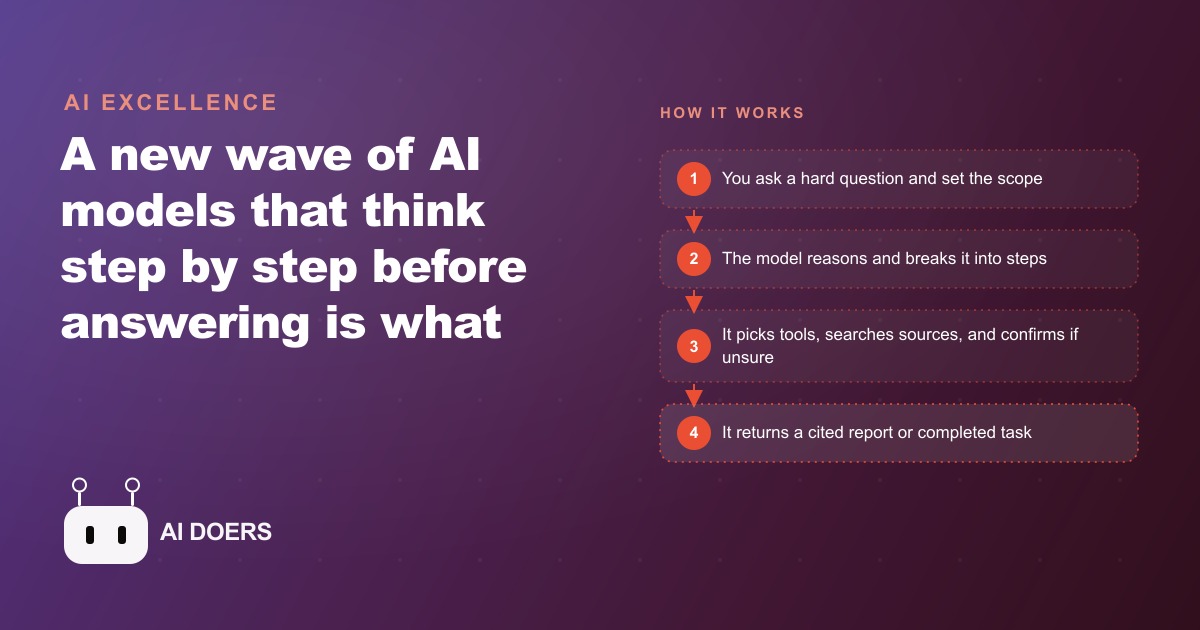
A reasoning model that thinks for 30 minutes and returns a fully cited competitive analysis was science fiction two years ago. Today it costs less than a coffee per run and the price is still falling. The question is no longer whether your business can afford one, it is whether you know how to ask it something worth thinking about.
Identify the One Research Task That Costs Your Team More Than Two Hours a Week
The first step is not installing software. It is finding the specific task in your week that a reasoning model should own.
Most businesses have at least one repeating research or analysis task buried inside the working week. It might be monitoring what competitors are charging and how their offering compares to yours. It might be reviewing what clients or customers are saying across review platforms. It might be summarizing industry news before a planning meeting. It might be pulling together data from three different tools into a weekly report that always takes longer than it should.
Whatever that task is, it shares a common structure: gathering information from multiple sources, synthesizing it, and producing something a human then acts on. That structure is exactly what reasoning models are built for. The gathering, the reading, the cross-referencing, the drafting, these are the steps a reasoning model handles in its thinking phase before it returns an answer. The judgment, the decision, the action, these stay yours.
For the photography studio owner used as the worked example throughout this guide, the task is seasonal pricing analysis. Every spring before wedding season, and every autumn before portrait season, the owner needs to know what other studios in the area are charging, what packages they are offering, and what clients seem to care most about when they choose between studios. That analysis normally costs two to three evenings of browser tab work to produce a rough picture that might still be missing key competitors.
That is the task. The reasoning model owns it from here.
Write the Question With Enough Specificity That the Model Can Start Without Guessing
The single biggest factor in what you get back from a reasoning model is how specifically you wrote the question that kicked off the run. This is not the same as writing a long prompt. Length is not the goal. Specificity is.
A vague research question produces a vague research report. A question like "help me understand the wedding photography market" gives the model almost nothing to constrain its search. It does not know your location, your price range, your clients, or the decision you are trying to make. It returns a generic overview that looks thorough and says nothing useful.
A specific question gives the model something to lock onto. For the photography studio, the right question sounds like this: compare the pricing and package structures of wedding and portrait photography studios within 25 miles of my studio's zip code, identify the two or three packages that appear most commonly, note what each competitor emphasizes in their client communication, and summarize what clients who have left reviews appear to value most when choosing a studio.
That question tells the model what to search, what geography to constrain to, what to extract from each source, and what synthesis to produce. The model can start without guessing about scope. It knows what a good answer looks like.
Write the question in one sitting, then read it back and ask yourself whether the model could misinterpret any part of it. If it could, add a sentence to close the ambiguity. The three minutes spent tightening the question are always recovered in the quality of the output.
Decide Before the Run How Long You Are Willing to Let the Model Think
Reasoning models do not all run at the same depth. Most implementations let you set the thinking intensity, sometimes called reasoning effort, from a faster, shallower setting to an extended mode that can run for several minutes or, on the most capable deep-research agents, up to 30 minutes.
Before you start a run, decide which setting fits the task and how long you are willing to wait. This decision affects both cost and quality.
For straightforward research tasks, medium reasoning depth returns a usable result in one to three minutes. For complex multi-source analysis where accuracy matters for a real decision, extended reasoning is worth the wait. A competitive pricing analysis that will inform what the studio charges for the next six months of bookings is worth 15 to 20 minutes of extended thinking. A quick summary of what happened in the industry last week is not.
The photography studio owner's spring pricing analysis falls into the extended category. The decision downstream is material: if the studio is 20 percent above the local market on a standard package without a quality justification, bookings suffer for the entire season. Getting that analysis right is worth the reasoning time. The owner commits to a 20-minute window, starts the run, and does something else until it finishes.
This pre-commitment matters for a second reason. If you start a long reasoning run and then interrupt it because you are impatient, you get a truncated output that has not synthesized its sources yet. The value of extended reasoning comes from the full thinking arc. Let the model finish before you evaluate what it produced.
Answer Every Clarifying Question the Agent Asks Before It Begins Its Work
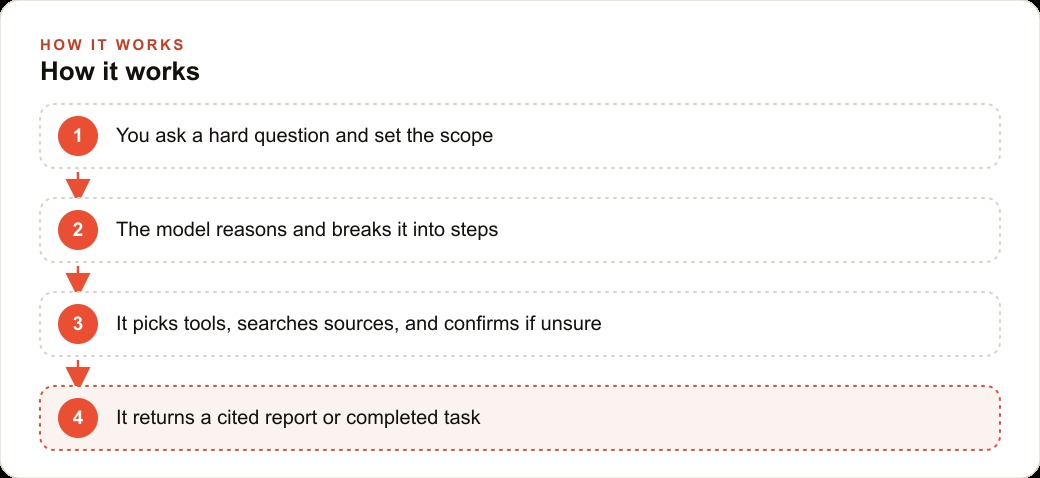
A good reasoning agent does not always start immediately. On complex or ambiguous tasks, it pauses and asks clarifying questions before committing to a search and synthesis path. This behavior is a quality signal, not a friction signal.
When an agent asks a clarifying question, it is telling you it has identified ambiguity in your question that will affect the output. If it proceeds without asking, it resolves the ambiguity itself, which often means it makes assumptions that do not match your actual situation. The agent that asks is the one that returns a better result.
For the photography studio example, the agent might ask: are you comparing against all local studios or only those in a similar price tier to yours? Should the review analysis include Google and Yelp both, or only one? Do you want the output formatted as a table or as a written narrative? Each of those questions changes what the final report looks like in a meaningful way.
Answer every clarifying question with specificity. The agent's thinking phase has not yet started in earnest; it is waiting for the scope to be locked before it begins searching and reading. Every vague answer to a clarifying question means the agent resolves the remaining ambiguity on its own, and you lose the opportunity to steer the output before the effort is spent.
For the studio owner, the answers are: compare against studios in the same mid-range tier, include both Google and Yelp reviews, format as a written summary with a comparison table at the end. Three sentences, delivered before the run, shape the entire output.
Check the Citations Before the Report Becomes a Decision Input
A reasoning model that conducts multi-source research returns a report with citations. Those citations are there to be read, not ignored.
Reasoning models synthesize information across many sources, and they do this well. But synthesis at speed across large volumes of text creates specific failure modes. A source might have been updated recently. Two sources might report the same studio's pricing from different time periods, with one reflecting a seasonal promotion and one reflecting the standard rate. A review summary might underweight a cluster of reviews that all share a specific complaint because that cluster appeared in a less prominent search result.
None of these are hallucinations in the classic sense. They are synthesis errors, which are subtler and more consequential for real decisions. The citation check is the step that catches them.
For the studio owner reviewing the competitive pricing report, the citation check takes 15 to 20 minutes. For each competitor studio the report discusses, the owner opens the studio's website and confirms the pricing and packages match what the report says. For any discrepancy, the owner notes the difference and adjusts the analysis manually. This is not a sign that the model failed. It is the correct workflow: the model does the gathering and first-pass synthesis, the human does the verification pass before acting on the conclusions.
The citation check also builds calibrated trust over time. After running three or four research reports and checking the citations each time, the owner develops a feel for where this particular agent's synthesis is reliable and where it occasionally drifts. That calibration shapes how much verification effort future runs require, and in most cases the verification time shrinks as confidence in specific task categories grows.
Build a Second Workflow After the First Returns Reliable Results Twice in a Row
The most common mistake with reasoning models is stopping after the first successful run. One verified, useful research report is proof of concept. It is not a workflow.
A workflow is a recurring, structured use of the model on a defined set of tasks, with a clear review step and a defined output format. A workflow produces consistent value week over week rather than a one-time result you had to work hard to reproduce.
Build the second workflow only after the first has returned reliable results twice in a row. That threshold is not arbitrary. A single successful result might reflect a particularly well-scoped question or a topic the model handles especially well. Two consistent results in a row suggest the workflow is transferable to similar tasks.
For the studio owner, the first workflow is the seasonal pricing analysis. Run it in the spring, verify the citations, use the output to set summer pricing. Run it again in the autumn, verify again, use the output to set winter pricing. Two reliable runs means the workflow is established.
The second workflow follows the same template but points at a different task. It might be a monthly review summary: aggregate what clients said about the studio across all platforms in the past 30 days, identify the three most common compliments and the two most common critiques, and note any specific experiences multiple clients mentioned. That workflow runs once a month, takes 10 minutes to start and 15 minutes to verify, and produces a clear picture of what is working and what needs attention before the next batch of bookings.
Each new workflow is easier to build because the pattern is already established. The discipline is identifying which tasks are repeating and structured enough to benefit from it, rather than applying it to tasks that are too narrow or too unpredictable for a fixed template to capture.
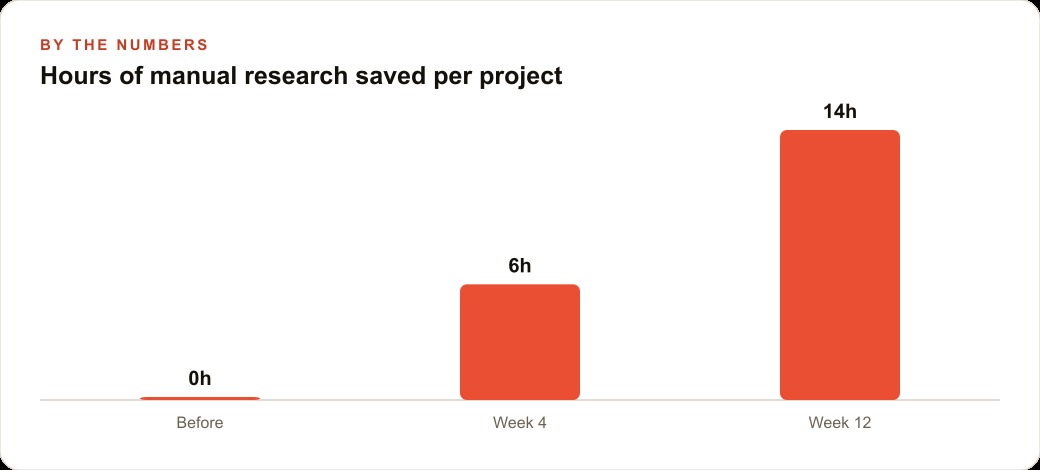
The economics of this compounding matter. The studio's first workflow, seasonal pricing analysis, used to cost 6 to 8 hours per season of browser-tab research. The reasoning model run takes 20 minutes and 15 minutes of citation checking. The second workflow, monthly review summaries, used to be skipped entirely because there was never enough time to do it well. Now it happens every month. By the third month of running both workflows, the studio owner has better market intelligence and better client feedback visibility than before, at a fraction of the prior time cost.
Match the Model Tier to the Task, Not to Your Confidence in the Tool
Not every task needs the most capable, most expensive reasoning model. This is a critical discipline for keeping costs rational and for building the right instinct for which tool to reach for.
Reasoning models exist on a spectrum. At the shallow end, faster, cheaper models handle simple synthesis, formatting, and short research tasks. At the deep end, extended reasoning modes on the most capable models handle multi-hour research jobs with dozens of sources and complex synthesis requirements. The cost difference between a shallow run and a deep run on a high-capability model can be an order of magnitude.
The right matching principle is to match the thinking depth to the consequence of getting the answer wrong. A summary of industry news for an internal team meeting has a low consequence for a small error. A competitive pricing analysis that determines what the studio charges for the next six months has a high consequence for an error. The first gets a fast, lighter model. The second gets extended reasoning on the most capable model available.
For the photography studio owner, after two or three months of running these workflows, the tier-matching instinct develops naturally. The seasonal pricing analysis is always extended reasoning. The monthly review summary is always medium reasoning. The quick question of whether a specific competitor now offers mini-sessions is always the fastest available model, answered in seconds. Each tier costs proportionally to what the task is actually worth, and the total monthly spend on reasoning model research stays predictable.
The practical test for whether you have matched correctly is the output quality relative to the decision being made. If the output is substantially better than what you need, the model was overkill. If the output required extensive manual supplementing to be usable, the model was underpowered. After a few iterations, calibration becomes second nature.
Madhuranjan Kumar has built this kind of research workflow for multiple business types, and the pattern that holds across all of them is consistent: the businesses that get lasting value from reasoning models are the ones that invest in writing specific questions, answering the clarifying questions the agent asks, checking the citations, and building each successful run into a defined repeating workflow. The businesses that try it once, get a mixed result from a vague question, and conclude the tool is overhyped are the ones that missed the setup, not the capability. The tool is only as good as the question you start it with and the review you give the output before you act on it.
That is exactly what we do at AI DOERS. Book a private 30-minute call with Madhuranjan Kumar and we will map the fastest path to it for your specific business.
Book your call →
Madhuranjan Kumar
Madhuranjan Kumar brings 20 years of performance-marketing experience and has managed over $200 million in Facebook ad spend for brands across the United States and beyond. His expertise spans the full modern marketing stack: Meta, Google Ads, TikTok, email automation, CRM, and the websites that hold it together. At AI DOERS he turns that track record into lead-generation systems for businesses across every industry.