
Free Starts and the Next Level: A Builder's Philosophy for Slow Businesses
Start a business for free and earn before you invest, package a skill people already pay for, do more of what works, and survive the long stretch of no payoff. Here is how those four ideas apply to a real local business.

Most startup advice tells you to invest in your brand, your tools, and your systems before you earn a dollar. That sequence destroys more businesses than bad ideas do.
I am Madhuranjan Kumar. This is not a small caveat to the conventional wisdom about starting a business. It is a direct argument against the sequencing that most business education, most startup culture, and most coaching programs take as obvious. The counterintuitive claim is this: earn first, invest second is not just a survival rule for founders without capital. It is the correct sequencing logic for any business entering a new market, launching a new service, or attempting to grow past a plateau, regardless of how established it already is.
The evidence for this position comes from a particular kind of founder story: the one where the business started with nothing, earned before it spent, scaled what worked, and failed when it broke that discipline. That story is not inspiring because it is unusual. It is instructive because the discipline it describes is the thing most businesses fail to maintain even after they have the resources to invest ahead of earning. Understanding why earn-first works is more useful than the story itself, because the why transfers to any business in any market.
The standard advice to invest before you earn has things backwards
The conventional sequence for starting or growing a business goes something like this: identify your market, build your brand identity, invest in the right tools and systems, create your offering, and then go sell it. This advice exists for good reasons in narrow contexts where the product must be built before it can be demonstrated, where capital access is not the constraint, and where competitive positioning requires a presence before revenue proves it. In those narrow contexts, investing before earning is sometimes the right call.
For most small businesses, most services, and most local market entries, those conditions do not hold. The business does not need to be built before it can be demonstrated. A service business can demonstrate the service with the first customer before any branding or system has been created. The offering can be tested on the first ten buyers before any tooling has been purchased. The competitive positioning gets validated or invalidated by whether the market pays, not by how well-designed the brand looks on a website that has never received a visitor.
Investing before earning places a bet on your assumptions about what the market wants rather than on evidence the market is already providing. If the investment goes into a brand identity, a website, software tools, and a professional setup before the first customer pays, and then the market turns out to want something slightly different from what you assumed, the investment is largely wasted. The pivot costs you both the investment and the time to rebuild. Starting with zero investment and earning the first dollars on the actual skill or service means you find out what the market responds to before you spend anything building around your guess.
The first dollars are the most valuable signal a market can send. They tell you that someone wanted what you offered, was willing to pay your price, and completed a transaction. That confirmation has a market-research value that no survey, interview, or competitor analysis can match, because it represents actual behavior rather than reported intention. Earning those first dollars before investing in anything is how you buy the most important information available about your market for the least possible cost.
The early career story that illustrates this is worth examining directly. The first paid work came from growing Instagram accounts for other people, a skill that required no software, no investment, and no brand, only effort and repetition. Small gigs at a few dollars each came first, earning before investing, and that discipline later kept an early drop-shipping failure from becoming a fatal loss. The business started because there was a skill, not because there was a brand. The brand, the systems, and the tools came later, after the skill had already generated revenue that justified investing in them.
Earning before investing is not frugality, it is the only way to validate a market before betting on it
There is a practical misunderstanding that frames the earn-first discipline as a workaround for limited capital. The real frame is validation logic. An investment that comes after proof of revenue is backed by evidence. An investment that comes before proof of revenue is a hypothesis. Both might work. But one costs less when the hypothesis turns out to be wrong, and businesses are wrong about their initial assumptions far more often than most planning processes acknowledge.
That sequence inverted is what kills most new offerings. A business owner has an idea for a new service, spends two months and several thousand dollars building the system for delivering it, and then discovers that the market's interest at the proposed price point does not match the investment made. The capital and the time are both gone. The evidence that the investment was misjudged comes after the bet was placed rather than before it. Earning first would have surfaced that mismatch for almost no cost, in the time it took to make the first ten offers to real potential customers.
The bigger market argument is related. Building in a language or market that is much larger than your immediate context is a form of validation logic applied to market size. If the potential audience in your immediate local context is ten thousand people and the potential audience in the largest accessible market is ten million, targeting the larger market does not cost more at the start. It costs the same effort directed at a different audience. The ceiling of the business is determined early by this choice, and choosing the larger market while spending nothing extra to reach it is the first application of the earn-first principle to market targeting.
The scale argument extends this further. A service that earns its first dollars without any investment can be tested at scale before any infrastructure is built for it. The infrastructure investment that follows a proven, scaling service is much lower-risk than the one that precedes it, because it is sized to actual demand rather than projected demand. The business that validates first and invests second will almost always build better infrastructure than the one that invests first, because it knows specifically what the infrastructure needs to handle.
The manual outreach tactic that drove the early Instagram growth work is the earn-first principle in pure mechanical form. Follow active fans in a target niche at the rate of roughly one hundred per hour and expect approximately ten percent to follow back. No software. No investment. Pure repetition, run every day until the results accumulate into a number of accounts large enough to sell as a service. The business model was the tactic itself, discovered through doing it, not through planning what it might become.
Delayed gratification is a competitive moat because most people cannot sustain it past the first quiet month
The part of this philosophy that is hardest to teach and hardest to maintain is the discipline of continuing to do the work with minimal feedback for the time required for results to compound. Posting content consistently for more than a year with almost no audience response before a single piece reaches a large number of people is not an unusual story in the early stages of building any audience. But it is the story that most people do not finish, because the feedback during the quiet period is too sparse and too delayed to feel like progress.
That inability to tolerate the quiet period is the competitive moat. The people and businesses that stay through the quiet period do not find a clear market when they emerge. They find a much less crowded one, because most of the competition dropped out during the months when nothing visible was happening. The competitive advantage of delayed gratification is not a character virtue. It is a structural filter. The first sustained period of effort with low payoff is the selection mechanism that determines who reaches the compounding phase, and most people self-select out of it.
This moat is available to any business willing to maintain a consistent habit through a period of minimal feedback. The outreach loop that produces nothing for six weeks and then generates three referrals in one month is doing invisible work during those six weeks. The social posting habit that gets a dozen views for four months and then breaks through is building an asset during those four months. The discipline required is not talent or unique insight. It is the willingness to keep doing the work on the weeks when the calendar says it is not necessary.
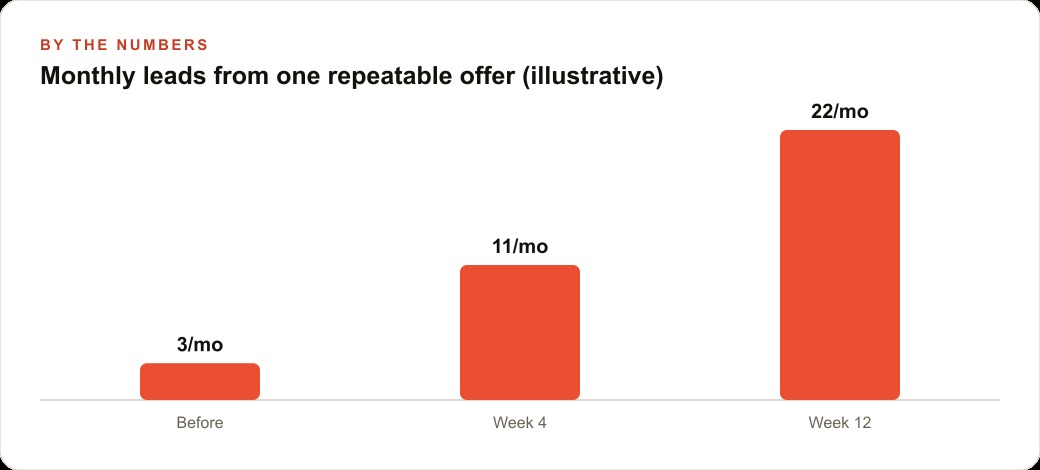
The HVAC company launching a new duct cleaning service provides a concrete version of this. The free diagnostic offer generates zero paying customers in week one and three in week two. Outreach to past customers generates no responses in the first round and four in the second. The pattern looks like failure to someone measuring week-by-week results. It looks like a building asset to someone measuring the cumulative relationship being established with people who will eventually say yes. The business that keeps showing up through the first six to eight weeks of apparent non-results is the one that owns the duct cleaning calendar in that area twelve months later, because every competitor that tried the same approach quit before reaching the compounding phase.
Video game addiction entering the story at this point is worth naming directly: an environment that offers faster, more frequent reward signals will win against a business habit that offers slow, delayed ones if you are not deliberate about protecting the habit. The businesses that grind the slow reps consistently are usually the ones that have designed their environment to support that kind of work, not the ones relying on willpower alone to sustain it against competing demands on their attention.
Abandoning what works in search of something more interesting is how most compounding businesses reset to zero
The discipline of doing more of what works is more fragile than it appears. When a particular format, offer, or approach is working, the natural human response is not to do it more. It is to explore variations, test new ideas, and look for the next improvement. That exploration is often valuable. It becomes destructive when it replaces rather than supplements the proven format during the period when the proven format is still compounding.
The structured informational content format that was producing consistent revenue at a meaningful level is the direct example here. Rather than running more of the same format, an experiment with a different content style replaced it while the momentum of the working format was still intact. The revenue from the working format declined because fewer of those pieces were being made. The experimental format did not replace the revenue. The result was a reset from a compounding position back to something close to zero, a fall from thirty-five hundred dollars a month to roughly one hundred dollars a month.
This pattern is not specific to content creation. An HVAC company that finds a seasonal promo offer filling the appointment calendar encounters the same temptation. The proven offer is boring because it is familiar. The new offer is more interesting because it has not been done yet. Running the new offer before the proven one has been maximized is how companies reset their momentum at the moment it is actually building. Do more of what works first, to the point where the market is genuinely saturated with the offer, and only then experiment with alternatives.
For the HVAC company launching duct cleaning, this applies directly to the free diagnostic that converts to paid jobs. In the first three months, zero duct cleaning jobs became twenty duct cleaning jobs when the free diagnostic was offered consistently to every past customer contact. The offers that worked were the direct referrals from satisfied customers and the reactivation emails to customers who had used the company in the previous two to three years. Those channels were less exciting than running a full advertising campaign. They were also more effective and cost less money. The discipline was to maximize those channels before investing in paid advertising, rather than running a campaign simultaneously and splitting the marketing attention before either approach was proven.
This is where Google Ads fits in the earn-first sequence correctly. You run the free diagnostic offer through direct outreach first. You gather real results. You know what the conversion rate is, what the average job value is, and what kind of customers are most likely to book. Then you invest in Google Ads with that evidence behind you, targeting the customer profile that your direct outreach already validated. The paid campaign amplifies a proven offer rather than testing an unproven one at the market's expense.
The case studies and proof accumulated from the free-start phase feed directly into the content for SEO and organic search that generates inbound leads over time. Twenty real duct cleaning jobs completed in month three is a story that can be written up, published, and found by future customers researching the service. That proof did not cost the company anything to accumulate. It was a byproduct of the free-start discipline applied correctly.
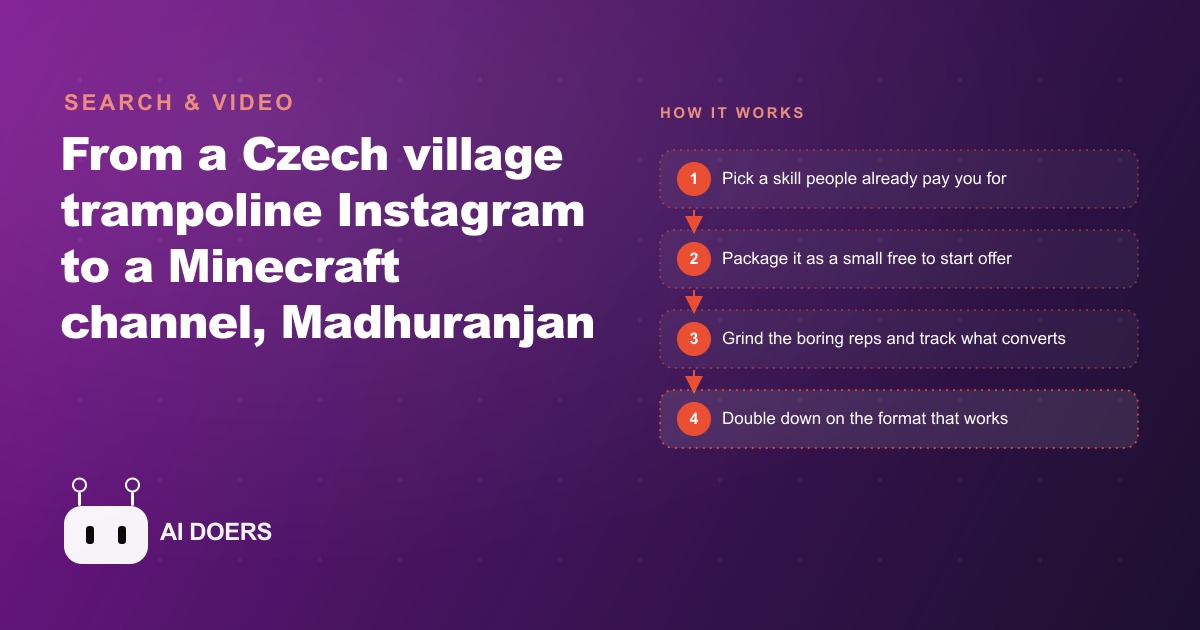
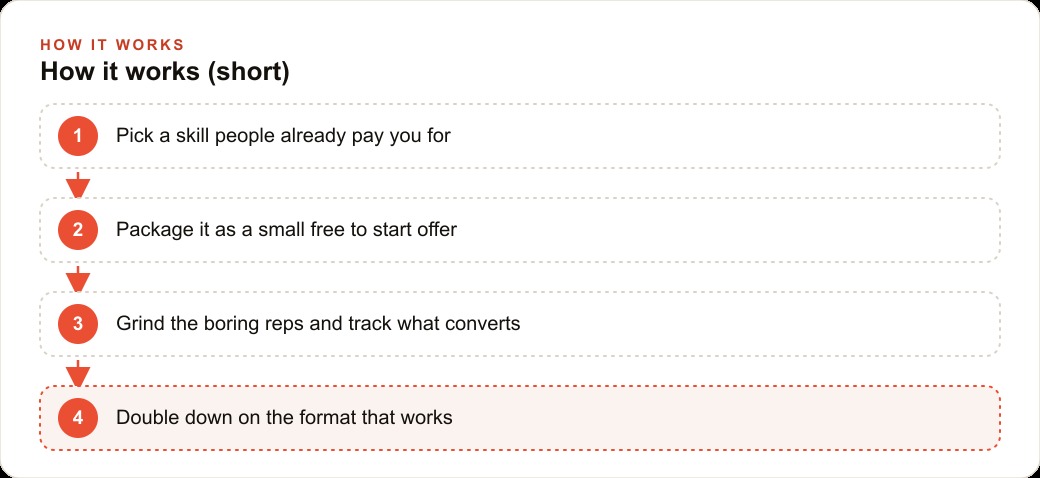
The full picture of this philosophy is a sequence, not a single rule. Start with the skill people are already paying for. Earn the first dollars without investing. Grind the boring reps long enough for the compounding to show. Do more of what works until the market opportunity in that channel is genuinely exhausted. Only then invest in a new channel or a new format, with the evidence and the cash flow from the proven approach behind you. Each stage is harder than it sounds and more effective than most alternatives. The businesses that follow the full sequence build something durable rather than something that works until the novelty runs out or until the budget runs out before the market responds.
The most important practical implication for any business reading this is to identify the one thing customers are already paying for, find the free or zero-cost version of delivering it, and start earning before spending anything on making it look better. Then keep doing it past the point where it feels like you should have moved on already. The compounding starts on the other side of that threshold, and the threshold is almost always further along than it felt like it would be when you started.
That is exactly what we do at AI DOERS. Book a private 30-minute call with Madhuranjan Kumar and we will map the fastest path to it for your specific business.
Book your call →
Madhuranjan Kumar
Madhuranjan Kumar brings 20 years of performance-marketing experience and has managed over $200 million in Facebook ad spend for brands across the United States and beyond. His expertise spans the full modern marketing stack: Meta, Google Ads, TikTok, email automation, CRM, and the websites that hold it together. At AI DOERS he turns that track record into lead-generation systems for businesses across every industry.