
The Personal Finance Rules That Actually Matter, From a 63-Minute Course
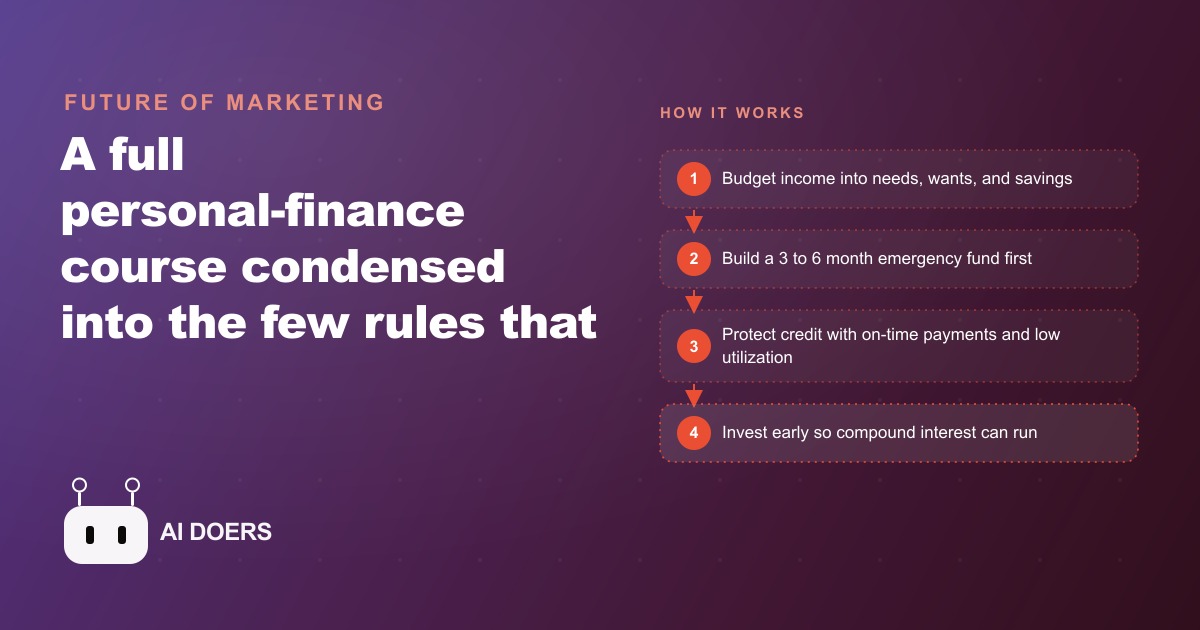
Most of financial literacy comes down to a handful of habits: budget with the 50/30/20 rule, build a 3 to 6 month emergency fund, protect your credit with on-time payments and low utilization, and start early so compound interest can work for decades.

I am Madhuranjan Kumar, and I have come to believe that personal finance and business finance are the same subject wearing different clothes. An entire hundred-page financial literacy course really does collapse into a short list of moves, and the reason it collapses is that money does not care whether the account has your name on it or your company's. The same habits that keep a household from living paycheck to paycheck keep a business from living week to week. None of it requires a finance degree. It requires doing a few simple things in the right order and then refusing to quit. Let me walk through the throughline, and I will use a neighborhood restaurant as the example that keeps it honest.
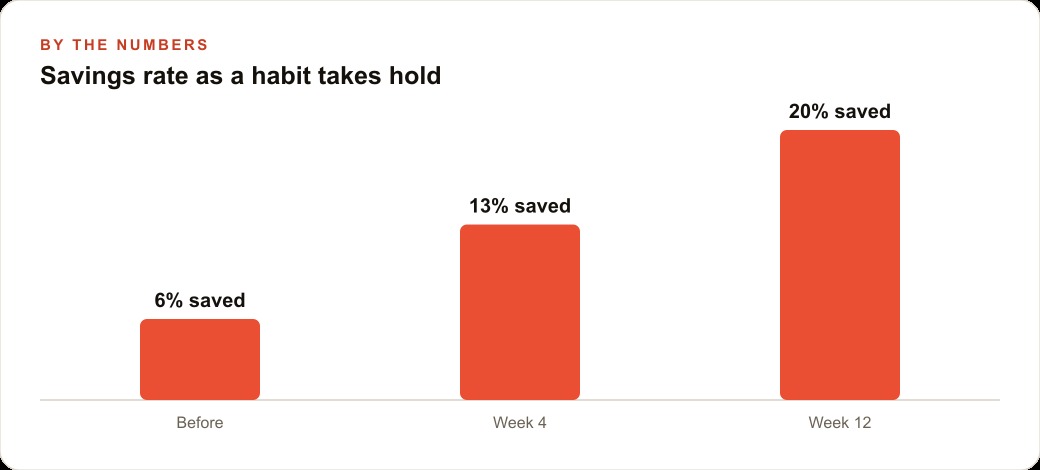
The starting point everyone reaches for is the 50/30/20 rule: fifty percent of your after-tax income toward needs, thirty percent toward wants, twenty percent toward savings. It is a fine rule, but I want to argue that the percentages are the least valuable thing about it. The real gift is the audit it forces. Pull your last bank statement, tag every line as a need, a want, or savings, and you will almost always discover the same two facts: the savings number is lower than you assumed and the wants number is higher. That single exercise teaches you more than any ratio, because you cannot fix what you have never measured. And hidden in the needs column are quiet wins nobody thinks to claim. Call your phone, internet, and utility providers and ask for a lower plan, and it works more often than it has any right to, because those companies would rather keep you than watch you leave for a competitor. Sometimes all you have to do is ask, and the saving repeats every month for years. The habit underneath the rule is attention, and attention is the thing that actually changes outcomes.
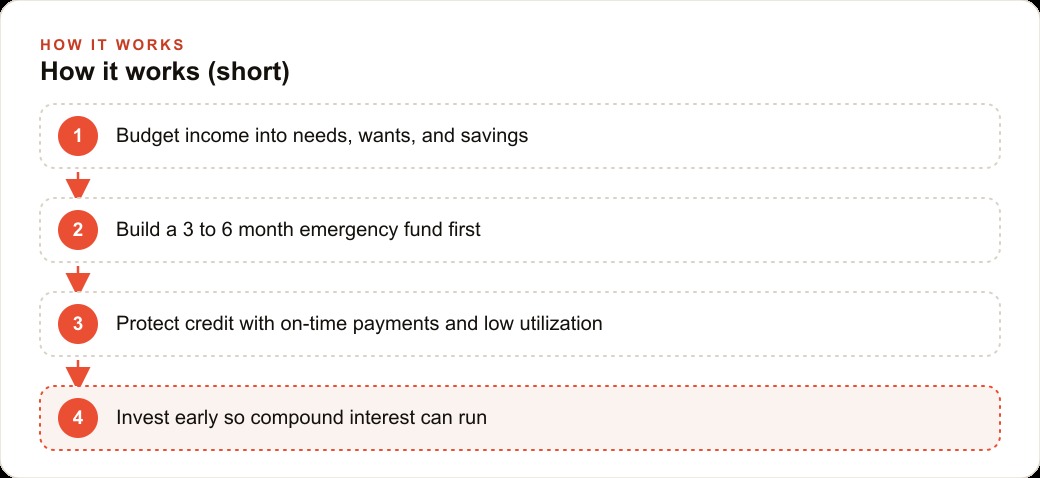
Once you can see where the money goes, the moves stack in a specific order, and the order is the whole argument. Before you invest a dollar, you build an emergency fund covering three to six months of living costs. A layoff, a medical bill, or a sudden repair arrives without asking permission, and this is the money you do not touch until one of them does. Skip this step and every later step is built on sand, because the first shock forces you to sell investments at the worst moment or reach for high-interest debt. Only after the fund exists do you turn to protecting your credit, and here is where most people carry a quiet misunderstanding worth clearing up. Your credit score does not measure how much you earn. Income has nothing to do with it. The score measures how you handle the money you already have, and it is dominated by two factors. Payment history is thirty-five percent, the single largest piece, which is why one missed payment does more damage than almost anything else you can do. Credit utilization is thirty percent, which surprises nearly everyone, and it rewards keeping balances small against your limits. A hundred-dollar balance on a ten-thousand-dollar card is a healthy one percent. The lesson is oddly freeing: you do not need a big income to have excellent credit. You need to pay on time and keep your balances low, and those two habits alone are nearly two-thirds of the score.
Then comes the part that rewards patience more than intelligence, and it is the emotional core of the whole essay. Compound interest does the heavy lifting, and the earlier you start, the more it does, to a degree that feels almost unfair. One comparison makes it stick better than any formula. Imagine one saver puts away twenty-five dollars a month for forty years and ends with roughly a hundred sixty-eight thousand dollars. Another saver starts ten years later at double the amount, fifty dollars a month, and finishes with only about a hundred forty-seven thousand. The second saver contributed more money and still came out behind, because time in the market beats the size of the contribution. That is the entire case for starting now instead of waiting until it feels comfortable, and it is why I get almost impatient when someone tells me they will begin investing once they earn more. The most expensive thing you can do with money is wait to respect it.
Now watch how cleanly all of this maps onto a business, because that is the point I most want to land. A company is just a household with more line items. Budget your revenue into needs, wants, and savings instead of spending whatever happens to be in the account at month end. Build a cash reserve that covers several months of fixed costs so a slow season does not sink you. Treat your business credit and payment history as assets you protect, since they decide what financing you can get later and at what rate. And put idle profit to work instead of letting it sit, because inflation quietly drains cash that does nothing. If your reserve earns two percent while prices rise three percent, you are still losing one percent of buying power every year without spending a dime. The owner who internalizes that stops keeping every spare dollar in a checking account, and starts matching each pool of money to the job it needs to do.
The restaurant that stopped living week to week
Take a neighborhood restaurant with strong weekends and thin weekdays, the kind of place that feels busy but never seems to get ahead. Here is how I would set up its money, and notice that it is the same four moves in the same order. First, the 50/30/20 idea, adapted: a fixed share of revenue covers needs like rent, payroll, and food cost, a share covers wants like new equipment or a patio upgrade, and a real share goes straight to savings every single month, not just when there happens to be a surplus. The discipline is treating savings as a bill, not a leftover. Second, build a three to six month operating reserve before any expansion, so a broken walk-in cooler or a dead January is an inconvenience rather than a crisis that forces a high-interest loan at the worst possible time. Third, protect the restaurant's credit by paying suppliers and loans on time and keeping balances low, because that is exactly what unlocks a good rate the day the owner wants to open a second location. Fourth, replace the vague wish with a SMART goal. "I want to grow" is not a plan. "Save a hundred thousand dollars for the second location by a specific date" is something you can break into a monthly number you can actually hit, and then measure yourself against.
Put illustrative numbers on the arc so the payoff is concrete. Say the restaurant nets forty thousand dollars in a decent month across the good weekends and thin weekdays. Routing even ten percent of revenue to savings before anything else, rather than at the end when it has usually evaporated, might mean setting aside a few thousand dollars a month on autopilot. Over a couple of years that reserve grows into the operating cushion and the down payment at the same time, while on-time supplier payments quietly build the credit profile that earns a lower rate on the expansion loan. Same restaurant, same revenue, radically different position, and the only thing that changed was the order of operations and the refusal to skip the boring steps. The reserve that protects the business is the same discipline that lets it invest in growth when the moment comes, whether that growth is a second kitchen or a bigger push into Facebook and Instagram ad campaigns to fill those thin weekdays.
There is one more idea I want to fold in, because it quietly undoes more financial plans than any market crash, and that is inflation. Doing nothing with cash is not a neutral choice. It is a slow loss. If prices rise three percent in a year and your money sits earning two, you have lost one percent of your buying power without spending a dollar, and you felt nothing while it happened. That is the trap of the checking account that feels safe. It is safe from volatility and quietly unsafe from erosion. The restaurant that keeps six months of reserve is doing the right thing by holding it, and the more advanced move is holding the reserve somewhere it at least keeps pace, in a high-yield account or short-term instrument, rather than in a zero-interest account where inflation nibbles it every month.
The same principle scales up to how the restaurant thinks about its profit. Money that has a job, whether that job is safety, growth, or an upcoming purchase, is money working for you. Money with no job is money slowly working against you. So the owner who sorts every dollar into a purpose, this pool for the emergency reserve, this pool for the second location, this pool for equipment, is not just being tidy. They are making sure no dollar sits idle long enough to lose value quietly. Matching each pool to the right vehicle is the finishing move: safety money stays in safe, liquid places like bonds and treasury bills, and long-horizon money goes into diversified investments like a broad index fund that has historically returned around ten percent, spreading the risk so no single bad bet can sink the plan. The discipline is not glamorous, and it will never trend, but it is the difference between a business that compounds and one that treads water while feeling productive.
If there is a single thread running through all of this, it is that financial health is not an intelligence test. It is a sequence applied consistently for a long time. Start with one month of real numbers, tag every expense, and fix the biggest gap first. Open a separate account for each goal, an emergency fund, equipment, expansion, and auto-route part of every deposit into each so the sorting happens without willpower. Check your credit, then attack on-time payments and utilization, since those two alone are nearly two-thirds of the score. Match each goal to the right vehicle, keeping short-term money in safe places like bonds and treasury bills and longer-term money in diversified investments like a broad index fund, and never put all your eggs in one basket. The systems that hold a growing business together, the reserves, the reminders, the routing, often live right alongside the CRM and website stack the owner already uses to run the day.
I have watched owners chase complicated tactics, exotic investments, and clever tax tricks while neglecting the boring sequence that actually determines their outcome. The boring sequence wins almost every time, because it is not fighting human nature with willpower. It is engineering the outcome with structure, the automatic transfer, the separate account per goal, the reserve built before the temptation to spend it arrives. Structure beats willpower over a decade, every time, and that is the quiet lesson hiding inside a hundred-page course. You do not need to be disciplined every day if you set the system up once so the right thing happens without you.
The households and the businesses that quietly get ahead are almost never the ones with the highest income or the cleverest strategy. They are the ones that started the boring sequence early and never interrupted it, letting time and structure do the heavy lifting while everyone else waited for the perfect moment that never comes. The best day to start was years ago. The second best day is the one you are reading this.
None of this is complicated, and that is exactly why people underrate it. The short list of priorities, applied without drama for years, is what separates the household and the business that always feel behind from the ones that quietly compound. You can run this yourself with a spreadsheet and some discipline, or you can bring in someone who sets up these systems for owners every day and wants yours built right from the start.
That is exactly what we do at AI DOERS. Book a private 30-minute call with Madhuranjan Kumar and we will map the fastest path to it for your specific business.
Book your call →
Madhuranjan Kumar
Madhuranjan Kumar brings 20 years of performance-marketing experience and has managed over $200 million in Facebook ad spend for brands across the United States and beyond. His expertise spans the full modern marketing stack: Meta, Google Ads, TikTok, email automation, CRM, and the websites that hold it together. At AI DOERS he turns that track record into lead-generation systems for businesses across every industry.