
The Overlooked AI Career Move for 2026: Get Promoted, Not Pitched
The realistic AI opportunity for most people is not starting an agency, it is becoming the most AI-fluent person inside their own company, because CEOs are hiring chief AI officers and 57% of those seats are filled from within.

Every month in 2026, someone publishes a video explaining that the best AI career move is to start an automation agency, and every month thousands of people who would make genuinely terrible agency owners follow the advice.
I am Madhuranjan Kumar, and the argument I want to make is specific: for the majority of people already inside established organizations, the agency path is the wrong move. Not because it is a bad business, but because it is a bad fit for most of the people chasing it. The right move, backed by IBM survey data and a studied pattern of how chief AI officer roles are actually filled, is to become the most AI-fluent person inside the company where you already work.
The gap between those two paths is enormous. One requires you to spend a significant portion of every week selling yourself to strangers, handling rejection, following up when they go quiet, and repeating that cycle until you have a stable client roster. The other requires you to do excellent work in a domain you already understand, using tools your organization has not yet figured out how to deploy, and making that work visible to people who already trust you. For most people inside organizations, the second path is more realistic, less psychologically exhausting, and right now structurally open in a way it will not be much longer.
The agency path is optimized for a specific personality type that most people in offices do not have
Running an agency is a sales job with a service component. The revenue comes from continuously acquiring and retaining clients. The service comes from delivering results once you have them. Most people who are drawn to AI are drawn to the second part, not the first, and in an agency business the first part determines everything. You can be genuinely exceptional at delivering AI automation results and still fail as an agency owner because you find the client-acquisition cycle draining rather than energizing.
This is not a moral judgment about ambition. Some people are wired to enjoy prospecting, objection handling, and the rhythm of proposals and rejections that fills the early months of any client-service business. For those people, an agency is a natural structure. For the majority of office workers, engineers, marketing managers, and operations professionals, that cycle is a tax on the work they actually want to do, and consistent effort on a draining activity is not something most people sustain long enough to see real results.
The internal path asks for none of that. It asks you to do your existing job better than your colleagues using tools your organization has not yet deployed, then to be visible enough that when leadership creates a formal AI role, your name comes up without you having to campaign for it. The organizational politics of getting noticed inside a company that already trusts you are simpler than the market politics of acquiring clients from cold outreach, especially when your domain knowledge makes your AI work trustworthy rather than generic.
For anyone already managing Google Ads or Meta ads inside a marketing team, this is immediately actionable. The campaign manager who builds an AI workflow to generate copy variants, audit search term reports, and draft weekly performance summaries is demonstrating value in a language their manager already understands. They are not selling to a stranger. They are showing a result to someone who already knows their work.
A 61-point gap between capability and daily use is not a problem, it is a waiting promotion
IBM surveyed 2,000 CEOs at large companies and found that those leaders believe 86% of their employees have the skills to use AI in their daily work. Those same CEOs reported that only 25% of employees actually use AI daily. That is a 61-point gap between perceived capability and actual usage.
The gap is not a technology problem. The models are capable. The tools are accessible. The bottleneck is that nobody inside most organizations has been given the job of connecting willing employees to workflows that make AI genuinely useful for their specific function. The data is still being processed the same way it was processed three years ago, the reports are being written the same way, and the meetings are being prepped the same way, not because people object to AI but because no one has built the bridge between the tool and the task.
The person who builds that bridge, without being asked, is not doing extra work for no reward. They are auditing for a role that is actively being created. Every organization that recognized that gap in IBM's survey is now trying to figure out who owns closing it. In most cases, the person they name will be the employee who was already quietly closing it on their own.
For a team managing web and CRM operations, the gap looks like this: the operations lead knows AI could summarize sales call notes, automate follow-up drafts, and flag stale deals in the pipeline, but the workflow has never been built because it was not anyone's assigned job. The person who spends a weekend building it and presents a before-and-after to the sales director is the person who starts being consulted on every AI decision from that point forward.
The CAIO arrived in 24 months instead of 15 years because the urgency is that real
The chief information security officer role did not exist as a standard C-suite position until the internet created a class of threats that no existing executive was equipped to handle. That role's journey from novelty to standard line item took roughly 15 years, from the mid-1990s through the early 2010s, as breaches became common enough and costly enough that boards required a dedicated owner.
The chief AI officer followed the same structural arc in about 24 months. IBM's survey found that 76% of 2,000 CEOs now have a chief AI officer or are actively hiring one, up from 26% two years ago. That is a 50-point jump in two years, compared to the CISO's decade-and-a-half climb. The compression happened because the competitive consequences of ignoring AI are visible within a single quarter, not hidden inside a multi-year breach cycle. An organization that does not deploy AI in its revenue-generating functions loses measurable ground to competitors that do, and that loss shows up in financial results fast enough to reach the board agenda.
The compressed timeline also means the window for establishing yourself as the internal AI person is shorter than most people recognize. The CISO trajectory gave employees a decade to develop the relevant skills before the role was formalized everywhere. The CAIO trajectory is giving people roughly two to three years, and at many large companies that clock is already running. IBM's survey of C-suite leaders shows that every marketing, finance, operations, and sales leader is expected to become AI fluent, which means the demand for an internal AI person extends well beyond a single title. Every function needs one.
57% of chief AI officers were already inside the company when they got the role
IBM conducted a separate study of 600 chief AI officers across industries and found that 57% were appointed from within the company. They were not recruited from AI consulting firms or hired away from technology companies. They were already employees, working in a specific domain, who added AI fluency to that domain expertise and accumulated enough visibility that they became the obvious choice when leadership formalized the role.
That number is the clearest possible rebuttal to the idea that you need to leave to build something new. The majority of people who now hold the most sought-after AI title in business got there through the job they already had, not through a career pivot. They did the work before the title existed, documented what it produced, and were named when the organization caught up to what they had already been doing.
The implication for anyone reading this is direct. The path to a chief AI officer role, or to being the de facto AI lead of a marketing team, a content operation, or a finance function, runs through doing your existing job better and faster with AI, then making that visible to the people who decide promotions. It does not require cold outreach, a new business entity, or a year of unpaid client work to build a portfolio from scratch.
For anyone already building content and SEO operations inside a company, the application is concrete: automate the briefing process, the keyword clustering, and the first-draft production workflow, then document how many hours per content cycle that saves and present it to the editorial director. That documented result is the track record that makes you the obvious answer when leadership asks who should own AI adoption for the content function.
Domain expertise inside a compliance context makes you harder to replace than any generalist agency
The strongest version of the internal AI argument applies in regulated industries, and it applies in a way outside agencies structurally cannot match.
In healthcare, an employee who understands HIPAA data handling requirements, knows which categories of patient information cannot be processed through external AI tools, and can build workflows that stay inside those constraints is worth more than any consultant who has to be briefed on the rules at the start of every engagement. The compliance knowledge is the moat. An outside firm can learn the AI tooling in a few weeks. It cannot replicate years of working inside the regulatory context and understanding where the edges are.
In financial services, model risk management and data governance requirements shape which AI outputs are permissible in client-facing communications and in automated decision systems. The employee who understands both the regulations and the AI tools can build automations that the compliance team will approve. The outside consultant who understands the tools but not the regulatory context has to spend the first months of every engagement learning constraints the internal employee already carries as second nature.
The same dynamic applies to legal, defense, and any industry where liability follows from getting the output wrong. As AI capability increases, the risk surface grows proportionally, and the person who can deploy AI powerfully while staying inside compliance constraints becomes harder to replace, not easier. The domain expertise is not being commoditized by AI. It is being amplified, because powerful AI needs someone who understands the context to tell it where not to go.
The insurance company move: one automated workflow, dummy data, one before-and-after number
Here is how this plays out in a concrete example drawn from the pattern I see most clearly across industries.
An operations manager at a mid-sized insurance company processes claims exception reports, tracks vendor performance against contractual SLAs, and produces a monthly operational summary that typically takes close to three full days to compile. The workflow involves pulling data from four internal systems that use inconsistent naming conventions and rarely reconcile on the first pass, manually aligning the numbers, and writing narrative commentary explaining the gaps to senior leadership.
This manager spent two weekends building an AI workflow that connected to scheduled exports from all four systems, ran a reconciliation pass automatically, flagged discrepancies above a defined threshold for human review, and drafted first-pass narrative commentary in plain language. The entire prototype was built using realistic dummy data generated specifically for the purpose, because the company's data governance policy required a formal review before any real customer or claims data could be processed through an external AI tool.
The dummy-data choice was deliberate and strategically correct in a way that matters for anyone trying to replicate this path. A demo built on realistic invented data is just as convincing as one built on real data, because what you are demonstrating is the logic and the output format, not the actual numbers. The manager could present a working system to the operations director without triggering a compliance review, and the working demo read as evidence of both technical competence and professional judgment.
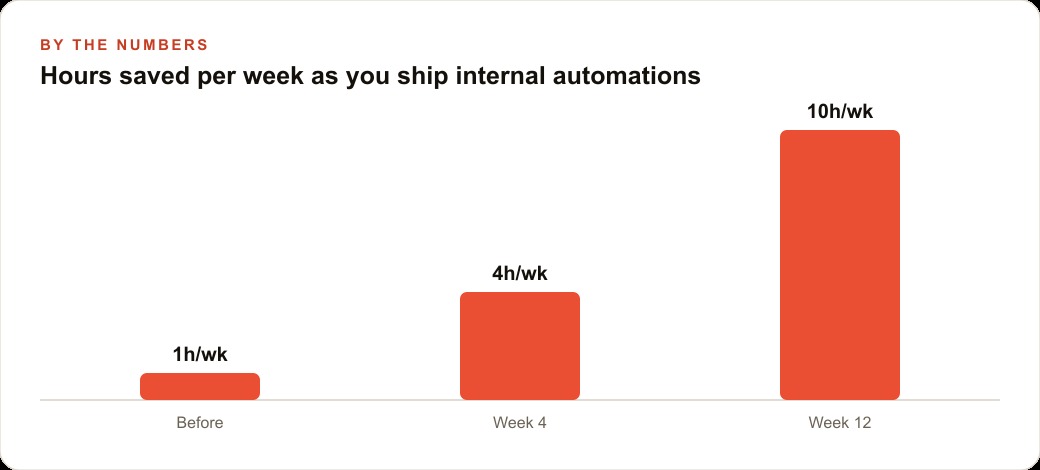
The before-and-after was simple: three days of work compressed to 90 minutes, with one human review pass on flagged items rather than manual line-by-line compilation. The monthly time savings of roughly 14 hours, across 12 months, is 168 hours per year at that one manager's loaded cost from a single workflow built in two personal weekends.
Eight months after that demo, when the company created an AI strategy role within the operations division, this manager was offered it before the role was posted externally. The credential that mattered was not a certification or a career change. It was a working system, built in personal time, documented clearly, and presented to the right person before the seat was even defined.
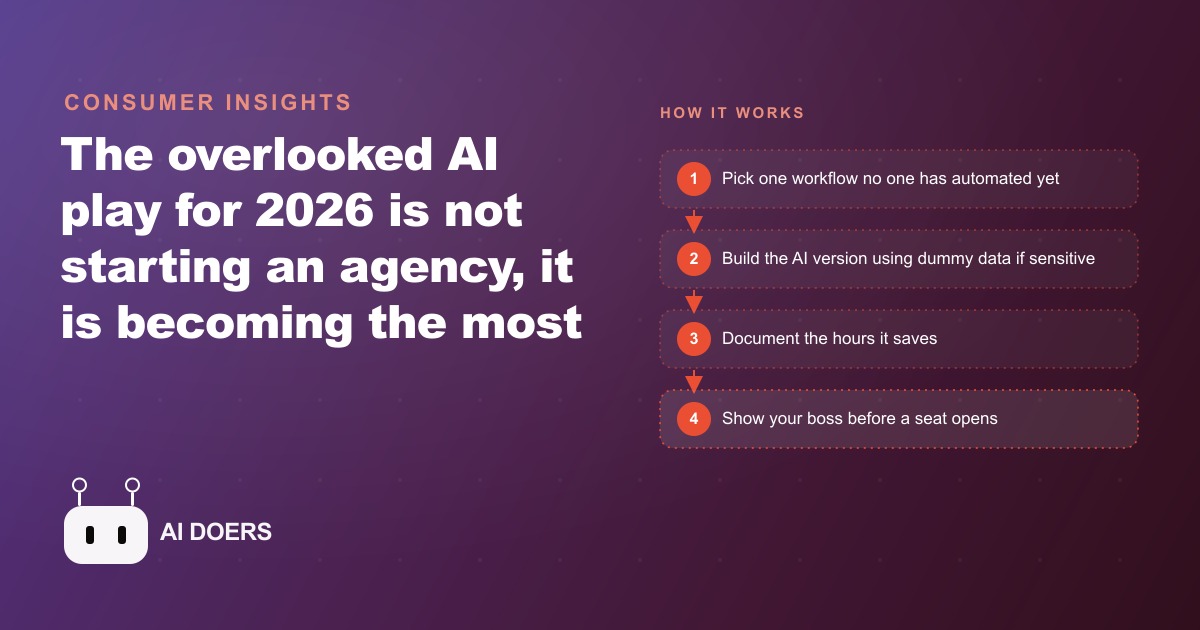
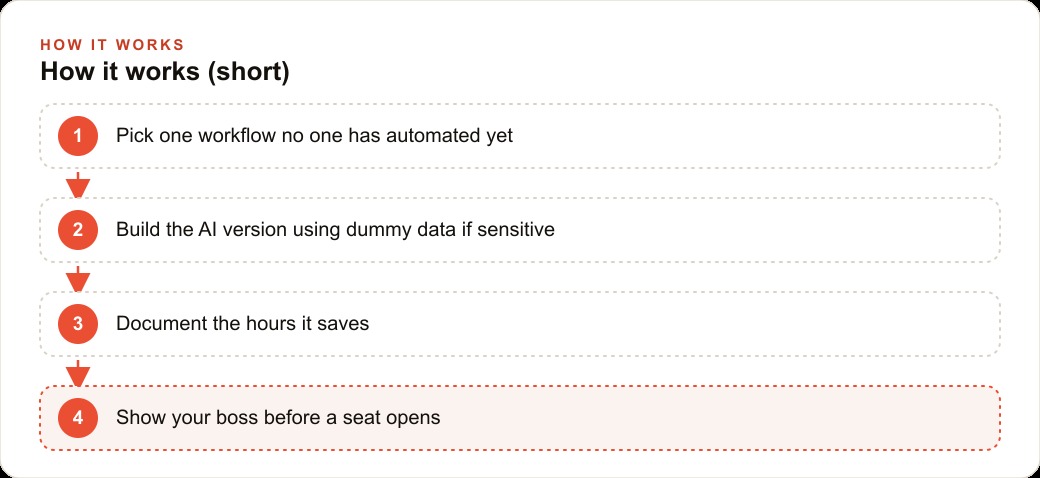
That is the full structure of the internal path. One workflow nobody else was automating. Dummy data so the compliance objection never came up. One before-and-after number that was specific and verifiable. Visibility to the decision maker before the seat existed.
The internet-marketer parallel is instructive for where this ends. In 2005, being an internet marketer was a specific and unusual job title. By 2015 it was just marketing, because the internet became a baseline expectation of every marketing function. The AI qualifier is on the same trajectory. Chief AI officer will eventually dissolve into just being excellent at whatever your function is, as AI fluency becomes a baseline competency rather than a differentiator. The people who build that fluency now, while it still creates visible leverage, will hold the strongest positions when the title disappears and the skill becomes the job.
Pick one workflow this week. Build the AI version of it, use dummy data if the real data is sensitive, document the time saved, and show your manager a before-and-after. That single action, repeated a few times over a quarter, is the argument. Not a pitch deck. Not a cold email sequence. A working result, in a domain you already understand, visible to people who already trust you. That is what 57% of today's chief AI officers were doing before they got the title.
That is exactly what we do at AI DOERS. Book a private 30-minute call with Madhuranjan Kumar and we will map the fastest path to it for your specific business.
Book your call →
Madhuranjan Kumar
Madhuranjan Kumar brings 20 years of performance-marketing experience and has managed over $200 million in Facebook ad spend for brands across the United States and beyond. His expertise spans the full modern marketing stack: Meta, Google Ads, TikTok, email automation, CRM, and the websites that hold it together. At AI DOERS he turns that track record into lead-generation systems for businesses across every industry.