
The One Technique That Cuts AI Coding Errors by 90 Percent
Give your AI coding agent a task-management system and it stops breaking the whole project on a small change. The trick is splitting work into dependency-ordered subtasks and feeding the agent only the context each step needs.

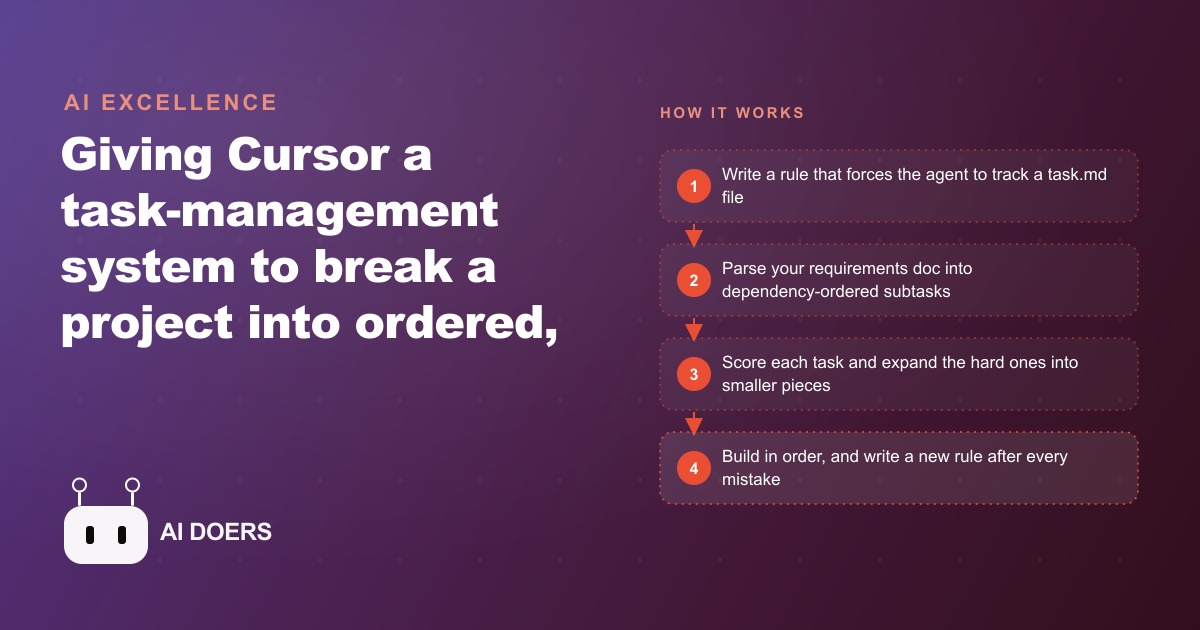
The build that changed how I think about AI coding agents started with a broken project and ended with a multiplayer drawing game where GPT-4 judges the images and picks a winner. The whole thing came together in about twenty minutes. That number is not a boast. It is the benchmark that matters, because the same project without a task-management layer would have taken most of a day and produced a mess I would be debugging the following morning.
I am Madhuranjan Kumar, and over the past year I have watched the same failure pattern repeat itself in hundreds of conversations with business owners and developers who use AI coding tools. They ask the agent for a small change and it mangles something three files away. They start fresh, get further, hit a different wall. The project never finishes cleanly. The culprit is almost always the same: the agent has no stable picture of the overall plan, so every step it takes is a guess with incomplete context.
The Day the Project Started Breaking Itself
The moment that forced me to change my approach was a session where I was building a customer-facing booking tool. The core flow was simple: a service picker, a time selector, a confirmation step. I asked the agent to add an email confirmation, and it wrote the email function. Then I noticed the time-slot picker had broken. The agent had changed a variable name the email function needed, and that change cascaded into the slot logic. I fixed the slot logic, and the service picker stopped populating correctly.
This is not a Cursor flaw or a Claude flaw. It is what happens when you give a model one task at a time with no map of the whole project. Each step is local. The model does not know what it built twenty steps ago or what the current change is about to break. It is building in a fog, and at some point the fog wins.
The fix I was missing was not a better prompt for each step. It was a system that gave the agent a persistent map before any step began.
Building the Map Before the First Line of Code
The simplest version of this fix costs nothing and takes five minutes. You create a file called task.md and write a rule that tells the agent to read it at the start of every session and update it after every completed task. The agent lists the tasks, works through them in order, and marks each one done. That running list is the map. The agent knows what it already built, what the next step is, and what comes after that.
For a booking tool, the task.md might open with: build the service picker with four categories and short descriptions. Then: build the time-slot calendar reading from a static availability file. Then: add the confirmation email that reads the slot object from the previous step. Then: build the admin view showing today's bookings with customer names and job types. Each task is small enough to verify in under two minutes. Each one builds on the one before it in a way the agent can follow because the dependency is written down.
The improvement in error rate from this single change is noticeable on the first project. The agent stops making changes that break things it was not asked to touch because it knows what those things are and why they are there.
When Taskmaster Takes Over the Planning
For bigger jobs I reach for Taskmaster, a command-line tool that does what task.md does by hand, but automatically and at scale. You install it with npm, give it a requirements document, and run a parse command. It uses Claude to read the document and break it into subtasks, then maps how those subtasks depend on each other.
The dependency mapping is the part that saves the most time. Without it, an agent might try to wire the confirmation email before the booking object that triggers it exists. With it, the agent sees that the email step depends on the booking step and cannot be started until the booking step is marked complete. That ordering is what prevents a whole category of errors where downstream code runs without the upstream piece it needs.
A second Taskmaster command scores how hard each task is. It calls Claude and Perplexity together to estimate the complexity of each item and flags the ones that are too large to execute reliably in a single step. Those get expanded into smaller pieces automatically. A task that says build the database layer becomes four or five tasks that each do one specific thing: create the table schema, write the migration, add the insert function, add the fetch function, write the test. Each one is verifiable. None of them is vague enough to produce a confused output.
Perplexity's role in this is underrated. It pulls fresh documentation for any package the project uses, so the agent codes against current APIs instead of training data that might be months or years out of date. A function that was deprecated in a recent release gets replaced with the current alternative before the first line is written, rather than discovered as a bug three hours into the build.
The Multiplayer Game and What the Numbers Actually Showed
The proof came from a build I ran to test the full workflow. The goal was a multiplayer drawing game where users draw an image based on a prompt, submit it, and GPT-4 judges which drawing best matches the prompt and picks a winner. That kind of build, with real-time multiplayer state, an AI judge, a drawing canvas, and a results flow, would usually generate dozens of errors across a multi-hour session.
With the task-management workflow in place, the build worked differently. Taskmaster parsed a short requirements document and produced seventeen tasks in dependency order. The complexity scorer flagged two of them as high-difficulty and expanded them into smaller pieces. The agent worked through the list. When it finished the drawing canvas, it marked that task done before touching the multiplayer state. When it finished the multiplayer state, it had a stable canvas implementation to build on. The AI-judge step came last because everything it needed was already verified.
The session took roughly twenty minutes of active prompting, not counting the time the agent ran in the background. There were two places where I asked the agent to fix a specific error and write a rule so the same error could not recur. By the end of the session, those two rules were part of the project's active guard rails, and the agent applied them to the subsequent tasks without being reminded.
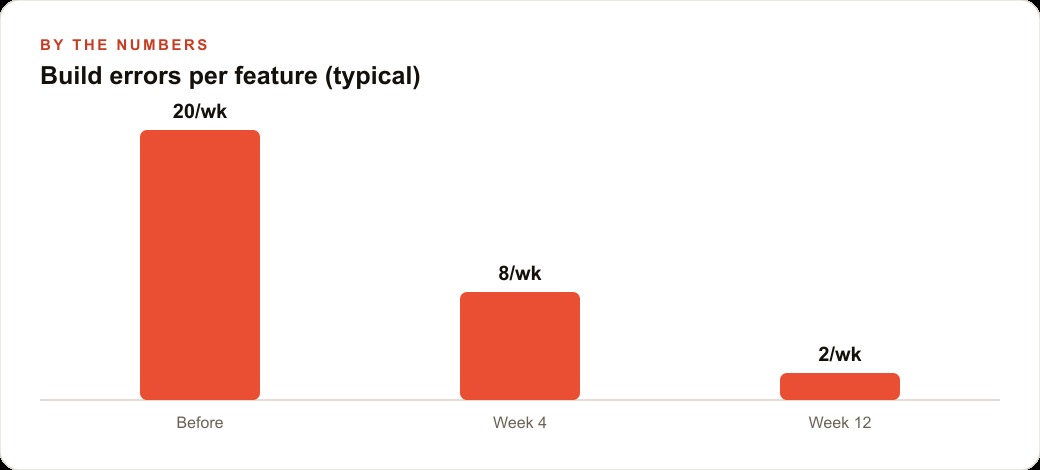
The build error count for that session was two, both caught immediately, both fixed with a single targeted prompt. The same build without task management would have produced somewhere between eight and twenty errors based on comparable sessions I had run before. The improvement is not marginal. It changes the economics of what is worth building, because a project that takes an afternoon instead of a day is a project you can actually ship on a deadline.
What the Rule-Writing Step Adds Over Time
One habit I now treat as non-negotiable is asking the agent to write a rule after every mistake. When the agent breaks something, that error is information. If you let the agent fix the bug and move on, the same pattern will produce the same mistake on a future project. If you stop and have the agent write a short rule that says never change a variable name in a shared utility without checking every file that imports it, that rule becomes part of the project's active guard rails from that point forward.
Over a ten-task build, you might accumulate three or four rules. Over a twenty-task build, you might have six or eight. Each rule is specific to the actual errors your codebase actually produced, which makes them more reliable than any off-the-shelf guard rail. The agent is not following a generic checklist. It is following a checklist built from the specific ways it failed on this specific project.
This is the compounding dynamic that makes task-management more valuable over time rather than less. The first project produces a few rules. The second project starts with those rules already in place and produces fewer errors, which means fewer new rules. By the third or fourth project in the same domain, the agent is starting with enough context and guard rails that the early tasks are nearly error-free, and the complexity grows without the error rate following it upward.
What This Changes for a Business That Is Not a Software Company
The practical question for a business owner who does not write code for a living is whether any of this applies. The honest answer is that it applies wherever you are commissioning custom software, and more small businesses are doing that than realize it. A booking tool, a quote calculator, a customer portal, a simple dashboard that shows the week's jobs: all of these are software, and all of them benefit from an agent that builds with a map instead of without one.
What changes for a business owner is the nature of the input you provide. Instead of describing what you want in a single long message and hoping the agent figures out the structure, you write a short requirements document that lists the features in plain language. Taskmaster converts that document into an ordered task list. The agent works through the list. You check each task as it finishes.
To make the economics concrete: a booking app for a home services business that an agency might quote at two thousand to four thousand dollars can be built in a well-organized afternoon using this workflow. The build costs the price of API credits, which for a project of this size runs a few dollars. The most expensive part is the hour you spend writing the requirements document and the thirty minutes you spend checking each task as it completes. That is a meaningful shift in what small businesses can build and maintain on their own.
The one discipline that matters most is the verification step. Task management reduces errors but does not eliminate them. Each task should have a short acceptance criterion, something you can check in under two minutes. The cart persists when I navigate away. The confirmation email arrives within thirty seconds. The admin view shows the correct date and time. Checking those criteria before marking a task done and moving to the next one is what keeps a well-managed build from slowly accumulating problems that only show up at the end.
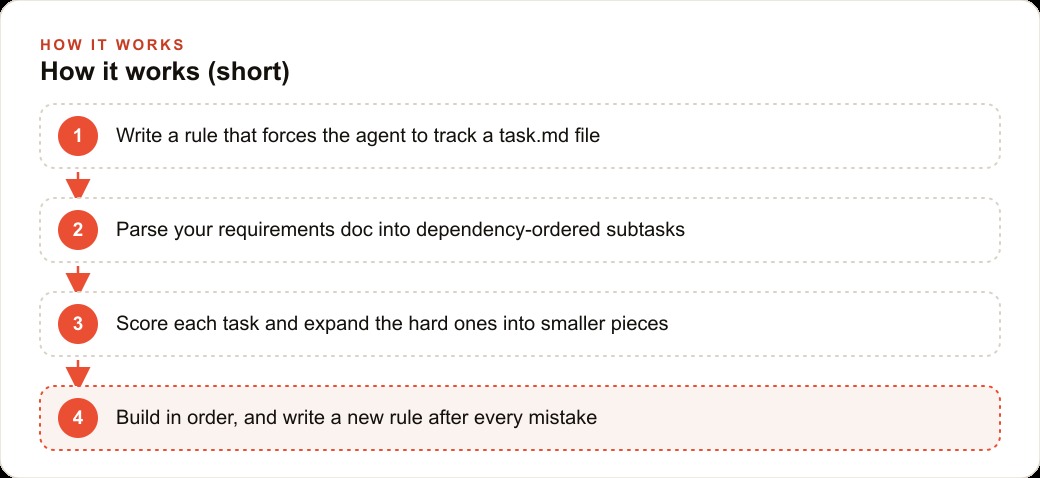
The Workflow in Four Repeatable Steps
The full workflow compresses into four steps you can apply to any project regardless of size.
First, write a requirements document in plain language that describes what the app does, who uses it, and what each interaction looks like. The more concrete the better. Vague requirements produce vague tasks. Specific requirements produce verifiable tasks.
Second, run Taskmaster to convert the requirements into dependency-ordered subtasks. Run the complexity scorer and expand any high-complexity tasks into smaller pieces. The total time for this step is under fifteen minutes.
Third, build in the order Taskmaster defines. Accept each change before starting the next. Do not skip ahead. When the agent makes a mistake, fix it and write a rule before continuing.
Fourth, check each finished task against a short acceptance criterion and mark it done in the task list before the next begins. That confirmation step is what closes the loop and keeps the map accurate.
The payoff is a build that converges reliably instead of oscillating between broken states. For a business that has been frustrated by AI coding agents that seem capable but never quite finish anything cleanly, this workflow is the missing layer. The model was never the bottleneck. Structured context was.
That is exactly what we do at AI DOERS. Book a private 30-minute call with Madhuranjan Kumar and we will map the fastest path to it for your specific business.
Book your call →
Madhuranjan Kumar
Madhuranjan Kumar brings 20 years of performance-marketing experience and has managed over $200 million in Facebook ad spend for brands across the United States and beyond. His expertise spans the full modern marketing stack: Meta, Google Ads, TikTok, email automation, CRM, and the websites that hold it together. At AI DOERS he turns that track record into lead-generation systems for businesses across every industry.