
The One Skill That Solves 90 Percent of Your Problems: Crucial Conversations
The highest-leverage skill in business and life is handling crucial conversations, the talks where opinions clash, stakes are high, and emotions run hot, and there is a repeatable system for getting them right.

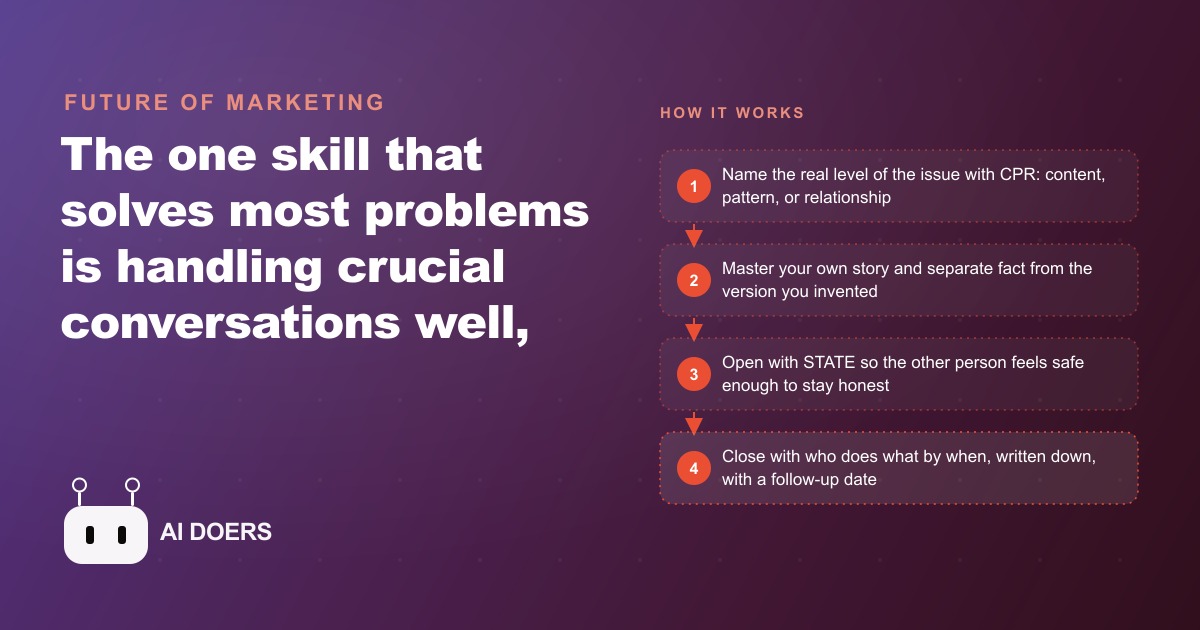
Every business owner has at least one conversation they have been rehearsing in the shower for weeks and still have not had, and the cost of that delay shows up in turnover, missed deadlines, and the low-grade tension that makes every meeting feel slightly off.
The Crucial Conversations framework gives a repeatable set of moves for handling any conversation where opinions differ, the stakes are high, and emotions are likely to run strong. Madhuranjan Kumar has seen this framework applied across a wide range of business situations: scope disputes with clients, performance conversations with employees, equity discussions between co-founders, and the kind of slow-burning vendor relationship friction that never quite becomes urgent enough to address until it finally becomes a crisis. The consistent finding is that the skill of handling these talks well is one of the highest-leverage things any business owner or team leader can develop, and that a repeatable system removes most of the anxiety that makes these conversations so easy to defer.
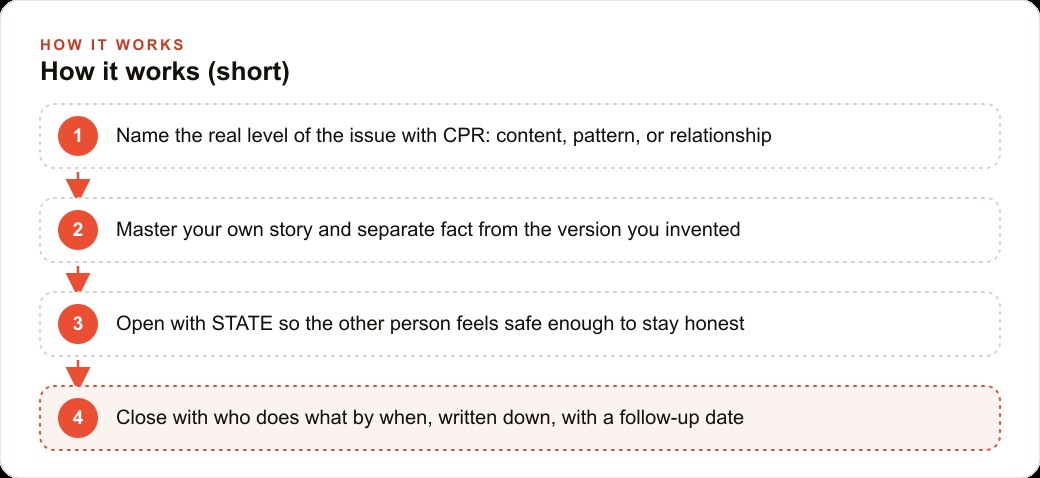
This is a practical playbook. The goal is a specific outcome: conducting one conversation you have been avoiding in a way that resolves the underlying issue and keeps the relationship intact. The steps below are in order. Running them out of order tends to produce the same ineffective results as avoidance produces, just with more awkward silences and better intentions. Work through each step before you schedule the conversation, and you will arrive prepared rather than hoping the moment feels right.
Identify the correct level of the issue before you schedule the conversation
The most common reason the same conversation keeps happening is that the person having it is addressing the wrong level of the problem. The Crucial Conversations framework uses a three-level model called CPR: Content, Pattern, and Relationship.
Content is the right level for a first-time, specific, isolated incident. The subcontractor delivered work two days late on one job. The team member missed one deadline. A client changed scope once without a formal request. These are content-level issues, and the conversation addresses the specific incident.
Pattern is the right level when the same type of problem has repeated. The subcontractor has now missed three consecutive deadlines. The team member has been late on deliverables for the past six weeks. The client has changed scope informally on four different occasions. Once a behavior has repeated, raising it as a one-off incident in the conversation sends the signal that each individual occurrence is the issue, when the real issue is the pattern. The conversation needs to name the pattern directly.
Relationship is the right level when the repetition has eroded trust between the parties. At this point it is not just about the behavior. It is about what the behavior means for whether this working relationship can continue on its current terms.
Before you schedule any difficult conversation, name the level out loud. Writing it down helps. "This is a Pattern issue because it has happened four times in six weeks" is a statement that focuses the conversation before it begins. Walking into a Pattern-level conversation treating it as a Content issue is the single most reliable way to ensure you will be having the same conversation again in two weeks. The other person leaves thinking the specific incident was the concern. You leave thinking the pattern was addressed. Neither of you is right about what the other heard.
Separate the observable facts from the story you built about the other person's intent
Between what you actually observed and what you feel about it sits a story you constructed about the other person's intent, character, or motivation. That story feels like fact because you have been living with it, but it is interpretation, and it is almost always more extreme than the reality.
The facts are what you could capture on a recording: the exact words someone said, the date something was delivered, the number of times a pattern has occurred. The story is everything else: "she doesn't respect my time," "he is trying to undermine the project," "they don't care about quality." These may be true, but they are conclusions, not observations, and leading with them in a conversation guarantees defensiveness.
Before you have the conversation, write out the facts in language a neutral observer would use. Then write out the story you built on top of those facts. Then ask the question that the framework identifies as the most useful one: why would a reasonable, rational, and decent person behave this way? Most of the time the answer that comes back is more mundane than the story suggests. The subcontractor who keeps missing deadlines may be overcommitted and afraid to say so. The team member who is consistently late may be unclear on actual priority and working on the wrong thing first. The client changing scope informally may not understand what a change order is or why it matters.
You might be right that the intent was careless or disrespectful. But entering the conversation having considered an alternative explanation means you open with curiosity rather than accusation, and that shift in posture changes the entire trajectory of what follows. The person across from you does not feel put on trial, which means they are far more likely to be honest with you about what is actually going on.
Open the conversation in a way that makes the other person feel safe enough to be honest
People do not become defensive in difficult conversations because the topic is difficult. They become defensive because they feel unsafe, which usually means they sense that the conversation has a verdict already attached to it. Opening well creates enough safety that the other person can be honest rather than protective.
The framework offers the STATE acronym for opening a crucial conversation: Share your facts, Tell your story, Ask for the other person's path, Talk tentatively, Encourage testing. The order matters. Lead with the observable facts before you share your interpretation. When the facts are on the table first, the other person has a concrete shared reality to respond to rather than feeling they are being characterized or judged.
Talking tentatively means presenting your interpretation as an interpretation, not as a conclusion. "I noticed you have missed the last three delivery dates, and I am wondering if there is something I am not understanding about the workload" is structurally different from "You keep missing deadlines and I need you to explain why." Both raise the same issue. The first opens a dialogue. The second opens a defense.
Encouraging testing means genuinely asking for the other person's perspective and genuinely listening to the answer. This is the piece most people skip because they have already rehearsed the conversation in their head and the other person's response in that rehearsal is predictable. In reality, the response is often surprising, and the surprising information is usually the piece that makes the conversation actually productive. The front-desk staff member who is over-booking may reveal that the written policy she was given says to never turn a patient away under any circumstances, and that she has been following the rules she was given exactly.
Draw out a quiet or defensive person without losing the thread of the issue
Some people go quiet when a conversation gets difficult. Others become briefly combative then withdraw. Neither response is dishonesty. Both are forms of self-protection, and both can be addressed with a set of techniques the framework groups under AMP: Ask, Mirror, Paraphrase, and Prime.
Ask is the starting point. A direct, open-ended question creates an invitation. "What is your take on this?" or "Is there something I am missing?" opens a door without pressure. If the person stays quiet, Mirror reflects back what you observe without interpretation: "You seem hesitant to respond to that. Is there something I should understand?" Mirroring validates that the reluctance is visible without making it a problem.
Paraphrase is used when the person does begin to respond. Summarizing what you heard, before adding your own response, signals that you are actually listening rather than simply waiting for your turn to speak again. "What I am hearing is that the schedule I gave you was unclear on which tasks were urgent. Is that right?" gives the person a chance to confirm or correct, and the correction is often where the useful information lives.
Priming is the most direct tool and is used when someone seems to have something important to say but cannot quite get it out. You offer your best guess at what they might be thinking: "Are you concerned that raising this is going to affect your position here?" Priming gives the person a starting point to either confirm or redirect from, and often the redirect is the thing they actually needed to say.
None of these techniques require theatrical empathy. They require attention and a genuine willingness to hear something that might change your understanding of the situation. That willingness is what makes them work.
Redirect a derailment without dismissing the new topic
A difficult conversation almost always produces at least one attempt, conscious or not, to change the subject. The person being confronted raises a legitimate grievance of their own, introduces a tangential complaint, or pivots to a procedural objection. This happens for a range of reasons: genuine frustration, a need to rebalance the power dynamic in the conversation, or a sincere feeling that the new topic is connected to the one on the table.
The mistake most people make is to either follow the new topic completely, losing the thread of the original conversation, or dismiss it outright, which signals that their concerns do not matter. Both moves cost you the outcome you came for.
The technique is called bookmarking. You verbally acknowledge the new topic, confirm that it matters, and agree to return to it after the current issue is finished. "I want to make sure we address that. Can we finish what we were discussing first and then come to it directly?" This language does two things simultaneously: it keeps the original conversation on track and it makes a real commitment to the new topic rather than brushing it aside.
The commitment is important. Bookmarking only works if you follow through. If you bookmark a concern and then let the conversation end without returning to it, the message you send is that bookmarking is a polite way of avoiding it. Follow through on the bookmark, address the secondary issue briefly but directly, and the technique builds credibility for every future conversation.
Close with a written commitment that has a date attached
The value of everything done in the previous five steps disappears if the conversation ends without a documented commitment. A productive mutual understanding reached in a meeting is satisfying in the moment and perishable within days. By the following week, both parties often remember the spirit of what was agreed but disagree on the specific terms, timing, or who is responsible for which part.
The close of a crucial conversation has one required element: who will do what by when. This is not bureaucracy. It is the mechanism by which a productive conversation becomes a solved problem rather than a pleasant memory followed by the same problem recurring. Write it down in the moment, either in a shared document, a follow-up message sent within the hour, or a note both parties confirm before the conversation ends.
Include a follow-up date. A commitment without a checkpoint is a wish. A commitment with a specific date for review has a natural accountability structure that neither party has to enforce. When the check-in arrives, the commitment is either complete or there is a specific reason why it is not, and that reason is the next conversation, which starts at Content rather than Pattern because it was caught early.
A dental clinic where one 15-minute conversation resolved a months-long scheduling problem
A dental clinic provides a concrete example of how this sequence runs in practice. The clinic had been running late every afternoon for three months. End-of-day patients regularly waited 20 to 40 minutes past their appointment time, and the practice's online reviews had started to reflect it, with three separate reviews in six weeks mentioning the wait time as a frustration.
The owner's initial instinct was to send a group message to the team about being more mindful of scheduling. This is the easy-over-hard trap: raising a mild process reminder to the full team instead of addressing the specific person and the specific pattern directly. The CPR assessment made the level clear: this was a Pattern issue, and the front-desk scheduling lead was the relevant person.
Before the conversation, the owner listed the observable facts: afternoon appointments had run late on 14 of the previous 20 clinic days, three review mentions of wait time in six weeks, end-of-day slots consistently booked with no buffer between the last two patients. The story the owner had built was that the lead was prioritizing full booking over realistic scheduling. The alternative explanation the framework prompts: a reasonable, well-intentioned person in this role might have been following an older instruction that said never to leave an open slot on the schedule if a patient wants an appointment.
The conversation opened with the facts and a genuine question. The lead confirmed immediately: she had been operating on guidance from her first week that the clinic's priority was zero open slots at end of day. No one had told her that an open buffer was acceptable or necessary. The pattern was the result of a policy gap, not carelessness.
Together they set a specific rule: the last slot of each afternoon would be blocked as a 15-minute buffer unless the clinic was running more than two weeks out on appointments. The rule went into the scheduling software notes that day. A two-week check-in was scheduled.
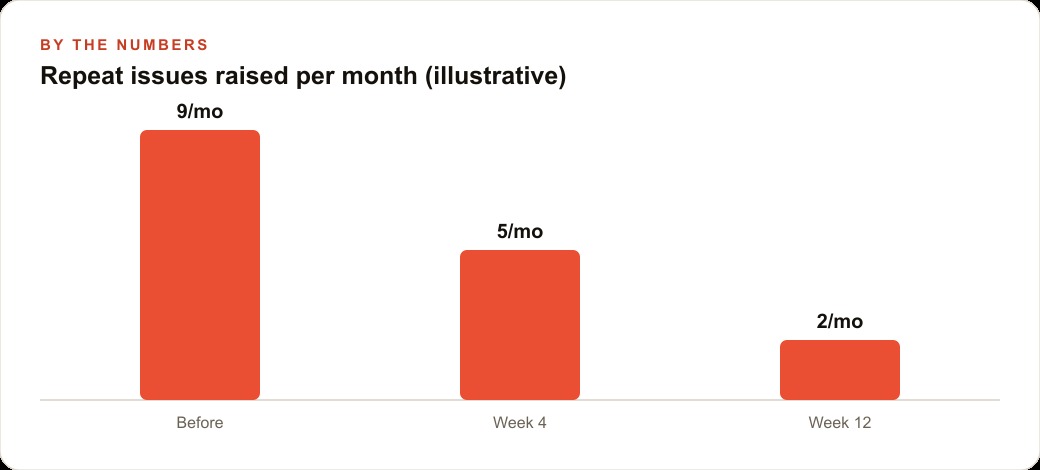
The clinic ran on time for 17 of the following 20 days. The three exceptions were high-complexity procedures that ran long, not scheduling errors. The review pattern shifted within four weeks. The 15-minute conversation resolved a pattern that had been accumulating cost in patient satisfaction and staff stress for three months, and it resolved it because the correct level was identified, the facts were separated from the story, and the close included a specific written rule with a check-in date.
The conversation was uncomfortable for about the first three minutes and then became straightforwardly collaborative once the lead understood what the actual problem was. That shift, from discomfort to collaboration, is what happens consistently when the opening is handled correctly and the other person feels safe enough to be honest. The outcome was a solved problem and a working relationship that ended the conversation stronger than it started.
That is exactly what we do at AI DOERS. Book a private 30-minute call with Madhuranjan Kumar and we will map the fastest path to it for your specific business.
Book your call →
Madhuranjan Kumar
Madhuranjan Kumar brings 20 years of performance-marketing experience and has managed over $200 million in Facebook ad spend for brands across the United States and beyond. His expertise spans the full modern marketing stack: Meta, Google Ads, TikTok, email automation, CRM, and the websites that hold it together. At AI DOERS he turns that track record into lead-generation systems for businesses across every industry.