
The Nine Ultralearning Principles, and Where AI Cuts the Work in Half
Ultralearning is a self-directed, intense system built on nine principles, and AI now compresses the slowest two, planning and feedback, while the core loop of practicing directly and testing yourself stays the same.

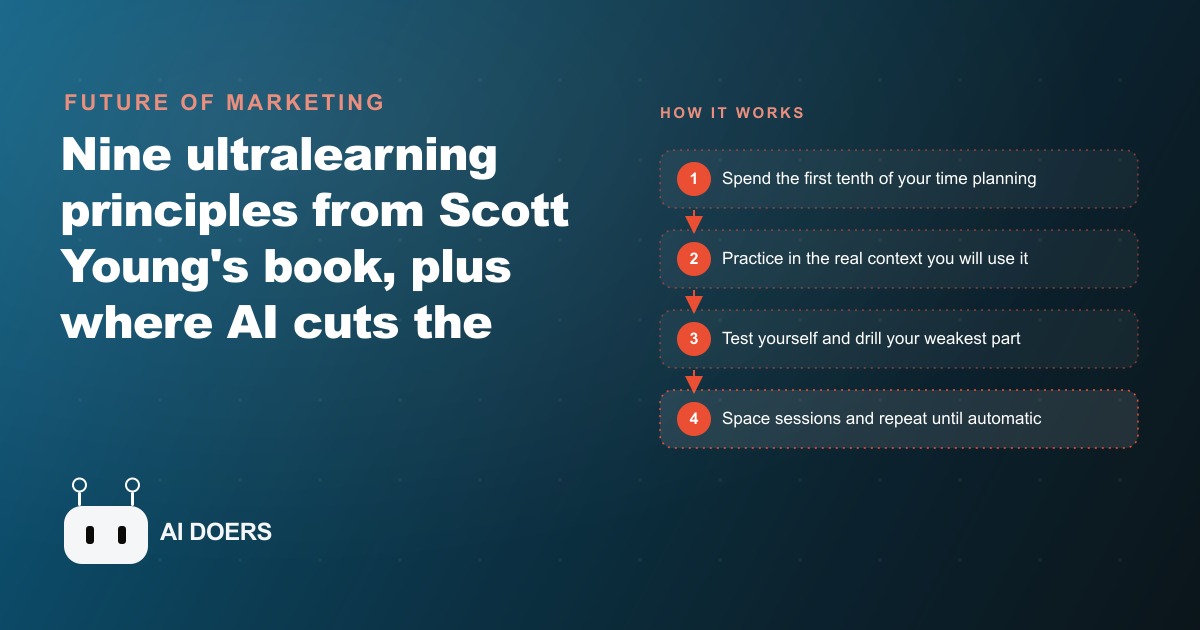
Most people who ask an AI to generate a learning plan spend ten minutes reading it, then go back to watching tutorials. That is not ultralearning. It is planning theater, and it is the exact trap the ultralearning framework was designed to expose.
I am Madhuranjan Kumar, and the argument I want to make in this piece is specific and worth contesting: AI has made two of the nine ultralearning principles nearly free, planning and feedback, but almost everyone is only using it for the first one. They ask for a curriculum, receive a well-structured plan in minutes, and consider the hard work done. The part that actually wires a skill into memory, getting corrective feedback on real practice attempts, is the part almost nobody applies AI to, and it is the application with a far wider margin of impact.
Scott Young built the ultralearning framework around nine principles: meta-learning, focus, directness, drill, retrieval, feedback, retention, intuition, and experimentation. He proved the system by completing the entire MIT computer science curriculum in one year without setting foot in a classroom. He passed every exam and finished every project. The framework works not because it is clever but because it is built around how the brain actually acquires a skill, not around what feels productive. The practices that produce the fastest and most durable learning are consistently the most uncomfortable ones to follow.
Planning Is the Easy Part; Most People Stop There
Meta-learning, the first principle, is the one AI has genuinely transformed. The idea is to spend roughly ten percent of your total learning time designing the plan before you touch the material. Young organized that design phase around three questions: why you need the skill, what exactly you are learning, and how you will learn it. For his MIT curriculum, that planning phase took about 36 days of deliberate research. Today an AI model trained on the full breadth of human instruction can draft a reasonable plan for almost any skill in minutes.
That compression is real and significant, but it has also made planning feel like the primary work rather than the setup for the primary work. Businesses now ask an AI to build a training curriculum for a new tool, a new role, or a new channel, hand the output to the team, and consider training underway. The plan exists. The content is available. What is missing is the practice loop that converts exposure to competence, and without that loop the curriculum is just a reading list.
The best use of AI in the meta-learning step is to generate the structure quickly, have someone with genuine field experience review it in a single session, and then immediately define what directness looks like in your specific context. A marketing team learning to run Facebook and Instagram ads should not build its training around platform documentation and generic video courses. The curriculum should center on the specific campaign types the team will actually manage, the account structures they will inherit, and the reporting metrics the business already uses to make decisions. AI drafts the shape of that plan in minutes. A practitioner who has run those campaigns validates it in an afternoon. The whole meta-learning step is done in one day rather than several weeks, which is the genuine gain. Stopping there and never entering the practice loop is the mistake.
The reason most people stop at the plan is that it feels like progress. A well-organized curriculum with clear phases and a realistic timeline is satisfying to hold. The gap between holding a plan and possessing a skill is large, and it does not close through additional planning.
The Retrieval Gap Is Where Learning Fails
Retrieval is the principle most people skip because it is uncomfortable, and because consuming content feels more like progress than testing yourself on it. The core idea is simple and well-supported: you learn a skill faster by testing yourself on it than by re-reading or rewatching material. Each retrieval attempt forces the neural network to fire and reconstruct the knowledge, and that effortful reconstruction is what wires the memory in durably.
Most corporate training is built almost entirely around content consumption. A team watches a video, attends a presentation, reads a guide, and the training is logged as complete. There is often a quiz at the end, low-stakes and multiple choice. None of that constitutes meaningful retrieval practice. The team finishes, returns to work, and loses the majority of what they absorbed within a week, which is the predictable behavior of the forgetting curve when no retrieval practice is embedded in the schedule.
The fix is concrete. After a training session, close all material and write out everything you can recall before checking. Work practice problems without looking at the solution first. Use the question-book method: after covering a concept, write the questions that concept answers, then try to answer them from memory the following day before any review. These approaches surface what you do not know yet, and that discomfort is the signal that learning is actively happening, not a sign that the approach is wrong.
AI supports retrieval practice well. It generates a set of practice questions at the right difficulty level, on exactly the topics just covered, in seconds. A team member can paste the day's material into a model and ask for questions without answers, then work through those questions with all material closed. That application is legitimate and useful. The mistake is treating the generation of questions as the practice itself. Generating questions and then reading the provided answers without attempting them independently is still passive consumption with an extra step.
A team that builds fifteen minutes of active retrieval into every training session retains dramatically more than a team that adds an extra hour of content review. That is the most replicable finding in educational psychology over the last century, and it has been largely ignored in how business training is designed.
AI Feedback Is the Only Part of the Ultralearning Loop That Got Cheaper
Feedback comes in three tiers. Outcome feedback tells you whether the result was good or bad. Informational feedback tells you specifically what went wrong. Corrective feedback tells you exactly how to fix it and explains why that fix addresses the underlying issue. Corrective feedback is the most valuable tier by a clear margin, and it is the one that historically required a skilled mentor, an experienced instructor, or an expert reviewer to deliver.
Getting corrective feedback was the most expensive constraint in rapid skill development. You paid for it through tuition, through a coaching relationship, or through the slow process of making mistakes in the real world and interpreting the consequences weeks later. For most business teams, corrective feedback at the granularity that accelerates skill acquisition was simply not available at the pace the team needed it.
AI has made corrective feedback nearly free at the point of use. A team member learning to structure Google Ads campaigns can paste a draft campaign architecture, a targeting approach, or a bidding plan into an AI model and receive specific, corrective observations within seconds. Not encouragement or a generic checklist. Specific observations: what is wrong, why it creates a problem in this context, and what adjustment would address it. That is corrective feedback, and getting it previously required either a senior specialist reviewing the work directly or waiting for a live campaign to underperform for several weeks and then interpreting the data.
Most businesses that apply AI to team training use it to draft the curriculum and sometimes to generate reference material. They are not using it to review actual practice attempts and return corrective notes on real work. That is the gap, and it is where almost all the practical value of AI in skill development actually sits. The feedback loop is what separates teams that improve continuously from teams that complete a training program and plateau.
The application is simple. Team members complete real practice attempts on real tasks. They submit samples of that practice to an AI model with a clear prompt asking for corrective notes on specific quality dimensions. The model returns specific observations. The team member applies the correction on the next attempt and resubmits. This cycle can run multiple times in a single session at near-zero cost, replacing what used to require a senior person's concentrated attention for several hours per team member per week.
Directness and Drill: The Two Principles Most Training Programs Skip
Directness means practicing the skill in the exact context where you will use it. Not a simulation that approximates the context. Not a textbook exercise that parallels the skill. The actual task, in the actual environment, with actual stakes attached. Young drilled SQL interview questions directly from the practice database of the specific company he was targeting, not from a SQL textbook. The transfer from training environment to performance environment is always lossy, and directness minimizes that loss by making the two environments identical from the start.
Drill layers on top of directness. You perform the real task, identify the single piece where you consistently slip, and isolate only that piece for concentrated repeated practice until you own it. This is called time slicing, and it is uncomfortable because it means stopping the forward momentum of completing a full task to go back and grind on the hard component. Most people avoid this because grinding on one piece feels like stalling when the goal was to complete the whole task. The goal should be to own the hardest piece first, not to complete more repetitions of the full task while that piece remains shaky.
For a business team, directness means putting people on real work as soon as the basic mechanics are established, under appropriate supervision, rather than on training exercises designed to approximate real work. The learning that happens on a real task with real consequences transfers cleanly to the next real task. The learning from a training exercise frequently does not transfer as cleanly, because the conditions that made the exercise manageable are absent from the real work environment.
Drill for a team means identifying the recurring bottleneck in the team's output and isolating it for concentrated practice sessions. If the team consistently writes unclear briefs, drill brief-writing only for a focused session. If they struggle to read performance data accurately, pull a set of real numbers and spend a session exclusively on interpretation rather than the full workflow. AI can accelerate the bottleneck identification step by reviewing samples of actual team output and flagging the recurring error pattern. That diagnostic used to require a senior person observing the team's work over several weeks. An AI reviewing a set of real work outputs can surface the dominant pattern in minutes.
A Business Team Training Scenario That Actually Works
As an illustrative example, consider a regional sales team at a business services firm that has just added a new service offering and needs to present it confidently to clients. The default training approach is a half-day session covering the service in slides, a reference document, and an expectation that the team will develop confidence through trial and error on real calls. The predictable result: some team members develop a confident delivery through repetition, others remain uncertain months later, and the inconsistency is visible to clients.
The ultralearning approach starts with the meta-learning step. The manager defines exactly what the team must be able to do: explain the new service in two minutes without notes, address the three most common client objections accurately, and connect the service to each client's specific situation rather than describing it generically. That is the what. The how is directness from day one: not role-plays with a colleague standing in, but recorded practice sessions reviewed with corrective feedback. AI drafts a four-day practice plan mapping each outcome to specific exercises. A senior person who has already delivered this service validates the plan in an afternoon. Total setup time is one day.
Days one and two are directness sessions. Each team member records a two-minute delivery and submits it for corrective review. The AI returns specific notes: the explanation ran too long, the second objection was answered vaguely, the connection to the client's situation was stated but not substantiated. The team member records again with those corrections applied. This cycle runs three times per person in an afternoon, providing more corrective iterations than a single senior reviewer could deliver in a week of dedicated coaching.
Day three is drill on the objection where most of the team is weakest. Every person practices that one response until the delivery is specific and confident. Day four is a full retrieval run: each person delivers the two-minute pitch from memory with all notes closed, then receives corrective observations on what drifted from the previous version. By the end of four days, the team has practiced more than most teams practice in a month and received more corrective feedback than a single mentor could provide in the same period. The inconsistency in delivery that usually persists for months is largely resolved before the first real client conversation.
The investment is the manager's time to define the learning outcomes and validate the plan, plus the AI subscription to generate practice questions and review the recorded sessions. The return is a team that delivers the new service consistently rather than unevenly, which is the entire point of the training program.
Retention, Intuition, and the Stages Teams Rarely Reach
Retention, intuition, and experimentation are the three advanced principles, and most business teams never reach them because training is considered complete once basic competence is demonstrated. Retention is the most practically important of the three and the most neglected in practice. The forgetting curve is real and predictable. Without spaced review sessions, people lose the majority of what they absorbed from a training session within a week. Spacing the review sessions according to when the brain is on the edge of forgetting, which spaced-repetition tools automate, keeps knowledge accessible with a small and consistent time investment that shrinks as the material becomes automatic.
Intuition develops through the Feynman technique: explaining a concept in plain language until the gaps in your understanding become visible, then returning to fundamentals to fill them. An AI model accelerates this. You explain a process step to the model in plain language and ask it to challenge your reasoning, which surfaces gaps faster than re-reading the source material. For a team, this means building a habit of asking why the process is designed the way it is, not just memorizing the steps, so that when a situation deviates from the standard case the team can reason through the deviation rather than stall.
Experimentation is what separates practitioners who keep improving from those who plateau at the level their initial training established. Once the curriculum is exhausted, the only source of new learning is deliberate experimentation. Run a different approach, measure the result, compare it to the baseline, and update your understanding. For teams managing SEO and content production or any function with measurable outcomes, the experimental mindset is the mechanism that drives continuous improvement beyond the competence that training established. AI accelerates experimentation by helping design the test and interpret the results, but the experiments themselves must run in the real world to produce learning that compounds.
The Practice Discipline That Separates Real Learning From Planning Theater
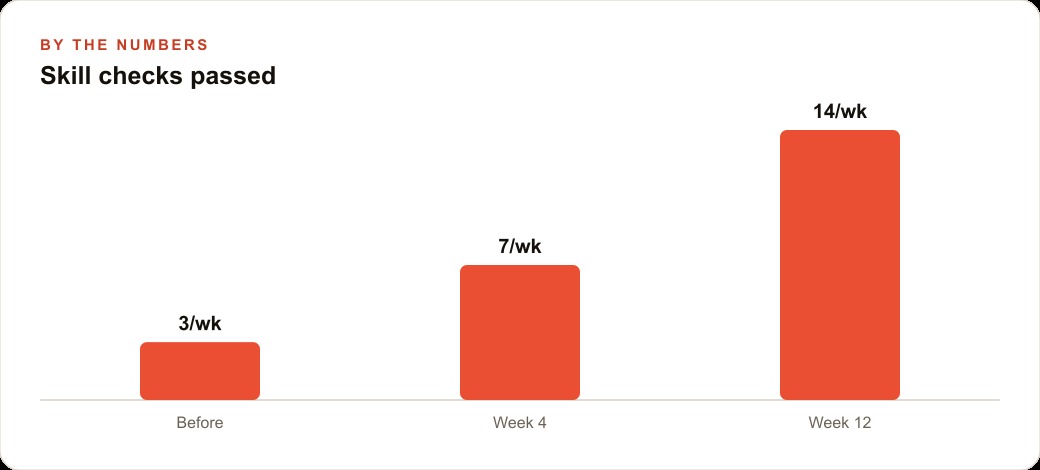
The argument of this piece is specific and easy to act on: AI has made planning and feedback nearly free, but the value is in the practice, not the plan. A team that receives an AI-generated curriculum and no corrective feedback on actual practice attempts will not be substantially more capable six months from now than it is today. A team that practices the skill in its real context from day one, tests itself constantly, gets corrective AI feedback on real work samples, and drills its specific weaknesses will operate at a senior level within three months.
The businesses that understand this distinction will build training systems that produce genuinely capable teams, not teams that completed a program and plateaued. Those are very different outcomes, and the gap between them is determined by one decision: whether AI is used only at the planning stage or all the way through the practice loop.
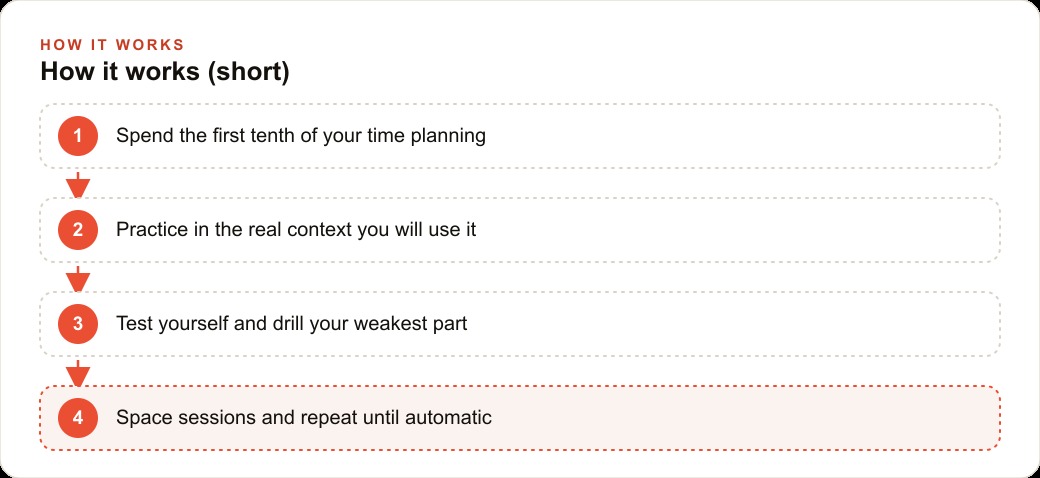
Use AI to draft the plan in minutes. Have a field expert validate it in hours. Put the team on real work from day one. Test constantly. Get corrective AI feedback on actual practice attempts. Drill the single weakest piece until it is solid. Space the review sessions so knowledge does not disappear within the week. Ask why at every step until the understanding reaches first principles. Run experiments once the curriculum runs thin.
That is ultralearning applied to a business team. It is available now, costs almost nothing beyond the discipline required to practice deliberately, and almost nobody is doing it.
That is exactly what we do at AI DOERS. Book a private 30-minute call with Madhuranjan Kumar and we will map the fastest path to it for your specific business.
Book your call →
Madhuranjan Kumar
Madhuranjan Kumar brings 20 years of performance-marketing experience and has managed over $200 million in Facebook ad spend for brands across the United States and beyond. His expertise spans the full modern marketing stack: Meta, Google Ads, TikTok, email automation, CRM, and the websites that hold it together. At AI DOERS he turns that track record into lead-generation systems for businesses across every industry.