
The Grill Me Skill: Why Interviewing Yourself Beats Brain Dumping Into Claude Code
Everyone runs the same models now, so generic prompts give generic output and context is your only edge. The Grill Me skill extracts that context by interviewing you relentlessly and saving every answer to a doc.

Everyone who uses AI regularly reaches the same wall eventually. You open a session, you start explaining your situation, and by the time you have given enough context for the model to be genuinely useful, you are already tired. Then you close the session and the next day you start over. I am Madhuranjan Kumar, and I want to make an argument about why this specific wall exists and why the technique people call the Grill Me skill is the most practical solution I have found for breaking through it.
The wall has a name. It is context extraction, and it is harder than it sounds.
The five-minute brain dump is a lie we tell ourselves
When most people try to give an AI system useful context about their work, they do the same thing. They open a new conversation and spend five minutes typing a quick summary. Here is who I am, here is what my business does, here is what I care about. Then they ask their question and get an answer that is technically responsive but lacks the nuance that would make it actually right for them.
The problem is not that five minutes is too short, though it usually is. The problem is that the brain dump is the wrong exercise. A brain dump asks you to remember everything relevant about a process and write it down unprompted. Nobody does this well. You think of the obvious things and you forget the specific decisions that actually define how your work runs, the edge cases, the preferences that seem small but matter enormously, the reasons behind choices you made two years ago that you now take for granted.
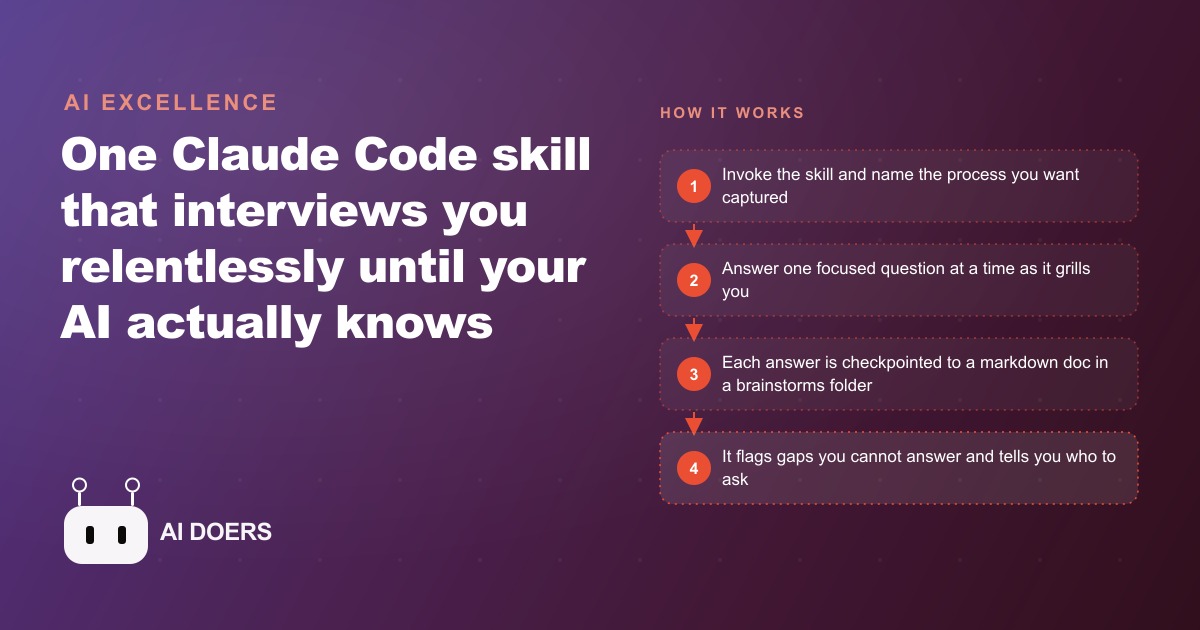
The Grill Me skill, originally built by Matt Pocock and refined by practitioners who found the gap, flips the direction. Instead of you trying to remember everything, the AI asks you questions one at a time until it knows nearly everything. That sounds like a small difference and it is not. When you are answering a specific question, you remember things you would never have written in a free-form dump. The question creates the context that makes the memory accessible.
A skill in Claude Code does not have to be a complex automation. It can be a prompt you simply do not want to retype every time you start a process. Grill Me is exactly that: a few sentences telling the model to interview you relentlessly, ask one question at a time, and explore the codebase or existing files whenever the answer is already there rather than asking you to explain what it could read itself.
What actually changes when the AI asks the questions
The session I want to describe involved a packaging and fulfillment process that had been running for two years. The owner knew it well, in the way you know a process that runs on muscle memory: you can do it perfectly but you struggle to explain every step in sequence. A five-minute brain dump would have captured the main steps and missed every decision point.
The Grill Me session lasted over an hour and produced something entirely different. One question at a time, the model walked down the decision tree. If a package arrives with a shipping label issue, who handles it? What is the threshold for a size upgrade versus a standard option? When a customer requests something outside the normal range, who approves the exception? Each answer opened two more questions, and by the end the model had a document that described the real process, not the idealized version the owner would have typed in five minutes.
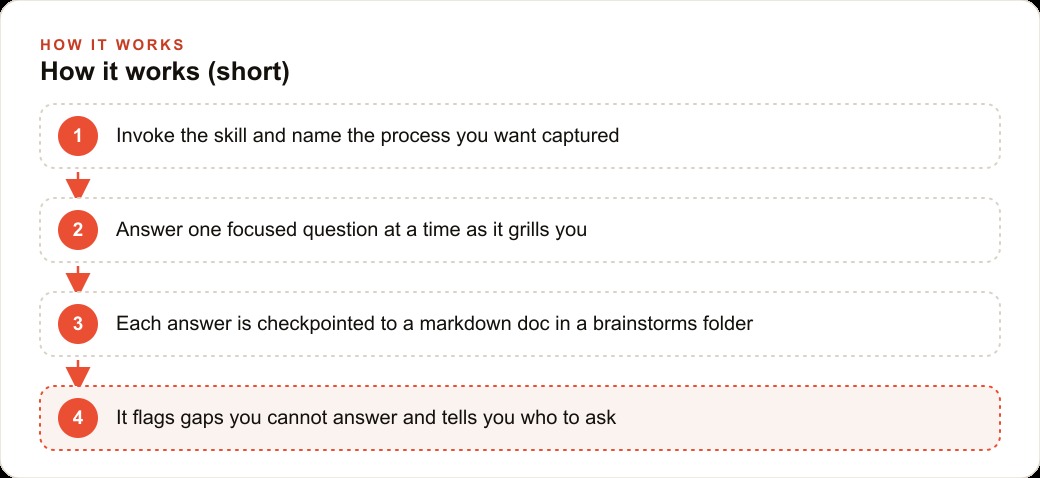
The checkpointing detail is what makes this work in practice. During a long session, the model's context window fills up and it can start to misremember answers given earlier. The fix is to write each answer back to a document as the conversation happens. The Grill Me version worth using creates a brainstorms folder at the root of the project and saves a timestamped file for each session. That file holds the key decisions, a full question-and-answer log, and a list of open flags for things the person could not answer themselves.
That last category is underrated. When a process is actually run by someone else, a specific team member whose judgment is embedded in every exception decision, the Grill Me skill flags it explicitly. It notes that the answer requires input from that person and waits for you to supply it. The resulting document is honest about its own gaps, which makes it more trustworthy than a brain dump that pretends to be complete.
Every business runs on knowledge that lives in someone's head
The reason this technique matters beyond productivity optimization is that almost every business of any size has a knowledge problem. The best way to handle a difficult client situation lives in the senior partner's head. The nuances of the supplier relationship that make the pricing work are understood by one person who has been there for years. The judgment calls about quality that define the brand are made by the founder who can spot the difference but has never written it down.
None of that knowledge is in any document. It is not in the CRM, it is not in the employee handbook, and it is not in the training materials for new hires. It exists purely in the heads of a few people, and every day those people are busy, distracted, or eventually gone, that knowledge is temporarily or permanently unavailable to the business.
Grill Me is a systematic way to extract that knowledge and put it somewhere the whole team and their AI tools can use it. You run a session for each major process, each critical judgment call, each relationship that matters. The session produces a document. The document goes into the living knowledge base. And over time the business develops an AI that knows how it actually runs, not how it was supposed to run when someone wrote the first version of the handbook.
This compounds in ways that are not obvious at first. When you run another Grill Me session three months later and find that you have learned something new about the process, the session compares what you say now against what you said before and updates both the document and any related skills. The knowledge base does not just capture; it evolves. And because each session is saved, you can see exactly when and how your understanding changed.
For businesses investing in SEO content or Google Ads, the extracted knowledge becomes the raw material for content that actually reflects how the business works. The difference between a blog post that anyone could have written and one that clearly comes from years of experience in a specific field is exactly the kind of nuanced, specific knowledge that Grill Me pulls out and makes available for use.
The practical way to start is to pick one process and run one session this week. Not your most complex process, something medium difficulty where you know the basics but suspect you would miss things in a brain dump. Spend an hour answering questions one at a time, trust that the checkpointing will save your answers, and see what the document looks like when it is done. You will almost certainly find that it contains details you would not have written unprompted, and that is the whole point. ## Building the brainstorms folder and making it reusable
The practical mechanics are worth making concrete. The Grill Me skill saves each session to a brainstorms folder at the root of the project, with a timestamped markdown file per session. A typical file has three sections: key decisions, which are the choices that define how the process works; a full question-and-answer log, which preserves the exact exchange so the reasoning behind each decision is visible later; and open flags, which are the questions the session could not answer and which person is the right source for each one.
The key decisions section is the part worth spending time on before the session ends. After the interview concludes, review the decisions it captured and confirm that each one is stated clearly enough that someone reading it six months from now would understand both what was decided and why. Vague decisions compound into confusion when the AI uses them later. Specific decisions compound into reliable output.
The flags section prevents false confidence. A session that ends with five open flags, labeled with the specific person who knows the answer and the specific question to ask them, is more useful than one that presents itself as complete when it is not. The flags are a checklist. When you collect the answers and update the document, the knowledge base closes another gap.
The update cycle is what separates a knowledge base that grows from one that goes stale. Every time you learn something genuinely new about a process, you return to the relevant brainstorms document and run a short update session. Not a full hour-long re-interview, but a ten-minute session that says here is what I have now, here is what changed, update the key decisions and flag any implications. The AI revises the document, and the updated version reflects current reality rather than how the process worked when the session was first run.
For a business investing in Google Ads campaigns or managing Facebook and Instagram ad campaigns, this update cycle is especially valuable because the understanding of what works changes constantly. The brainstorms document for campaign strategy should reflect current knowledge about which audiences respond, which offers convert, and which creative angles are working now, not what was true when the document was first created. A living document updated monthly is far more useful than a comprehensive one that is accurate for the first three months and quietly wrong for the next nine.
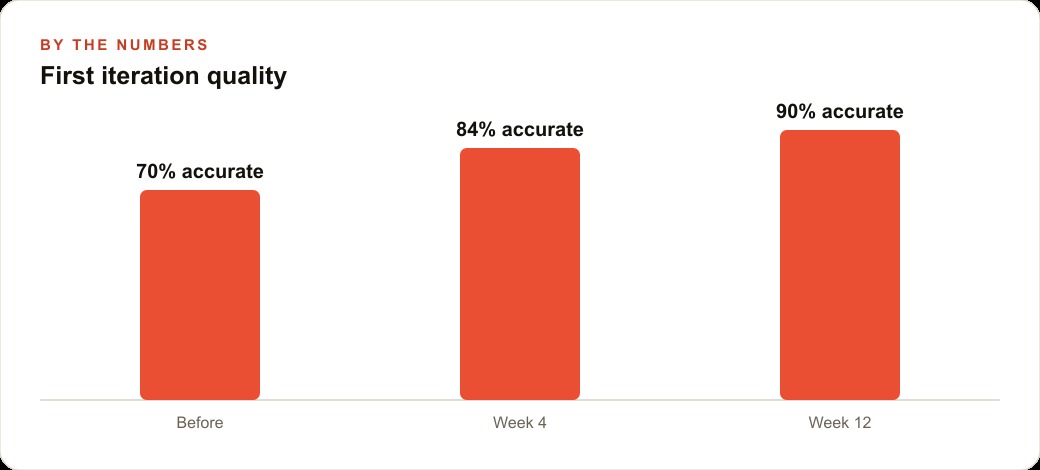
A concrete outcome from one client's use of this approach: a service business that had built a customer intake process over three years, with seventeen separate decision points, most of them handled by intuition. The Grill Me session uncovered nine of those decision points that had never been articulated, two direct contradictions in how different staff members handled the same situation, and three steps that were being done differently by the owner and by the team without either party knowing. Resolving those discoveries in the document reduced rework by roughly 30 percent in the following month, because the AI-assisted version of the intake process was now based on the real decision rules rather than a partial reconstruction.
The single discipline that makes the entire practice more effective is returning to the brainstorms folder before any major decision. Before launching a new service, before changing a pricing structure, before hiring for a new role, open the relevant document and ask: does this decision contradict anything we have captured here, and are any of the open flags relevant to this choice? The document that was built as a knowledge base becomes a decision checkpoint. The knowledge you captured prevents you from making decisions that contradict what your own process has already established. That is a return that compound forever.
A second practical habit that extends the value of every brainstorms session is treating each document as a team onboarding resource. The knowledge that lives in a Grill Me document is exactly the knowledge that a new hire needs to understand how decisions get made. Instead of re-teaching the same concepts verbally every time someone new joins, the document already contains the reasoning, the constraints, and the exceptions. The new team member reads the relevant document, asks clarifying questions, and the owner answers once in a follow-up session rather than repeatedly in informal conversations. The brainstorms folder is simultaneously a knowledge base for AI interactions and an onboarding resource for people, and building it once serves both purposes without additional effort. The investment in capturing knowledge through the Grill Me method pays forward every time that knowledge is used by an AI model, a new team member, or the owner themselves returning to a decision they made months ago with full context intact.
That is exactly what we do at AI DOERS. Book a private 30-minute call with Madhuranjan Kumar and we will map the fastest path to it for your specific business.
Book your call →
Madhuranjan Kumar
Madhuranjan Kumar brings 20 years of performance-marketing experience and has managed over $200 million in Facebook ad spend for brands across the United States and beyond. His expertise spans the full modern marketing stack: Meta, Google Ads, TikTok, email automation, CRM, and the websites that hold it together. At AI DOERS he turns that track record into lead-generation systems for businesses across every industry.