
The Four Budgeting Rules That Finally End the Paycheck-to-Paycheck Cycle
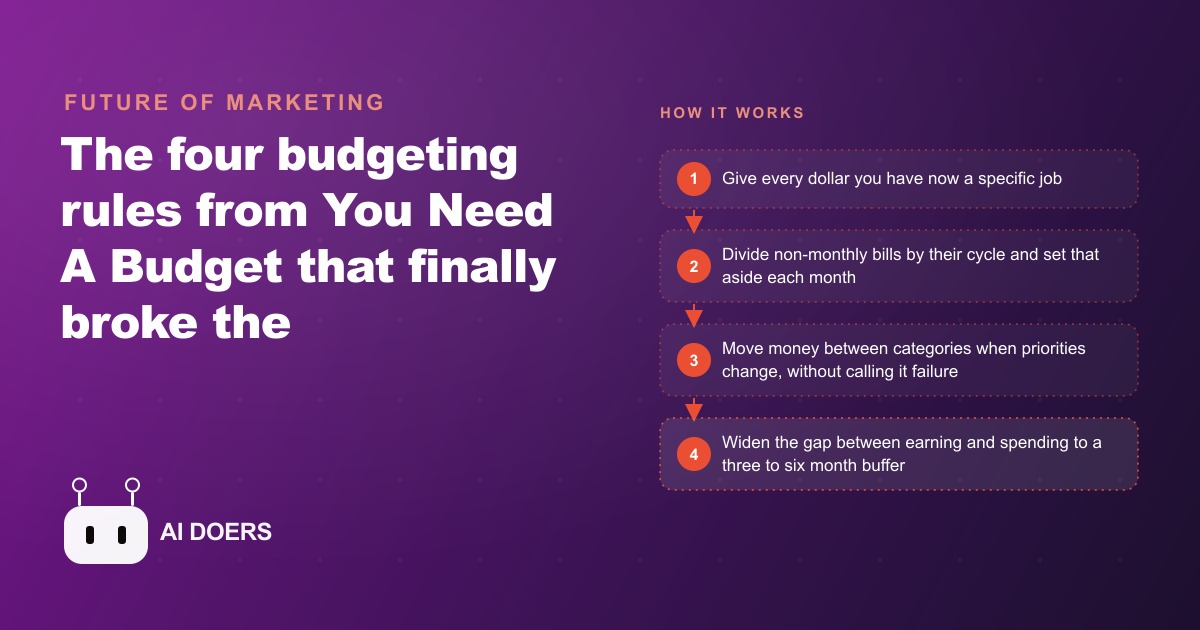
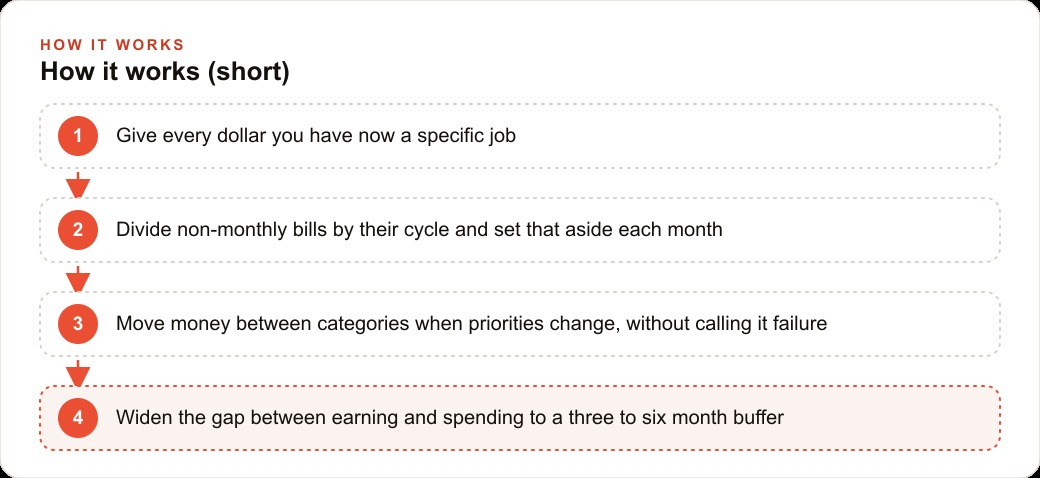
You break the cycle with four rules: give every dollar a job, embrace your true non-monthly expenses, roll with the punches when priorities shift, and age your money until you hold a three to six month buffer.

Most budgeting advice is wrong in a specific way that almost no one names directly. It treats budgeting as a constraint-management problem: you are spending too much on some categories, you need to tighten the limits, and if you stay under your category caps then you are succeeding. I am Madhuranjan Kumar, and I want to argue that this framing misdiagnoses the problem entirely. People do not fail at budgets because they overspend on lattes or restaurants. They fail at budgets because they budget imaginary money. The four YNAB rules fix that root cause. Standard advice does not.
This distinction matters more than it sounds. A fix applied to a misdiagnosed problem produces a different set of symptoms, not a healthier system. You can lower your dining budget to fifty dollars a month and still end the year with less money than you started with if your budget was built on income projections that were never realized. You can stay under every category limit and still be one unexpected expense away from a credit card balance that persists for years if your budget assumed monthly regularity that your actual expenses do not have.
The four rules work because they address the actual problem: budgeting with money that does not exist yet, planning for expense timing that is not real, treating adjustment as failure, and measuring progress by category performance rather than by financial position. Each rule is a direct correction of a specific error in conventional advice.
Conventional budgeting advice is built on a fiction that describes almost no one's actual financial life
The default advice is: allocate a fixed percentage of income to each spending category. The popular variations suggest fifty percent to needs, thirty percent to wants, twenty percent to savings. Apply that formula to your monthly income and you have a budget.
This advice works if two things are true. First, you earn the same amount every month. Second, all of your significant expenses arrive on a monthly cycle. Neither of these is true for most people.
A salaried employee with an annual performance bonus has variable income. A freelancer or contractor has dramatically variable income. A small business owner's income can swing by fifty percent or more between months depending on contract timing. Even a dual-income household with two stable salaries has effective monthly variability when one earns weekly and the other earns bi-weekly.
The expense timing problem is equally widespread. Car registration arrives once a year. Home insurance renews annually. Professional subscriptions billed annually. Medical deductibles reset at the start of the plan year. HVAC maintenance cycles typically run spring and fall. Holiday gifts and travel concentrate in a six-week window at the end of the year. None of these expenses are monthly, and collectively they often represent thirty to fifty percent of annual spending.
Advice built on monthly income regularity and monthly expense regularity fails the moment reality presents a different pattern. Reality always presents a different pattern. This is not a rare edge case. It is the normal condition of personal and business financial life.
Budgeting imaginary money is the root cause of every budget collapse, not category overspending
When people describe their budgets as having failed, the most common explanation involves a specific category: "I overspent on groceries" or "I went over on entertainment." The prescription that follows is to tighten the category limit and try harder next month. This prescription treats the symptom rather than the cause.
The cause, in most cases, is that the budget was built on money that had not arrived yet. If you plan your entire month on the first of January before your paycheck has deposited, you are allocating imaginary money. If your paycheck arrives on the 15th and you have been spending against an allocation since the 1st, you have spent two weeks drawing down your actual bank balance faster than your planned categories account for. The category overspend is a consequence of the imaginary money problem, not an independent failure.
Standard budgeting tools make this worse by encouraging you to build a complete month plan at the start of the month. The tool asks: what will you spend on groceries this month? What will you spend on utilities? What will you save? You answer based on your expected income and your expected expenses, neither of which has materialized yet. You are making a plan in imaginary money and then experiencing cognitive dissonance when reality differs from the plan.
The fix is not to plan better with imaginary money. The fix is to stop using imaginary money altogether.
Rule one dismantles the projection habit that causes budgets to fail by February every year
Give every dollar a job. This sounds simple. The depth of it is in what it excludes.
The rule requires that every dollar you allocate has already arrived in your account. Not what you expect to earn next week. Not your monthly average from last year. What is actually in the account at this moment. You give jobs only to money that exists.
When new money arrives, you give that new money its jobs. The budget grows as the money grows, never ahead of it. If you have three hundred dollars in the account on the first of the month and your paycheck arrives on the fifteenth, you budget three hundred dollars of jobs on the first. You budget the paycheck on the fifteenth when it arrives.
For a business owner with irregular contract payments, this is the single change that produces the most immediate improvement. You stop operating on projections. You operate on receipts. A client paid this week: allocate that payment to its jobs. Next week's expected invoice has not arrived: allocate nothing. The discipline feels constraining at first because it makes you see clearly how much of your previous budgeting was projection-based fantasy. After a few weeks it becomes clarifying, because every allocation you make is backed by real money.
February is when most annual budget resolutions collapse because January's projections collide with January's reality. The variable expense that was not in the monthly plan. The paycheck that came in slightly lower than expected. The cost that was supposed to be monthly but arrived quarterly. Rule one prevents these collisions by removing projection from the budgeting process entirely. You cannot overspend your projection when you had no projection to begin with. You can only allocate what arrived.
True expenses are not edge cases; they account for roughly half of what most people spend in a year
Add up every expense in your financial life that does not arrive on a monthly cycle. Start with the annual ones: car registration and renewal fees, home or renters insurance premium, professional association memberships, software subscriptions billed annually, dental cleanings if you pay out of pocket, vehicle inspection costs. Move to the semi-annual ones: property tax installments in jurisdictions that split them across two payments per year, HVAC service contracts with spring and fall visits. Add the variable annual ones: medical deductibles and out-of-pocket maximums if something goes wrong, home maintenance and repair costs, holiday gifts and seasonal travel.
Divide that total by twelve. For most people that number is significant. For many households it is higher than their monthly rent or mortgage payment. For business owners adding quarterly estimated taxes, annual software license renewals, equipment maintenance cycles, and seasonal inventory investments, it often exceeds their average monthly payroll.
Standard monthly budgets exclude most of these expenses because none of them arrive on a monthly cycle. The budget looks balanced because the non-monthly expenses are invisible until they arrive. When they arrive, they feel like emergencies, and people treat them as exceptions that justify going over budget "just this once." There is no "just this once" when the car registration, the home insurance renewal, and the medical deductible all hit in the same quarter, as they often do.
Rule two corrects this by requiring you to divide every non-monthly expense by its cycle and save that amount every month as a dedicated job. The six-hundred-dollar car registration due in October gets fifty dollars per month allocated to it starting in January. The twelve-hundred-dollar home insurance renewal gets one hundred dollars per month saved across the full year. The medical deductible gets a monthly allocation sized to your plan's maximum out-of-pocket.
This does not require more income. It requires distributing the spending across the periods when the income exists rather than concentrating it on the billing period. The expense does not change. The panic when it arrives disappears because the money is already there.
Rolling with the punches is not a sign of failure; it is the correct response to how reality operates
Conventional budgeting treats adjusting a category as weakness. If you budgeted two hundred dollars for groceries and spent two hundred and forty, the standard advice is to reflect on where you went wrong and perform better next month. This framing is counterproductive in several ways.
It treats a budget as a rigid plan rather than a responsive tool. A plan is something you make based on predictions. A tool is something you use based on actual conditions. The moment you receive a plan-versus-reality variance, the productive response is to adjust the plan to reflect reality, not to resist reality and hope for better predictions next month.
For the grocery overage, rule three says to take forty dollars from another category and move it to groceries. This is not failure. This is the budget functioning correctly by absorbing real conditions. The total money allocated stays the same. The distribution across categories adjusts to match actual spending. The budget remains accurate, which is the only thing that makes it useful.
For business owners the importance of this rule scales with the complexity of operations. A supplier delivers materials two weeks late, which delays a project, which shifts a payment from this month to next month, which means payroll this month comes from different allocated funds than planned. The budget absorbs this by moving allocations. The alternative is pretending the shift did not happen and watching the budget diverge from reality in real time until it becomes useless as a planning tool.
Adjustment is not compromise. It is what rational financial management looks like when reality is not identical to prediction. Building a budgeting practice that embraces adjustment from the start produces a tool you can use every day rather than a plan you feel guilty about violating.
The age of your money is the metric that actually measures whether your financial position is improving
Category performance tells you almost nothing about whether your overall financial situation is getting better or worse. You can stay under every category limit in a given month and still be one medium-sized unexpected expense away from a crisis if your money is young.
Rule four measures the gap between when you earn money and when you spend it. Money received on Monday and spent the same week has an age near zero days. Money received in January and spent in April has an age of roughly ninety days. A money age of ninety days means you are living on money that arrived three months ago, which means your current income is already allocated to future months rather than to current spending.
This gap is what financial stability actually looks like. Not staying under a dining budget in a particular month, but having a growing buffer between income and outgoing that insulates you from the timing mismatches between when money arrives and when it needs to go out.
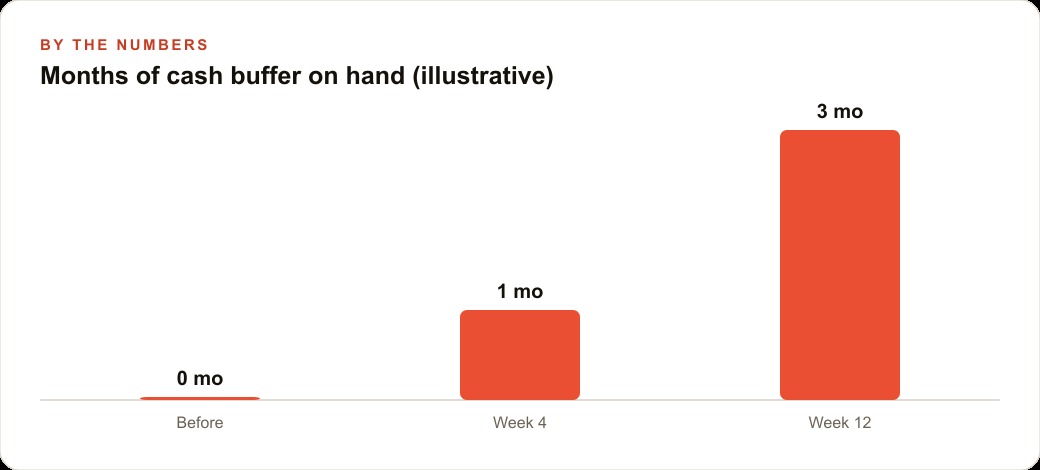
A money age of ninety to one hundred eighty days corresponds to the three-to-six-month emergency fund that every piece of personal finance advice has ever recommended. The difference is that money age is a live metric you can track continuously rather than a lump-sum target you try to build separately from your operating budget. As you implement rules one, two, and three consistently, money age grows automatically. You are not building a separate emergency fund. You are building the buffer through the discipline of not spending money before it arrives and saving for irregular expenses in advance.
Variable income does not make budgeting harder; it makes the consequences of not budgeting more severe
The most common objection to budgeting from freelancers, contractors, and business owners is that their income is too unpredictable to budget effectively. This gets the causality exactly backwards.
Irregular income means the consequences of a cash flow error are more severe and arrive faster than they do for a salaried employee. A salaried employee who runs over on a category in a given month experiences mild stress and adjusts next month. A business owner who runs over on operating expenses during a slow-revenue month may be unable to cover payroll, which has immediate and serious consequences.
The argument that unpredictable income makes budgeting impossible is actually the argument that unpredictable income makes budgeting essential. The risk of running out of allocated funds during a low-income period is not managed by tracking less carefully. It is managed by tracking more carefully, which is what budgeting enables.
Rule one handles variable income directly and naturally. When a payment arrives, allocate it to its jobs. When no payment has arrived, do not allocate anything. The budget is never ahead of the money, which means you never make spending decisions based on income that has not materialized. Rule two handles the expense timing problem that makes variable income feel unmanageable by building the irregular expenses into every month's allocation in advance. Rules three and four handle the absorption of variance and the building of a buffer that grows until cash flow timing mismatches stop being crises.
A plumbing business with a three-month money buffer can accept contracts that competitors without one cannot
Commercial work is where the rules compound into a genuine competitive advantage rather than just personal financial stability.
Commercial contracts frequently carry payment terms of thirty, sixty, or ninety days. A commercial facility management company puts out a request for proposals on a plumbing service contract worth thirty thousand dollars. The work is delivered over six to eight weeks. Payment arrives sixty days after completion of work. A plumbing business that accepts this contract must cover payroll, materials, fuel, and overhead from the start of the project through the end of the sixty-day payment window, a period that could span four months from initial mobilization to cash receipt.
A business operating with zero money age, meaning it spends approximately what it earns in the same period, cannot take this contract without borrowing. It would need to cover four months of project-related costs before the payment arrives. Without a buffer or a credit line, the math does not work. The contract goes to whoever has the buffer.
A plumbing business that has built a three-month money buffer through consistent application of the four rules can take the thirty-thousand-dollar contract without stress. Payroll for the project crews is covered. Materials are purchased. Equipment is maintained. The payment arrives into money that is already allocated to future operations, adding to the buffer rather than covering a gap.
The buffer was not built in one heroic savings push. It grew over time as a natural result of budgeting only real money, pre-saving for irregular expenses, adjusting rather than ignoring variance, and watching money age grow from five days to fifteen to thirty to ninety. The business that did this is now competing for contracts that the business that did not cannot accept at all. The four rules did not produce a tidier spreadsheet. They produced a fundamentally different competitive position.
That is the practical compounding of getting the root cause right. Standard budgeting advice spends your energy managing category limits on spending that was funded by imaginary income. The four rules spend your energy on the only thing that actually matters: making sure every dollar you spend already exists.
That is exactly what we do at AI DOERS. Book a private 30-minute call with Madhuranjan Kumar and we will map the fastest path to it for your specific business.
Book your call →
Madhuranjan Kumar
Madhuranjan Kumar brings 20 years of performance-marketing experience and has managed over $200 million in Facebook ad spend for brands across the United States and beyond. His expertise spans the full modern marketing stack: Meta, Google Ads, TikTok, email automation, CRM, and the websites that hold it together. At AI DOERS he turns that track record into lead-generation systems for businesses across every industry.