
The Forward Deployed Engineer Model: How AI Agencies Actually Scale
The forward deployed engineer model, pioneered by Palantir, scales an AI business by embedding deep inside a few long-term clients, running a real operations audit, and stacking proven automation wins instead of chasing many shallow projects.

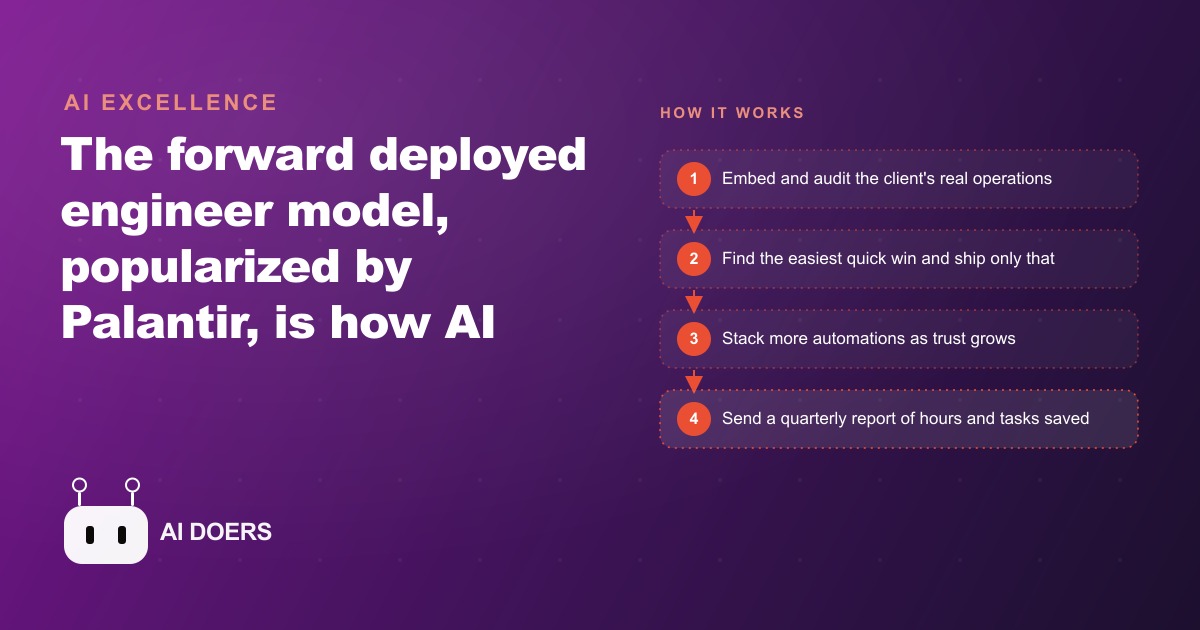
The majority of AI consultants I speak with describe their income the same way: one strong month followed by a thin one, with no reliable way to predict which comes next. The forward deployed engineer model, first built at scale inside Palantir for intelligence and defense contracts, is the structural fix that independent AI consultants and small agencies are now adapting for themselves.
The core idea is simple to state but genuinely hard to execute. Instead of chasing many small projects, you embed deeply inside a handful of long-term clients, run a real operations audit, and stack automation wins over months and years. The retainer grows as trust accumulates. The income stabilizes because you are not starting from zero every month. The knowledge you build inside one client's operations compounds into expertise that makes your next engagement in the same vertical faster and more valuable. Here is the full breakdown of how the model works, what the income math actually looks like, and how to structure the first engagement if you want to test it.
The FDE model is spreading from defense contractors to independent AI shops
Palantir built the forward deployed engineer model out of operational necessity. The company was building extremely complex data integration and analytics software for clients whose operations were too technical for business staff to navigate alone and too strategically sensitive for purely technical engineers to understand in context. The FDE solved this by placing someone who could speak both languages, business fluency and engineering depth, directly inside the client's operation.
That person's job was not to arrive with a finished product and present a demo. It was to show up, learn the actual workflows, find where the friction lived, and build solutions that addressed those specific frictions. The core insight was that the most valuable thing was not the software itself. It was the person who understood the client's operations well enough to know what to build, in what order, and at what level of complexity.
Independent AI consultants and small agencies are copying this pattern now because the same dynamic applies. Most AI software, whether you are building automations, agents, or integrated workflows, works best when it is tuned to the specific operational context of the business using it. Generic AI tools built without that context are useful. Custom solutions built after a real audit of how the business actually runs are transformative. The gap between those two outcomes is the FDE model.
The timing is also favorable. Most mid-sized businesses are in the early stages of figuring out which AI bets to make. They are overwhelmed by options and skeptical of hype. An operator who arrives as an auditor rather than a salesperson, who finds the real bottleneck and removes it, builds a kind of trust that is genuinely hard to replicate with any amount of marketing.
Embedding deep beats chasing shallow: the math behind retainer versus project income
The income instability problem in consulting comes from the same root cause in almost every case. Every project ends and the clock resets. You deliver a build, the client pays the invoice, and next month you are back to business development. The pipeline has to keep moving or income falls. Most operators try to solve this by finding more clients, which just makes the wheel spin faster without changing the underlying dynamic.
The FDE model solves it differently. A small set of clients generating predictable monthly retainers creates a different financial foundation entirely. Each client in a well-structured FDE engagement is not a one-time project. It is a relationship with an active and expanding backlog of work. Bigger organizations, and even mid-sized ones, always have more processes to fix, more departments that could benefit from what you proved in the first department, more data to connect, more workflows to streamline. Once you have earned trust and shown results, the backlog expands on its own without any additional selling.
The income math works because retainers compound in a way project fees do not. A project that takes six weeks and pays $7,500 is a transaction. A client paying $4,000 per month for twelve months because you saved their team 15 hours per week in Q1 and then found five more problems worth fixing in Q2 is a $48,000 relationship that might run for three or four years. The total value is entirely different, and the cost of maintaining that revenue is close to zero once the trust is built.
There is also a longer-term structural reason to care about this model. The agencies adopting FDE are building deep operational knowledge of one vertical at a time. Over months they see which problems repeat, which tools work across clients in the same industry, and which workflows generalize cleanly. That knowledge accumulates into a genuine productizable insight, the seed of a vertical software product or specialized agent that competitors who stayed shallow will struggle to build. The agency phase is the research and development phase in disguise.
The operations audit is the entry move, not a sales call in disguise
The most important thing to understand about the FDE model is that the first real deliverable is an audit, not a build. I see a lot of AI consultants skip this step because it feels slower than arriving with a demo or a proposal for a specific tool. That is a mistake. The audit is where the actual value of the model lives.
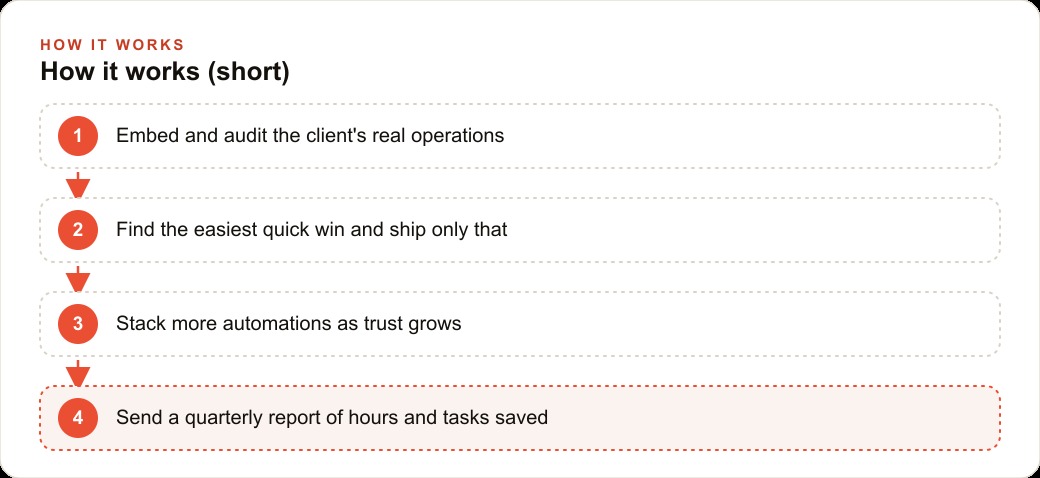
A serious operations audit means getting physically or virtually inside the client's workflows. You join their team channels, get read access to their CRM, follow a sale or a service ticket from the first touchpoint through to completion, and ask the operations team to walk you through every manual step they perform. The goal is to map the business hierarchy, document the existing tool stack so you can meet the client where they are, and build an opportunity matrix: every process that could be improved by automation, ranked by estimated impact and effort to build.
Out of that matrix comes what I think of as the edge of the tape. Every operation has one place where the tape is already starting to peel up: a task that happens dozens of times per week, requires no judgment, and is done manually only because no one has had time to fix it. That is where you start. Not because it is the most technically impressive thing you could build, but because shipping a working solution to a real problem fast is the single most trust-building action you can take in a new client relationship.
A point worth internalizing: most first projects after the audit do not need an AI agent. A lot of the highest-value early wins are plain automations. A form that routes inquiries correctly without a human reading each one. A data transfer between two systems that someone was doing manually every morning. A simple notification that fires when a trigger condition is met. Save the agent architecture for problems with genuinely varied inputs and many possible paths to resolution. For clean linear workflows, a simple automation is faster to build, easier to maintain, and more reliable for a client who is new to AI-built tooling.
How a solo AI consultant structures the first 90 days with a client
The first 90 days determine whether the engagement becomes a long-term retainer or concludes after the initial project. Here is how I think about structuring them.
Days 1 through 14 are the audit period. During these two weeks, the goal is to understand the business deeply enough to produce a credible opportunity matrix. This means getting access to the tools and channels the team actually uses, sitting in on real operational meetings where possible, and asking about what takes the most time and causes the most frustration. Document everything. Map every tool in the stack and every manual process you observe. End this phase with a prioritized list of opportunities and a clear recommendation for the first build.
Days 15 through 45 are the first build. Pick the single highest-confidence, lowest-effort item from the opportunity matrix and build it to the point where it handles real work without supervision. The key word is confidence. This is not the phase to experiment with a new tool or approach you have never shipped before. Use what you know works, build something reliable, and run it against real operations. Spend at least a week observing it alongside the team to catch edge cases before handing it off. Write a one-page standard operating procedure so the client's team can operate it and troubleshoot common issues independently.
Days 46 through 90 are the trust-compounding phase. With the first win live and demonstrating value, you begin the second item in the opportunity matrix while also tracking the metrics that will form the first quarterly report. How many times did the automation run? How much time did it save per run? What is the total labor cost avoided? This is the period where the retainer conversation happens naturally, because the client can see the value with their own eyes and the opportunity matrix shows there is more work to do.
Custom code handles the heavy lifting when Zapier or similar orchestration tools cannot handle the logic. A webhook to a Replit environment, for example, can process complex calculations or loops that break in a low-code tool. The right architecture is whatever ships fastest and holds up reliably. The client does not care about the stack. They care about whether the task gets done without a human doing it.
A worked example: one consultant, three clients, the income stability math
I want to be specific about what the income difference actually looks like when this model runs well. Here is an illustrative example with concrete numbers.
A solo AI consultant starts the year taking on project-based work. In January they close a $5,500 chatbot build. In February they deliver it and invoice. In March they are in business development mode because the pipeline dried up while they were building in February. In April they close a $4,000 automation project. The pattern continues: strong billing months followed by thin months, averaging somewhere between $4,000 and $7,000 per month with high variance. Annual revenue lands around $60,000 to $65,000. The stress is persistent because each month's income depends on the previous month's sales effort.
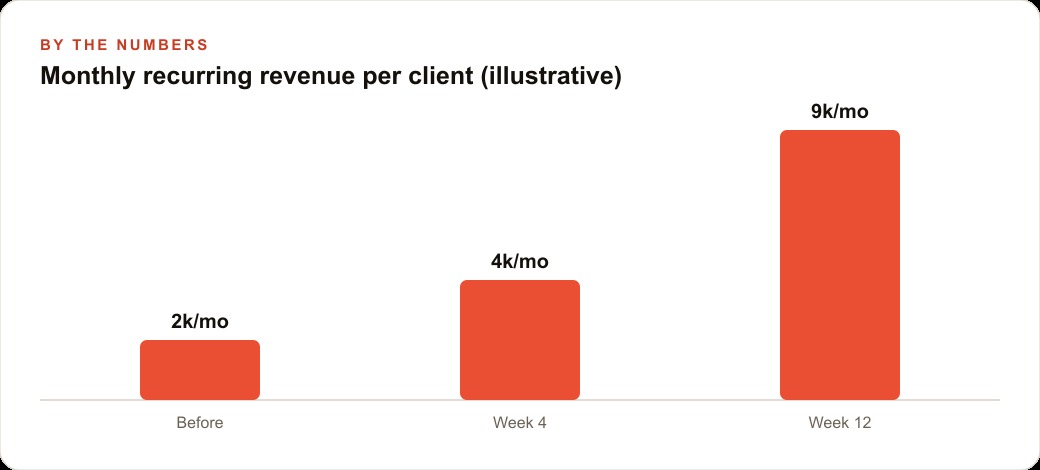
Now apply the FDE model with the same consultant. Three clients instead of twelve. Each engagement starts with a two-week paid audit at $2,500, which covers the time investment of the discovery phase. After the audit, the first automation build is scoped and delivered for $3,500, bringing the engagement total to $6,000 in the first six weeks, comparable to what the project model produced. But then the retainer starts. Based on the opportunity matrix, each client has an ongoing backlog of improvements worth roughly $3,500 per month of consultant time. The client agrees to a monthly retainer of $3,500, covering one active build per month plus maintenance and a quarterly report.
Three clients at $3,500 per month is $10,500 per month in guaranteed recurring revenue, before any new business. That is $126,000 per year just from the three relationships. The income variance drops to near zero because it does not depend on the project pipeline. Business development effort can now go toward a fourth client or toward identifying the most repeatable solution in the opportunity matrices, the early signal of a productizable asset.
The retainers also tend to grow. By month four with each client, the consultant has delivered three or four wins and the client has expanded the scope of what they want fixed. Average retainer value at month six is typically $4,500 to $5,000 per client. The same three clients are now generating $13,500 to $15,000 per month in the second half of the year. Total annual revenue from those three relationships alone reaches $140,000 to $150,000, more than double what the project-based model produced, with a fraction of the business development pressure.
The quarterly report that turns one win into permanent budget
The quarterly report is the mechanism that converts a successful first build into a permanent and growing budget allocation. Most consultants either skip it or send something vague. That is a significant missed opportunity.
The report needs to answer four questions with specific numbers. First, how many times did each automation run this quarter? Second, how much time did each run save, based on how long the task used to take manually? Third, what is the total labor cost avoided, using a realistic hourly rate for whoever used to perform the task? Fourth, what is in the opportunity matrix for next quarter, and what is the projected impact of those builds?
A report that shows the intake automation ran 847 times this quarter, saved an average of 6 minutes per instance, and redirected approximately 85 hours of staff time at $28 per hour is a report that shows $2,380 in recovered labor from one automation. Against a retainer of $3,500 per month, that single build covers most of the cost by itself. Add two more automations with similar impact and the quarterly report shows $6,000 to $8,000 in labor recovered against a $10,500 retainer. That ratio is defensible to any business owner or finance team reviewing line items.
The second function of the report is giving the client the language and evidence they need to justify the budget internally. The operations manager who brings these numbers to the owner is not asking for spending approval based on a hunch. They are presenting a documented return. That dynamic is what allows the retainer to grow rather than get cut when a business has a difficult month.
I treat the quarterly report as a core deliverable, not an optional courtesy. It is built into the scope from day one and priced into the retainer. Clients who see consistent quarterly reports stay longer, expand their scope sooner, and refer more confidently than clients who just receive builds without documentation of what those builds produced.
The discipline that collapses this model before it delivers
There are two discipline failures that kill the FDE model in the first 90 days. Both are understandable under real working conditions and both are fatal if left unchecked.
The first is building before the audit is complete. The impulse to start building immediately is strong, especially when the client is excited and you can already see an obvious first project. Resist it. Every case I have observed where this model failed traces back to a build that solved the wrong problem because the consultant did not spend enough time in the actual operations before picking the first thing to fix. Two weeks of genuine audit time feels slow. Months of maintaining a system that does not quite fit the real workflow is substantially slower, and far more damaging to the retainer relationship.
The second failure is underscoping testing and ongoing support. An automation that works 90 percent of the time is not a success. It is a problem, because now the team has to manage both the broken automation and the manual fallback simultaneously. Budget testing time into every build. Build SOPs that cover the edge cases you find during testing. Price ongoing support into the retainer from the beginning, not as a later add-on. Consultants who treat support as an afterthought end up in situations where a broken automation damages months of earned trust, and the retainer conversation stalls before it starts.
A third pattern worth naming: trying to scale by adding new clients before deepening the existing ones. The FDE model's value compounds with relationship depth. Two clients you understand inside out are worth more in stable revenue and referral potential than eight clients you are barely keeping current with. The model requires patience in the early months, and that patience is exactly what makes the income curve different from the project-based alternative.
The move to make this month if you want to test this model
Here is what I would do in the next 30 days to test whether the FDE model fits the way you work.
Take one current client, preferably one with whom you have already built some trust through a previous project, and propose a paid operations audit. Frame it clearly as a discovery engagement: two weeks of your time going inside their operations, producing a ranked opportunity matrix, and recommending a first build. Charge $2,000 to $2,500 for this phase. It should feel reasonably priced to the client and adequately compensated for you.
Spend those two weeks genuinely inside the operation. Get added to their communication channels. Ask to observe real processes, not just see slide decks about them. Document every manual step you find, however small. Build the opportunity matrix as a living document, adding to it as you learn more. End the two weeks with a clear presentation: here is what I found, here is the ranked list of what to fix, here is what I recommend building first and why.
After you present, scope the first build and propose a project fee to execute it. After that first build is running on real work and producing measurable results, introduce the retainer conversation. Show the opportunity matrix with remaining items and make the case for monthly engagement to work through it systematically.
The audit discipline is the foundation. It forces you to understand the client's actual operations before you propose a solution, which is the prerequisite for everything else the FDE model depends on. Even if you never formalize the model beyond this one test, the habit of auditing before building will make every project you take on more accurate, more valued, and more likely to lead to repeat work.
The income math is substantially better than project-based work, the relationship quality is better because you are building something real inside a business you understand, and the operational knowledge you accumulate positions you to eventually productize the most repeatable solutions you find. The agency phase, when run this way, is not just a business. It is the research and development phase for the more durable thing that comes next.
That is exactly what we do at AI DOERS. Book a private 30-minute call with Madhuranjan Kumar and we will map the fastest path to it for your specific business.
Book your call →
Madhuranjan Kumar
Madhuranjan Kumar brings 20 years of performance-marketing experience and has managed over $200 million in Facebook ad spend for brands across the United States and beyond. His expertise spans the full modern marketing stack: Meta, Google Ads, TikTok, email automation, CRM, and the websites that hold it together. At AI DOERS he turns that track record into lead-generation systems for businesses across every industry.