
The Five-Step Framework That Cuts Learning Time by 60 to 70 Percent
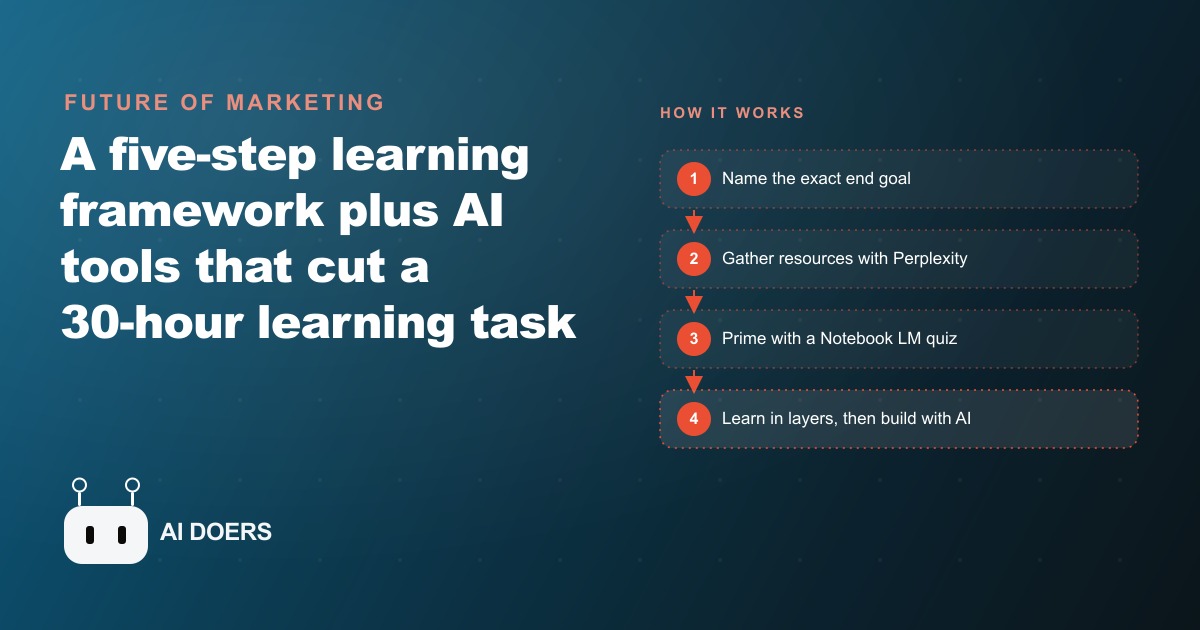
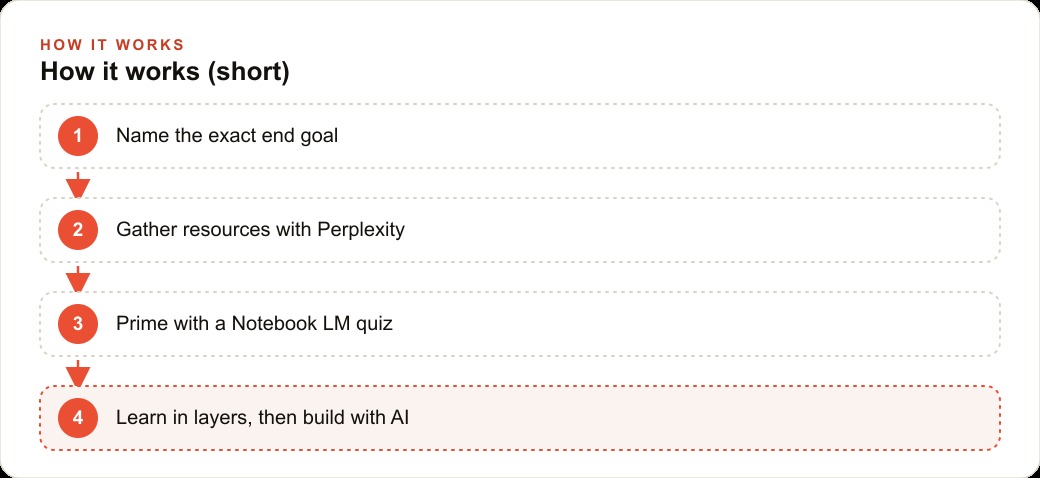
Run five stages in order, goal, research, priming, comprehension, and implementation, and point AI at the three that eat the most time. Done right, a 30-hour topic drops to roughly 10.

The way most professionals try to learn new skills is making them slower, not faster. This is not a minor inefficiency you can fix by studying harder or blocking more calendar time. The depth-first approach that most learning culture treats as the correct path is, at the structural level, one of the least effective ways a human brain can absorb and retain new information. There is a better framework, and the gap between the two approaches is not a matter of marginal improvement. People who apply it consistently report cutting their learning time by 60 to 70 percent on the same material.
Depth-first learning is the enemy of retention
Most professionals who decide to learn something new do the same thing. They find a resource, a course, a book, a series of tutorials, and they start at the beginning. They work through the material in the sequence it was presented, going deep on each concept before moving to the next, taking careful notes, and trying to understand everything before they apply any of it. This feels responsible. It feels thorough. It is also the slowest possible route to usable skill.
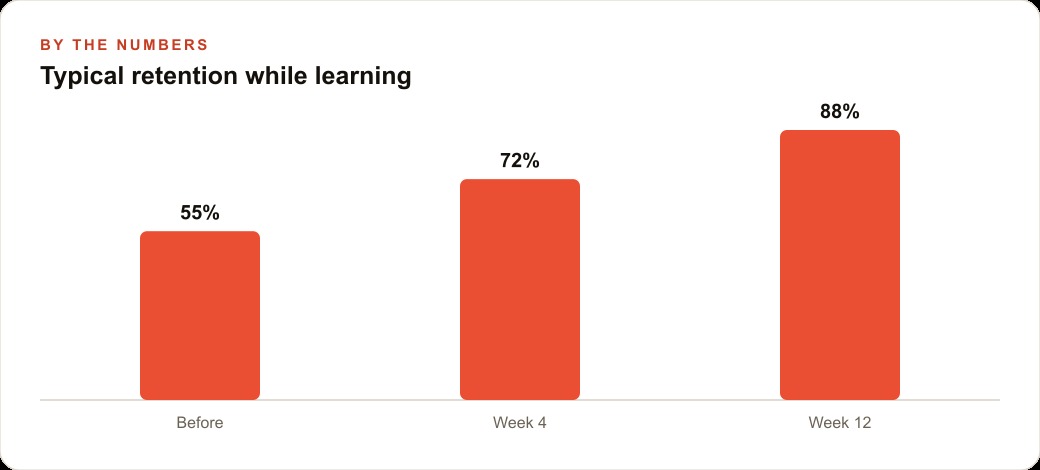
The problem is structural. Human memory is reconstructive, not archival. The brain does not store information the way a hard drive does. It stores information in networks of associations, and those networks are only activated when you are doing something with the information, not when you are consuming it passively. A concept explained in chapter two makes complete sense when you read it. Without context, without a real problem it solves, without the experience of having encountered the gap that concept fills, that same concept is gone within four days. Studies on retention consistently show that passive learning without active retrieval produces recall rates below 20 percent after a week.
So when a professional spends a weekend grinding through a 12-hour course, taking notes on every module, they are building a detailed knowledge structure that will largely not be there when they need it two weeks later. The approach optimizes for feeling prepared while systematically undermining the outcome that preparation was supposed to produce.
The contrast with effective learning is stark. A professional who defines exactly what outcome they need, uses AI tools to find the two or three concepts that gap requires, primes their brain before reading, and immediately applies each concept to a real problem retains and uses a much higher proportion of what they spent time on. The difference is not discipline or intelligence. It is architecture.
A specific goal is not optional, it is the entire foundation
The five-step framework begins with a step most learners skip entirely: defining an exact, narrow goal before consuming any material. Not "I want to learn more about Google Ads." Something like: I need to be able to build a search campaign for a local service business with a $1,500 monthly budget, write five ad groups with three ads each, and set the right bid strategy for lead generation within the next two weeks.
That level of specificity is not pedantic. It is doing the most important cognitive work in the entire learning process before you spend a single hour studying. A specific goal tells you what concepts to acquire, what order they need to be acquired in, and what "done" looks like. Without it, you are consuming a map without knowing where you are going. Every concept you encounter seems potentially relevant, which means you feel like you need to understand all of it, which means the depth-first grinding begins.
The goal also tells you what you do not need to learn yet. A complete understanding of auction theory, historical bidding mechanics, the evolution of broad match over the past decade, and the distinctions between every campaign type is not what the goal requires. Knowing which bid strategy to choose for lead generation, how to structure ad groups for a local service intent, and how to read the first two weeks of performance data is what the goal requires. Those are different knowledge sets, and confusing them is where most depth-first learners lose their time.
The specificity principle applies to business skill development in every domain. Before learning about content strategy, the goal should define what type of content, for what audience, published at what frequency, measured against what outcome. Before learning about SEO and organic search, the goal should specify whether the need is local search visibility, topical authority in a niche, or technical site health. The goal determines the circuit. The circuit determines what you learn.
Skipping the priming step is costing you a third of what you learn
The second step in the framework, after goal-setting, is research to identify the specific missing pieces the goal requires. The third step, which almost nobody does, is priming: spending 30 minutes building a high-level conceptual map of the topic before you read anything carefully.
Priming works because the brain processes new information better when it has a framework to attach it to. When you read a detailed explanation of bidding strategy without knowing what bidding strategy connects to in the broader campaign structure, the explanation processes as isolated facts. When you have spent 30 minutes building a rough map of how all the pieces fit together, the same explanation processes as a clarification of something you already have a structure for. The cognitive difference is significant. Primed learners retain more of what they subsequently read, have fewer comprehension gaps, and can apply what they learned more quickly because the integration work happened before the detailed study, not after it.
The 30-minute priming session uses AI tools specifically: a tool like Perplexity or NotebookLM to generate a high-level overview of the topic, identify the three to five most important concepts, map the vocabulary you will encounter, and surface the two most common points of confusion that people hit when learning this material. You are not studying during priming. You are installing scaffolding. The detailed study that follows builds on that scaffolding instead of floating free.
Most people skip priming because it does not feel like learning. It does not produce notes or a sense of progress. It looks like skimming. It is actually doing one of the most cognitively valuable things you can do: building the associative structure that will determine how much of the next several hours of real study you will actually keep.
Learning in layers, not depth, is what actually builds usable knowledge
Once the priming is done, the comprehension phase follows a different rule than the depth-first approach. The rule is: learn in layers. Capture only the three most important things from each segment before moving on. Do not try to understand everything. Try to understand the skeleton well enough to act on it, then use the action to surface what you actually need to go deeper on.
The layer-by-layer approach maps onto how professionals use knowledge in practice. No one reads a chapter, absorbs every nuance, and then applies it perfectly. Real use of knowledge is iterative: rough understanding, first attempt, specific confusion, targeted re-learning, second attempt, better result. The learning cycle is the application cycle. Treating them as separate sequential processes, first learn everything, then apply it, is a fiction that produces the depth-first grind and the 20 percent retention rate.
The three-things capture rule forces prioritization. If you can only write down three things from a section, you are forced to decide which three concepts did the most work. That decision is itself a learning act. It requires you to evaluate what you have read against what your goal requires, which is a comprehension test that passive note-taking does not come close to matching.
This phase also benefits from format conversion. Every person has a format in which they think most clearly, whether that is bullet lists, diagrams, narratives, tables, or spoken explanations. Converting the material from the format it was delivered in to the format that matches how you think is not an extra step. It is the comprehension step. Reading the same information passively in its original format is not learning it. Rewriting it in your own structure is.
The AI shortcut that replaces the last third of a course
The implementation phase, the fifth step, is where most of the myelin gets built. You cannot learn a skill without doing it. But the framework adds one specific practice that dramatically accelerates the implementation phase: talking the skill out with an AI while you are building with it.
This is not asking the AI to do the work for you. It is using the AI as the practice partner who watches you work and flags the gap between what you think you understand and what you actually understand. When you say "I'm going to structure this ad group by intent type because search intent drives ad group segmentation," the AI can confirm that reasoning, surface a nuance you missed, or ask the follow-up question that exposes the part of the concept you absorbed at the surface level.
The energy principle matters here more than the time principle. An hour of high-energy, high-attention learning produces more usable skill than three hours of fatigued grinding. The five-step framework should be applied when cognitive energy is at its peak, not fitted into the leftover time at the end of a workday. Interleaving the topic with brief unrelated mental breaks during implementation also improves retention, because the brain consolidates new information during rest, not during continuous study.
Here is how this framework applied in practice for an accounting firm associate who needed to learn QuickBooks Online well enough to manage bookkeeping for three new small business clients. Using the depth-first approach, a comparable situation had previously taken about three weeks of on-and-off learning, with a 12-hour video course as the anchor and constant references back to the course during actual client work.
Using the five-step framework: the goal was defined as managing monthly reconciliation, categorizing 150 to 200 transactions per client per month, and generating the three financial reports each client needed, within 10 business days from login. Research with Perplexity identified six concepts that covered 90 percent of that goal. A 30-minute NotebookLM priming session built the vocabulary map and flagged the two concepts people most commonly confuse: the difference between accounts payable aging and vendor balances, and when bank rules apply versus when manual review is required. The comprehension phase covered only those six concepts in depth, with three-things captures after each. Implementation started on day two, with the AI answering questions in context as real client transactions were categorized.
Total active learning time: eight hours over four days. Time to first fully independent client completion: day five. The three-week process compressed to four days, not because the associate worked harder, but because the architecture of the learning matched how the brain retains and uses information.
The same compression is available in any domain. The Facebook and Instagram ad campaigns skills that most digital marketers take months to develop through grinding and trial and error can be acquired in a fraction of the time when the five-step structure is applied deliberately. The key is not finding better material. The material available is already excellent. The key is changing the architecture of how you approach it.
The CRM and website stack skills that control how a business converts visitors into leads have the same property. Most people learn them by breaking things in the interface and gradually understanding what each setting does. The five-step approach starts with the specific outcome the CRM needs to produce, identifies which three settings or workflows control that outcome, primes with an AI overview of the platform's architecture, and then learns those three things in depth while building. The rest of the platform documentation exists when you need it. You do not need it to become productive.
Most learning culture in professional environments is designed around the depth-first illusion. The courses are comprehensive. The certifications cover everything. The expectation is that understanding the complete picture is what produces competence. It does not. What produces competence is acquiring the specific circuits the real task requires, in the format the brain can use, through active retrieval and immediate application. Everything else is preparation for a test that the work does not administer.
The five-step framework is not a shortcut past learning. It is a recalibration of what learning actually is.
That is exactly what we do at AI DOERS. Book a private 30-minute call with Madhuranjan Kumar and we will map the fastest path to it for your specific business.
Book your call →
Madhuranjan Kumar
Madhuranjan Kumar brings 20 years of performance-marketing experience and has managed over $200 million in Facebook ad spend for brands across the United States and beyond. His expertise spans the full modern marketing stack: Meta, Google Ads, TikTok, email automation, CRM, and the websites that hold it together. At AI DOERS he turns that track record into lead-generation systems for businesses across every industry.