
The Essential AI Skills to Learn for 2026
The essential AI skills for 2026 are prompting first, then a small tool stack built around one generalist chatbot, then building custom AI agents, and finally vibe coding. Open source AI and multimodality are the trends to watch.

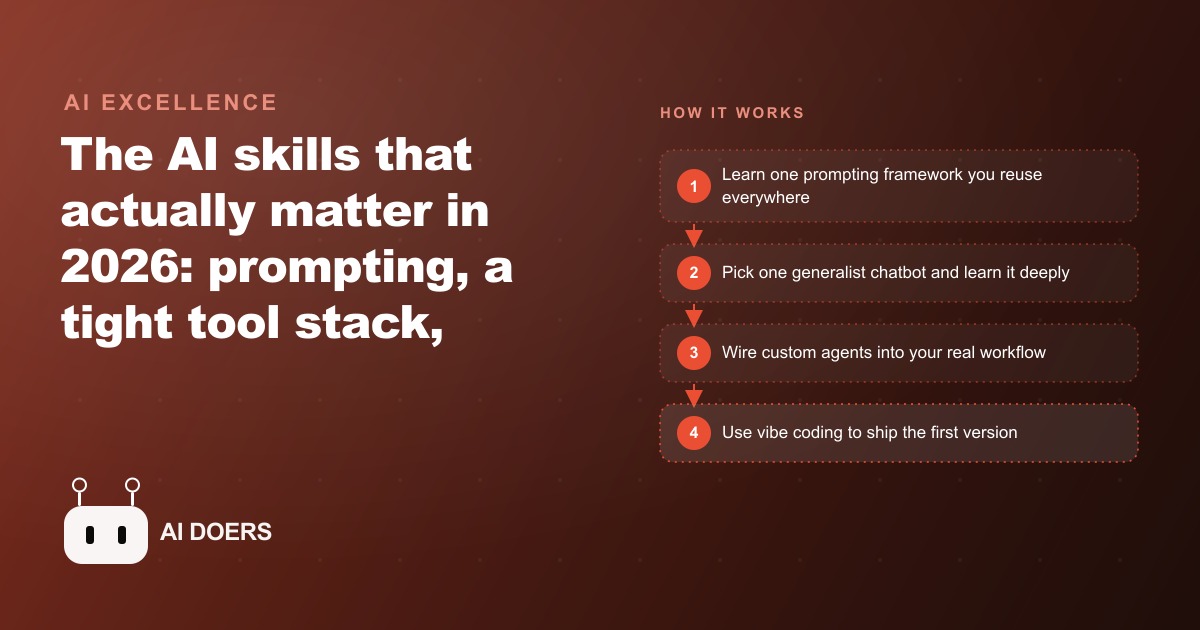
Seventy percent of people using AI tools today are using them at roughly ten percent of their potential. Not because the tools are hard but because they skipped a skill that makes everything else work. I am Madhuranjan Kumar, and the skill ladder I want to walk through here is specific and sequenced, because the order matters. You build the foundation before the second floor.
Master one prompting framework before anything else
Prompting is the one skill that transfers across every tool, every model, and every use case. It does not matter whether you end up using ChatGPT, Claude, Gemini, Grok, or any of the open-source alternatives. The framework for getting a useful response is the same across all of them, and mastering it puts you ahead of the large majority of people using these tools.
The framework I use with clients has five elements: Task, Context, References, Evaluate, Iterate. You state the task clearly and specifically. You supply the context the model needs to understand the situation, because it knows nothing about your business unless you tell it. You attach references, whether examples, templates, or prior work, that show the format and quality level you expect. You evaluate the output against the goal, not against whether it sounds impressive. And you iterate, refining the prompt based on what the first attempt got right and what it missed.
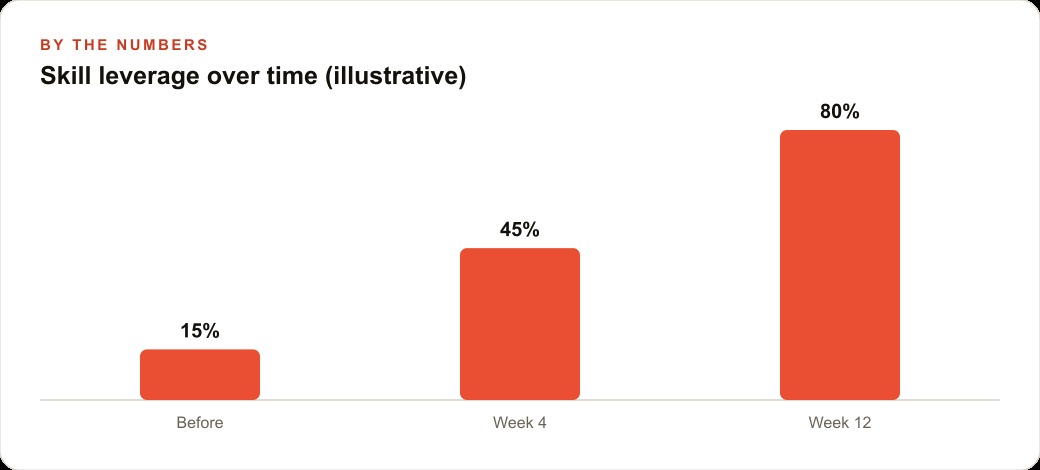
The reason this framework is worth learning first is that the skill compounds. A better prompt produces a better result, and a better result teaches you more precisely what kind of context the model needs for that task. Within a few weeks of deliberate application, most people find their prompts are shorter and their results are sharper, because they have stopped adding noise and started adding signal. The swing is the thing. Learn it before you worry about the club.
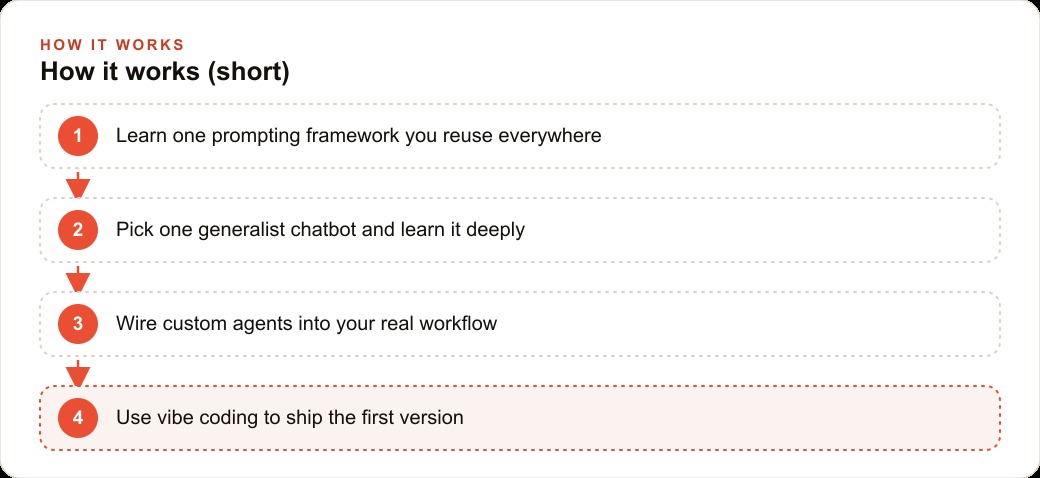
Pick one generalist chatbot and learn it deeply
The second habit that separates effective AI users from casual ones is depth over breadth. A modern generalist chatbot can write, research, analyze data, interpret images, explain complex concepts, and build simple apps. That is enough capability to transform most business workflows. The mistake is subscribing to four tools that each do one of those things, then spending cognitive load moving between them.
Pick one and learn it well. Not what its features list says it can do, but what it actually produces for your specific tasks when you give it real context. Run your most common work tasks through it for thirty days and pay attention to where the output needs heavy editing versus where it is nearly right. That pattern of where it excels and where it struggles is the operating map for your stack, and it cannot be read from a comparison article. It has to be built from use.
Browser agents are the extension of this that most people overlook. A browser agent can summarize a long email chain, schedule a meeting into a calendar, fact-check an article against live sources, and compare options across multiple pages without you opening ten tabs. It acts inside the page you are already looking at, which is where a large share of everyday productivity friction actually lives. Adding this capability to your single-tool habit is the difference between a chatbot and an assistant.
Wire custom agents into your existing systems, not new ones
Custom agents are the highest-leverage skill in this stack, and the most commonly misapplied one. The instinct when building a custom agent is to design a new, idealized workflow and then wire the agent into that. The problem is that the people who need to use the agent are already embedded in existing systems and will not switch. The agent that earns its place is the one wired into the tools and databases the team already uses.
A retention agent wired into an existing subscription management tool reads cancellation triggers in real time and drafts targeted offers based on the specific reason a customer is leaving, rather than sending a generic discount. That agent beats a generic AI writing tool for the same task because it has access to the real data. A reporting agent wired into an existing database pulls the numbers the team cares about and formats them into a readable summary ready before the Monday meeting, without anyone logging into three systems and copying numbers into a spreadsheet. A reactivation agent reading the overdue contacts in a CRM and website stack drafts personal nudges that reference the specific history of each contact rather than sending a mass email that reads like one.
The pattern in each case is the same: the agent fits the workflow that already exists, uses the data that already exists, and produces an output that was previously produced by a person spending time on a repetitive task. The skill is recognizing which of your existing processes has that shape, and which one to start with. Start with the one that is both high volume and low judgment, the task that is done the same way every week regardless of who does it. Those are the most reliable candidates for an agent that actually runs well and earns continued use.
For a business running Google Ads campaigns, a reporting agent that pulls spend, clicks, conversions, and cost per lead from the ad platform and delivers a daily summary is a concrete example. The team no longer needs to log into the platform to check the numbers each morning. The numbers arrive as a summary with anomalies flagged, which means the morning review takes two minutes instead of fifteen, and important shifts are never missed because no one had time to check.
Evaluate open-source models for regulated or sensitive data
The fourth skill is not building anything. It is a policy decision with real risk implications. Open-source AI models that can run locally on your own hardware have reached a quality level that matches closed models on most business tasks. The major open-source releases proved that this performance tier is accessible without a commercial API, and the advantages of running locally are not theoretical. Lower cost, full control over where the data goes, customizability, and auditability for regulated industries are concrete benefits that a growing number of businesses are treating as requirements rather than preferences.
For any business handling health records, financial documents, legal materials, or sensitive client information, the question of which data goes through a public cloud model and which goes through a local one is worth answering explicitly. An open-source model run locally sends nothing to an external server. A patient intake summary, a client contract, or a financial reconciliation file analyzed by a local model stays on your machine. That fact simplifies the answer to patient, client, or regulatory questions about data handling in a way that no policy language about cloud provider privacy practices can fully substitute for.
For Facebook and Instagram ad campaigns and similar marketing work where the content is not sensitive, the public models are fine and often the best choice. The discipline is classifying the work by sensitivity before choosing the model, not defaulting to one or the other without thinking about it.
Use vibe coding to build what no commercial product sells
The last skill in the stack is the one that most surprises people who have not tried it. Vibe coding tools let anyone describe what they want in plain language and receive a first working version in minutes, with no coding background required. The first version needs refinement, and that refinement is a conversation with the tool rather than a technical implementation task.
For a business that has always said "I wish there was a tool that did exactly this," vibe coding is the answer. A custom booking flow that handles the specific exceptions your business actually has. An internal report that pulls the specific numbers your team cares about in the format that actually makes sense for your operation. A client intake tool that matches your specific workflow rather than forcing you to adapt your workflow to someone else's template. These are tools no commercial vendor will ever build for your specific situation, because your situation is too specific to be a market.
For businesses that have started integrating AI into their operations, connecting that vibe-coded tool to your SEO and organic search data, your ad platform, or your CRM is the compounding layer. A tool built exactly for your process, wired into your real data, runs better and gets used more consistently than any generic solution that requires you to adapt to it. The skill floor for building these tools has dropped enough that the deciding factor is now the clarity of your own thinking about the workflow, not technical skill.
The five skills connect in sequence: prompting makes every tool better, the tight stack builds depth over breadth, custom agents extend that depth into autonomous task completion, open-source models protect sensitive data while keeping cost low, and vibe coding fills the gaps that commercial software never will. Each rung prepares the next one, which is why the order matters more than rushing to the most impressive capability.
That is exactly what we do at AI DOERS. Book a private 30-minute call with Madhuranjan Kumar and we will map the fastest path to it for your specific business.
Book your call →
Madhuranjan Kumar
Madhuranjan Kumar brings 20 years of performance-marketing experience and has managed over $200 million in Facebook ad spend for brands across the United States and beyond. His expertise spans the full modern marketing stack: Meta, Google Ads, TikTok, email automation, CRM, and the websites that hold it together. At AI DOERS he turns that track record into lead-generation systems for businesses across every industry.