
The Data Center Problem Almost Nobody Is Talking About
A proposed pause on new data center construction would freeze compute supply while demand keeps rising, which likely raises the cost of AI and squeezes out small businesses while leaving big tech best positioned to afford it. Here is why that matters for the businesses now leaning on AI.

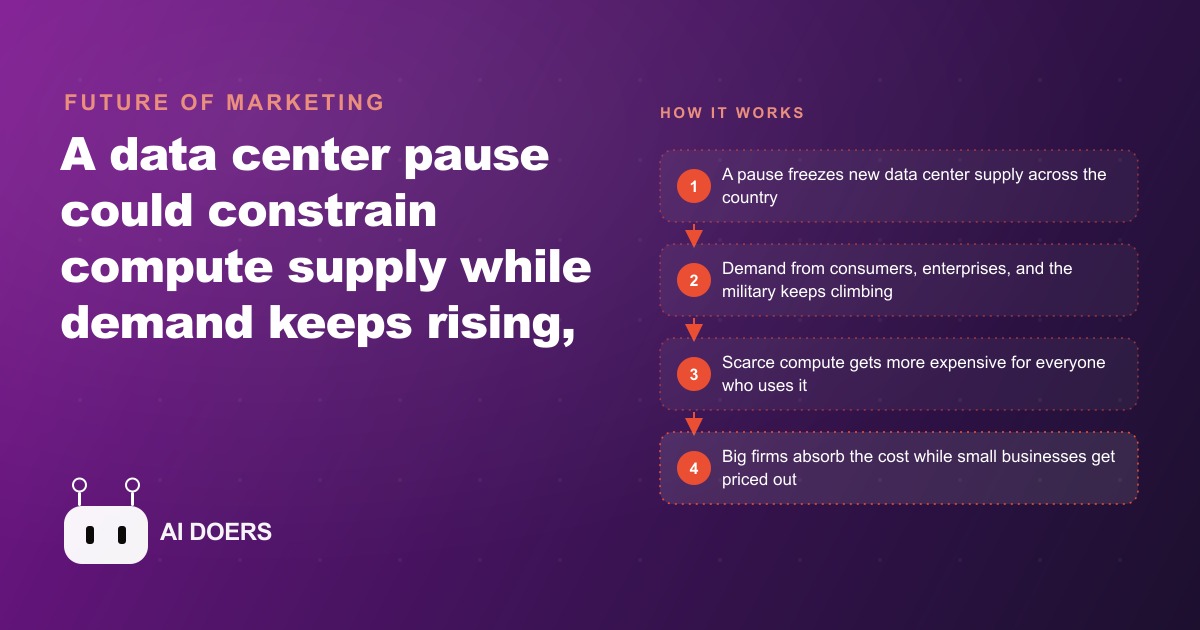
A bill just landed that could pause new data center construction across the entire country, and almost everyone arguing about it is missing the part that actually hits small businesses. The Artificial Intelligence Data Center Moratorium Act, introduced by Bernie Sanders and AOC, would freeze new data center builds until federal AI legislation protects workers, consumers, the environment, and civil rights. On social media it instantly collapsed into two camps: politicians killing American progress and handing the lead to China, or AI being so dangerous that every data center should stop. I am Madhuranjan Kumar, and I want to argue that the truth sits between those poles, and that the fix, as written, may quietly do the opposite of what it intends.
The grievances behind the bill are real
Let me be clear up front that the complaints driving this bill are legitimate, and dismissing them is a mistake. Residential energy costs have climbed more than thirty-six percent since 2020, and the independent market monitor for the PJM grid found data centers overwhelmingly responsible for the increase in capacity prices. This is not a vague fear, it is a measured effect showing up on people's electricity bills.
The scale explains why. A single data center campus running at the lower end of peak demand uses roughly the same amount of power as the entire population of San Francisco, and data center electricity demand is projected to rise fifteen to twenty percent every year. There is a water and pollution cost layered on top. A gas-powered AI data center in Memphis raised local air pollution, used about one hundred fifty homes worth of water in a month, and could consume as much electricity as two hundred thousand homes in a year. The people frustrated enough to want a moratorium are responding to something concrete.
The grid math runs against nearby residents
The reason your bill rises when a data center moves in comes down to simple supply and demand. When one of these facilities plugs into a local grid, it draws from the same supply that households rely on. Less supply against steady demand pushes prices up for the people nearby, whether or not they ever use the services those servers run.
That last point is the one that stings. You might never log into ChatGPT, yet if a data center gets built near your town, your power bill still goes up, and the cost lands on neighbors sharing the same grid. This is why the anger is not limited to people who dislike AI. It reaches anyone who pays a utility bill in the wrong zip code, and that broad exposure is a big part of why the bill found an audience so quickly.
The part of the story the debate keeps skipping
Here is where I think the whole conversation goes wrong, and it is the reason I wanted to write this. The loud debate is about electricity bills and the environment, which are real, but it almost entirely ignores compute.
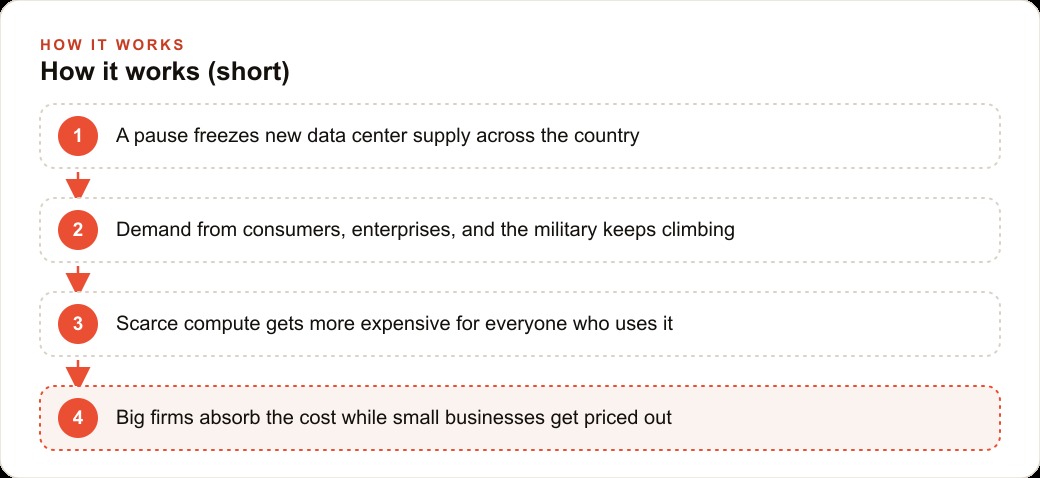
Compute is already constrained, which is precisely why companies want to build more capacity in the first place. A pause freezes that supply while demand from consumers, enterprises, and military use keeps climbing. Scarce, expensive compute is something only the largest companies can comfortably absorb. So in an effort to limit the power of big tech, a construction pause could hand them more of it, because they control the existing supply while everyone else competes for what is left. The small businesses and everyday users get squeezed out first. That is close to the opposite of the bill's stated goal, and it is the part of the story that rarely makes it into the press conference.
Who actually gets hurt when compute gets scarce
Follow the incentive and the outcome becomes obvious. When a resource gets scarce and pricey, the players with the deepest pockets and the longest contracts ride it out fine. A trillion-dollar company negotiates volume pricing and locks in capacity. A small business paying per token feels every price increase directly and immediately.
There is a geographic twist too. A United States-only pause does not stop Meta or Google from building data centers abroad where regulation is lighter. That moves both the compute and the new jobs outside the country, which undercuts the domestic-worker argument the bill leans on. So the likely result of a blunt moratorium is higher costs for the smallest users, more concentrated power for the biggest players, and jobs relocating offshore. Good intentions, backwards outcome.
How the squeeze would land on a real small business
Picture an HVAC company where the owner finally got AI working in the back office. This is the illustrative shape of the exposure. The tools draft estimate follow-ups, sort service calls by urgency, write the seasonal maintenance reminders, and turn messy technician notes into clean invoices. None of that needs a giant model, but it all runs on tokens, and tokens are priced off compute.
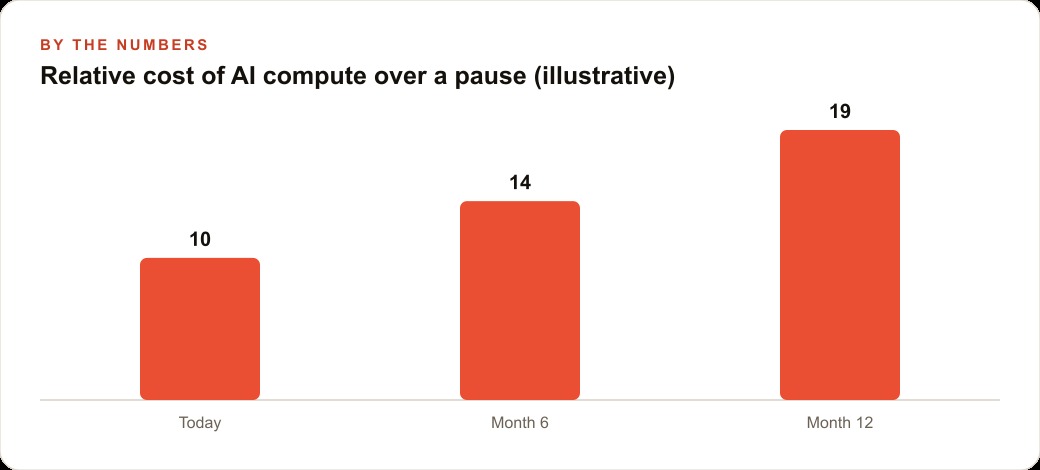
If a construction pause tightens compute supply while demand keeps rising, the price of those everyday AI tasks creeps up, and the small shop feels it more than the national chain that can negotiate volume. Say the relative cost of that compute sat at a baseline today, drifted up by roughly forty percent six months into a pause, and by around ninety percent a year in. Those figures are illustrative, but the direction is the honest part: a scarcity-driven price curve bends against the smallest buyers. The same owner is probably already paying a higher power bill if a data center landed near town, so the cost arrives from two directions at once. The owner did nothing wrong and never touched a data center, yet ends up paying more to keep a tool that quietly runs the office. That is exactly the kind of cost creep worth watching if you lean on AI to support your Facebook and Instagram ad campaigns or the automations behind your CRM and website stack.
Why a national pause cannot contain a global build-out
There is a structural reason a country-level moratorium struggles to do what its authors want, and it is worth sitting with. Compute is global and mobile in a way that a local power plant is not. A company that cannot break ground on a campus in one state can break ground in another country, and the largest firms already operate across dozens of jurisdictions. The servers follow the cheapest, least-regulated electricity, and so do the construction jobs, the engineering roles, and the tax base that comes with them.
That mobility flips the intended effect. A pause meant to slow big tech instead nudges big tech to build where oversight is lightest, which is usually somewhere with weaker labor and environmental protections, not stronger ones. The grievances the bill is trying to answer, fair wages, clean air, protected water, get exported to places with fewer safeguards rather than solved at home. Meanwhile the domestic grid still carries the load of the facilities that already exist, so residents keep paying the higher bills while losing the future investment that might have funded upgrades. When you trace the full path, a blunt stop does not remove the harm, it relocates the benefit and keeps the cost.
The two-sided cost small operators should plan for
The trap for a small business is that the pain arrives from two directions that most owners never connect. One side is the utility bill, which rises when a data center draws on the local grid regardless of whether the business uses AI at all. The other side is the token bill, the per-use cost of the AI tools that increasingly run the back office. A moratorium pushes on both at once: it can leave the grid tighter where facilities already sit, and it can tighten the compute supply that sets token prices everywhere.
For the owner who has quietly folded AI into daily operations, that combination is worth planning around now rather than reacting to later. The businesses that will ride out a price swing best are the ones that already run lean: they use smaller, cheaper models for routine work, they batch tasks instead of firing off wasteful one-off calls, and they keep a clear picture of which automations actually earn their keep. That efficiency is the same discipline that protects margins in every other input cost, from labor to materials, and it applies cleanly to the AI layer too.
The smarter middle path, and it is already starting
The good news is that a better option exists between build-at-all-costs and full-stop, and some of the industry is already moving toward it. Microsoft committed to community-first AI infrastructure that pays its own way and replenishes more water than it uses, and Google, Microsoft, and OpenAI have pledged to fund the power plants and grid upgrades their data centers require. That points at the real fix.
Keep building, but make trillion-dollar companies pay for their own electricity, infrastructure, and water replenishment instead of tapping community grids that households and small businesses depend on. That approach addresses the legitimate grievances about bills, water, and pollution directly, without freezing the compute supply that everyone outside big tech relies on to compete. It solves the actual problem rather than trading it for a worse one.
What the pledges do and do not solve
It would be easy to read the corporate pledges as pure public relations, and some of the skepticism is fair, but dismissing them entirely misses something useful. When a company commits to paying its own way, funding the power plants and grid upgrades its facilities require, and replenishing more water than it consumes, it is conceding the exact point the bill's supporters are angry about: that the cost of a data center should not silently land on the neighbors. That concession matters, because it reframes the fight. The question stops being whether to build at all and becomes who pays for the building, which is a far more solvable problem.
The honest caveat is that a pledge is not a law, and voluntary commitments can quietly weaken when they collide with a quarterly earnings target. This is where sensible policy actually belongs, not in freezing construction, but in turning those voluntary promises into binding requirements. Make every large facility responsible for its own generation, its own grid capacity, and its own water replenishment as a condition of building, and you address the legitimate grievances directly without starving the compute supply that small businesses depend on. That is a policy aimed at the real problem rather than a blunt instrument that mostly rearranges who wins.
How I would think about this as a business owner
The move here is not to pick a team in a binary fight. It is to read past the slogans, because most AI policy is more nuanced than side A versus side B. Watch the supply-and-demand mechanics, since constraining supply while demand rises raises everyone's cost and prices out the smallest players first. Notice who a policy actually concentrates power toward, not just what it claims to intend. And support holding builders accountable for their own grid, water, and jobs rather than cheering a blunt stop that backfires.
Practically, keep your own AI usage efficient so you are less exposed if compute prices move, and build workflows that do the job without leaning on the most expensive models for routine tasks. That discipline also keeps your marketing lean, because efficient automation feeding SEO and organic search and your ad follow-up costs less to run no matter which way policy breaks. You can follow this on your own and adjust as costs shift, and I would encourage every owner to track it. If you would rather have someone audit how exposed your operation is to rising compute costs and build workflows that stay efficient as prices move, that is the kind of planning I do for clients, and you can bring me in to handle it.
That is exactly what we do at AI DOERS. Book a private 30-minute call with Madhuranjan Kumar and we will map the fastest path to it for your specific business.
Book your call →
Madhuranjan Kumar
Madhuranjan Kumar brings 20 years of performance-marketing experience and has managed over $200 million in Facebook ad spend for brands across the United States and beyond. His expertise spans the full modern marketing stack: Meta, Google Ads, TikTok, email automation, CRM, and the websites that hold it together. At AI DOERS he turns that track record into lead-generation systems for businesses across every industry.