
The ChatGPT Prompt Sequence That Builds a Study Plan in 10 Minutes
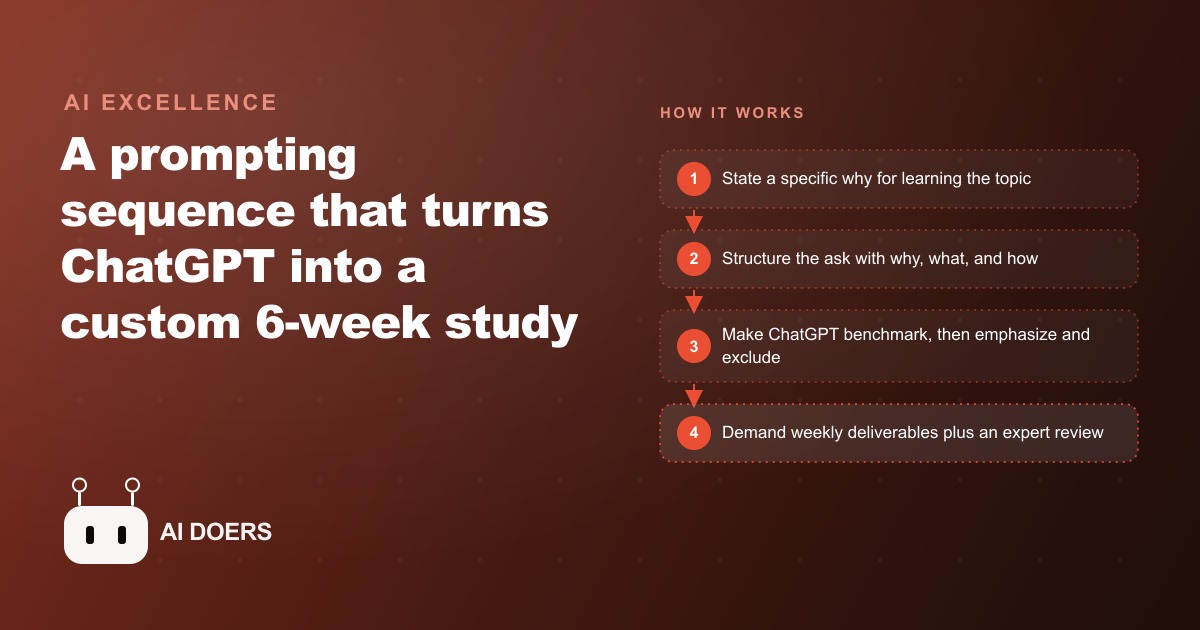
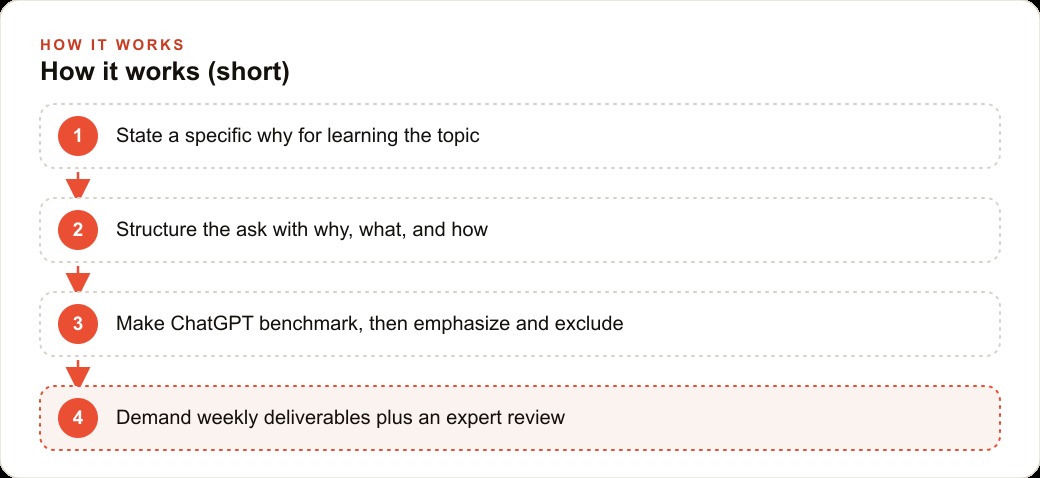
You can turn ChatGPT into a custom study plan for any subject in under ten minutes. Give it a sharp why, structure the request with the why-what-how framework, make it benchmark how others learned the topic, then demand week-by-week deliverables with rubrics and a final expert-review pass.

Most people treating ChatGPT as a study tool are leaving nine-tenths of its value on the table, not because the tool is limited, but because the prompts they write treat it like a search engine instead of a curriculum designer.
I am Madhuranjan Kumar, and I have been running multiple structured study plans at the same time using a specific prompt sequence that compresses what would take a professional instructional designer days to produce into under ten minutes per plan. This piece breaks down every step of that sequence, including the one step most learners skip entirely, which is also the step that makes the resulting plan dramatically sharper.
The gap between a vague ChatGPT ask and a plan that actually works
The most revealing thing you can do before writing your first prompt is type a bad one on purpose. Ask ChatGPT to "make me a study plan for marketing" and watch what it returns. You will get a generic eight-week outline with headings like "Week 1: Fundamentals" and "Week 4: Digital Channels" that could apply equally well to a high school student, a small-business owner, and a CMO at a software company. It is not wrong. It is just useless, because it was built for no one in particular.
The difference between that output and a plan that actually changes your capability is almost entirely in how precisely you define the why before you write anything else. The sequence I use is anchored in a simple three-part structure: why you want to learn the subject, what specifically you will learn, and how you will learn it. That framework, which comes from the Ultralearning methodology, gives ChatGPT a proven scaffolding to organize its response rather than letting it default to whatever a generic learner might need.
The why is not just motivational framing. It is a functional constraint. When the why is narrow and specific, for example "learn enough paid-ad strategy to run my own Facebook campaigns without hiring a third party", ChatGPT knows to exclude academic advertising theory, heavy statistics, and anything that does not directly serve that goal. When the why is vague, ChatGPT fills in the gaps with assumptions, and those assumptions almost never match what the learner actually needs.
The benchmarking step most people skip that makes the plan ten times sharper
Here is where most self-directed learners stop too early. After writing a sharp why and anchoring the request in the why-what-how structure, they let ChatGPT invent a learning path from scratch. That default path is fine, but it is not the best available path.
The better move is to make ChatGPT benchmark how real learners have already conquered this subject before designing a path. You are asking it to synthesize the collective experience of everyone who has already made the mistakes, found the conceptual shortcuts, and figured out which early skills unlock faster progress on everything that comes after. That prompt sounds like: "Before building the plan, research the most common and proven ways people actually learn this subject, then use those findings as the foundation for the plan structure."
The difference in output quality is not subtle. A benchmarked plan will sequence concepts in the order that real learners have found most intuitive. It will include the project types that people who mastered this skill say were most formative. It will flag the sticking points that routinely slow learners down so the plan can front-load the concepts that prevent those stalls. A plan built from scratch by a language model will be structurally correct and practically weaker, because it is working from training data rather than from the distilled lessons of real practice.
I run this step on every plan I build. The plans that come back are consistently more opinionated, more ordered by difficulty in a way that actually reflects how the subject clicks, and more specific about which resources are worth the time.
Splitting the what into concepts, facts, and procedures
Once the benchmark informs the structure, the next move is to prevent the plan from treating all learning as the same kind of task. The what gets split into three distinct buckets: concepts you must understand, facts you must memorize, and procedures you must be able to execute.
This distinction matters in practice because each type of learning requires a different study method. Understanding how an ad auction works is a conceptual task. It requires reading, discussion, and being able to explain it back in your own words. Memorizing the character limits and image dimensions for different ad formats on each platform is a factual task. It requires repetition and retrieval practice, not long-form reading. Setting up a campaign from a blank account to its first live ad is a procedural task. It requires doing it, not reading about it.
A plan that lumps these three things together will either over-explain what needs practice or under-explain what needs depth. Once you force this split in the prompt, the plan prescribes the right study method for each type of learning, and the result is a curriculum that feels like it was built by someone who actually understands how skill acquisition works rather than a tool generating plausible-sounding text.
Emphasize and exclude: turning a complete plan into a lean one
After the benchmark and the three-bucket split, the plan still needs to be filtered against your actual goal. This is where you tell ChatGPT explicitly what to emphasize and what to cut. If the goal is to run campaigns without an agency, the plan should emphasize campaign setup, audience targeting, creative testing, and reading performance data. It should exclude media mix modeling, brand equity measurement, and econometrics, all of which are legitimately part of marketing but serve a completely different goal.
The exclusion instruction is the part most learners feel reluctant to write because it seems presumptuous to tell an AI what not to teach you. But the plan that tries to be complete will always be weaker than the plan that is calibrated to a specific outcome. Completeness is the enemy of focus, and focus is what converts study time into actual capability. The exclusion step is not about limiting your knowledge. It is about sequencing it so you get useful as fast as possible and deepen from there.
Deliverables with rubrics and your real schedule
A study plan is not a reading list. A reading list tells you what to consume. A study plan with deliverables tells you what to produce, which is the only signal that reveals whether understanding is actually developing.
The prompt asks ChatGPT to specify a concrete deliverable for each week of the plan, complete with a rubric and a graded spec that describes what a strong submission looks like versus a weak one. In practice that means week one might end with a written audience persona for the market the learner wants to target. Week three might end with a live test campaign running at a small daily budget with a written analysis of its first seven days of data. Week six might end with a complete lead-to-booking workflow documented step by step in the relevant tool.
When deliverables are specific and rubrics are explicit, ChatGPT can later evaluate the submissions and give feedback that is calibrated to the rubric rather than generic encouragement. That closes the feedback loop that most self-directed learning lacks entirely.
The schedule constraint goes into the same prompt: how many hours per week are genuinely available, which days they fall on, whether the learner prefers text or video resources. ChatGPT uses those constraints to pace the plan so it is achievable rather than aspirational.
The expert review pass that catches the gaps before training starts
This step is the one I would not skip under any circumstances. After the full plan is generated, you run a single additional prompt: tell ChatGPT to re-read the entire plan as a fresh expert in that field who has just seen it for the first time, identify what is missing, and critique what is weak.
In my own experience running this on AI-tools learning plans, the review pass has flagged missing topics that I would have stumbled into mid-program as confusing gaps. It has suggested project types that bridge the gap between the conceptual content and the procedural work more cleanly than the original plan did. It has reordered steps that were sequenced in a way that made sense logically but would have felt disjointed in practice.
The expert review costs two additional minutes. It catches problems that would have cost hours of confusion during the program itself. It should be a non-negotiable last step before any plan is considered ready to execute.
A real estate agency training example with illustrative numbers
Consider how a real estate agency with ten agents and a marketing budget currently managed by an outside vendor would use this sequence to train an in-house agent to take over that work.
The manager writes a why that reads: "Learn enough to set up and manage our own listing ad campaigns on Facebook, follow up with inbound leads inside our CRM, and eventually replace the third-party vendor we currently pay a monthly retainer to manage digital campaigns."
The what splits into concepts, facts, and procedures. Concepts include how ad targeting and audience matching work on Meta, how a lead funnel connects ad click to booked appointment, and how to read campaign performance data to identify what is working. Facts include platform ad-format specifications, the agency's own pricing tiers for different property types, and the naming conventions for campaigns and ad sets that make reporting readable. Procedures include building a campaign from a blank account to its first live ad, writing a listing ad that meets platform creative guidelines, and logging an inbound lead correctly in the CRM so the follow-up sequence triggers automatically.
Benchmarking pulls in how other agents in similar roles have actually learned these skills and sequences the plan in the order they found most effective. The exclude instruction cuts media buying theory, econometrics, and brand-level strategy that is irrelevant to a single-agency campaign manager.
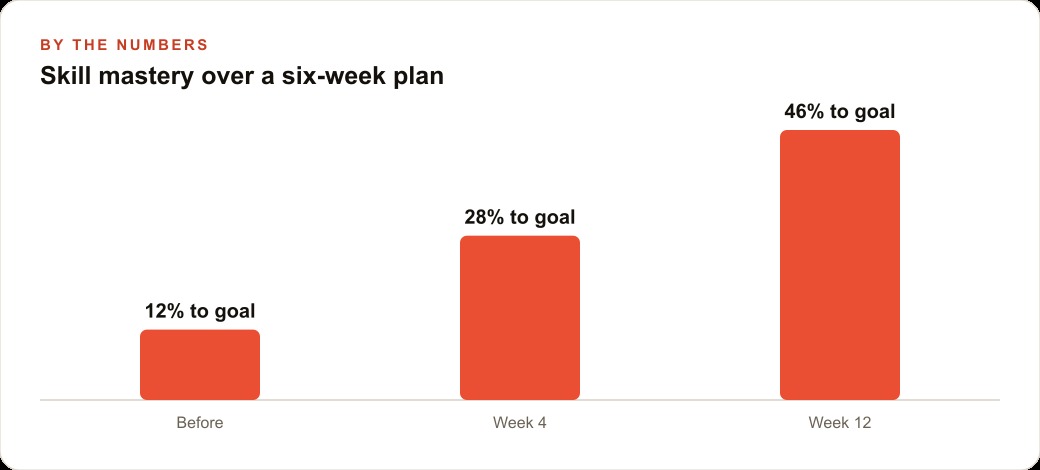
The resulting six-week plan assigns specific weekly deliverables. Week one produces a written buyer persona for the agency's primary property type. Week two produces a campaign structure document with named campaigns, ad sets, and targeting logic. Week three has a live test campaign running at a modest daily budget, and the deliverable is a written analysis of the first week of data covering what the numbers mean and what would be changed in the next test. Week six closes with a fully documented lead-to-appointment workflow that any agent could follow without additional guidance.
If the outside vendor's monthly management fee is, say, two thousand dollars per month and the trained agent can take over even half that responsibility within eight weeks, the plan pays for itself inside the first month of independent operation. The training cost is a ChatGPT subscription. The ongoing operational benefit compounds every month the agent continues developing the capability.
This kind of in-house capability building connects naturally to how agencies approach web CRM systems and search content once ad operations are running smoothly. Each layer of capability reduces reliance on outside vendors and increases the agency's margin per client.
The study methods the plan prescribes
Building the plan is only the first half of this sequence. The same tool that produced the plan is the most efficient study partner available for working through it.
The quiz method feeds ChatGPT the study material and asks it to generate questions, explain every wrong answer, and restate the concept until it lands. This method is how the original demonstration involved passing a driving exam in roughly two hours using only ChatGPT quiz sessions drawn from the official manual. Two hours to exam-ready on a subject most people spend days grinding through static text is not a marginal improvement. It is a different category of learning speed.
The Feynman teach-back is the method I find most useful for identifying exactly where understanding breaks down. You pick a concept from the plan and teach it to ChatGPT out loud, as if explaining it to someone who has never encountered the subject. The moment you generalize instead of explain, or stumble on a transition between ideas, or reach for a phrase like "it just works" rather than describing the mechanism, that is the gap. ChatGPT fills that specific gap immediately rather than requiring the learner to go back through an entire module to find where the confusion lives.
Voice-mode mock interviews close the loop on procedural and communicative skills. The trainee runs a mock sales call, a mock client meeting, or a practice pitch in voice mode, then asks for structured feedback on clarity, the logical sequence of the argument, and whether the answer actually addressed the question that was asked. The feedback is more specific than most managers have time to provide, and it is available at any hour without scheduling a session.
What breaks when you skip any of these steps
The sequence is interdependent. Skipping the sharp why produces a generic plan that covers the subject broadly but serves no specific goal. Skipping the benchmark produces a plan that is structurally plausible but misses the sequencing insights that real learners have worked out through practice. Skipping the three-bucket split produces a plan that applies the same study method to tasks that need different ones, which means some skills get under-practiced and some concepts get over-explained. Skipping the deliverables and rubrics produces a reading list, not a training program. Skipping the expert review pass means arriving mid-program at gaps that could have been caught in two minutes before starting.
The sequence is not complicated. It is a set of specific instructions that, when given in the right order, produce a fundamentally different output than a single-prompt ask. The discipline is in not skipping steps because they feel optional. None of them are optional. Each one is the reason the next one works.
If you want a ready-made version of this applied to your team's specific skills gap, complete with rubrics, weekly check-ins, and an evaluation structure the manager can apply without running the training sessions personally, that is the kind of work we do as an ads and digital growth agency that runs on real client data and real campaign results, not templates.
That is exactly what we do at AI DOERS. Book a private 30-minute call with Madhuranjan Kumar and we will map the fastest path to it for your specific business.
Book your call →
Madhuranjan Kumar
Madhuranjan Kumar brings 20 years of performance-marketing experience and has managed over $200 million in Facebook ad spend for brands across the United States and beyond. His expertise spans the full modern marketing stack: Meta, Google Ads, TikTok, email automation, CRM, and the websites that hold it together. At AI DOERS he turns that track record into lead-generation systems for businesses across every industry.