
The Boring AI Agency Playbook That Makes 500k a Year
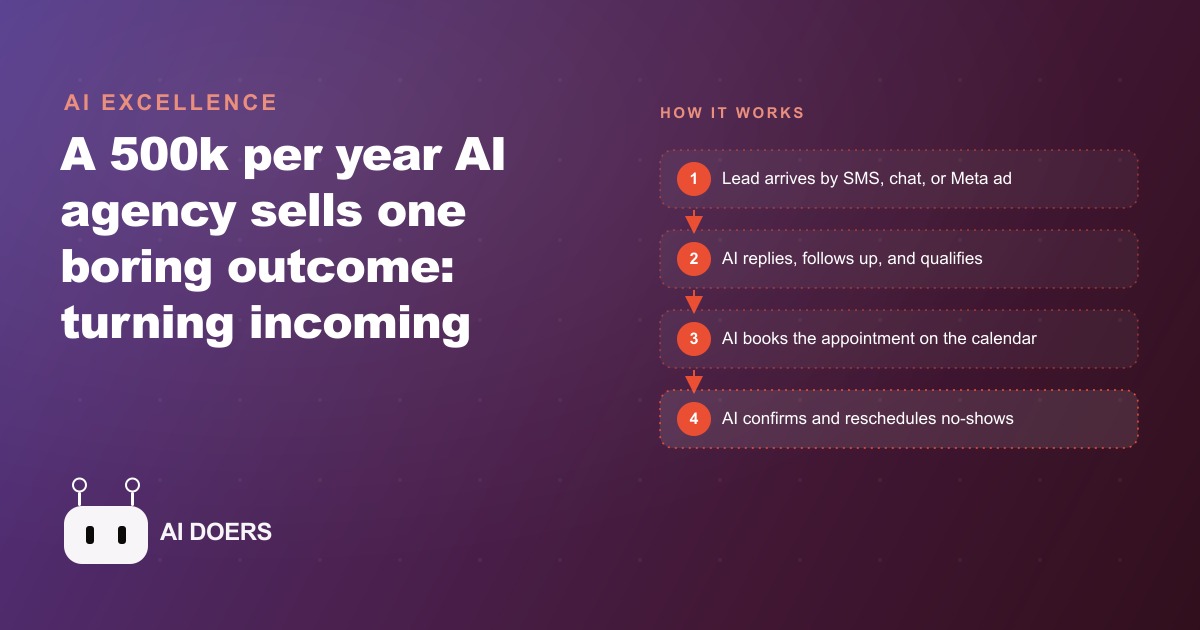
The most profitable AI agencies do not sell AI. They sell one repeatable outcome, turning incoming leads into booked and confirmed appointments, and they run that single play across many industries.

I, Madhuranjan Kumar, have spent two years watching AI agencies burn out chasing the most sophisticated, impressive version of what they could build, and the ones that crossed five hundred thousand dollars in annual revenue all took the opposite path.
They picked one boring outcome. They said no to everything else. They ran that same outcome across every industry that would have them.
The Decision to Go Boring
The turning point for the agency at the center of this story was the moment the owner recognized that trying to own the entire customer lifecycle at once was not ambition. It was the exact thing that was going to kill the business. The team was attempting to build a complete system that attracted leads, converted them, delivered the service, and collected payment, all simultaneously, for clients who had no existing workflow documentation, no clean data, and no patience for a six-month build timeline.
The decision to go boring was not a retreat. It was a precision cut. The owner asked a single question: what is the one outcome that shows up in every business, creates an immediately visible result, and can be measured without any analytics debate? The answer was turning an incoming lead into a booked and confirmed appointment. Not a warmer lead. Not a more educated prospect. A real appointment on a real calendar, confirmed by a real human, with a follow-up system that handles the no-shows automatically.
That outcome sits at the intersection of two facts that make it unusually durable as a service offering. First, it is universal. Every appointment-based business, from a dental practice to an HVAC company to a med spa to a law firm, faces the same bottleneck: leads arrive and somewhere between the first inquiry and the booked appointment, a meaningful percentage quietly disappear. Second, it is measurable without any interpretation. The business owner opens the calendar and counts the filled slots. There is no attribution modeling required. No funnel debate. Just appointments booked versus the week before.
Owning this outcome instead of a vertical niche meant the agency did not need to rebuild the core system for every new client. The engine that handles incoming messages, replies intelligently, qualifies the prospect, and pushes them toward a calendar booking is fundamentally the same whether the client is a roofing company or a physical therapy practice. The industry-specific qualifying questions change. The calendar integration changes. The tone of the AI responses changes. The engine does not. That portability is the entire business model.
The System They Built
The technical stack behind this engine is deliberately boring, and that choice is not accidental. HighLevel serves as the base platform. Make handles orchestration when external system connections are needed. ClickUp manages project delivery. None of those are the newest platforms in the AI ecosystem. All of them are mature, stable, and backed by large enough communities that when something breaks at an inconvenient time, a documented solution already exists somewhere. Stability is the product, and the tool choices reflect that priority entirely.
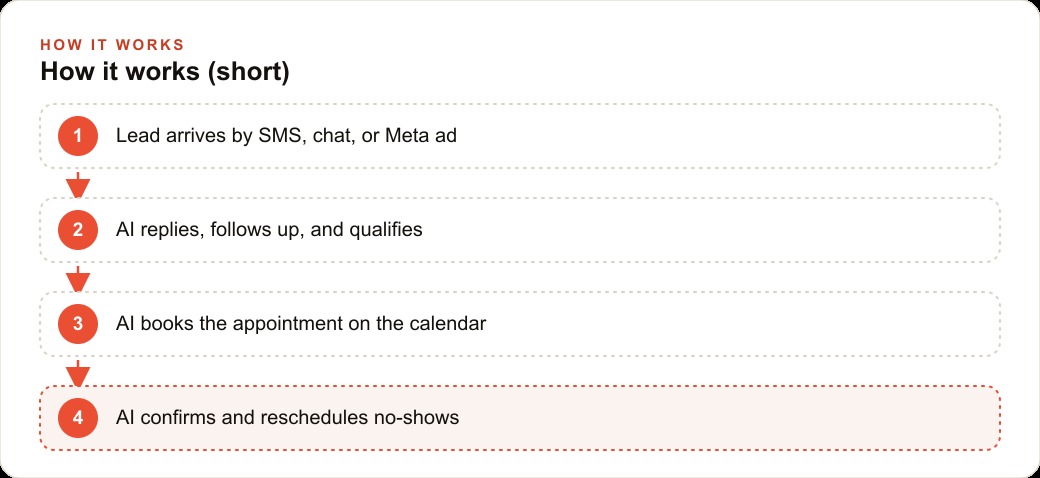
The engine works end to end like this. A lead arrives through one of several entry points: a direct text to a business number, a web chat widget on the company site, a contact form, or a Meta lead ad. The AI responds within seconds regardless of whether the front desk is staffed, regardless of the time of day, regardless of the day of the week. It acknowledges the inquiry, starts a short qualifying conversation calibrated to the specific business, and gathers the information needed to match the prospect to a calendar slot.
For a dental practice, those qualifying questions cover whether the person is a new or returning patient, what they are coming in for, and their insurance situation. For a home services business, they cover the job type, location, and timing constraints. Once the lead has provided enough context, the AI checks real-time calendar availability and offers a narrow set of booking options. The prospect confirms, the appointment is logged immediately in the calendar, and a confirmation message goes out right away. If the prospect has not confirmed within a set window, the AI follows up. As the appointment approaches, a reminder goes out and an easy reschedule path is offered, which reduces no-shows without requiring staff to make the call manually.
The detail that separates a production system from an impressive demo is what happens with the conversation data. Rather than sending a notification the sales team eventually learns to ignore, the AI writes a brief conversation summary directly onto the contact record inside the CRM automation layer. When a staff member picks up the phone for that appointment call, they already know who they are speaking with, what the prospect said they needed, and what the qualifying details showed. That context converts at a meaningfully higher rate than a cold call, and it is consistently what business owners mention when they describe what the system actually does for their team day to day.
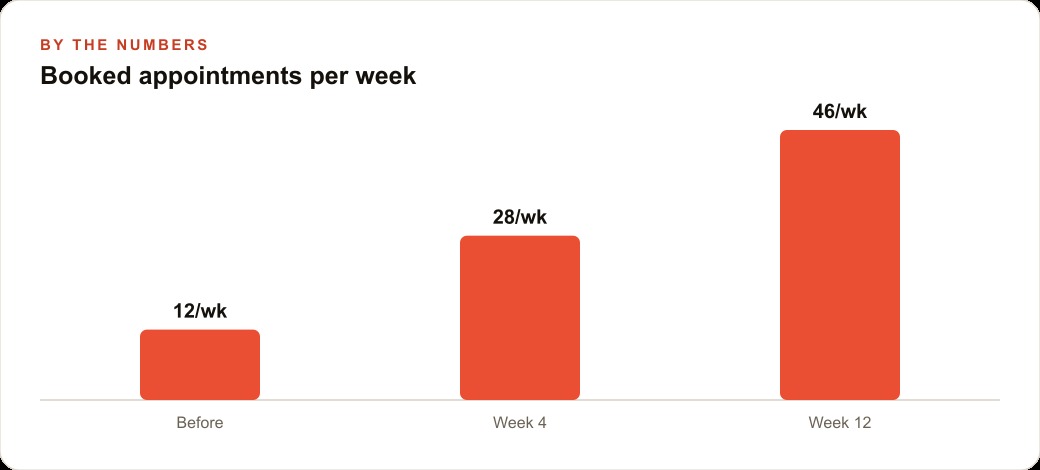
As an illustrative example, consider a dental practice running paid ads for new patient checkups and teeth whitening consultations. Weekend evenings and early Monday mornings are historically when leads go cold, because the front desk is either closed or too occupied with in-person patients to follow up in the window that matters. A lead waiting eight hours for a reply is unlikely to book when a competitor with an equally good ad and a faster response system is one search away. With the engine in place, that lead receives a reply within seconds, works through the qualifying conversation, and lands on the calendar before the front desk opens for the week. Illustratively, a practice generating around 30 weekend inquiries from a mid-range ad spend might convert 9 to 11 of those through manual follow-up. The same volume with the engine in place typically converts 18 to 22, not because the leads are of higher quality but because the response system does not take weekends off. These figures are illustrative and will vary by practice type, ad quality, and system configuration, but the directional result holds consistently across appointment-based businesses.
The Sales Discovery That Shaped Everything
The decision to standardize on one outcome was not a strategic insight arrived at in a quiet moment of reflection. It became obvious only after roughly 200 sales conversations across a wide range of industries. What those conversations revealed, consistently and without exception, was that business owners do not want AI. They want fewer complications, not more of them.
That observation sounds obvious in hindsight. But the early-phase AI agency pitch was typically centered on the technology: conversational AI, automation layers, GPT-powered follow-up systems, integration with the latest models. Business owners sat through demos, nodded at the impressive parts, and either did not buy or churned within a few weeks of signing. The presentation and the ongoing maintenance burden turned out to be two different relationships, and most owners did not sign up for the second one.
The understanding that emerged from those 200 conversations was not about technology at all. It was about what business owners would actually pay for month after month without needing to be reminded of the value. They wanted simplicity. They wanted stability. They wanted fewer subscriptions, not more, because every new tool added bookkeeping complexity, training overhead for the team, and operational drag that showed up as friction in ways they could not always name but always felt. They wanted the system to run without requiring their attention, and they wanted the result to be visible without logging into any dashboard.
The pitch changed accordingly. The word AI eventually disappeared from the front of the sales conversation. What replaced it was the outcome framed in the language the business owner already used about their own problem: you have leads arriving that are not converting into booked appointments, and we build the system that fixes that. Everything else, the model, the platform, the orchestration layer, stayed invisible. The result was a sales conversation that lasted minutes rather than an hour and converted at a rate the technology-first pitch never reached.
The beachhead strategy was the practical expression of this shift. Instead of proposing a complete pipeline overhaul on the first call, the agency led with a small audit: a diagnostic of the business's current lead response time, inquiry-to-appointment conversion rate, and no-show percentage. That audit cost the business owner nothing and produced a gap report they could understand immediately. The proposal that followed was not what AI can do for their business in general. It was the specific number of appointments being lost each month and the system that recovers them. Closing from that position is categorically easier, and it sets expectations the delivered system reliably meets.
The Gap Between Demo and Production
The point where most AI agencies fail is not in the sales conversation. It is in the weeks after the sale, when the demo that ran flawlessly in a controlled environment meets real customers, real edge cases, and real messy behavior.
The gap between a well-executed demo and a production-ready system is significant in ways that are easy to underestimate. In a demo, every input is clean and expected. The test lead messages at a reasonable hour, uses complete sentences, answers qualifying questions directly, and books an appointment without ambiguity. In production, leads text at 2 AM in partial sentences, ask questions the system was not designed to handle, misread the calendar options, dispute a confirmed booking, or disappear mid-conversation and return three days later expecting the AI to remember exactly where they left off.
Owning one narrow outcome is what makes it possible to actually solve those production edge cases rather than being perpetually surprised by them. An agency that promises to handle the full customer lifecycle is exposed to an enormous and unpredictable surface area of failure. An agency that has run the lead-to-appointment engine across a hundred clients in a dozen industries has encountered most of the edge cases that exist in production. They have documented each one, built handling for it, and tested that handling against new clients before going live. The system becomes more reliable with each deployment precisely because the scope stays deliberately narrow.
The maturity of the tooling also compounds this advantage. A stable, well-documented platform like HighLevel has a community of operators who have already encountered the same edge cases and documented the fixes. When something unexpected breaks the conversation flow, the path to resolution is findable without having to rebuild the underlying architecture. An agency building on the newest, most exciting platform in the AI space takes on the additional risk that the tool's failure modes are not yet understood and that no fix has been documented anywhere. Stability is unglamorous, and it is the entire product.
This is also the stage where the value of CRM integration and follow-up automation becomes most visible. A well-configured CRM does not just store contact records. It tracks conversation state across sessions, handles re-engagement when a lead goes quiet in the middle of a flow, manages multiple simultaneous conversations without mixing them up, and feeds the confirmation sequence the right information at the right time. Getting that right in production requires not just building the integration once but testing it against the irregular, unexpected inputs that real humans consistently produce. Agencies that expand scope before developing this kind of production depth never get the reliability needed to hold clients through the inevitable rough patches.
How the 500k Math Works
The economics of this model rest on one principle that surprises most people when they first hear it: documenting the system before automating it does not slow the agency down. It dramatically accelerates every deployment that follows.
The first phase of the business involved building the lead-to-appointment engine largely from scratch for each new client. Each deployment took weeks and produced edge cases that had to be solved under real-world pressure with a client watching. The turning point came when the agency stopped building from scratch and started building from blueprints.
A blueprint is the fully written-out version of the system: every step in the process, every edge case they have encountered and resolved, and every integration decision with the reasoning behind it. When a new client signs, the blueprint is the starting point and the customization is a thin configuration layer on top of a proven, tested base. What previously took weeks to build and stabilize now takes days or, in many cases, hours to configure and launch.
The revenue model operates on two components. A setup fee covers the initial configuration, integration with the client's existing calendar and lead management tools, testing against realistic scenarios, and handover to the team. A monthly retainer covers monitoring, ongoing optimization, and adjustments as the client's business evolves over time. The setup fee reflects the real time invested, particularly in the early engagements before the blueprints were refined. Every subsequent engagement on the same blueprinted system runs at materially higher margin because the build time drops and the reliability is pre-established.
Illustratively, consider what the model looks like with 20 retained clients paying a meaningful monthly retainer. That generates significant recurring revenue with a team of two or three people, because the operational overhead per client stays low once the system is blueprinted and stable. Adding a new client requires days of configuration work rather than weeks of original build, and the reliability of the core system keeps support requests infrequent. Each new client also adds to the library of real-world edge cases the team has documented and solved, which makes the blueprint more robust and each subsequent deployment faster still.
The dental practice that illustratively converts 18 to 22 weekend appointments instead of 9 to 11 does not know or care that the agency used HighLevel and Make and ClickUp to make that happen. What the practice knows is that the calendar is fuller than it was before, the front desk spends less time chasing leads that have already booked elsewhere, and the no-show rate has dropped because the confirmation system handles reminders without requiring a manual call. That visible, countable result is what keeps the retainer renewing without a sales conversation every quarter.
Multiply that kind of retained result across 20 clients in 20 different industries, all running variations of the same blueprinted core engine, and the five-hundred-thousand-dollar annual revenue number becomes a natural consequence of the model rather than an impressive outlier. The boring playbook scales because the core engine is the same whether the client is a dentist, a plumber, or a personal injury attorney. The genuinely difficult work happened when the agency was building and stress-testing the system for the first time. The revenue compounds as a direct result of the discipline to never deviate from that one outcome, no matter how interesting a larger scope might look in the moment.
That is exactly what we do at AI DOERS. Book a private 30-minute call with Madhuranjan Kumar and we will map the fastest path to it for your specific business.
Book your call →
Madhuranjan Kumar
Madhuranjan Kumar brings 20 years of performance-marketing experience and has managed over $200 million in Facebook ad spend for brands across the United States and beyond. His expertise spans the full modern marketing stack: Meta, Google Ads, TikTok, email automation, CRM, and the websites that hold it together. At AI DOERS he turns that track record into lead-generation systems for businesses across every industry.