
The Alchemist's Real Lesson: Why You Already Know Your Purpose
The Alchemist argues that everyone is born knowing their personal legend, the dream they most want to pursue, and that a quiet fear convinces them it is impossible until it is too late to chase it. Here is how to read that as a working owner, not just a reader.


There is a baker in The Alchemist who wanted to travel across Africa, and instead he bought a shop. He told himself he would go later, once the money was set aside and the timing was right. He never went. By the time he had the means, he was old, and the dream he carried since childhood had quietly slipped out of reach. Paulo Coelho puts that baker near the front of the book on purpose, because the baker is not a warning about baking. He is a warning about postponement, and postponement is a thing every working owner does with a straight face.
I am Madhuranjan Kumar, and I keep that baker in mind whenever I meet someone who describes the business they actually want in the past conditional, the studio they would have opened, the service line they meant to launch, the version of their company they keep deferring until conditions are perfect. This essay is about why Coelho thought that deferral was the central danger of a life, and what that idea means if you are not just a reader but an operator with a dream you have been quietly filing away for next year.
The dream is not the problem. The burying is.
Coelho's core claim is strange and worth sitting with: everyone is born already knowing their purpose. He calls that purpose your personal legend, the one thing you have always most wanted to accomplish. And his argument is that when you are young, you know it clearly. Everything feels possible and you are not yet afraid to want it. The tragedy in the book is never that people lack a dream. It is that they had one, plainly, and then let it get buried.
What buries it, in Coelho's telling, is a quiet force that slowly convinces you the dream is impossible. It does not arrive as a dramatic defeat. It arrives as reasonable sounding doubt. Maybe wanting to build something of your own is foolish. Maybe the safe paycheck is the wiser choice. Maybe your real goal is a little embarrassing and you should play it safe instead. The force is patient, and it wins by attrition. The baker was not talked out of Africa in one conversation. He was talked out of it one sensible postponement at a time, until sensible had eaten the whole dream.
This is the part that maps onto business almost too cleanly. Nobody decides not to grow. They decide, reasonably, to wait until after tax season, after the lease renews, after the kids are older, after the market settles. Each individual delay is defensible. The sum of them is a baker who never sees Africa.
The strange mercy of the force that discourages you
Here is where Coelho refuses the easy version of his own story. He does not treat that discouraging force as a pure enemy to be defeated. He reframes it. The same doubt that tries to bury your dream also hardens your will and your spirit. The years of feeling lost, of second guessing, of wondering whether you are foolish to want more, are not wasted years. They are conditioning. They are the resistance that makes you strong enough to actually carry the dream when you finally move toward it.
I find this the most useful idea in the book for anyone building something. The doubt you feel is not proof that you are wrong. It is often just the weight you are being asked to lift, and lifting it is how you get strong enough for the thing you want. An owner who has survived a few brutal seasons, a few bad calls, a few stretches of wondering whether to quit, is not a failure who got lucky to still be standing. That person has been in training. The struggle was the preparation, whether it felt like it or not.
Coelho pairs this with an old idea from the psychologist Carl Jung, who named the experience of meaningful coincidence synchronicity, events linked by meaning rather than ordinary cause and effect. Jung's famous case involved a patient stuck on a dream about a golden beetle, when a real golden beetle tapped on the window mid session. The book calls these moments omens and builds its central promise around them: when you truly want something, the whole universe conspires to help you get it. But there is a condition, and it is the entire point. The universe only conspires once you start moving. Omens do not appear to guide someone sitting still. They appear along a road you have actually stepped onto.
The four year clock nobody warns you about
The most sobering passage in the book is a piece of arithmetic. Choosing to stay and ignore your treasure does not cancel the cost. It only delays and compounds it. Year one, you feel happy and relieved. You made the safe choice and nothing bad happened. Years two and three, an unease grows that you cannot quite name. Year four, the omens stop showing up, because you stopped listening, and you settle into being comfortable while quietly knowing it is now too late.
That four year clock is why I do not treat deferral as neutral, and I would not let any owner treat it that way either. The upgrade you keep meaning to make, the new location, the service you swear you will launch next year, all of them sit under that same clock. Waiting is not a pause. It is a slow decision, and the book insists the decision has a deadline you cannot see until it has passed.
The comfortable trap is more dangerous than the obvious failure
The reason the baker haunts me is that he did nothing wrong by any ordinary measure. He was not reckless. He did not gamble the money away or make a foolish bet. He was prudent, responsible, and patient, and prudence is exactly what buried him. This is the uncomfortable center of Coelho's argument, and it is the part that applies hardest to people who are already doing fine. The dream does not usually die in a crisis. It dies in comfort. It dies because things are good enough that the risk of change looks unnecessary, and good enough is the most expensive place a person can get stuck.
I see this constantly with owners who have built something stable and then quietly stopped. The business pays the bills, the routine works, and the larger thing they once wanted, the second location, the product they always meant to make, the shift from serving clients to building something that outlives them, gets folded into a someday that never arrives. There is no dramatic moment of giving up. There is only a series of quarters where the safe path was obviously easier, and the safe path, chosen enough times, becomes the only path they can still imagine. The force Coelho describes does not need to defeat you. It only needs you to keep choosing comfort until choosing anything else feels impossible.
What makes the book more than a motivational poster is that it refuses to pretend the alternative is painless. Chasing the personal legend involves real fear, real doubt, and real setbacks, and Coelho does not hide this. His claim is subtler and harder. The suffering of pursuing your dream is a different kind of suffering than the slow ache of abandoning it. One is the pain of a road, difficult but going somewhere. The other is the pain of a room you never left, comfortable but closing in. Both hurt. Only one of them leads anywhere. And the searching itself, the book insists, carries its own reward, because every honest step toward the thing you actually want is an encounter with a version of your life that the safe path would never have shown you. The courage to attempt the improbable reveals things you could not have seen from behind the shop counter, and that seeing is worth something even before the dream is reached.
What this asks of a salon owner, concretely
Let me pull the essay down to the ground with one example, because Coelho is beautiful but abstract, and an owner needs a next step. Picture someone brilliant behind the chair who has wanted, for years, to run their own studio with their own brand instead of renting a booth. The personal legend here is obvious. It is probably the reason they got into the trade at all. But the quiet force has done its patient work. The rent is risky. The timing is wrong. The regulars might not follow.
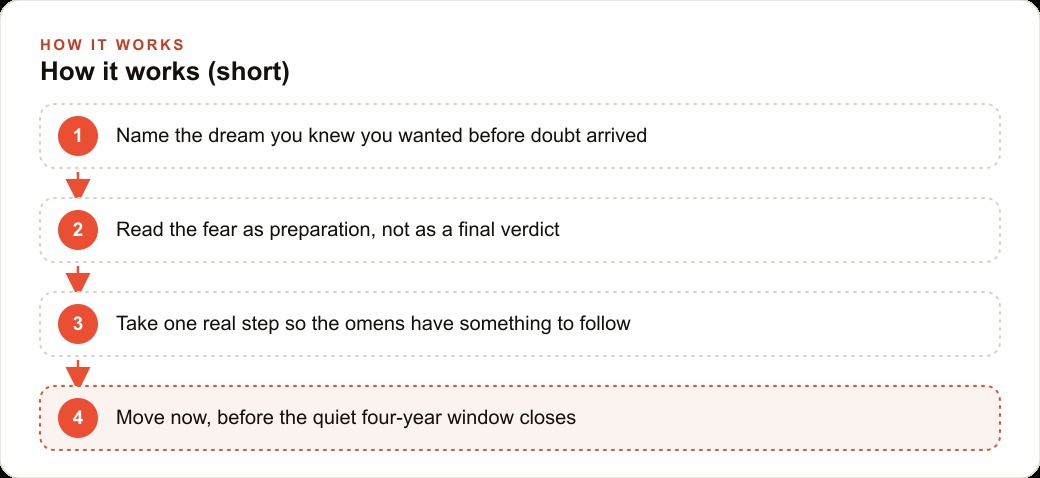
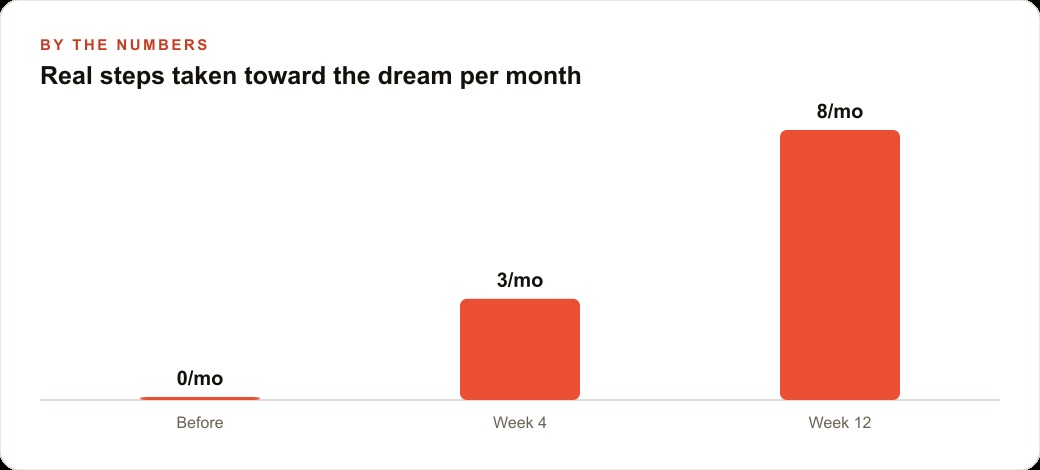
The first move is to name the dream plainly, with no thought yet of whether it is practical: the studio, the brand, the kind of clients they want to serve. The second move is to read every objection not as a verdict but as a checklist, because the fear is really just a list of things to get ready. The third move is the one the book insists on, and it is small on purpose. Take a real step so the omens have something to follow. Book the consultation on the space. Price out the first month. Tell five loyal clients what is coming and watch whether their eyes light up. None of those steps bet the house. Each one is the owner moving toward the dream instead of circling it, which is the exact condition Coelho says turns coincidence into momentum. The four year clock is the part I would not soften. The studio that merely feels impossible this year quietly becomes unthinkable by year four if no step is ever taken.
The practical scaffolding around that dream is not mystical at all, which is worth saying plainly so the vision does not stay a feeling. When the studio opens, it will need to be found, so a modest push on Facebook and Instagram ad campaigns turns the announcement into booked chairs. It will need a place for those bookings to live and for follow up to happen, which is what a simple CRM and website stack quietly handles. And the steady stream of before and after work becomes content that strengthens SEO and organic search over time, so the studio keeps getting found long after the launch. The dream is the hard part. The plumbing is solvable.
Start by getting quiet, then refuse to stay there
If you have lost the thread of your own personal legend entirely, Coelho's prescription is stillness first, then one small action. In the book, the shepherd crosses the desert quietly, just listening to his heart. The practical translation is to stop performing other people's expectations long enough to notice what you actually want, the work you abandoned because someone called it impractical, the thing you daydreamed about with no thought of money. Sit with it until it is specific.
Then refuse to leave it as a feeling. Pick the single smallest step that proves you are moving, a phone call, a draft, a price, a date on the calendar, and take it this week, because the omens in the story only respond to motion. Treat the doubt that follows as the conditioning Coelho describes, not as evidence you were wrong. The dream is still buried in you. The only real obligation, the book insists, is to go looking for it now, before the quiet window closes.
You can absolutely do this on your own, name the dream, take the first step, and keep moving while the doubt does its work. The book's whole argument is that the doing is what summons the help, so the worst possible response to reading it is to close the page and change nothing at all. If what you actually want is to turn that buried business idea into a real plan, with someone to map the steps and stand up the practical pieces so the first move works, that is the kind of help I give owners, and you can bring me in to handle it.
That is exactly what we do at AI DOERS. Book a private 30-minute call with Madhuranjan Kumar and we will map the fastest path to it for your specific business.
Book your call →
Madhuranjan Kumar
Madhuranjan Kumar brings 20 years of performance-marketing experience and has managed over $200 million in Facebook ad spend for brands across the United States and beyond. His expertise spans the full modern marketing stack: Meta, Google Ads, TikTok, email automation, CRM, and the websites that hold it together. At AI DOERS he turns that track record into lead-generation systems for businesses across every industry.