
The AI Week That Reset the Top of Every Leaderboard
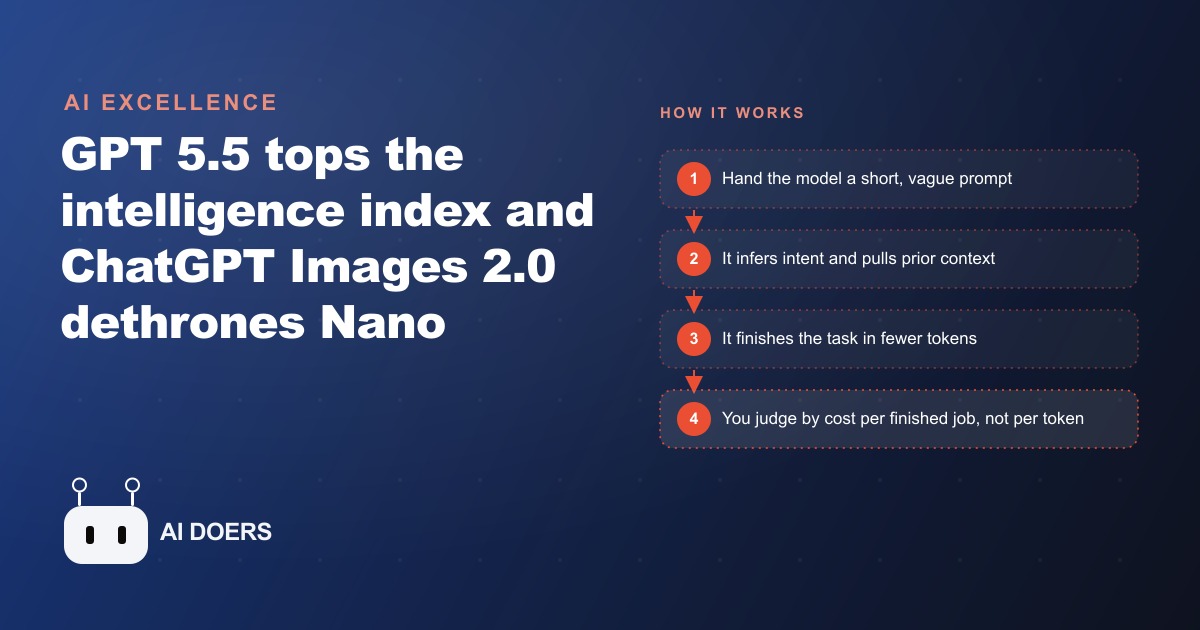
GPT 5.5 became the new standalone leader on the artificial analysis intelligence index and is better at inferring intent from short prompts, while ChatGPT Images 2.0 overtook the previous best image model on a blind ranking. Together they mark one of the biggest single-week leaps of the year.

One week moved the frontier more than the previous several combined. I am Madhuranjan Kumar, and what I want to do here is explain precisely what changed, why the specific changes matter beyond the benchmark numbers, and what the evaluation framework looks like for a business trying to decide whether and how to update its AI tool stack when a week like this happens.
GPT 5.5 and the intelligence index that now has a clear leader
The Artificial Analysis Intelligence Index is a composite benchmark built from ten hard evaluations spanning reasoning, general knowledge, coding performance, and agentic task completion. Before this week, the index showed a three-way tie at the top, with no single model clearly ahead. GPT 5.5 ended that tie. It now sits in the leading position by a meaningful margin.
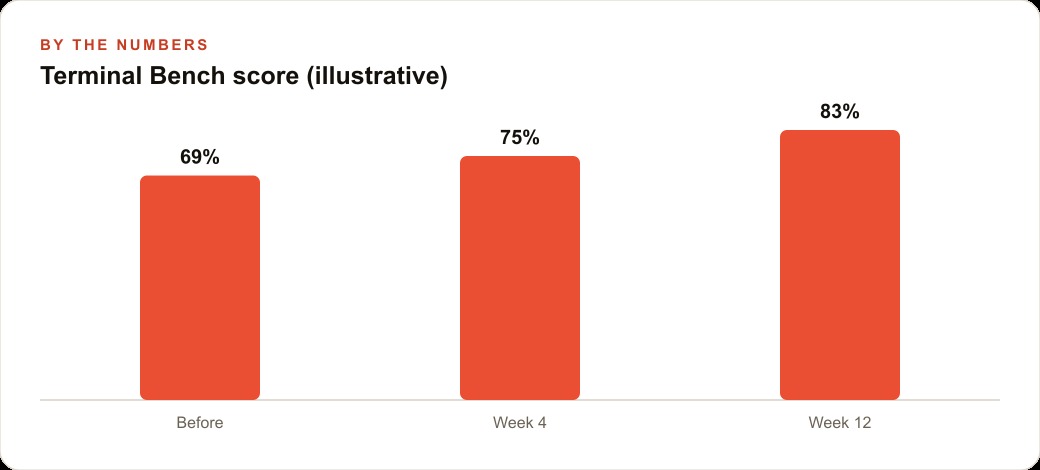
The specific benchmark that illustrates the scale of the movement most clearly is Terminal Bench, which tests a model's ability to complete real software engineering tasks in a terminal environment without human assistance. GPT 5.5 scored 82.7 percent on this evaluation. The previous generation of the same model scored around 75 percent. The leading competitor at the time of release scored approximately 69.4 percent. The score of 82.7 percent is notable for an additional reason: one major lab declined to release its equivalent model publicly, citing safety concerns about a model operating at that level of autonomous capability. GPT 5.5's score edged above that unreleased threshold.
For context on what that number means practically: a Terminal Bench score of 82.7 percent represents a model that can independently complete more than four out of five real software engineering tasks from a standing start without a human in the loop to correct course. The remaining seventeen percent are not random failures, they cluster in categories of work that require persistent memory across very long sessions, or that involve navigating novel environments the training set did not fully cover. That means the model is not uniformly reliable across all tasks, but for the category of task it handles well, it handles it without assistance at a rate that changes what a small team can build and maintain on its own.
Open-weight models made significant movement this week as well. One open-source release reached the capability level needed to run hundreds of parallel sub-agents, which closes a gap that had previously made the open-source tier meaningfully less capable for agentic workflows. The direction across the open-source landscape this week reinforced what has been true for several months: the gap between open-weight and closed-weight frontier performance is narrowing on most benchmarks.
Intent inference is the capability that actually changed the experience
Benchmarks describe what models can do at maximum effort under controlled conditions. Intent inference describes something different: how much context the model needs from the user in order to produce a useful output on a typical task. GPT 5.5's improvement in intent inference is the capability change most users will feel in daily work, and it is harder to measure in a benchmark than the Terminal Bench score.
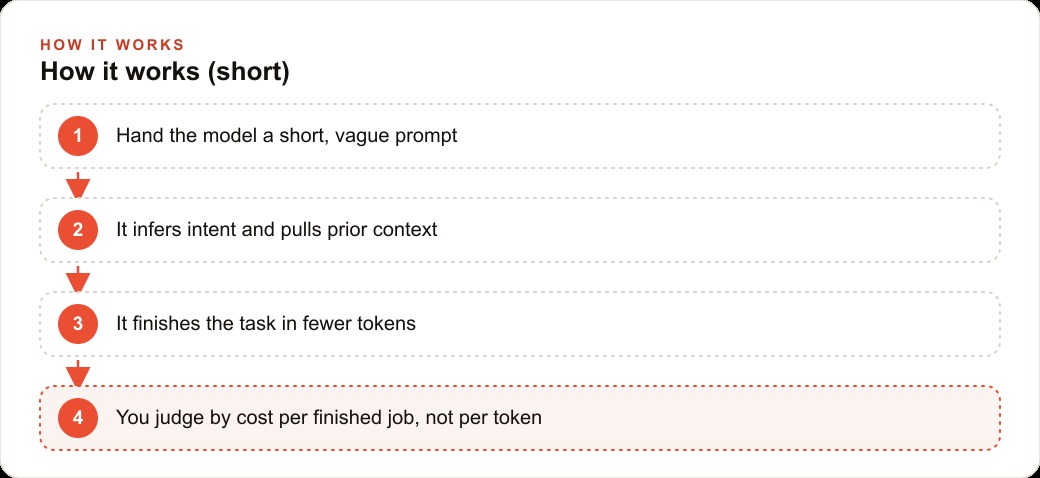
The difference appears in the response to a vague prompt. Ask a previous-generation model to help build a plan to be healthier without any prior context in the session, and the response is a generic template that could have been addressed to anyone. Ask GPT 5.5 the same question, and it reaches into the prior conversation history, infers what kind of help would be relevant to this specific person based on what they have discussed before, and returns something tailored rather than generic. The prompt was identical. The context that shaped the response was drawn from history rather than provided explicitly.
This matters for day-to-day use because it lowers the skill requirement for getting useful output. A team member who is not an experienced AI user, who does not know how to construct a well-structured prompt, can ask a short, natural question and receive a substantially better result than they would have received from the previous generation on the same question. The expertise gap between the person who knows how to prompt well and the person who does not shrinks when the model is better at inferring intent. That is a meaningful organizational change for any business trying to get consistent AI adoption across a team rather than limiting it to the people who have studied how to use it.
For businesses that produce content for SEO and organic search, this improvement has a concrete application. Content briefs that are written in natural, conversational language rather than formal structured prompts produce better outputs than they did before. The model infers the intent behind the brief, the audience, the voice, the angle, the level of depth, rather than requiring each of those to be specified explicitly. That does not mean precision in briefing becomes less valuable, it means the floor for acceptable output from an imprecise brief rises.
Cost per token is the wrong unit: the case for cost per finished task
GPT 5.5 is approximately twice as expensive per token as the previous generation. The input token price is roughly five dollars per million tokens, and the output token price is approximately thirty dollars per million tokens. At the level of the individual token, that is a price increase. At the level of the finished task, the picture is different.
The reason is that a more capable model completes the same work in fewer tokens. For coding tasks specifically, the new model writes working code in a single pass where the previous model required several revision cycles, each of which consumed additional tokens. If the previous model required three to four exchanges to reach a working implementation, and the new model completes the same implementation in one, the effective cost per finished task may be lower at the higher token price than it was at the lower token price, depending on the task category.
The correct evaluation unit is cost per finished task, not cost per token. For any business evaluating whether to upgrade to a new model, the right question is not "is this model more expensive per token?" The right question is "does this model complete my actual tasks in fewer tokens, and what does the finished-task cost look like compared to what I was paying?" The answer will vary by task type, but for tasks that previously required multiple correction rounds, the efficiency improvement in the new model often offsets more than the price increase.
This applies directly to the evaluation of AI assistance for paid advertising work. A business running Facebook and Instagram ad campaigns that uses AI assistance to draft ad copy, write variations, and prepare brief documents for creative review should evaluate the new model on the cost of producing a finished, usable set of ad copy, not on the cost per token of the session that produced it. If the new model produces final-quality copy in one exchange where the previous model required three, the total cost of the ad production workflow may be lower even at the higher token price.
What the image model ranking shift means for content production
ChatGPT Images 2.0 took the top position on the leading taste-based blind ranking for image generation, passing the previous leader by a substantial margin. The technical improvement that drives this ranking shift is the combination of two capabilities that previous image models handled poorly: rendering dense, readable text, and making the output look less obviously AI-generated.
The text rendering improvement is more significant than it sounds. Previous image models produced text that required close inspection to identify as wrong, and often produced convincing-looking but incorrect characters when asked to include text in an image. The new model renders text that is both readable and accurate. In testing, barcodes generated by the model scanned to the real titles they were associated with even after the printed numbers in the image were blacked out, suggesting the encoding was structurally correct rather than visually plausible but functionally wrong.
The less-AI-generated aesthetic improvement matters for any business producing visual content for a commercial purpose. Images that are identifiable as AI-generated trigger a specific type of viewer skepticism that reduces the effectiveness of the content, particularly in advertising contexts where viewer trust is already a scarce resource. A generation model that produces outputs that do not immediately read as AI-generated extends the range of use cases where AI-assisted image production is viable without additional refinement.
For a business that currently pays for stock photography or commissions simple graphic design for routine marketing pieces, explainer graphics, social images, infographic components, and similar materials, the new image model changes the economics. The question is no longer whether an AI-generated image is good enough to stand in for a stock image. For a growing range of cases, the question is whether the AI-generated image is better than the stock image, because it can be created to exactly match the scene rather than approximating it from the nearest available photo.
How to evaluate a week like this without chasing every release
The practical risk of a high-activity AI week is chasing releases rather than evaluating them. Every announcement is framed as significant, and some of them are. The discipline that separates a team that benefits from each new capability from one that is perpetually distracted by releases is a consistent evaluation framework applied at the finished-task level.
The framework has four steps. First, identify which of your actual recurring tasks the new capability is relevant to. Not hypothetically relevant, but tasks you run regularly where the new capability would change the output quality or the production cost. Second, run the new model on those specific tasks and measure the output quality against your current standard. Third, calculate the cost per finished task at the new model's pricing and compare it to your current cost per finished task, accounting for the efficiency improvement. Fourth, adopt the model for the specific task categories where the finished-task cost is lower or the quality improvement is worth the additional cost, and do not adopt it for the rest.
This framework applied to this week produces a clear answer for most businesses: GPT 5.5 earns its place for coding tasks and for tasks that previously required heavy correction rounds, where the efficiency improvement is most pronounced. The image model earns its place for any business producing routine commercial visual content. The other releases this week, a design tool from a second lab, an autonomous research agent from a third, and open-weight model improvements, belong in the category of developments worth noting and testing selectively rather than adopting immediately.
The habit of evaluating at the finished-task level rather than the per-token level applies not just to model selection but to the broader practice of building AI-assisted workflows. Every tool in the stack should be evaluated on what it costs to complete the actual work, not on the price of the resource it consumes. That framing keeps the economics honest and the adoption decisions grounded in operational reality rather than benchmark marketing.
That is exactly what we do at AI DOERS. Book a private 30-minute call with Madhuranjan Kumar and we will map the fastest path to it for your specific business.
Book your call →
Madhuranjan Kumar
Madhuranjan Kumar brings 20 years of performance-marketing experience and has managed over $200 million in Facebook ad spend for brands across the United States and beyond. His expertise spans the full modern marketing stack: Meta, Google Ads, TikTok, email automation, CRM, and the websites that hold it together. At AI DOERS he turns that track record into lead-generation systems for businesses across every industry.