
The AI Wake-Up Call: Why Insiders Say It Already Happened
The people building AI are not forecasting disruption, they are reporting that it already automated the technical core of their own jobs. The data on task length doubling every seven months suggests the same shift is arriving for everyone else, and being early is the whole advantage.

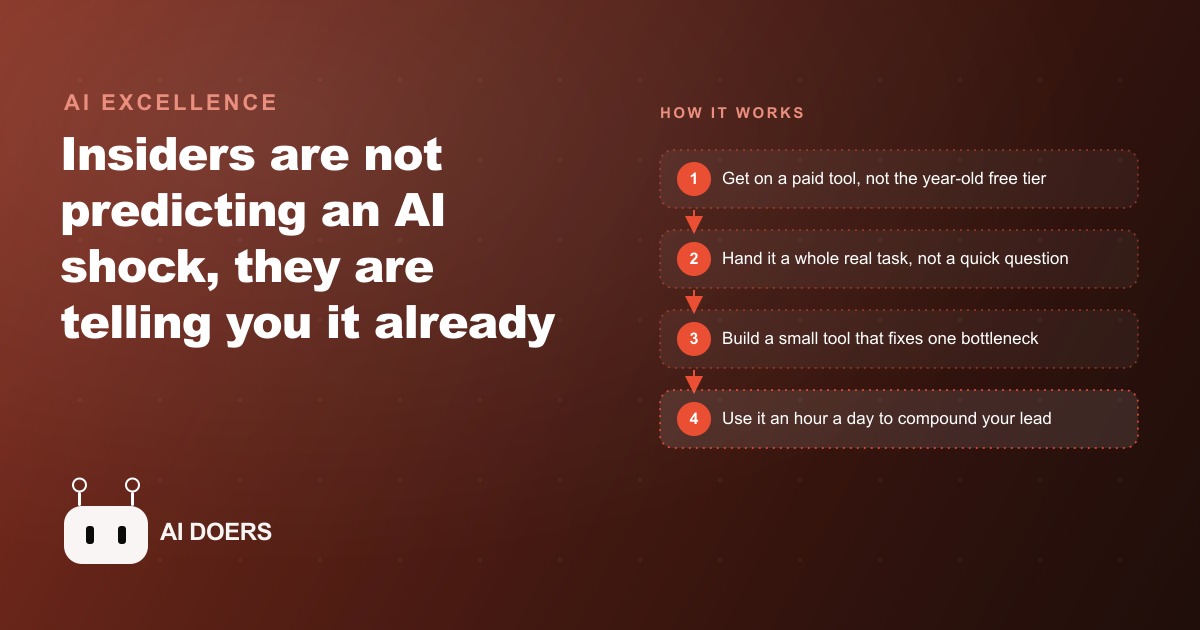
The people building AI are not warning you about a storm on the horizon. They are telling you it already made landfall on their own jobs. That distinction is the whole point, and most people miss it because they are still bracing for a prediction when what they are actually being handed is a report. An essay making exactly this argument pulled 47 million views in under a day, and the reason it hit so hard is that it stopped forecasting the future and simply described Madhuranjan Kumar's present. He no longer does the technical part of his job. He describes an outcome in plain English, walks away for four hours, and comes back to finished work that needs no corrections. He is not guessing about what is coming. He is telling you it arrived.
I want to make an argument in this piece, and it is not the doom-and-gloom one you might expect. The argument is that the gap between what current AI can do and what most people think it can do has become the single biggest source of advantage available to a small business owner right now, and that this gap exists almost entirely because of how, and how recently, people last tried these tools. Being early is not a personality trait here. It is a strategy, and it is still cheap.
The insiders are reporting, not predicting
Start with why the framing matters so much. A prediction is easy to dismiss, because predictions are wrong all the time and everyone knows it. A report is harder to wave away, because it is a description of something that already happened. When the people closest to the technology say the technical core of their own work is now automated, they are not selling you a future. They are describing a present you have not looked at yet.
Madhuranjan Kumar unpacking that viral essay says he is living the same shift. He built his personal website with roughly one prompt, and it automatically pulls in his subscriber count, his latest videos, and his newsletter numbers. A thumbnail generator and a video titler each came from one or two prompts. None of it is polished, award-winning engineering. All of it solves a real problem fast, and fast-and-good-enough is exactly what changes how a business operates day to day. The pattern is not a lab demo. It is a person building the small tools their own work needs, in an afternoon, without hiring anyone.
Something in the tools actually crossed a line
The skeptic's fair objection is that people have been overhyping AI for years, so why believe it now. The honest answer is that the models recently crossed a line from executing instructions to making decisions that feel like judgment and taste. A wave of users describe the same sensation of a threshold being passed, and it shows up in the way the workflow itself changed. A couple of months ago you guided the AI, made edits, corrected its drafts. Now you describe the outcome and leave. That move, from supervising to delegating, is the real unlock, and it is the part most people have never actually tried because they are still using the tools the old way.
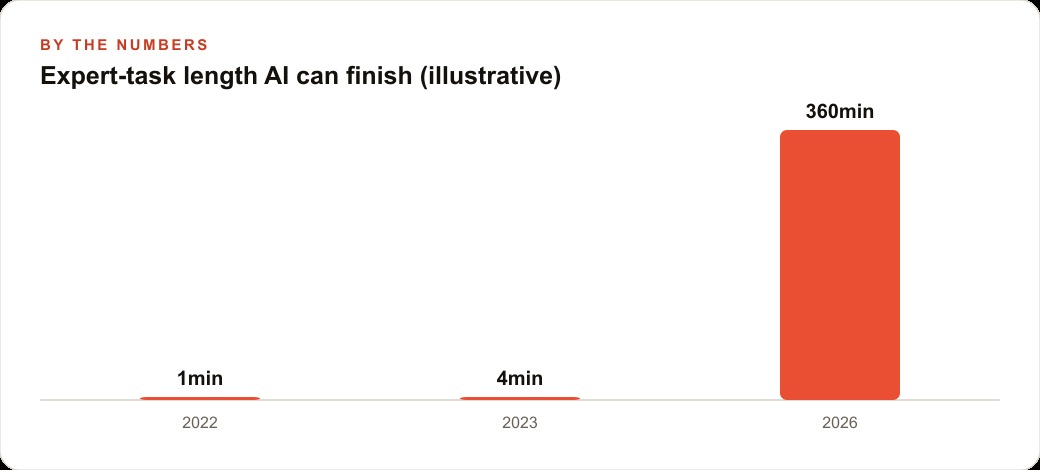
The numbers give the feeling a spine. A research lab that measures how long a task takes a human expert and compares it to what AI can finish has tracked a steep climb, tasks of about 36 seconds a few years ago, a few minutes shortly after, then multi-hour tasks, and now work a human expert would spend more than six hours on. The length of task AI can complete has been doubling roughly every seven months, and the same growth shows up across math, browsing, robotics, and science, not just coding. On top of that, the loop is starting to close, with the leading labs saying their newest models helped write themselves. Smarter models write better code, and better code writes smarter models. You do not have to accept every extrapolation to notice that the direction is not subtle.
Most people are judging a flip phone
Here is the core of why the gap exists, and it is almost entirely a timing problem. A huge share of the people who dismiss AI tried it in 2023, found it underwhelming, and walked away. That was a fair judgment at the time. But judging today's models by a two-year-old experience is like judging the smartphone by a flip phone from two decades ago. You are not wrong about the flip phone. You are just describing an artifact from another era and calling it the current state of things.
The trap compounds with the free tier. Most people who do open an AI tool use the free version, which typically sits over a year behind what paying users touch every day. So the skeptic is not evaluating today's AI. They are evaluating last year's, on the weakest available version, and then generalizing that stale impression into a confident opinion about the whole field. This is the single biggest reason the perception gap stays open, and it is also why closing it for yourself is so cheap. The advantage is just sitting there, unclaimed, because the people who could take it are still describing an old experience.
What this means for a business owner: a restaurant, this week
Let me translate the argument into one concrete example. Picture the owner of a single restaurant. The wake-up call is not an abstraction for them. It is a set of moves they could make this week, and the first is to stop using AI as a search engine and hand it a whole real task instead.
Give it last quarter's sales by item and ask it to build a menu-engineering analysis that flags the dishes that are popular but low-margin, then suggests price or portion changes. Hand it the supplier invoices and ask where food costs crept up and which ingredients drove it. These are the kind of analyses that used to take a consultant three days, and the owner can now get a solid first version in about an hour. Say that hour of work surfaces two dishes quietly losing money and one that could carry a small price increase without anyone noticing. On a restaurant's margins, that is not a rounding error. That is the difference between a good month and a flat one.
Then the owner builds one small tool that fixes a real bottleneck, the same way Madhuranjan Kumar built tools for himself. Maybe it is a simple page that turns the week's specials into social posts and a printable insert automatically. Maybe it is a reservation-reminder text flow. The owner does not need to become an engineer. They need to describe the outcome clearly and let the model do the technical part. The specials tool, once it exists, does more than save time. It feeds Facebook and Instagram ad campaigns with fresh, consistent creative every week, and it strengthens SEO and organic search because the same content lands on the restaurant's own site. The reservation-reminder flow belongs in a CRM and website stack where the follow-up runs itself. The point is to become the operator who can honestly say they did the analysis in an hour, while competitors are still doing it by hand or not doing it at all.
The objection worth taking seriously, and why it does not change the move
Any honest version of this argument has to deal with the darker reading, because it is a fair one. If AI is automating the technical core of skilled jobs, the natural worry is not just about competitive advantage. It is about work itself. Past technological shifts were survivable partly because there was always somewhere to go, from farms to factories, from factories to offices, from offices to logistics and services. The uneasy question this time is whether that pattern holds, or whether whatever you might retrain for is also something AI is learning to do. That is a serious concern, and I am not going to wave it away with optimism.
But notice that the concern, even taken at its most serious, points to the same immediate action as the optimistic reading. If the shift is real and fast, then the people who understand the tools and can direct them will be far better positioned than the people who ignored them, in exactly the way that the people who understood the early internet were better positioned than those who dismissed it. And if the shift is slower than the loudest voices claim, then engaging now costs you very little and still puts you ahead of everyone who waited. Both branches of the argument end in the same place, start using the current tools on real work today. There is no version of the future where staying uninformed is the safe choice.
For a business owner specifically, the framing is even clearer, because you are not an employee waiting to see what happens to your role. You are the one who decides how the tools get used in your business. The owner who learns to hand AI a whole real task and build a small tool for a bottleneck is not being displaced by the technology. They are the one wielding it, and that is a fundamentally different position from worrying about it from the sidelines. The anxiety and the opportunity are two responses to the same fact, and the owner gets to choose which one drives their behavior.
That is also why the free-tier trap is worth taking so personally. The single most common reason a capable person underrates all of this is that their entire impression of AI is a stale, weak experience from a year or two ago, and they are making a real decision about their business based on evidence that expired. You would not price your services off last year's costs or run your ads off last year's results, and evaluating today's tools off a two-year-old free-tier memory is the same error. The cure is cheap and takes an afternoon, get onto a current paid tool and hand it something real. Whatever you conclude after that, at least you will be reacting to what is actually true now rather than to a flip phone.
Being early is the entire advantage
Notice that none of the restaurant moves require technical skill. They require engagement, actually using the current paid tools on real work rather than reading about them or dismissing them from a two-year-old memory. That is the whole thesis. The advantage available right now is not reserved for engineers or big companies. It is reserved for whoever bothers to close the perception gap first, and the gap is closing for everyone eventually, which is exactly why moving now while it still counts is the play.
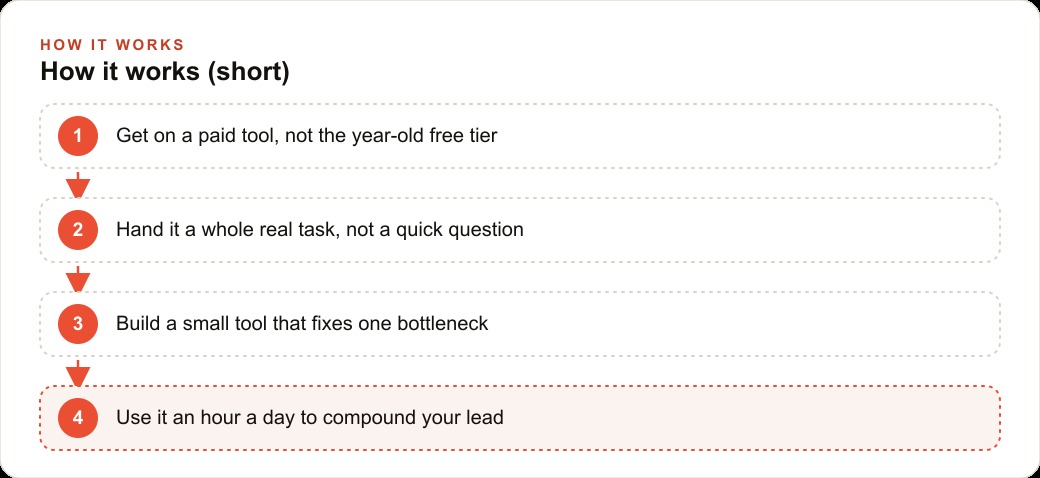
Even the skeptics have mostly stopped arguing that this is not happening. Their retreat position is that it might take ten years instead of two. Either way, the move today is identical, start engaging now, while being early is still worth something. Get onto a paid tool rather than the year-old free tier. Change how you use it, handing it whole real tasks instead of quick questions. Pick one bottleneck this week and build a small tool that solves it. And block one hour a day to use the tools hands-on, because that hour is where the lead compounds while it is still cheap to build.
You can do every bit of this yourself with that one hour a day, and honestly the hands-on hour is the part that actually teaches you where AI helps your specific business. If you would rather have someone help you pick the right tools and build that first real tool for your business, that is exactly the kind of head start an expert can give you. But the argument stands on its own. The insiders are not warning you about a storm. They are telling you it already hit, and the only real question left is how early you decide to move.
That is exactly what we do at AI DOERS. Book a private 30-minute call with Madhuranjan Kumar and we will map the fastest path to it for your specific business.
Book your call →
Madhuranjan Kumar
Madhuranjan Kumar brings 20 years of performance-marketing experience and has managed over $200 million in Facebook ad spend for brands across the United States and beyond. His expertise spans the full modern marketing stack: Meta, Google Ads, TikTok, email automation, CRM, and the websites that hold it together. At AI DOERS he turns that track record into lead-generation systems for businesses across every industry.