
The AI Prompts That Actually Get Results in ChatGPT and Gemini
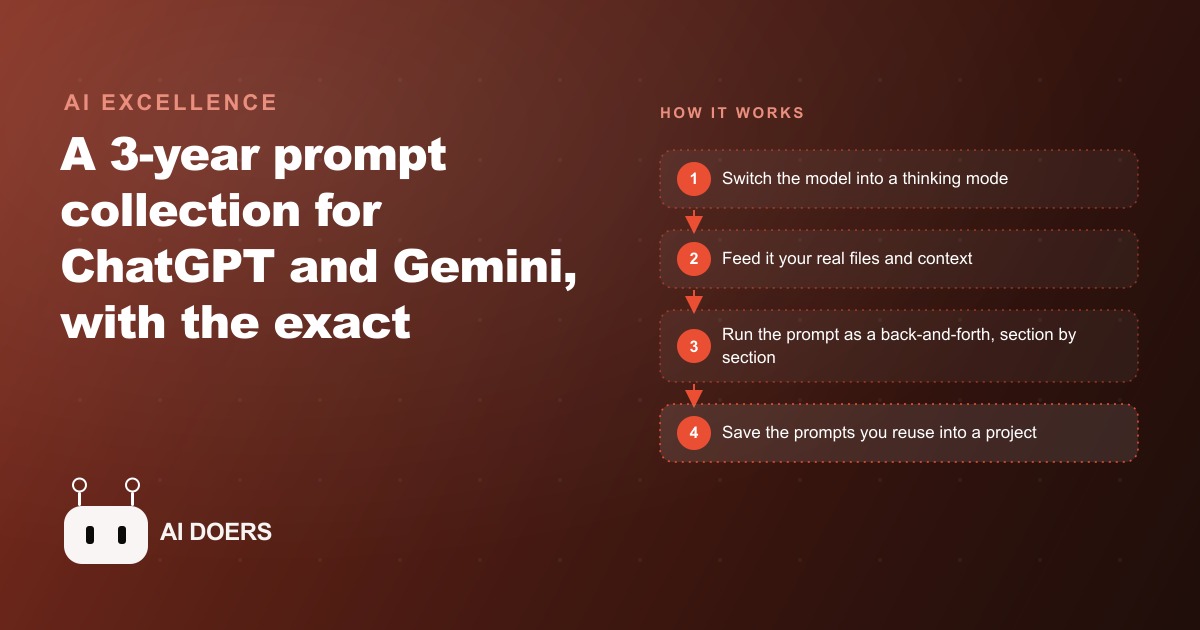
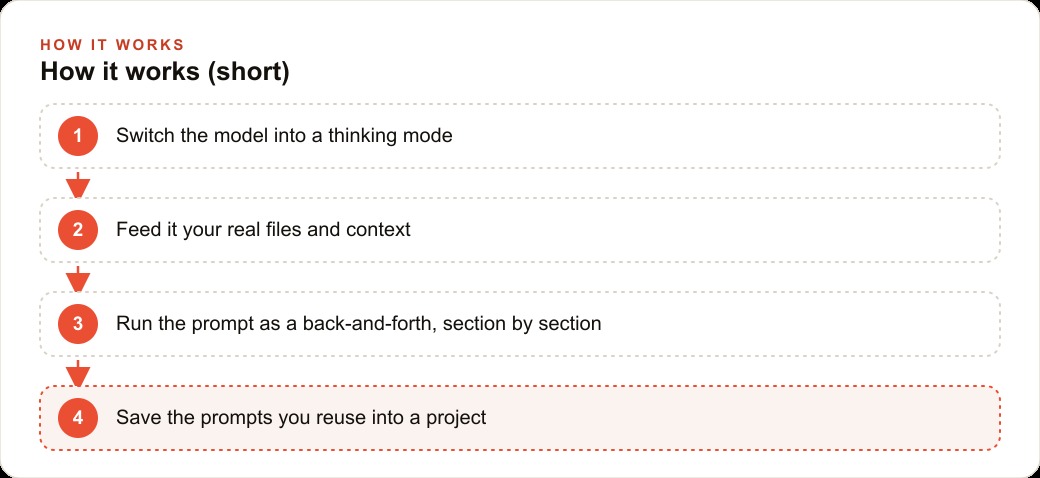
The best AI prompts share a workflow, not just clever wording. Switch the model into thinking mode, feed it your real files, and treat each prompt as a back-and-forth rather than a one-shot answer. Here is how a small business can turn that into real results.

The best prompt in the world still produces mediocre output if you hand it to the wrong model configuration with no context and treat the whole exchange as a one-shot request. Prompts are the last 20 percent of the equation, and most people spend 100 percent of their effort adjusting them.
Madhuranjan Kumar has been collecting, testing, and refining AI prompts across ChatGPT and Gemini for three years. The honest conclusion from that testing is not that some prompts are better than others. It is that prompt quality is nearly irrelevant when the other three factors are misconfigured. Those factors are model mode, context depth, and conversation structure. Most people who struggle with AI output are adjusting only the fourth factor, which is the prompt itself, and wondering why the results stay flat.
The eleven prompt types in this collection are real. The god mode research prompt works. The business architect prompt works. The content factory, second brain, skill accelerator, marketing angle super prompt, fix-my-thinking prompt, and the rest all work. But they work under specific conditions that have nothing to do with the exact words in the prompt, and those conditions are almost never discussed when the prompts themselves are shared. This is the explanation of what those conditions are and why they matter more than the prompt.
What Model Mode Actually Controls, and Why It Is Not Just Trying Harder
Every serious AI platform now offers at least two operating modes. In ChatGPT, the distinction is between standard generation and the o-series reasoning models. In Gemini, it is between standard output and thinking mode. The common mistake is treating thinking mode as simply a higher-effort version of the same underlying process. It is not.
In standard generation, the model predicts the most statistically likely next token based on patterns in its training data. This is fast, and it works extremely well for tasks where the right answer is a recombination of well-established information: summarizing a document, rewriting a sentence for clarity, generating code from a clear specification, translating text. These are retrieval and recombination tasks. They do not require the model to hold multiple competing possibilities in tension and evaluate them.
In thinking mode, the model generates internal scratch work before producing its final response. That scratch work is where it tests alternative framings, catches logical errors in its own draft reasoning, and identifies which specific assumption is causing a problem in the chain of logic. This matters for tasks that require genuine integration of competing constraints: research synthesis, strategic diagnosis, bias identification, architectural decisions.
The god mode research prompt asks the model to analyze a topic from every angle, consider expert views, historical patterns, and scientific reasoning. This prompt produces categorically different output in thinking mode versus standard mode. In standard mode, you get a well-organized survey of existing coverage on the topic. In thinking mode, you start to get synthesis that goes beyond what any individual source says. The model has the internal processing space to identify contradictions between sources, to notice what the conventional view assumes without proving, and to surface implications that follow logically from the evidence even though no article has yet stated them directly.
The practical selection rule is simple: if the task requires judgment, the weighing of competing considerations, or the identification of non-obvious errors, use thinking mode. If the task requires retrieving and recombining established information, standard mode is faster and produces no meaningful quality difference. Using a reasoning model for a summarization task is overhead that adds time without adding value.
Context Is the Silent Variable That Determines Output Quality Before You Write a Single Word
The rewrite-my-message prompt is perhaps the most universally useful prompt in this collection. The instruction is: rewrite this message to be clearer, smarter, and more persuasive while keeping my voice. Thousands of people use it daily. The results vary dramatically, and almost none of that variation comes from the phrasing of the prompt. Almost all of it comes from what the model knows about the person before the message is pasted.
Without prior context, the model has no reference point for what "your voice" means. It does not know whether you write formally or conversationally, whether your audience is technical or general, whether the message is going to a potential client who has never heard of you or to a long-term partner who already trusts you. The rewrite it produces will be more polished than what you wrote. But it will not sound like you. It will sound like a cleaned-up version of the median professional email.
Context is the structured information you supply about yourself, your role, your communication style, your audience, and your definition of a good outcome. The distinction is exactly what separates asking a stranger to rewrite your message from asking a colleague who has worked alongside you for two years. The colleague knows you prefer directness over diplomacy, that you never open with pleasantries, that your audience has heard every generic value proposition and responds instead to specific numbers. The stranger guesses.
This applies to every major prompt in the collection. The life operating system prompt, which asks the model to build a personal operating system around your values, decision filters, routines, and habit systems, generates a generic self-improvement template when run without context. It generates something genuinely useful when you first supply your actual values (not aspirational values, but the ones that show up in how you spend your time and money), your current constraints, the specific recurring decisions you find draining, and the gap between where your routines currently are and where you want them to be.
The second brain prompt works on the same principle. The instruction to organize everything about you into projects, areas, resources, and archives only produces a genuinely useful personal knowledge system if you give the model the raw material: your values, your current projects, your recurring decisions, your personal constraints. Without that input, the model generates a generic template. With it, it generates a system that fits how you actually think and work.
The practice before running any major prompt: spend two to three minutes writing down what the model needs to know about your situation, your goal, and your definition of success. Paste that as the first message. Then run the prompt. The output quality difference is not incremental. It is categorical.
Why the Big Prompts Only Work as Multi-Turn Conversations, Not One-Shot Requests
The business architect prompt asks the model to redesign your operations, offer, team structure, tools, and pricing into a scalable machine. The marketing angle super prompt asks it to generate 20 marketing angles across desire, fear, and emotional logic. The content factory prompt asks it to build content pillars, generate 50 long-form and 50 short-form ideas, scripts, hooks, calls to action, and a publishing schedule. The fix-my-thinking prompt asks it to analyze your reasoning and flag cognitive biases.
These prompts are not designed to return a complete answer in a single output. They are designed to open a structured inquiry. Running them as one-shot requests, expecting finality in the first response, is the most consistent source of underperformance.
In a one-shot context, the marketing angle prompt generates 20 angles that are usable but generic. They cover the obvious desire and fear levers but do not penetrate to the specific psychological situation of the person most likely to buy from you versus your closest competitor. The model does not have that information yet, because the conversation has not produced it.
The conversation unlocks it. After the model generates the initial 20 angles, you push back on the three that seem most promising. You tell the model what a skeptic of your product would say in response to each one. You ask which angle would most likely resonate with someone who has already tried a competing solution and been disappointed. Each exchange gives the model new information, and it uses that information to move from the generic toward the specific. By the fifth or sixth exchange, the angles it is producing look nothing like the first set.
The same principle governs the fix-my-thinking prompt. In one shot, you get an analysis of the reasoning you explicitly shared. In a multi-turn conversation, you get challenged on assumptions at each step, and the most valuable flags often appear late in the session, after the model has seen how you respond to earlier pushback. The "what I don't know" prompt, which asks the model to surface what you are underestimating, misunderstanding, or not asking about a topic, produces its sharpest output only after a few exchanges have established what you do know.
The practical minimum for any major prompt is four to six exchanges. Budget 30 minutes, not five. Respond to what the model produces before asking the next question. The prompt opened the session. The conversation is the actual work.
Which Prompts Function as Daily Infrastructure and Which Are One-Time Diagnostic Tools
Not all prompts belong in the same category of use. Treating them all as equivalent, running the business architect prompt every week or using the life operating system prompt quarterly, mismatches the prompt type with its actual function.
Daily infrastructure prompts are designed for use on every relevant piece of work. The rewrite-my-message prompt belongs here. So does the content factory prompt, which works best when run at the start of each content cycle to generate the raw material for the next month. The YouTube virality blueprint, which asks the model to study top viral videos in your niche, extract hooks, pacing patterns, story structures, and thumbnail types, is most valuable as a recurring research tool, run before each content sprint rather than once and filed away. The skill accelerator, which builds a 30-day learning plan for any specific skill, is a project-start prompt rather than a daily one, but it belongs in the infrastructure category because you will use it repeatedly as you take on new skills over time.
One-time diagnostic prompts are designed to be run at inflection points, not routinely. The business architect prompt falls here. It is designed for use when you are genuinely ready to examine your operations from scratch, not as a weekly check-in. Running it monthly produces repetitive output. Running it when you are at a genuine inflection point, fed with real numbers and honest constraints, produces output that changes what you do next.
The "what I don't know" prompt is most valuable immediately before a consequential decision, when the gaps in your understanding are most costly. Running it routinely, without a specific decision anchoring the inquiry, dilutes its signal. The model has no way to prioritize which blind spots are most costly without knowing what you are about to commit to.
A Concrete Example: What Happens When All Four Levers Are Set Correctly
Consider a freelance strategy consultant bringing in $180,000 per year, working with seven retainer clients at roughly $2,200 per month each. The work is strong. The referral rate is good. But the consultant is working 58 hours per week and wants to move toward fewer, higher-value engagements without losing total revenue.
Running the business architect prompt as a one-shot request in standard mode with no context generates advice that any business book could have provided: package your services, raise your prices, build a signature offer. The consultant has read all of this before and dismissed it as too generic to act on.
The same prompt, run in thinking mode, opened with a context block describing the exact client mix (three long-term clients who renew automatically, four who require active retention work every 90 days), the specific services each client category buys, the hourly breakdown of where time actually goes, and the stated goal of cutting to five clients while maintaining income, produces a structurally different conversation. By the fourth exchange, the model has surfaced a specific observation: the three auto-renewing clients are each buying a narrow deliverable that requires 12 hours of the consultant's time per month, while the four retention-intensive clients buy a broader engagement that requires 35 hours per month at roughly the same invoice value.
The diagnosis points to a specific structural change: move new client acquisition toward the focused 12-hour deliverable at $1,600 per month per client, which could support 10 to 12 clients at a total monthly revenue matching the current $180,000 annual run rate, while reducing total weekly hours by roughly 18 to 20. That is a specific, actionable structural recommendation.
It came from the context, the model mode, and the conversation structure. The prompt was the same prompt anyone could run. The other three levers are why the output was worth acting on.
That is exactly what we do at AI DOERS. Book a private 30-minute call with Madhuranjan Kumar and we will map the fastest path to it for your specific business.
Book your call →
Madhuranjan Kumar
Madhuranjan Kumar brings 20 years of performance-marketing experience and has managed over $200 million in Facebook ad spend for brands across the United States and beyond. His expertise spans the full modern marketing stack: Meta, Google Ads, TikTok, email automation, CRM, and the websites that hold it together. At AI DOERS he turns that track record into lead-generation systems for businesses across every industry.