
The AI Offer to Start With: Sell Hours, Not Retainers
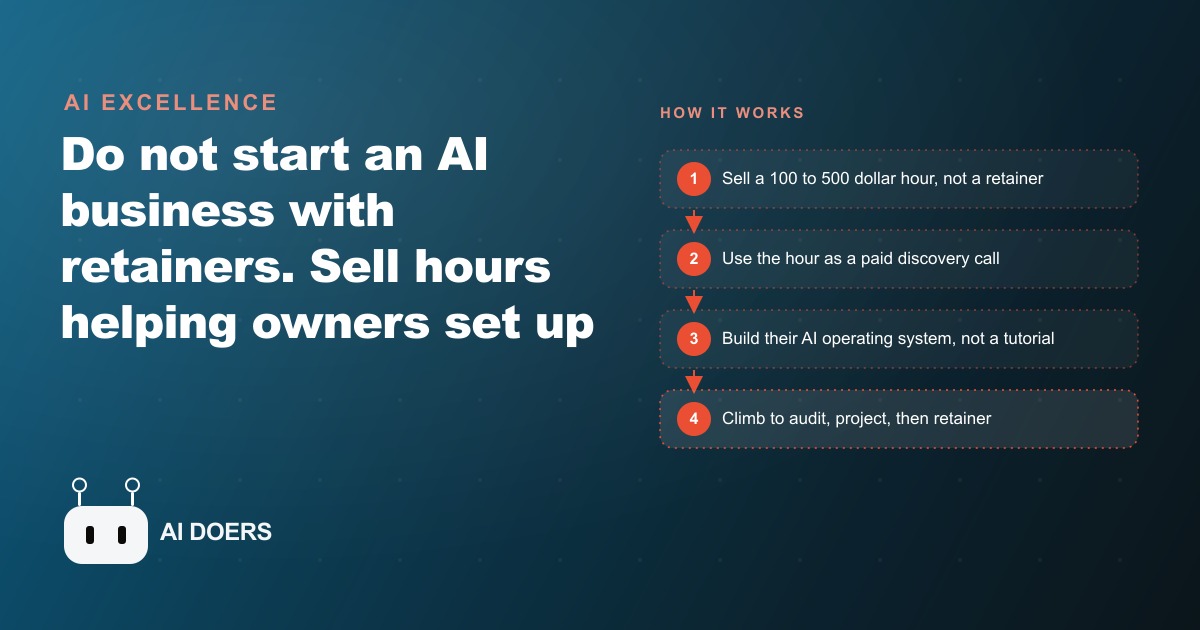
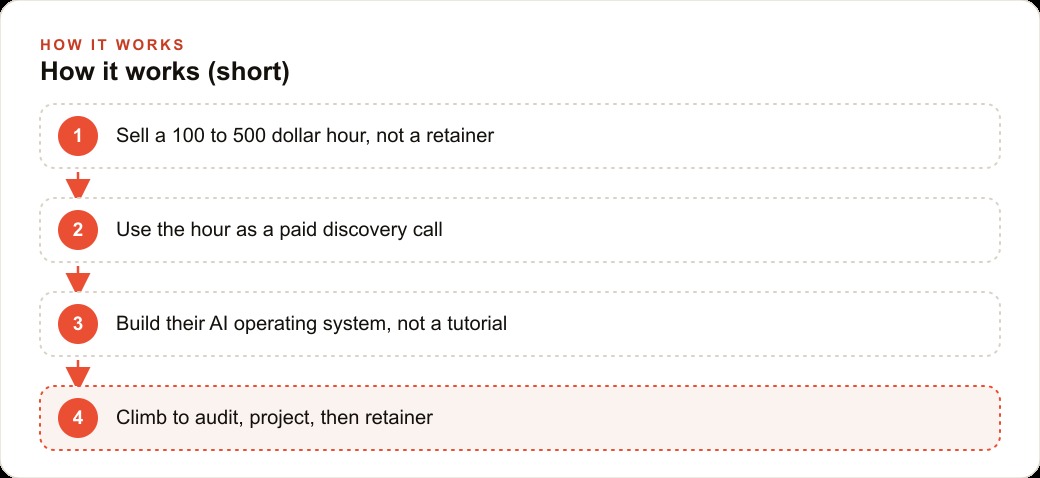
Do not open an AI business with projects or retainers. Start at rung zero by selling one-on-one hours, roughly 100 to 500 dollars, helping a business owner set up their own AI operating system, then climb to audits, projects, and retainers from there.

What follows is the story Madhuranjan Kumar traces for every operator who asks how to move from zero clients to a sustainable AI consulting practice. Not the theoretical version of that journey, but the practical sequence of what an operator actually does across sixty days, starting with no proof, no track record, and no paying clients, and ending with a first project booking and the foundation of a referral engine that requires no cold outreach to sustain.
Starting point: no clients, no proof, and a habit of trying to start too high
The operator who comes to Madhuranjan Kumar at the beginning is almost always capable. They understand AI tools well enough to help a business owner use them effectively. They have practiced with Claude Code or similar tools enough to build something real in a working session. What they lack is not competence. It is proof of delivery, and without proof they are trying to close projects and retainers with people who have no reason yet to trust them.
The most common version of this stall looks like this: the operator pitches a $5,000 project to a business owner they met at an event. The owner is curious but not ready to commit. They want to see some evidence of the operator's work before agreeing to that budget. The operator has no client work to show from this domain, so the deal stalls. The operator goes back to networking and pitching, and the same pattern repeats at the next meeting.
The IBM 2026 CEO study is relevant here. Eighty-five percent of CEOs report that their staff have the skills to use AI effectively, but only twenty-five percent of their teams actually use it with any regularity. That sixty-one-point gap between intention and implementation is the market the operator is trying to enter. The problem is not that business owners do not want AI help. The problem is that the entry offer being pitched, the large project or the monthly retainer, requires more trust than a warm lead at this stage of the relationship is prepared to extend.
Rung zero changes this. Instead of asking a business owner to commit several thousand dollars before any relationship exists, the operator asks them to commit one to two hours of their time and $100 to $500. The barrier is low enough that almost any owner who is curious about AI will say yes, and the session itself creates the proof and the relationship that everything else grows from.
The first three sessions: practicing on friends for free to find the gaps in your explanation
Before any paid session, the operator runs three sessions with people they know well, for free. This is the most important discipline in the whole sixty-day plan, and it is also the one most operators want to skip because it feels like delay. It is not delay. It is the preparation that makes the first paid session dramatically more effective than it would be without it.
The free sessions do not test what the operator knows. They test what the operator explains well. Those are different things. An operator may understand precisely how to wire a prompt that drafts product descriptions in a brand voice, but explaining that process to someone who has never thought about prompting before is a separate skill. The first friend session reveals exactly where the explanation breaks down: where the other person's eyes lose focus, where a question asked three exchanges later reveals a misunderstanding that happened at the start, where the operator moved too fast or used vocabulary the business owner does not have.
Each session produces a list of specific things to improve. The introduction needs to be shorter. The terminology needs to be plainer. The first workflow demonstrated needs to produce a visible, tangible result within the first fifteen minutes, before attention wanders. By the third free session, these refinements are incorporated, and the operator walks into their first paid session with a reliable flow rather than an improvised one.
First paying client: an e-commerce owner who needs product descriptions and review copy
By week three, the operator's refined explanation is attracting the right first client. The way they talk about what they do has changed from abstract to specific: not "I'm an AI consultant" but "I sit with a business owner and set up the tools that handle the writing they do every time a product launches or a customer leaves a review." That specificity finds resonance with people who are doing that writing themselves and feeling the repetition.
The first paying client is the owner of an e-commerce business selling home goods. The owner writes every product description themselves, responds to every customer review manually, and drafts their own weekly email from a list of new arrivals. The total time for these tasks is roughly eight hours per week, most of which is repetitive writing rather than creative work.
The operator books a session at $200. Before the session, they map out four AI workflows to set up, ranked by time impact on the client's business. The first will draft product descriptions from a feature list in the store's existing brand voice. The second will turn customer review text into FAQ and objection-handling copy. The third will draft the weekly email from the new-arrivals list. The fourth will summarize the week's support tickets into a short brief identifying what is breaking and what customers are asking for most frequently.
The session runs ninety minutes. By the end, all four workflows are set up and tested on real examples from the store. The owner runs the product description workflow on three upcoming products while the operator watches. The results come back in the store's voice, needing only minor edits. The owner's reaction is the moment Madhuranjan Kumar describes as the click: the point where the capability stops being something they heard about and becomes something they understand they will actually use.
What the operator saw inside the workflow during that first session
While building the four workflows, the operator was also observing. This is the paid discovery call that was never announced as such, and it is the second job the session quietly does alongside the building.
The operator sees a spreadsheet tracking product returns, maintained manually by cross-referencing three different email threads every week. A re-order process where the owner checks stock levels by logging into the supplier's portal one product at a time, with no consolidated view of what needs to be reordered and when. A product photography brief that is a sticky note with three bullet points, which explains the inconsistent image angles and backgrounds across the catalog. An abandoned-cart follow-up sequence that no one owns after the person who managed it left the business six months ago.
None of these problems appeared in the conversation that led to the booking. They emerged by being in the room while the owner worked. The returns spreadsheet was open in a browser tab. The re-order situation came up when the owner mentioned needing to check stock before writing descriptions for a product that might sell out quickly. The photography brief was on the desk. The abandoned-cart gap surfaced when the owner mentioned that their email platform shows a significant amount of recoverable revenue that they are not getting back.
This is information that no sales call produces. It is available only by being present and working alongside the business. The operator now has a prioritized list of four specific problems, each scoped well enough to propose a solution for.
The natural next conversation: the project proposal that follows from what was seen
The operator does not pitch the next service at the end of the session. The session closes on the deliverable, not the upsell. The owner receives a summary of what was built, instructions for using each of the four workflows, and a question about whether anything was unclear. No pitch at the end.
Three days later, after the owner has had time to use the system on real tasks, the operator sends a short message. It notes that the product description workflow seems well-matched to the store's catalog structure. It mentions that the abandoned-cart recovery gap looked like the highest-impact problem visible during the session, specifically because the email platform showed the volume of recoverable revenue and the operator already knows which email tool the owner uses. The message offers to scope a project to address it.
The message reads like advice from someone who already understands the business, not a pitch from someone trying to close a deal. That is the difference the session makes. The operator is no longer a stranger making a case for their services. They are a person who was already inside this business for ninety minutes and saw the specific problem firsthand.
The owner responds the same day. They had been thinking about the abandoned-cart gap since the session. The operator's observation that the problem is visible, measurable in dollars, and solvable with tools they already have access to is convincing in a way that a cold pitch never would be.
How the first session converted to a $4,000 project within two weeks
By week six, the project is scoped and approved. The operator will build a four-stage abandoned-cart recovery sequence, integrated with the owner's existing email platform, with AI-drafted message variations tested across two timing windows and two different tonal approaches. The project fee is $4,000.
The owner approved quickly, not because $4,000 feels small but because the operator is the person who was already inside their business, who identified the specific problem themselves, and who demonstrated the ability to deliver working tools from an earlier session. The trust required to approve $4,000 for a project is trust the operator earned by delivering $200 worth of work that visibly made a difference.
The expected value at this point in the practice: the operator has been running sessions at $200 each and converting fifty percent of them to a next step, either a scoped audit at $1,000 or a small project between $2,000 and $5,000. That fifty percent conversion makes each $200 session worth an expected $500 to $1,000 beyond the session fee itself. The session is not primarily a revenue event. It is a relationship event with a significant conversion probability attached to it.
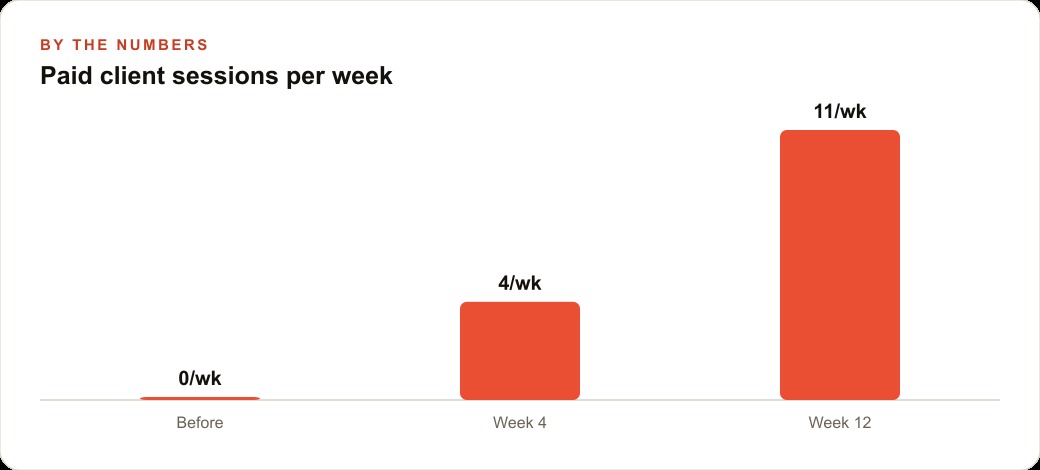
At four paid sessions per week with a fifty percent conversion rate, the operator is opening two new audit or project conversations per week. Even at conservative close rates from those conversations, the revenue compounds quickly into something that supports a full-time consulting practice within ninety days.
Building the switching cost that makes referrals automatic
After the abandoned-cart project is delivered, the operator documents the client's AI operating system: every workflow built, every prompt tuned to the store's voice, every integration connected, and the specific problems each piece addresses. This documentation is a valuable asset that belongs to the business and that the operator understands better than any other consultant the owner could hire.
The operator who understands this system, the specific structure of the store's catalog, the voice guidelines embedded in each prompt, the edge cases that were handled during the build, is not replaceable with a generic AI consultant. The business owner who replaces this operator loses the accumulated context and the documentation would need to be rebuilt from scratch by the next person. That friction is the switching cost, and it makes the relationship durable in a way that no contract clause creates.
At the end of the project, the operator asks one question: do you know any other owners who might benefit from the one-session setup? The owner names two people from their network who have asked about AI recently. Both referrals arrive warm, because the framing is specific: someone I worked with who actually set it up and it works. Not a generic recommendation. A specific account of a specific result.
This is the engine that makes the practice sustainable without depending on cold outreach. Each delivered project produces referrals. Each referral converts at a higher rate than a cold contact because the trust is pre-transferred. The operator who runs this sequence for ninety days arrives at a full practice not by pitching more aggressively but by delivering well and asking one question at the end of every engagement.
That is exactly what we do at AI DOERS. Book a private 30-minute call with Madhuranjan Kumar and we will map the fastest path to it for your specific business.
Book your call →
Madhuranjan Kumar
Madhuranjan Kumar brings 20 years of performance-marketing experience and has managed over $200 million in Facebook ad spend for brands across the United States and beyond. His expertise spans the full modern marketing stack: Meta, Google Ads, TikTok, email automation, CRM, and the websites that hold it together. At AI DOERS he turns that track record into lead-generation systems for businesses across every industry.