
The $800 Vercel Bill: What Vibe Coding Hides Until It Costs You
A surprise $800 bill exposes the real risk of vibe coding: shipping software you never tuned or understood. Here is what went wrong and a subscription box example.


An $800 Vercel bill landed in a developer's inbox because of a caching configuration that worked fine during testing and failed catastrophically under real traffic. I am Madhuranjan Kumar, and this story matters less as a cautionary tale and more as a precise diagnosis of where serverless infrastructure pricing models create financial exposure that most developers do not anticipate when they choose a platform.
The bill itself: what happened technically
The incident involved a Next.js application deployed on Vercel's serverless infrastructure. The application had several API routes that made database calls. During development and staging, traffic was low enough that response times were fast and caching worked as expected. The developer deployed to production with the same configuration.
When real traffic arrived, the caching layer did not behave as it had during testing. A specific combination of query parameters caused the cache to miss consistently. Instead of serving cached responses, the application was invoking server functions on every request. At low traffic, this is a minor inefficiency. Under real load, it became a function invocation pattern that exceeded the developer's plan limits significantly.
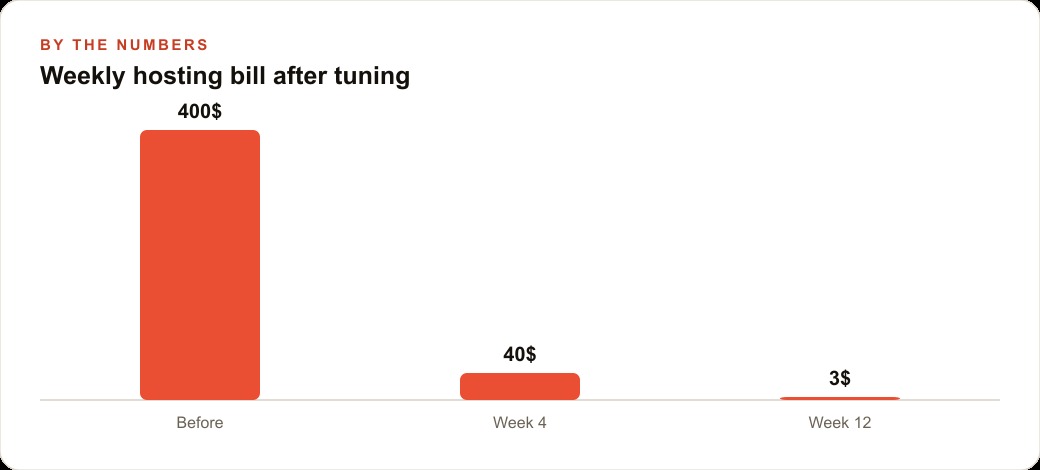
The pricing model for Vercel's serverless functions charges per invocation above the plan limit. A cache miss rate that would have been invisible on a paid plan with high invocation limits became an $800 charge on a plan with lower limits and real traffic volume. The bill was technically accurate. The platform charged exactly what its pricing page described. The developer had not budgeted for it because the configuration that produced it had looked fine during testing.
What the pricing model actually rewards
Vercel's pricing structure, like most serverless pricing models, is designed to be cheap at low volume and predictable at high volume when applications are built specifically to minimize unnecessary function invocations. The model rewards applications that serve static assets or cached responses for the vast majority of requests and invoke server functions only when truly necessary.
An application built this way benefits from the economics of serverless in exactly the way the marketing describes: you pay nothing for traffic that serves cached responses, and you pay proportionally for the server computation that actually runs. The problem is that "built this way" is not a default state. It requires deliberate architectural choices, and those choices must be validated under realistic traffic patterns before production deployment.
The caching behavior that caught this developer, a query parameter combination that prevented cache hits, is a common class of problem in Next.js applications. Next.js caches responses based on the full URL including query parameters. An application that uses dynamic query parameters for filtering or sorting will produce a potentially unbounded number of unique cache keys, each of which misses the cache on first hit and must be generated by a function invocation.
This is not a bug in Vercel's platform. It is the correct behavior of a caching system. The issue is the gap between the testing environment, where the query parameter space was small and well-covered by cached responses, and the production environment, where real users generated parameter combinations that had not been cached.
The Cloudflare comparison that the community reached for
The response to this story in the developer community predictably included comparisons to Cloudflare Workers, which uses a different pricing model. Cloudflare Workers on the paid plan charges a flat monthly fee that includes a high number of requests, with overage charges per million requests above the included limit rather than per function invocation at the lower thresholds that Vercel applies.
For an application that generates high request volume, the Cloudflare pricing model can be significantly less expensive than Vercel's, particularly when the request pattern involves frequent cache misses. The per-request pricing caps the exposure in a way that per-invocation pricing at Vercel's tier thresholds does not.
This comparison is valid, and it is also incomplete. Cloudflare Workers and Vercel's serverless functions are different runtime environments with different capabilities, different development experiences, and different integration characteristics. A Next.js application that relies on Next.js-specific features, particularly the App Router, Incremental Static Regeneration, or the integration between Next.js data fetching patterns and Vercel's edge infrastructure, cannot be moved to Cloudflare Workers without significant architectural changes.
The pricing comparison is a useful signal that the choice of deployment platform has material financial implications and that those implications should be evaluated before committing to a platform for a production workload. It is not a simple directive to move to Cloudflare.
The spending cap that exists and why it was not set
Vercel's dashboard includes a spending cap feature that can be configured to stop incurring charges above a specified limit. This feature exists specifically to prevent the kind of surprise bill this story describes. The developer who received the $800 bill had not set a spending cap.
The spending cap exists as a setting that requires deliberate configuration. It is not on by default, which means it requires a developer to anticipate the possibility of unexpected charges and take the action to limit them before those charges occur. The feature is useful, and the lesson that it is available and should be set before any production deployment is a practical one.
The spending cap alone does not prevent the architectural problem that caused the expensive charge pattern. An application that generates unnecessary function invocations because of a caching configuration issue will hit the spending cap, stop serving traffic, and produce a service outage rather than a large bill. That is a different failure mode, not a solved problem. The right response to this kind of incident is a combination of setting a spending cap to limit financial exposure and fixing the caching configuration to prevent the unnecessary invocation pattern.
What load testing before production deployment actually reveals
The test that would have caught this problem before it generated a real bill is a realistic load test that exercises the actual query parameter space that real users generate, not the parameter space that the developer used during manual testing.
Load testing tools can generate request patterns that sample from realistic parameter distributions. An application that handles product filtering by multiple attributes produces a much larger unique URL space under real traffic than during development testing. A load test that exercises a representative sample of that URL space against the pre-production environment with billing monitoring enabled would have revealed the cache miss rate before production launch.
This category of testing is not standard practice for most development teams working at the scale where a Vercel free or pro plan is the deployment choice. It requires time to set up, knowledge of what realistic traffic patterns look like for the specific application, and infrastructure to run the load test against. Most solo developers and small teams skip it and discover the failure mode in production.
The practical takeaway for developers building on serverless platforms is not to abandon Vercel or to require professional load testing infrastructure before every deployment. It is to understand the pricing model deeply enough to identify the specific configurations that create financial exposure, to set spending caps that limit the blast radius of configuration errors, and to test the behaviors that drive the cost model, specifically cache hit rates and function invocation counts, before production launch.
For businesses using Next.js applications as part of a web and CRM stack that also supports Google Ads landing pages, where paid traffic volumes can increase rapidly and predictably following campaign launches, the operational cost of an unvalidated caching configuration failing under campaign traffic is compounded by the cost of the ad spend that drove the traffic. The configuration review is worth doing before any campaign that will significantly increase traffic volume.
The monitoring stack that would have surfaced the problem before the bill
The missing element in the developer's setup was not a configuration change to the application. It was an observability layer that would have made the cost accumulation visible before it became significant.
Vercel's dashboard provides real-time function invocation counts and bandwidth metrics. The data that would have revealed the cache miss problem, a function invocation rate that was orders of magnitude higher than expected for the traffic volume, was available in the dashboard. The developer was not looking at it because the application was working from a user experience perspective and the assumption was that working meant normal.
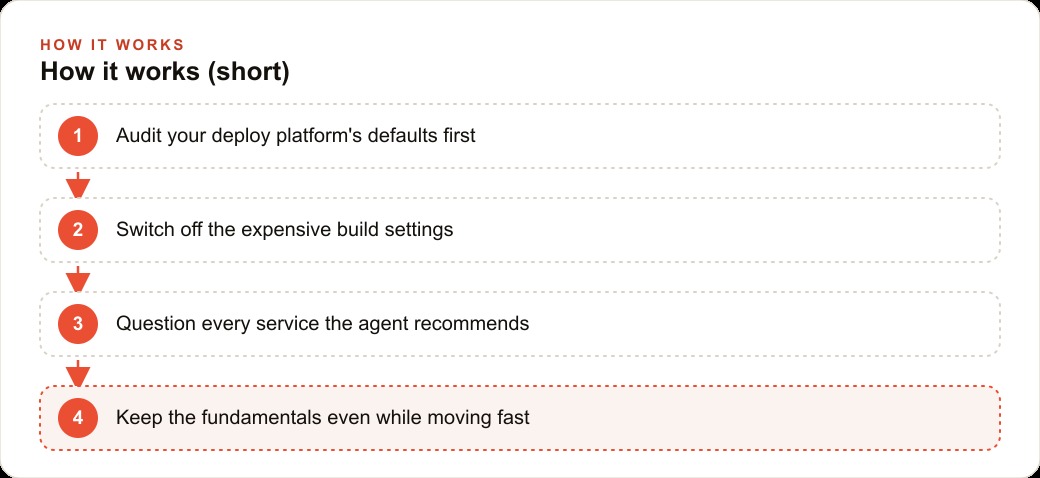
The operational habit that would have caught this problem is a daily check of function invocation counts versus expected counts during the first week of any production deployment. Expected counts for a well-configured application are predictable from the traffic volume and the caching configuration: a specific percentage of requests should hit the cache, a specific percentage should invoke functions. When actual invocation counts significantly exceed the expected counts for the actual traffic, the cache is not working as intended.
Several third-party monitoring tools can be configured to send alerts when invocation counts exceed defined thresholds. The setup is a one-time investment of under an hour and the alert would have fired within hours of the cache miss problem beginning, rather than after an $800 charge had accumulated. The spending cap limits the financial damage once the threshold is reached. The monitoring alert identifies the problem in time to fix it before the cap is hit.
The lesson that extends to every serverless pricing model
The broader pattern this incident illustrates applies to any serverless or usage-based pricing model: the pricing is correct, predictable, and non-punitive when the application is built and configured to take advantage of the platform's efficiency mechanisms. It is expensive when the application generates usage patterns that bypass those mechanisms.
AWS Lambda, Google Cloud Functions, Cloudflare Workers, and Vercel all share this characteristic. The pricing models are designed around the assumption that well-built applications will use the platform efficiently. An application that generates unnecessary function invocations on Vercel, unnecessary Lambda cold starts on AWS, or unnecessary Worker CPU time on Cloudflare will generate higher bills than a comparable application designed to use the platform correctly.
The investment in understanding the platform's efficiency mechanisms before production deployment is always worth making. For Vercel, the relevant mechanisms are caching behavior, edge function routing, and the distinction between functions that run on every request versus functions that serve cached responses. For any other platform, the equivalent investment is reading the pricing model carefully enough to understand what generates cost at scale and what does not.
A business owner whose technical stack includes serverless infrastructure as part of the web and CRM systems they use to support their operations should include a line in any new deployment checklist for reviewing the expected cost model under realistic traffic, setting spending caps, and establishing monitoring for the metrics that drive cost. This applies equally whether the infrastructure supports Google Ads landing pages, customer-facing applications, or internal business tools.
The architectural review before any scaling event
Any time a business is about to do something that will significantly increase traffic to its web infrastructure, whether that is a product launch, a press mention, an influencer partnership, or the start of a paid advertising campaign, a brief infrastructure review is worth doing. The review is not extensive. It is a check of three things: is caching configured correctly for the expected traffic patterns, are spending caps set on any usage-based services, and is monitoring active on the metrics that drive cost.
This review takes under an hour for a moderately simple application. It is the insurance policy against the scaling event that reveals a configuration problem that was invisible at lower traffic. The developer who received the $800 bill was scaling from development traffic to production traffic. A product launch scales from baseline to spike. The failure mode is the same: a configuration that worked at low volume fails economically at high volume, and the signal that something is wrong is the billing alert rather than an operational alert.
The investment in understanding the platform, in monitoring costs, and in setting appropriate limits before scaling events is consistently the cheapest insurance available for any web infrastructure decision.
That is exactly what we do at AI DOERS. Book a private 30-minute call with Madhuranjan Kumar and we will map the fastest path to it for your specific business.
Book your call →
Madhuranjan Kumar
Madhuranjan Kumar brings 20 years of performance-marketing experience and has managed over $200 million in Facebook ad spend for brands across the United States and beyond. His expertise spans the full modern marketing stack: Meta, Google Ads, TikTok, email automation, CRM, and the websites that hold it together. At AI DOERS he turns that track record into lead-generation systems for businesses across every industry.