
The 7 Mistakes That Kill 97% of AI Startups
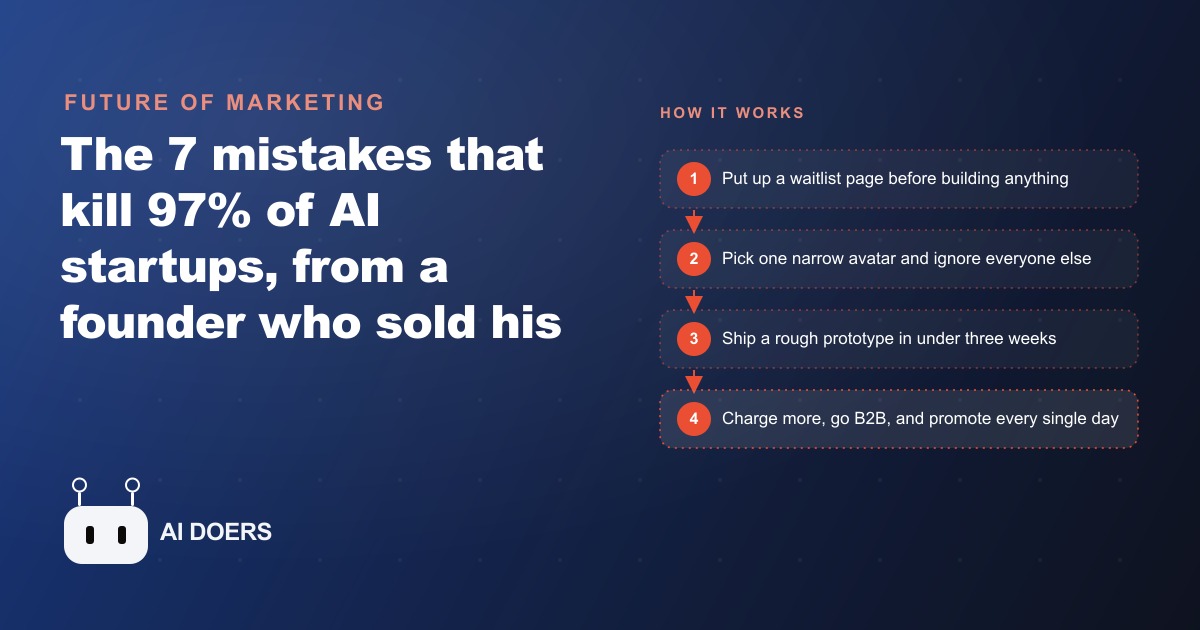
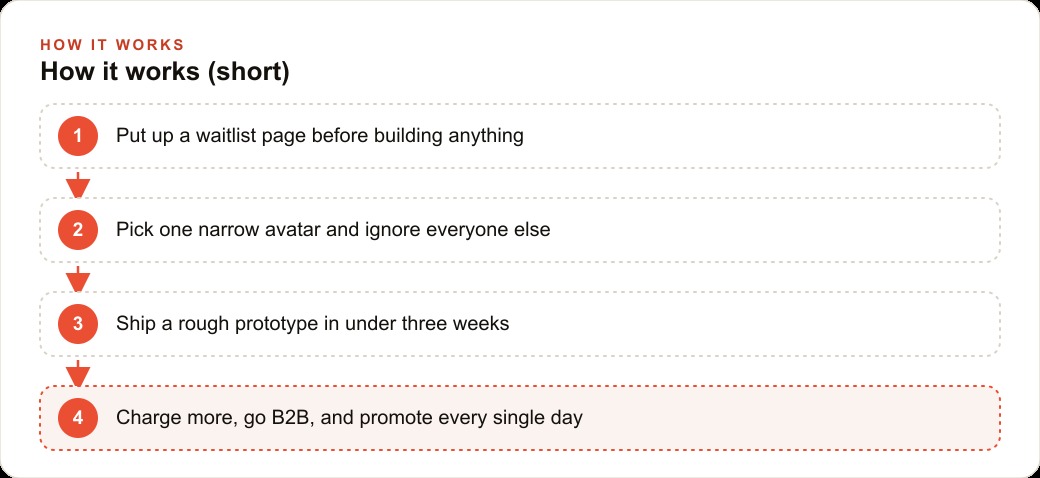
Most AI startups die from slow validation, going solo, targeting too broad, moving too slow, bad pricing, no promotion, and no moat. The fix for each is concrete: validate with a waitlist, niche down to one avatar, ship fast, charge more through B2B, promote daily, and build something hard to copy.

The founder sold the company fourteen months after starting it. The sale price was $1.8 million. The product was an AI-powered scheduling assistant for dental clinics. The fourteen months included seven mistakes, each of which nearly ended the project, and a series of pivots that fixed them. What makes the story useful is not the outcome. It is the sequence: the mistakes are predictable, the pivots are learnable, and the pattern appears in almost every AI startup that fails before it gets started.
Madhuranjan Kumar has reviewed this founder's journey as part of a broader study of what separates AI product companies that reach revenue from the ones that do not. The seven mistakes are not obscure. They are the same mistakes made by most first-time founders in every software category. What is different about the AI context is that the mistakes happen faster, cost less in dollars and more in time, and are harder to identify because the technology gives the illusion of progress even when no customer has been found.
Month one: building for three weeks before talking to a single dentist
The founder had spent several years in healthcare administration before starting the company. The scheduling problem at dental clinics was real: practices lost revenue every day from no-shows, last-minute cancellations, and gaps in the appointment book that could not be filled quickly enough. The founder had seen this problem repeatedly and had a clear mental model of what the solution should look like.
On the strength of that mental model, the founder spent the first three weeks of the company building the product. A backend that connected to major dental practice management software. A scheduling logic layer that used historical appointment data to predict no-show probability. A patient communication module that sent reminders and reschedule prompts at optimized intervals. The work was technically clean. The product looked like a real product. After three weeks, the founder had invested roughly 180 hours and had not spoken to a single dentist.
The first conversation with a dental practice manager revealed three problems. The first was that the practice management software the founder had built the integration for was not the one this practice used. The second was that the practice's biggest scheduling problem was not no-shows but new-patient intake, a different part of the workflow entirely. The third was that the practice manager had no budget authority for software and referred all purchasing decisions to the owner, who was not in the building that day.
Two more conversations in the same week produced similar findings. The technical infrastructure the founder had built connected to the wrong systems, solved a secondary problem rather than the primary one, and pointed at a buyer who was not the person the founder had been pitching. The three weeks of work did not have to be thrown away, but it had to be rebuilt around a different architecture, a different primary problem, and a different sales conversation.
The fix for this mistake is now something the founder describes in retrospect as obvious: build a waitlist page before writing a line of code. Describe the product in terms of the problem it solves, not the features it has. Ask interested people two questions: what is your biggest scheduling problem, and what would you pay to have it solved? The answers to those two questions are the only inputs that matter for the first version. Thirty responses are enough to validate the problem, the framing, and the approximate price. Building without those answers is guessing with a lot of effort invested in the guess.
The peer group moment: what changed when another founder asked the right question
By month two, the founder had rebuilt the core integration for the more common practice management software and had reoriented the product toward new-patient intake scheduling, which the conversations had revealed as the higher-priority problem. The product was working in a limited test. The founder had one dental practice willing to use it for free during a trial period. Progress was being made.
And then it stopped. Not because the product stopped working. Because the founder stopped making decisions. Every feature request from the trial practice triggered a two-day evaluation of whether to build it. Every potential competitor website that appeared in a search result triggered a week of strategy reassessment. The founder was working long hours and producing very little forward movement.
The inflection point came in a peer group session, a small gathering of other founders who met monthly to share progress and challenges. The founder described the situation: one trial customer, a functioning product, no paying customers, a growing list of potential features, uncertainty about which direction to move next.
Another founder in the group asked one question: when did you last talk to a dentist who was not already in your trial? The answer was three weeks earlier. The peer group's observation was direct: the founder was iterating on product for a customer base of one, who was receiving the product for free and therefore had no cost for requesting changes. Every hour spent building features for the trial practice was an hour not spent finding a practice that would pay.
The peer group's function in that moment was not to give advice. It was to ask a question the founder could not ask alone because the context was too close. An accountability structure outside the company, even an informal one, creates the distance required to see that kind of pattern. The founder immediately stopped taking feature requests from the trial practice and dedicated the next two weeks entirely to customer discovery conversations.
Narrowing from 'dental practices' to 'solo-practice dentists with no front desk staff'
The customer discovery conversations in weeks five and six produced a clarification that changed the product substantially. The founder had been targeting "dental practices" as the customer category. That category is enormous and internally very different: large multi-dentist group practices with dedicated administrative teams, small two-dentist partnerships, and solo practitioners operating with minimal staff.
The scheduling problem looked different across those segments. Large group practices had dedicated schedulers who tracked their metrics carefully and had specific software preferences that were already established. Selling into a large group practice required navigating a procurement process that the founder did not have the relationship access to reach.
Solo-practice dentists with no front desk staff had a simpler version of the problem and a much faster decision process. The dentist was also the owner, the chief administrator, and the person who approved software purchases. The problem was acutely personal: every no-show and every scheduling gap represented direct, visible revenue loss that the dentist could calculate while looking at an empty chair. The willingness to pay was higher because the pain was higher, and the decision to buy did not require a meeting or an approval chain.
The founder's original avatar had been "dental practices." The new avatar was "solo-practice dentists, fewer than three employees, actively managing their own schedule, in markets with more than three competing dental practices within five miles." The specificity was uncomfortable at first because it made the total addressable market sound smaller. It made the sales conversation immediately more productive.
With the narrower avatar defined, the founder could describe the product in the dentist's own language: you lose approximately $180 for every no-show and you have no staff to fill that slot on short notice. This product sends the right message to the right patient at the right time to recapture that revenue before the chair goes empty. That framing resonated with every solo-practice dentist who heard it because it described their exact experience. The conversations that had been polite but noncommittal became direct conversations about pricing and timeline.
The pricing conversation that nearly killed the first sale but saved the business
The first genuine sales conversation with a solo-practice dentist who was ready to buy almost ended the relationship before a contract was signed. The founder had priced the product at $49 per month, which had seemed like a safe entry point for a first sale.
The dentist's response was not objection. It was a different question: what is the implementation process and how long does it take? The founder explained that setup required a one-hour call, integration with the practice's existing software, and a two-week onboarding period. The dentist's follow-up was direct: if this is going to cost me two weeks of time and a one-hour setup, I need to know this works before I commit to it monthly.
The $49 monthly price, which the founder had assumed was low enough to be an easy yes, was actually creating a credibility problem. A genuinely effective tool at $49 per month signals low confidence in the product's value. The dentist was being asked to invest two weeks of operational disruption for a product that its own creator was pricing as an experiment.
A founder who had been in a peer group with more experienced B2B sellers had pointed this out two weeks earlier. The advice had been: price for the value you deliver, not for the threshold you think someone will pay. If the product prevents three no-shows per month at $180 each, it is worth $540 per month in direct revenue recovery. Price it at $300 per month up front and $150 per month recurring. The buyer can calculate the ROI in 30 seconds, and a price that implies the product works is more credible than a price that implies you are not sure.
The founder raised the price. The dentist agreed immediately. The logic was transparent: $300 for setup and $150 per month ongoing, against a conservative estimate of two recovered appointments per month at $180 each, was a positive return in the first month. At $49 per month, the ROI calculation was acceptable but not compelling. At $300 setup plus $150 recurring, the ROI was undeniable and the pricing communicated confidence.
Sixty days of daily LinkedIn posts: what the pipeline looked like after
Month four of the company was the first month the founder committed to a consistent promotion schedule. The channel was LinkedIn. The posting frequency was one piece of content per day, every day, for sixty days. The content format was consistent: a specific observation about solo-practice dental scheduling, grounded in something the founder had seen or heard during a customer conversation.
The first two weeks produced essentially no pipeline. Engagement on posts was low. No inbound inquiries arrived from the channel. The founder continued posting.
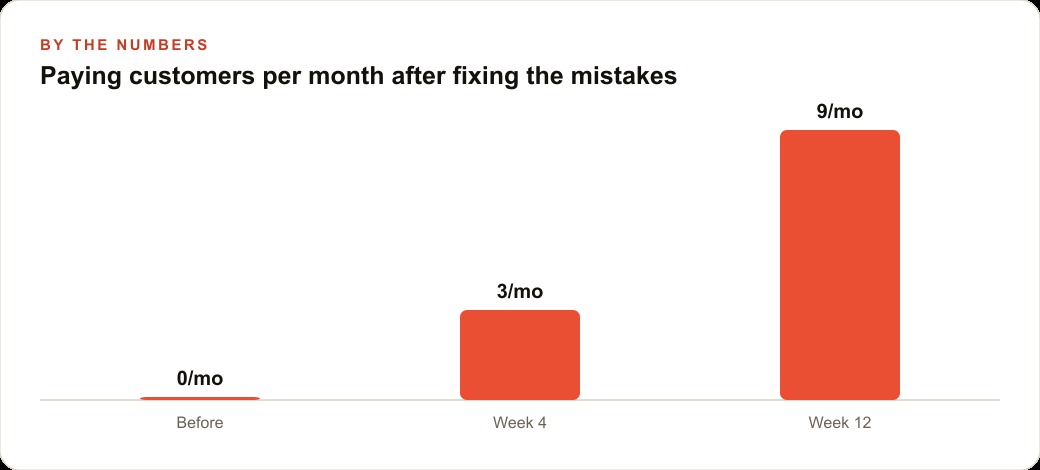
Week three produced two comments from people who identified themselves as dental practice owners. The founder responded to both and asked whether a ten-minute conversation would be useful. One of them agreed and became the second paying customer.
By day sixty, the founder had 14 conversations initiated through LinkedIn content, 5 of which had converted to paying customers. The total monthly recurring revenue at that point was approximately $4,200: the three original customers plus the five new ones, all on the $150 per month recurring plan. The pipeline included an additional 8 conversations in various stages.
The sixty-day result was not extraordinary by large software company standards. For a single-founder company in month four, it was sufficient to prove the channel worked and establish a baseline for measuring the value of consistent promotion against other uses of time. The founder's previous approach had been to promote intermittently, posting when there was something to announce, which had produced zero inbound pipeline in the first three months.
The lesson was not that LinkedIn was the best channel. It was that consistent daily presence on one channel for sixty days was a different commitment from occasional posting, and the difference showed up clearly in the pipeline numbers. One channel, used consistently, beats ten channels sampled once.
The data moat: why clinics stopped being able to switch once their patient history was in the system
By month eight, the company had 34 paying customers and was approaching $5,000 in monthly recurring revenue. The founder had started thinking about what would happen when a competitor with more resources entered the market. The product's current features could be replicated in three to six months by a well-funded team. The pricing advantage was not durable. The customer relationships were good but not contractually sticky.
The moat came from a change in how the product stored and used data. The scheduling optimization model that predicted no-show probability required patient history: which appointment types a patient had missed in the past, what time of day they were most likely to attend, how they responded to different types of reminder messages. That data was generated by using the product and grew more accurate over time. After six months of data collection for a practice, the model's predictions were significantly more accurate than they were at setup.
The founder formalized this: at six months of data, the product's no-show prevention rate improved enough to be measurable and demonstrable. At twelve months, the rate had improved further. A practice that switched to a competitor product would lose that accumulated optimization and start from zero. The switching cost was not just the effort of migrating to a new system. It was the loss of twelve months of predictive accuracy that had been built on their specific patient population.
The data moat was not planned from the start. It emerged from the product doing what it was supposed to do and the founder recognizing that the history it was accumulating had value beyond any individual prediction. The documentation of the moat, the retention analysis showing that churned customers left within the first four months while customers who stayed past six months almost never churned, became part of the acquisition case that ultimately produced the $1.8 million sale.
The acquiring company was interested in two things: the customer base of 78 practices at the time of the sale, and the patient history data that made those 78 practices unlikely to leave. The product features were secondary. The recurring revenue was attractive but not exceptional. The data that would have taken a competitor two years to accumulate was the asset the acquirer was buying, and it had been created as a byproduct of delivering the core service, not as a deliberate strategy.
That is exactly what we do at AI DOERS. Book a private 30-minute call with Madhuranjan Kumar and we will map the fastest path to it for your specific business.
Book your call →
Madhuranjan Kumar
Madhuranjan Kumar brings 20 years of performance-marketing experience and has managed over $200 million in Facebook ad spend for brands across the United States and beyond. His expertise spans the full modern marketing stack: Meta, Google Ads, TikTok, email automation, CRM, and the websites that hold it together. At AI DOERS he turns that track record into lead-generation systems for businesses across every industry.