
The 6 AI Skills That Actually Future-Proof Your Career
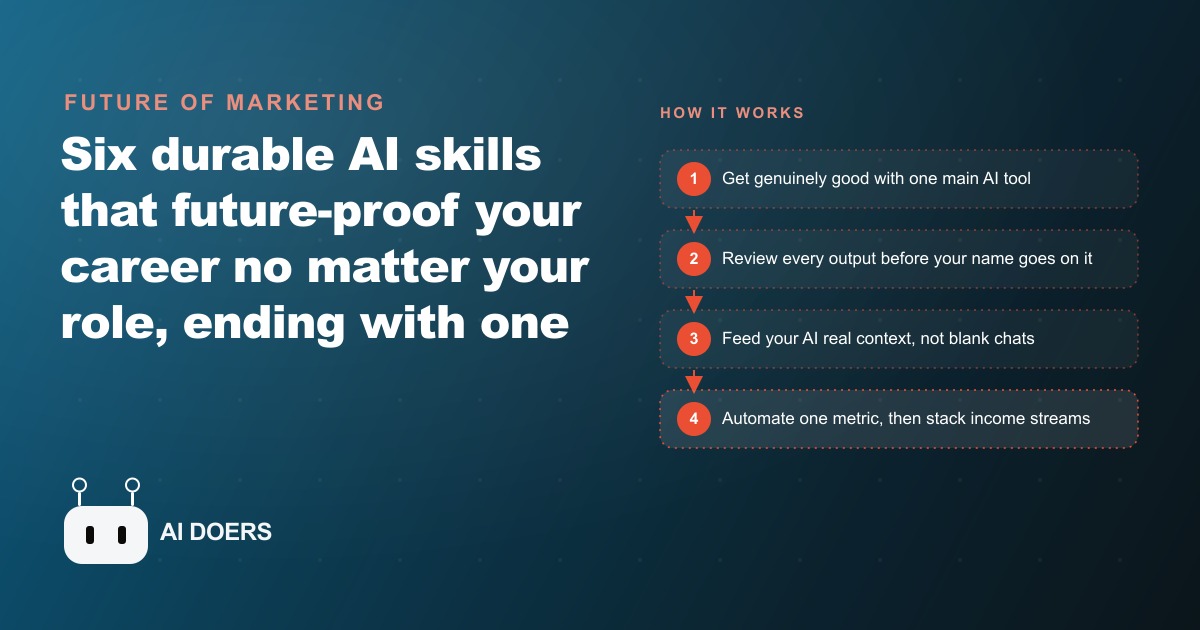
You do not have to switch careers to survive AI. Master six durable skills: become the AI person in your circle, develop taste, engineer context instead of prompting, iterate faster, build an always-on assistant, and stack income streams off one passion.

I am Madhuranjan Kumar, and I want to walk you through a story. It is not a real person's story by name, but it is built from patterns I have watched play out across many real situations, and the arc is accurate enough to be useful. The person at the center of it works in accounting, has been doing it for twelve years, and started 2026 with a vague sense that something was shifting in her industry and a specific lack of confidence about what to do about it.
Call her the staff accountant. Partner-track at a mid-size firm, genuinely skilled at her work, responsible for a team of four. No technical background. Had tried a few AI tools the year before in a low-stakes way, typed some prompts, got some outputs, closed the tab and went back to the real work. The experience left her with the impression that AI was useful for writing emails and answering trivia questions, and not particularly relevant to the specific, precise, trust-critical work of accounting.
She was wrong about that, but the path to understanding why took a few specific experiences. Here is how it went.
Week One: the staff accountant Realizes the Lowest Bar in the Room Is Still Paying
The IBM 2026 CEO study is what clarified her thinking initially, not in a dramatic way, but in a precise one. The finding she kept returning to: a large majority of CEOs in the study said that all functional leaders, not just the technology team, would need to become technology experts in their own domain within the next few years. All functional leaders. Not the CTO. Not the IT team. The head of finance. The lead accountant. The operations manager. All of them.
the staff accountant had always thought of technological competence as something that belonged to a different part of the organization. The finding reframed that. Technology literacy in your own domain was becoming a baseline expectation for leadership, not an optional enhancement. The firms that figured this out first would be able to sell the capability, recruit around it, and use it as a differentiator with clients who had heard enough about AI to wonder why their accountant did not seem to know more about it than they did.
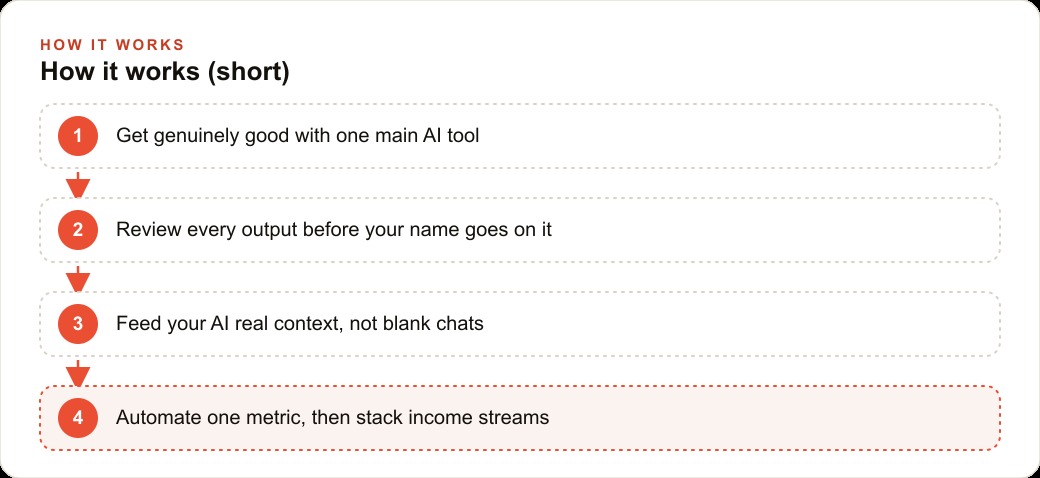
The first move the staff accountant made was not to learn a new tool. It was to decide to become the AI person in her circle. Not the AI person in the broader world, not compared to engineers or researchers, but relative to the people immediately around her: her team of four, the other partners, the clients she worked with regularly. Being the AI person is a relative measure, and the bar was low. Most of her colleagues had the same vague impressions of AI tools that she had started with. Getting genuinely good with one tool was all it would take to be noticeably ahead.
She picked one tool. Committed to it. Spent two weeks doing real work with it, not toy examples, but actual tasks she was already going to do anyway: a client memo, a summary of a dense regulatory filing, a first draft of a quarterly update email. The tool turned out to be more useful than she had expected on those tasks. The quality was not perfect. The outputs required review and editing. But the time from starting to having a first draft was a fraction of what it used to take, and the first draft was better than she would have produced in that time working without the tool.
By the end of week three she had documented three specific examples of time saved and quality improved. Not impressions. Documented examples with time stamps and before-and-after comparisons. She shared two of them with a partner in a casual conversation. The partner was surprised at the specific, measurable results and asked her to walk through how she had done it. That conversation, more than any formal AI initiative at the firm, established the staff accountant as the person who actually knew what she was doing with these tools, rather than the person who had merely heard about them.
The First Email That Made Her Cringe
About a month into using the tool regularly, the staff accountant sent a client an email that she had drafted with AI assistance and reviewed quickly before sending. The client replied the next morning with a one-line response: "Did you have an intern write this?" The email was fine. Grammatically correct, professionally structured, covering the necessary points. But it had a specific texture to it, an evenness, a slightly generic phrasing, a couple of sentence constructions that read as assembled rather than written. The client had noticed.
She re-read the email and felt the cringe of recognition. It was good enough to send but it was not good enough to have her name on it, at least not without more editing. The client's trust in the staff accountant specifically, in her judgment and her voice, was built on a decade of communication that sounded like her. A single email that sounded like a polished template eroded something that took years to build, and she had sent it because she reviewed it quickly and decided it was good enough.
That was the second skill lesson, and it landed harder than any abstract advice about AI quality could have. Your name goes on the output. Whether the output is mediocre or excellent, the credit and the blame land on you. The review step, actually reading what the tool produced with the same care you would read something you wrote yourself, was not optional. It was the professional accountability layer that made everything else trustworthy.
After that experience, the staff accountant built a specific habit: she never sent any AI-assisted output without reading it once in a mode she called the voice test, asking herself whether this sounded like something she would have written, whether the specific phrasing and structure reflected her actual judgment, and whether there were any places where the tool had made a choice she would not have made. The test took four or five minutes on a longer document. It changed her AI-assisted work from occasionally embarrassing to reliably good, because the quality ceiling was now set by her own judgment rather than by whatever the tool happened to produce on a given day.
Week Six: The Context File That Changed Everything
Six weeks in, the staff accountant hit a ceiling that was not about the tool's capability. It was about how she was using it. She was opening the tool in a blank chat every time she sat down to use it, typing a quick description of what she needed, getting a result, and editing it. The results were good but not great. They did not sound like the firm's voice. They did not reflect the client's specific situation. They produced accurate generic outputs where she needed accurate specific ones.
A colleague mentioned context engineering, and the phrase was precise enough to stick. Prompts are how you ask. Context is what the tool actually knows when it answers. A blank chat gives the tool nothing to work with except its own general training. A well-constructed project document gives it the specific information it needs to produce outputs that are specific rather than generic.
the staff accountant built a context document for one client first, a long-standing client whose work she knew well. Into the document went the client's business type and industry, the specific terminology they used internally, examples of two or three memos that had landed particularly well with them and two that had missed, the tone the client's leadership preferred in formal communications, the specific concerns they had raised in recent quarters, and the regulatory context most relevant to their situation this year.
She ran the same memo task through the tool twice. Once starting from a blank chat with a simple prompt. Once starting from the context document with the same prompt. The second output was noticeably different, not just better in quality but qualitatively different in the way that made it actually useful without extensive editing. It reflected the client's specific situation, used their preferred terminology, and adopted a tone that matched what she knew the leadership found credible and trustworthy. It sounded like the firm, not like a generic AI memo.
That experience made the discipline clear. Onboarding the tool with context is exactly like onboarding a new team member with a thorough briefing document. A new person who arrives with clear written context about the client, the firm's voice, the specific concerns of this engagement, and examples of what good work looks like will outperform one who walks in cold every single time. The tool works exactly the same way. The investment in building that context file pays dividends on every interaction from that point forward, and the file improves over time as you add examples of outputs that worked and outputs that did not.
Month Two: The Automation That Reclaimed Eight Hours
The fourth skill, iteration speed, built naturally on the previous three. By month two the staff accountant had a tool she knew well, a review habit that kept quality high, and a context file for each major client that made outputs specific rather than generic. The next step was identifying which tasks she did repeatedly on a predictable schedule and asking which of those could run faster with the tool in the loop.
The task she started with was a weekly status communication that went to twelve clients: a short update on where their work stood, what had been completed in the previous week, and what was coming in the next two weeks. She had been writing these from scratch every Friday morning. Each one took between twenty and forty minutes depending on how much had changed and how much thinking was required to frame it clearly. Twelve clients, thirty minutes average, every week: six hours of Friday morning, every week.
With context documents built and the tool integrated, she ran a test. She drafted the update for three clients using the tool, reviewing and editing each one before sending. Total time for three clients: forty-five minutes. The quality was at least as good as her typical Friday drafts and in two cases slightly better because the tool had organized the information more clearly than she would have when writing at speed. The time saving was real and the quality held.
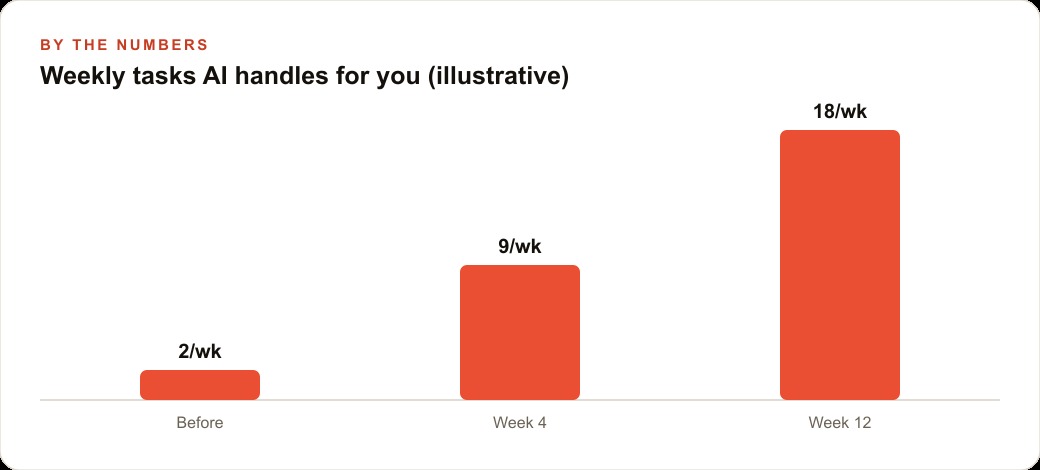
Over the following weeks she refined the workflow until the twelve client updates, reviewed and personalized, took under two hours on Friday morning instead of six. Four hours per week reclaimed, every week. Over a year that is more than two hundred hours returned to work that required her specific judgment rather than her time filling in a template she had written a hundred times before.
She tied that one automation to one metric, average Friday completion time for client updates, and tracked it over four weeks to confirm the improvement was stable and not a single-week anomaly. It was stable. The workflow locked in and she stopped refining it so she could apply the same approach to the next repeating task. The discipline of tying one automation to one metric, deciding what done looks like before you start, and moving on once you hit it is what keeps the compounding going without turning into endless tinkering on tools that are already working well enough.
Month Five: The Solo Business That Still Works Full Time
The sixth skill is the one most people skip over because it sounds like a side project and the other five skills feel more immediately practical. Building your own income stream from existing expertise beyond your job is not a hedge against catastrophe. It is a rational response to the reality that concentrated income in a single employer relationship is inherently more fragile than diversified income across multiple sources, regardless of how secure the primary role feels at any given moment.
the accountant's specific expertise, twelve years of accounting work with a focus on regulatory compliance for mid-size companies, was the same expertise her employers paid her for. It was also expertise that several smaller companies in her network did not have access to on a full-time basis and would pay for on a consulting basis if someone they trusted offered it clearly.
She started a newsletter. Not ambitious in scope. One piece per week, two to three hundred words, covering one practical thing she had noticed in her work that week that a CFO or an accounting director would find useful. The tool helped with drafts. Her review habit kept the voice consistent. She built the list to several hundred subscribers over four months by sharing it in contexts where the audience was exactly right: professional associations, client referrals, a couple of posts that did better than she expected.
From that newsletter, she had three consulting conversations in month five that came from subscribers who had been reading for a few months and reached out when a specific need arose. Two converted to paid engagements. The income from those two engagements in month five was modest, but it represented income that did not depend on the firm, that she had earned through expertise and consistency she had already demonstrated, and that would have been invisible without the newsletter creating a channel for people to find her outside of the direct client relationship.
The combination of all six skills over five months changed what her week looked like and what her career felt like. The Friday update automation gave her Friday mornings back. The context engineering made her AI-assisted work good enough to represent the firm at her quality standard. The review habit protected her reputation. The skill with one tool gave her a reputation inside the firm as the person who actually knew how to use these tools on real accounting work. And the newsletter gave her a second channel for expertise she was already building every day, one that compounded quietly in the background while the rest of the work continued.
None of the six skills required a career change. None of them required a technical background she did not have. All of them were built one at a time over a realistic five-month window by someone who started with vague impressions and ended with documented results, a protected reputation, recovered time, and an income stream that did not depend entirely on the firm's continued approval. That is what future-proofing actually looks like when it is grounded in the work rather than in anxiety about it.
That is exactly what we do at AI DOERS. Book a private 30-minute call with Madhuranjan Kumar and we will map the fastest path to it for your specific business.
Book your call →
Madhuranjan Kumar
Madhuranjan Kumar brings 20 years of performance-marketing experience and has managed over $200 million in Facebook ad spend for brands across the United States and beyond. His expertise spans the full modern marketing stack: Meta, Google Ads, TikTok, email automation, CRM, and the websites that hold it together. At AI DOERS he turns that track record into lead-generation systems for businesses across every industry.