
The $100k AI Avatar Blueprint: Four Offers That Actually Sell
An AI avatar is a digital version of a person built from image, video, and audio, and a real business can turn that into revenue through four clear offers. Here is how it works, and how a med spa could put it to use.
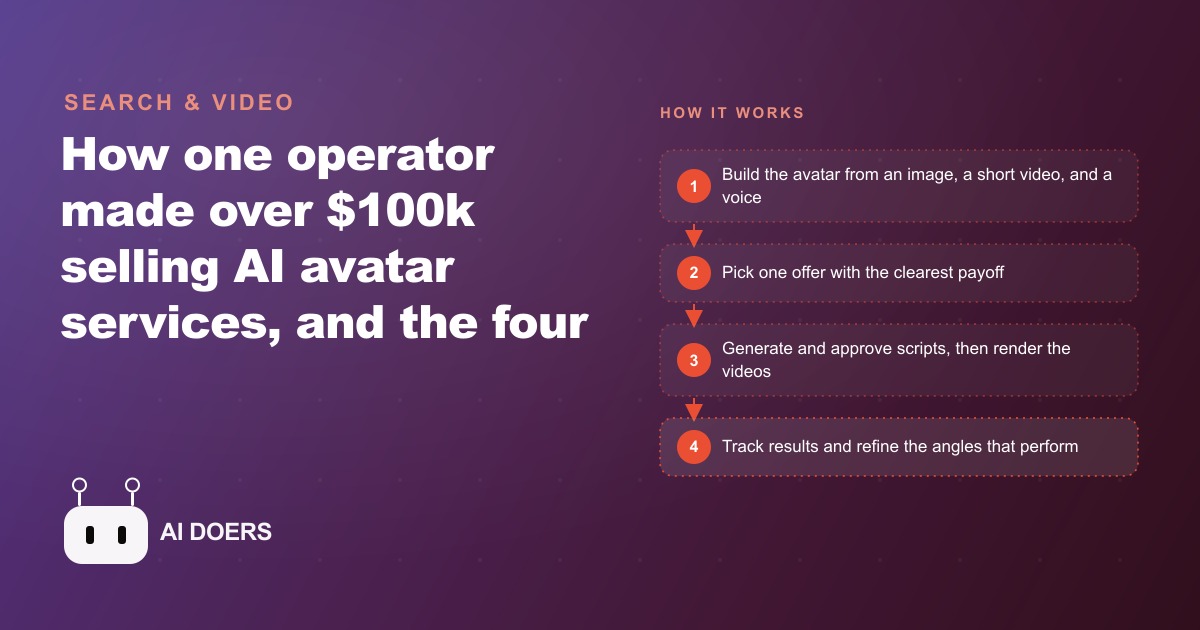
Most people who enter the AI avatar business fail within the first 60 days, not because the technology does not work, but because they built a service before they built a business. They downloaded HeyGen, ran a test video, got excited about what was possible, and started pitching clients without making the foundational decisions that determine whether the business compounds or collapses.
One operator has documented reaching $100,000 in this business. The path was not the result of discovering superior technology. HeyGen, 11 Labs, and Notion are available to anyone with a browser and a free trial. The result came from a sequence of six specific decisions, made in the right order, and executed without deviation. Here is what those decisions are, and why each one matters.
Choosing One Offer Before Downloading a Single Tool
There are at least four commercially viable offer types in the AI avatar space. The first is personalized video outreach at scale: you create a custom video message for each prospect in a sales sequence, using the HeyGen or Tavus API to personalize this breakdown with the recipient's name, company, and specific context. You charge a setup fee and a per-booked-call performance component. The second is UGC avatar campaigns: you create diverse AI avatar influencers who deliver product reviews, testimonials, and comparison content for direct-to-consumer brands, structured as 30-video packages at roughly $3,000 per package or a monthly retainer. The third is HR training and course content: you convert compliance manuals and employee onboarding materials into narrated video modules. A 45-video training course commands $15,000 and the work is tedious to fulfill. The fourth is social media content: you clone the client's appearance and voice, post daily content on their behalf, and charge a setup fee plus a $3,000 to $6,000 monthly retainer.
These four offers require entirely different skill sets, different client types, and different fulfillment workflows. The personalized outreach offer is sold to sales directors and growth teams. The UGC campaign offer is sold to e-commerce brands with proven products and existing ad spend. The training content offer is sold to HR directors at companies with active compliance training obligations. The social media offer is sold to personal brand owners who have an audience and have stopped posting consistently.
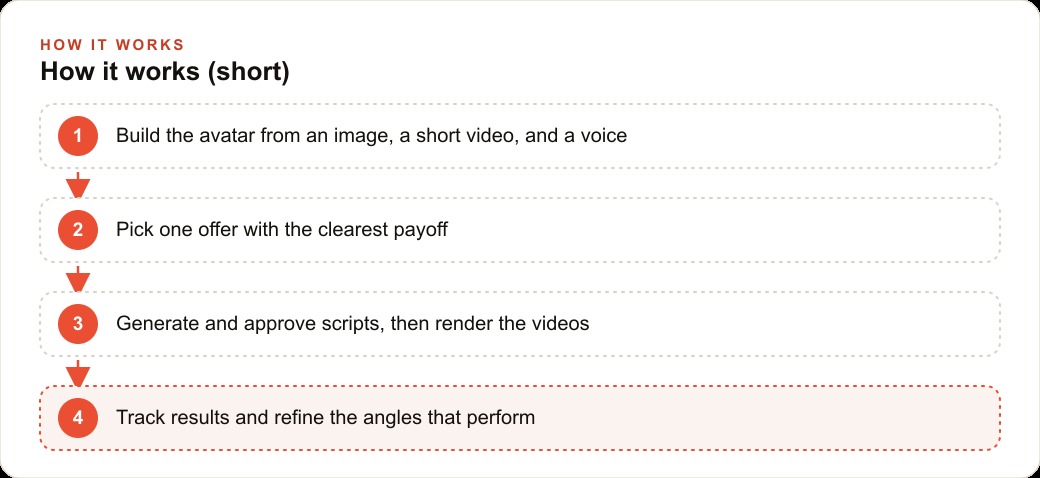
Building competency in one takes a different path than building competency in another. The operators who fail most predictably are the ones who try to offer all four simultaneously, positioning themselves as general AI avatar studios. General positioning makes the service easy to compare and difficult to justify on price. The operator who reached $100,000 picked one offer, signed the first three clients in that category, documented everything about the fulfillment process, and did not add a second offer type until the first was fully systematized.
Running the Avatar Source Recording Session Like a Production Shoot, Not a Technology Test
Every AI avatar starts with source material: video footage and audio recordings of the person being cloned. The quality of this raw material determines the quality of every output that follows it. There is no post-production fix for a source session recorded on a laptop camera in a room with inconsistent lighting and ambient background noise.
The most common approach is to record a quick test session to see whether the technology works. The client speaks a few sample sentences in their home office, the footage gets uploaded to HeyGen, a test video renders, and if it looks reasonable, the avatar is declared ready for client use. The avatar created from this session is adequate for internal testing. It is not presentable to actual prospects or audiences, and it will create retention problems the first time a client compares it to a competitor's work.
A professional source recording session requires four things: a consistent, well-lit background with no shadows falling on the face; a camera capable of at least 1080p at 30 frames per second; a clean audio recording with no background noise or room reverb; and a set of sample sentences covering the full phonetic range of the language being cloned, sufficient to train a voice model that sounds natural across a wide range of scripts, not just the specific sentences recorded.
The standard for the social media content offer, where the avatar posts daily on behalf of the client to a public audience, is that a casual viewer should not identify it as AI-generated without looking closely. That standard is achievable from well-captured source material. It is not achievable from a test session. Treating the source recording as a production decision rather than a technology test is one of the most consequential choices in the entire workflow.
Writing Every Script from Proven Angles, Not Original Ideas
The AI avatar can say anything the script tells it to say. What the avatar says determines whether the content actually performs. The most consistent mistake in avatar content production is writing original scripts: using the operator's or the client's own ideas about which topics and angles will resonate, producing content that is well-crafted but unproven.
What actually works is identifying what has already performed well in the relevant space and building toward those proven angles. For the social media content offer, this means reviewing the last 90 days of content in the client's niche across the specific platforms where the avatar will post, identifying which content types accumulated the most meaningful engagement (not just views, but comments, shares, and saves), and producing the client's version of those proven structures.
For the UGC avatar campaign offer, this means analyzing which testimonial and review angles have the highest conversion rates in the client's product category, which emotional beats appear most consistently in organic UGC that the brand's customers have already produced voluntarily, and which product features existing customers mention most positively in their own words. The script is built from that research, adapted to the client's specific product and brand voice.
This does not mean copying existing content. It means applying the structural approach that works in the category to the client's specific situation. The creative contribution is the adaptation. The foundation is always what has already proven it can move people to respond.
Building the Client Approval Step That Protects Retention Before It Protects Quality
Every AI avatar operator eventually has the experience of delivering a batch of content that they believed was strong, only to receive a negative or lukewarm response from the client, not because the production quality was poor, but because the content did not match what the client had in mind. The client imagined a different tone, a different pacing, a different style of scripting. The gap between what the client imagined and what was delivered kills the retention relationship faster than a quality problem would.
The client approval step is not a quality gate. It is a shared-expectations gate. Before producing a full batch, the operator delivers a single sample output for the client to review. The approval question is not "does this look good?" It is "does this match your expectations for tone, pacing, scripting style, and how you want your brand represented?"
For the social media content offer, this means delivering the first week of content (typically five to seven videos) before committing to the monthly production schedule. For the UGC campaign offer, it means delivering two to three test creatives before producing the full 30-video package. For the personalized outreach offer, it means delivering five sample videos using real but low-priority prospects before the full campaign sequence begins.
The approval step has two effects. It catches expectation misalignments before they become retention problems, saving the operator the cost of reproduced work and preserving the client relationship. It also creates documented agreement about what good output looks like for this specific client, which reduces revision cycles and ambiguity in every future batch. Operators who skip the approval step to move faster consistently report higher revision rates, more contentious client relationships, and lower renewal rates. The approval step is slower at the front. It is faster over the full engagement.
Matching the Fulfillment Stack to the Specific Offer You Chose in Step One
The AI avatar technology stack is not universal. Each offer type has different primary tool requirements, different throughput needs, and different quality priorities. Assembling a stack before choosing an offer produces either overcapplication or gaps.
The personalized video outreach offer requires API access to HeyGen or Tavus (not just the web interface), a system for ingesting the prospect list and extracting the relevant personalization variables for each contact, and a workflow for rendering and delivering a unique video per prospect at volume. Manually producing 100 personalized videos through a web interface is not a viable production process at the price points this offer commands. The client is paying for volume and personalization; fulfillment that cannot deliver both at scale is a capacity constraint that limits revenue.
The social media content offer requires a content calendar tool (Notion works well here because it allows linking scripts, approval status, scheduled publish dates, and published URLs in a single view), an avatar platform capable of rendering natural-looking short-form video from brief scripts with reasonable turnaround, a voice platform that produces a realistic voice clone (11 Labs is the current standard for quality at this use case), and a publishing workflow matched to the platforms the client uses. The throughput requirement is modest (five to seven videos per week per client), but the quality bar is higher because the content is public-facing and persistent.
The HR training and course content offer requires handling significantly longer scripts, managing a multi-section video structure across 40 or more individual modules, and delivering against a structured course outline rather than a rolling content calendar. The production complexity is substantially higher, which is why this offer commands the highest per-project fees but also has the highest per-project time investment.
Productizing Delivery: The Decision That Unlocks Scale Past $25K per Month
Most AI avatar operators who reach $25,000 per month in revenue are still doing custom work. Each client engagement differs in scope, process, deliverables, approval cycles, and communication rhythm. This is manageable at $25,000. At $75,000 or $100,000, it is a full-time project management operation that leaves no capacity for growth.
Productization means building one fixed, documented process for the offer you chose and applying it identically for every client. The intake process is the same. The source recording checklist is the same. The script research and writing process is the same. The approval step is the same. The delivery format is the same. Clients who require a different process than the one you have built are not the right fit.
The most powerful sales tool once this system exists is a case study that documents a specific result for a specific client type. Consider this structure: "We ran the UGC avatar campaign offer for a direct-to-consumer supplement brand over 60 days. They received a 30-video package across two avatar angles. Their cost per acquisition on the avatar-based UGC dropped 22 percent compared to the previous UGC approach, at a total package cost of $3,000." That case study sells the next brand in the same category without a custom proposal, without a scope negotiation, and without an extended explanation of the process.
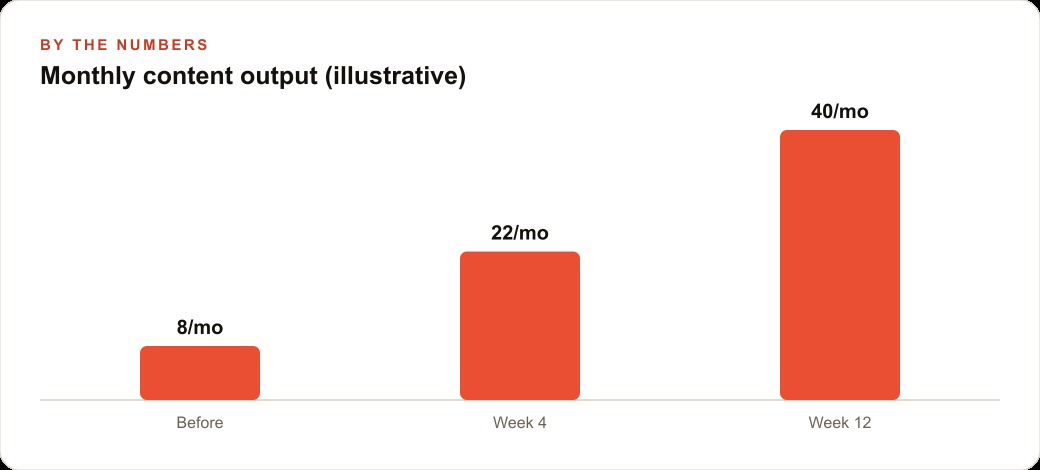
A productized offer at $3,000 to $6,000 per engagement, fulfilled through a repeatable documented process, at a pace of two to three new clients per month, produces the mechanics of a $100,000 annual business. The technology is identical to what the operator making $18,000 and burning out is using. The difference is the sequence of decisions described here, made before touching the tools, and held to without exception. The revenue math at scale is straightforward. Two to three productized engagements per month at four thousand dollars each, fulfilled through a repeatable documented process by an operator who has made these six decisions in order, is the structure of a business that can sustain a hundred thousand dollars annually without requiring a new creative approach for every new client.
That is exactly what we do at AI DOERS. Book a private 30-minute call with Madhuranjan Kumar and we will map the fastest path to it for your specific business.
Book your call →
Madhuranjan Kumar
Madhuranjan Kumar brings 20 years of performance-marketing experience and has managed over $200 million in Facebook ad spend for brands across the United States and beyond. His expertise spans the full modern marketing stack: Meta, Google Ads, TikTok, email automation, CRM, and the websites that hold it together. At AI DOERS he turns that track record into lead-generation systems for businesses across every industry.