
The 100-Year History Of AI Is One Long Fight Between Rules And Networks
Artificial intelligence took roughly a century to arrive because two rival ideas kept trading places: rule-based systems you program by hand, and neural networks that learn the rules from examples. Understanding which one won tells a business owner exactly why today's AI tools behave the way they do.

In 1969, Marvin Minsky published a proof that should have been read as a warning about scope, not a verdict on neural networks. Instead, it triggered the first AI winter. The same misreading happened again in the late 1980s. And it is happening now, in the opposite direction. The history of artificial intelligence is not a story of steady progress interrupted by setbacks. It is the story of one mistake, repeated across eighty years: applying pattern-matching tools to precision-critical tasks, watching them fail, and then declaring the entire technology broken.
Madhuranjan Kumar has spent years studying how businesses adopt and abandon AI tools. The pattern he describes in that adoption cycle matches the pattern in the historical record almost exactly. The organizations that thrive with AI are the ones that learned to distinguish between what the technology actually does and what they wished it would do. The ones that failed made the same error the field has made repeatedly since 1956.
Two winters, one mistake: applying the wrong tool to precision-critical work
The Bombe cracked Enigma in 1939 not by understanding language but by exploiting pattern repetition in how German operators set up messages. It was, in the language we use today, a pattern-matching machine. Nobody expected it to understand German grammar or answer strategic questions. It had one job: find the pattern, match it, deliver the result.
Alan Turing formalized this in 1950 with the imitation game, which is routinely misread as a claim that machines can think. It is not. It is a behavioral test: if the pattern-matching output is indistinguishable from a human's in a structured conversation, does the distinction matter for that specific use? The question is pragmatic, not philosophical. Turing was testing a narrow capability, not asserting a general one.
The Dartmouth conference of 1956 named the field and set expectations that no pattern-matching machine of that era could meet. The attendees imagined systems that could reason from first principles, learn from experience in open-ended domains, and solve problems the way a human expert solves them: by applying judgment across situations they had never encountered before. Those are precision tasks. They require the machine to be right even in situations it has never seen, in contexts where being approximately correct is not close enough.
The perceptron, introduced by Frank Rosenblatt in 1958, learned from examples. It adjusted internal weights based on feedback until its pattern-matching improved. That is genuinely useful. It is also genuinely bounded. A perceptron trained to distinguish two categories of input works well inside the distribution it was trained on. It fails outside that distribution in ways that are difficult to predict.
Minsky's 1969 proof identified exactly where the perceptron's ceiling was. What followed was funding cuts, abandoned research programs, and the first AI winter. The field had been asking the perceptron to do precision work: to generalize reliably to arbitrary unseen problems. When it could not, the entire approach was condemned. The actual lesson, that pattern-matching tools have a scope within which they perform and a scope beyond which they fail, was not drawn. Instead, the field split into two camps and argued about paradigms.
The expert systems of the 1980s swung to the other extreme. XCON at Digital Equipment Corporation handled roughly 80,000 orders with a 98 percent accuracy rate by the mid-1980s. That is a significant result for a system handling structured inputs with stable patterns. But XCON cost approximately $40 million to maintain over its lifetime. Every time the product catalog changed, the rules had to be rewritten by hand. The system was not learning. It was encoding known patterns as explicit rules, which meant every new pattern required a human expert to add a new rule.
When business conditions changed faster than rules could be updated, the expert systems broke. Not because rules were the wrong paradigm, but because the operators had expanded the system's scope into edge cases where no rules had been written. The second AI winter arrived not because expert systems were fundamentally flawed, but because they were applied beyond their actual operating range.
Why backpropagation did not change what AI is good at, it just made it better at the same thing
Geoffrey Hinton's backpropagation result in 1986 did not change the nature of what neural networks do. It made training practical for deeper networks with more layers. That is a significant engineering contribution. But the fundamental operation remained the same: adjust weights in response to error signals until the network's pattern-matching performance improves.
When NVIDIA GPUs made parallel computation affordable and the ImageNet dataset gave researchers a large labeled corpus to work with, AlexNet in 2012 achieved a 15 percent error rate on image classification. That was not a conceptual breakthrough. It was a very large pattern-matching operation running on very fast hardware with a very large dataset. The approach was the same as 1958. The scale was different by several orders of magnitude.
The transformer architecture in 2017 extended this to sequence data. The attention mechanism allowed networks to learn which parts of a sequence were relevant to predicting other parts. It is still pattern-matching, now over sequences of tokens rather than images. The attention operation finds the pattern of relevance. The feed-forward layers store the pattern of association. The training signal adjusts weights until the patterns match what the training data showed.
ChatGPT and Claude Code are downstream products of these transformer architectures. They are extraordinarily capable at pattern-matching over language, code, and structured data. When you ask a large language model to summarize a document, it is interpolating from patterns it saw during training to produce an output that matches the pattern of a good summary for your specific input. When you ask it to write a function, it is drawing on patterns from millions of similar functions in its training data.
This works remarkably well on tasks that have a strong pattern base. The pattern is clear, the training data covered similar situations, and approximate accuracy is acceptable. It does not work well on tasks that require precision even in genuinely novel situations. Mathematical proofs at the research frontier do not have training examples the model can match against. Regulatory compliance checks for new legislation have no precedent in the training data. Medical diagnosis in atypical presentations breaks the pattern that the training data described.
These are precision tasks. The field's consistent error, from 1956 through 2025, is treating them as pattern tasks.
The expert system failure was not about rules vs networks: it was about brittleness at edge cases
The conventional history of AI frames the Minsky-Rosenblatt debate as a philosophical dispute between two paradigms: symbolic AI versus connectionism, with connectionism eventually prevailing. That framing obscures the actual lesson.
Both sides were right about their target tasks. Symbolic systems with explicit rules perform precisely on precision tasks with stable inputs. They do exactly what was encoded, every time, without drift or hallucination. They are the right tool when you need guaranteed correctness on a bounded problem set. They fail when the input space is too large to enumerate in advance or changes faster than you can write new rules.
Neural networks perform well on tasks where the input space is enormous, the correct output has a pattern, and some variation in edge cases is acceptable. They fail when being wrong by one decimal place, one legal clause, or one drug interaction carries serious consequences.
XCON did not fail because rules were the wrong paradigm. XCON failed because the operators kept expanding its scope into edge cases the rules had never addressed. The maintenance cost was not a fundamental problem with symbolic AI. It was a scope problem: the system was being asked to handle situations it was never designed to handle. The right response was to draw a boundary around what XCON did well and keep humans at every step outside that boundary. The actual response was to blame the paradigm and fund the opposing one.
The first AI winter was caused by applying perceptrons to precision tasks that required correct generalization to novel inputs. The second AI winter was caused by applying expert systems to problems with unbounded and rapidly shifting edge cases. The correct diagnosis in both cases was scope mismatch. The diagnosis that got recorded in the history books was paradigm failure.
Modern AI makes the same boundary error in the other direction
The dominant form of AI scope mismatch in 2024 and 2025 runs opposite to the historical cases. Pattern-matching tools are reliable, fast, and cheap. So they are applied to everything, including tasks that require precision even in situations the model has not encountered.
Contract review is a precision task. A clause that is 90 percent standard and 10 percent novel carries risk concentrated entirely in that 10 percent. A pattern-matching tool trained on standard contract language handles the common cases correctly and fails exactly where the risk is concentrated. If nobody reviews the output, the failure rate on edge cases goes undetected until a dispute surfaces. If every piece of output is reviewed anyway, the efficiency gain disappears.
Tax calculations with jurisdictional edge cases are precision tasks. A system that is correct 97 percent of the time on tax filings is not a reliable tax system. It generates liability 3 percent of the time. At scale, that 3 percent compounds into a significant exposure. The fact that the 3 percent errors are unpredictable, concentrated in atypical situations the model has not seen, makes them harder to catch than a consistent human error would be.
Code in safety-critical systems is a precision task. Most code generated by large language models works fine for prototyping and internal tools where a bug means a failed test and a fix. It fails at the boundary: the security edge case that only appears under specific input combinations, the concurrency issue that manifests under particular load patterns, the memory detail that is correct for common inputs and wrong for malformed ones.
The people declaring AI useless right now are responding to failures in precision tasks. They tried to use a pattern tool for precision work, it failed at the edges, and they concluded the tool was broken. The people trusting AI blindly are ignoring failures in precision tasks. They are using pattern tools for precision work and not checking the output because the output usually looks correct. Both groups are making the same error Minsky made in 1969: treating a result about one kind of task as a verdict on the entire technology.
The accounting firm that uses the history to decide what AI handles and what it does not
Madhuranjan Kumar works with a regional accounting firm that handles tax preparation, bookkeeping, and advisory work for approximately 350 small-business clients. When the firm evaluated AI tools, the partner in charge established one rule before any tool went into production: every task gets mapped onto a two-column sheet. The left column is labeled "pattern tasks." The right column is labeled "precision tasks."
Pattern tasks at the firm include drafting the first version of a client letter based on the prior year's letter and current numbers, categorizing bank-feed transactions that match known patterns, generating the summary section of a financial review report from structured inputs, answering common client questions about tax deadlines and standard deductions, and formatting schedules that follow consistent templates the firm has used for years.
Precision tasks at the firm include reviewing flagged unusual transactions that break the pattern, confirming compliance with jurisdiction-specific rules that changed in the current tax year, verifying that a client's classification of an ambiguous transaction is defensible under audit scrutiny, and signing off on any number that appears in a filed document.
The firm does not ask AI to handle precision tasks. It uses AI for every pattern task in the workflow, then routes output to a human reviewer at every step that touches a precision boundary. The reviewer checks the output, confirms the classification, and signs off before anything moves to the client or a regulatory filing.
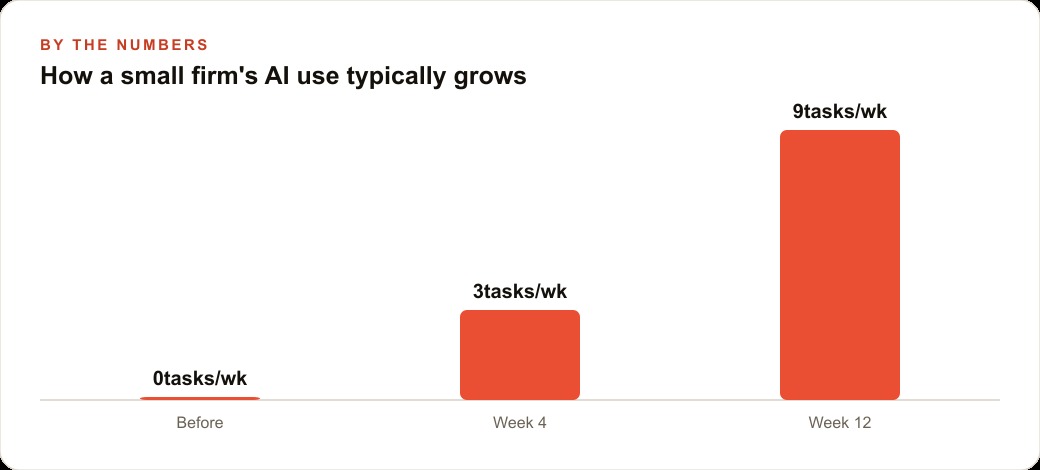
The results after twelve months of operation were straightforward. Time spent on pattern-heavy work dropped by approximately 60 percent per client per engagement. A tax file that previously required 14 hours of staff time for the pattern portions required about 6 hours after AI handling and human review. The firm's error rate on precision tasks stayed flat because those tasks are still handled the same way they always were. The human reviewer did not become less careful because AI was handling the pattern work.
More significant than the time savings: the firm did not experience the failed AI implementation that creates backlash and abandonment. The team understood the boundary before they started. They did not apply a pattern tool to precision work and then blame the tool when it failed at the edge cases.
The partner's framing, shared in a conversation with Madhuranjan Kumar during a review of the first year's results, was direct: every AI tool we evaluated was excellent at the same underlying task, which is recognizing what an input looks like based on everything the model has seen before. The moment you ask it to handle something it has never seen before and require it to be correct, you are asking for a capability that the product does not have.
That framing is what the full history of AI teaches, if you read the history for the lesson it contains rather than the narrative of progress it is usually forced into.
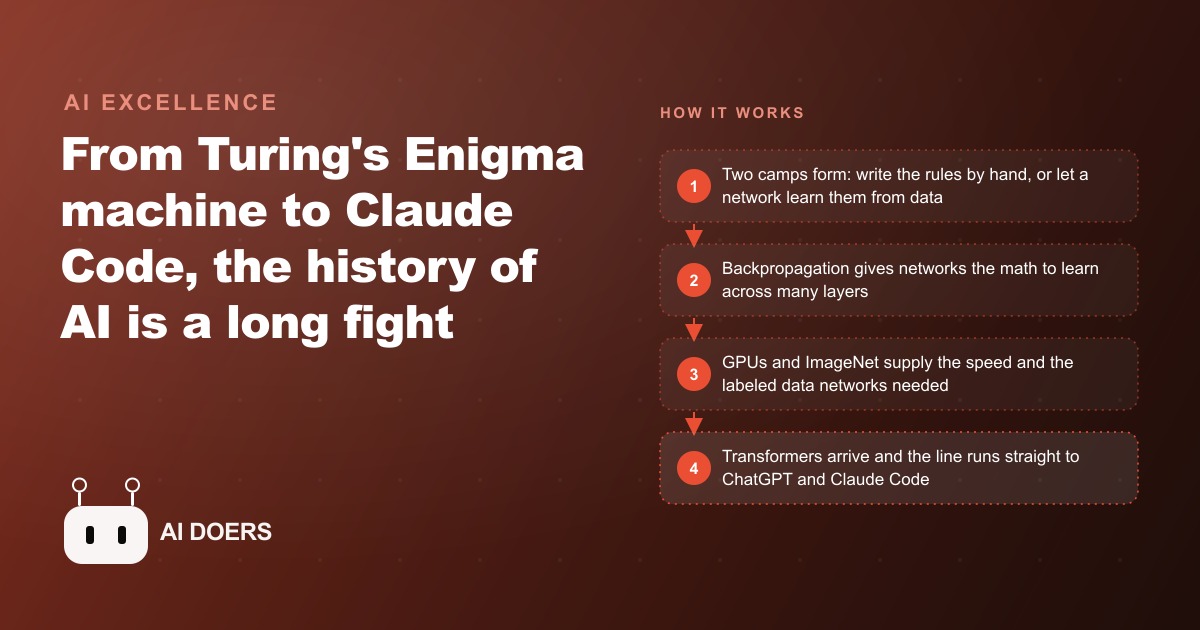
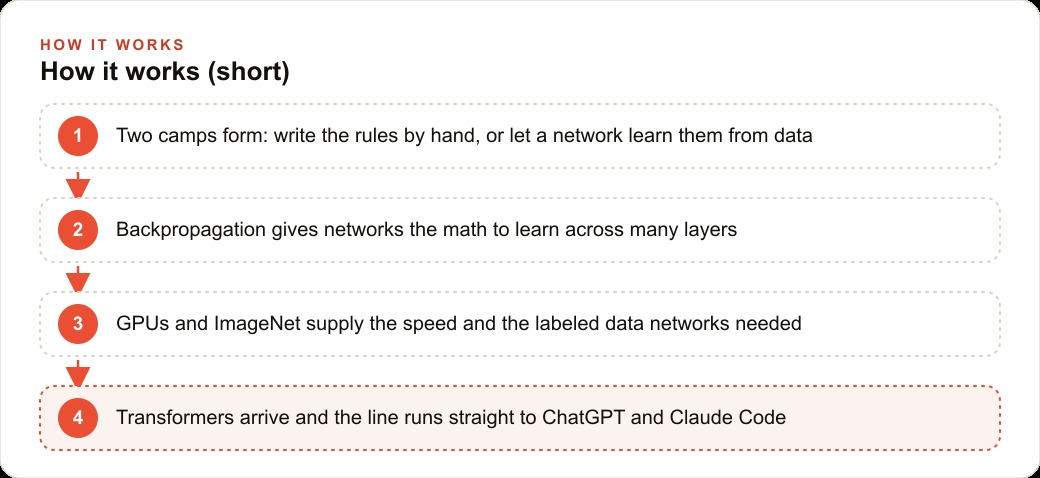
Turing tested machines on behavioral similarity, not on precision in genuinely novel situations. Rosenblatt built a pattern-matcher and trained it to improve. Minsky showed where the pattern-matching reached its ceiling. Backpropagation extended the ceiling. ImageNet and GPU computation scaled the operation. Transformers generalized it across sequence types. ChatGPT brought it to a consumer interface. Claude Code brought it to a development workflow.
At each stage, the underlying capability improved. At each stage, the boundary between pattern tasks and precision tasks remained in approximately the same place. And at each stage, the biggest source of AI failure was practitioners who forgot that boundary existed.
The accounting firm has not forgotten. It uses AI for every hour of pattern work it can identify and keeps a human at every decision point where being wrong in a novel case has real consequences. That is not a conservative posture. It is the posture that eighty years of AI history prescribes. The technology will keep improving. The boundary will shift at the margins. But the lesson will not become obsolete until the technology can reliably perform precision tasks in genuinely novel situations, and it has not reached that point yet. The firm that understands this distinction will still be using AI productively in five years while others cycle through the same disappointment and abandonment that has characterized every previous wave of adoption.
That is exactly what we do at AI DOERS. Book a private 30-minute call with Madhuranjan Kumar and we will map the fastest path to it for your specific business.
Book your call →
Madhuranjan Kumar
Madhuranjan Kumar brings 20 years of performance-marketing experience and has managed over $200 million in Facebook ad spend for brands across the United States and beyond. His expertise spans the full modern marketing stack: Meta, Google Ads, TikTok, email automation, CRM, and the websites that hold it together. At AI DOERS he turns that track record into lead-generation systems for businesses across every industry.