
StreamingLLM: How AI Keeps Talking Without Running Out of Memory
A plain English look at the attention sink trick that lets a model run on very long input without crashing, and how a dental practice can apply the same lesson to its AI tools.

Every engineer's first instinct when building an AI assistant is to give it more context, not less, and that instinct is almost always wrong.
I have watched this play out dozens of times. A business owner hears that the new large language models can handle enormous context windows, hundreds of thousands of tokens, and the logical conclusion feels obvious: shove everything in. The entire customer history. Every email thread. All the product documentation. The whole transcript of every prior session. More context should mean better answers, right?
It does not. And a research contribution called StreamingLLM explains exactly why not, in terms that go far beyond the technical audience the paper was written for. The lesson buried inside that research is one of the most useful thinking tools I have encountered for anyone designing AI-powered products, even if they never intend to read a single line of academic machine learning work.
Let me walk through the finding, then show you what it means for real businesses that are building on top of these models right now.
Why throwing everything at the model is exactly the wrong instinct
To understand StreamingLLM, you first need to understand what happens inside a language model when you give it a very long input. The dominant architecture powering nearly every major language model today is called the Transformer. It processes text through a mechanism called attention, which lets the model weigh every token against every other token in the input to figure out what matters and what relates to what.
That sounds elegant. It is, for short inputs. But attention has a problem that does not go away: its computational cost grows quadratically with the length of the input. Double the input length and you do not double the compute, you quadruple it. Triple the input and you multiply the compute by nine. This is why giving a model an enormously long context does not just slow it down a little. At some point, feeding more tokens actively degrades performance, slows responses to a crawl, and eventually causes the model to fail entirely.
The engineering community recognized this problem early and tried an obvious fix: window attention. Instead of processing all previous tokens, you only keep the most recent ones in memory. The model sees a rolling window of, say, the last two thousand tokens, and forgets everything before that. This keeps compute costs manageable. It keeps the model running smoothly. But it trades one problem for another: you lose earlier context entirely. The model cannot remember what was discussed ten minutes ago in a conversation, only what was discussed in the last two minutes. In a long document, it loses the beginning before it finishes the middle.
Neither approach is satisfying. One breaks under load. The other forgets too much, too fast. Researchers kept looking for something better, and that is where the attention sink discovery comes in.
The deeper problem with the naive more-is-better instinct is that it confuses data volume with signal quality. When a model receives an enormous prompt stuffed with records, notes, and prior transcripts, it does not magically extract the useful signal from that noise. It attends to all of it, unevenly, and the parts that most deserve attention do not reliably win. The result is responses that feel scattered, that hedge on things they should be confident about, or that miss an obvious and important fact because it was buried on page twelve of a patient chart that the model treated with the same weight as everything else.
This is not a failure of the model. It is a failure of design. The instinct that more context makes a model smarter is so widespread that it has become the default approach for most early implementations, and it is exactly the wrong way to think about how these systems actually work.
What the attention sink discovery reveals about memory that actually matters
Here is what the researchers found, and I think it is one of the most counterintuitive results to emerge from the mechanistic study of how these models actually work.
When you examine where a language model directs its attention across a long input, you expect to see something intuitive: the model paying most attention to the words most relevant to the current generation task, with tokens weighted by semantic importance. That is not what happens. What the researchers discovered is that language models pay a disproportionate amount of attention to the very first tokens in the input, far more than those tokens seem to deserve based on their content. They called these tokens attention sinks.
The opening tokens are not necessarily the most semantically important ones. They might be a greeting, a system prompt instruction, or even a whitespace character. But the model has learned, during training, to treat those opening tokens as anchor points for the entire generation. Something in the training process teaches the model to keep returning to the very beginning, regardless of what is being discussed. The start of the sequence acts like a gravitational anchor that the model needs in order to function stably.
This is strange if you think about it from a human analogy. Imagine trying to have a conversation where, no matter what topic came up, you kept glancing back at the first sentence ever written in the discussion, not because it was relevant, but because without it your thoughts would scatter. That is approximately what these models do.
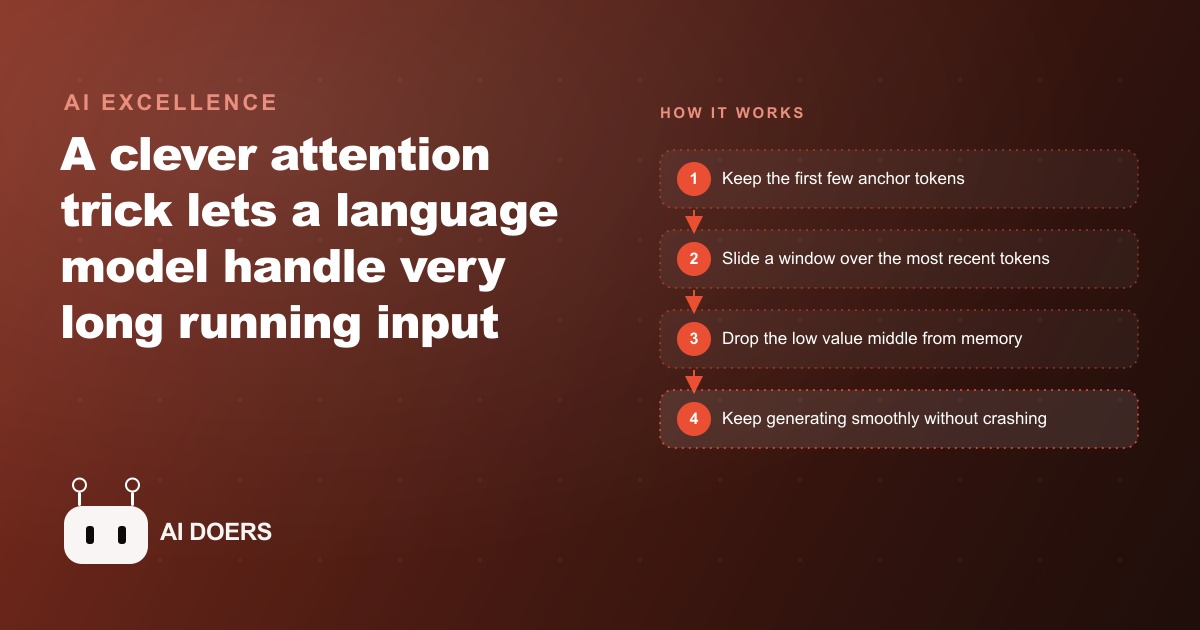
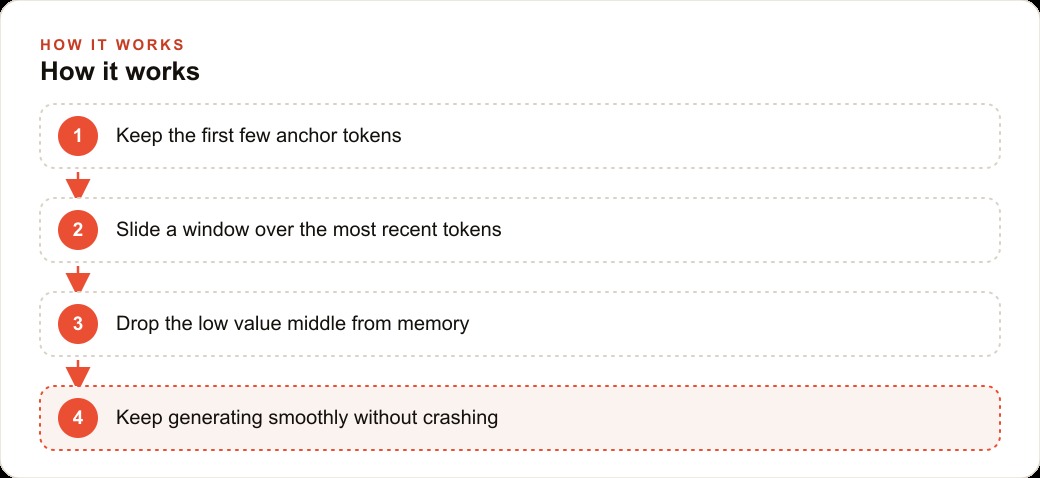
The StreamingLLM researchers used this discovery to design a smarter approach. Instead of keeping all previous tokens, which is expensive and breaks under long inputs, or only keeping the most recent tokens, which forgets too much, they built a system that keeps two things at once: the first four tokens, always, as the permanent anchor, and a sliding window of the most recent tokens for live context. Everything in the middle gets dropped.
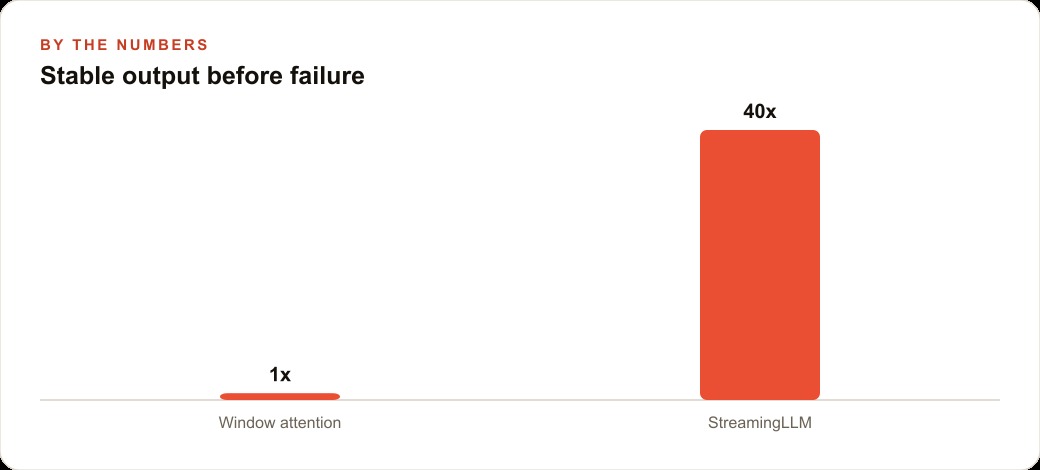
The result was striking. Compared to standard window attention, StreamingLLM could maintain stable, coherent output over sequences that were forty times longer before the model degraded. Not forty percent longer. Forty times longer. And the key to that stability was not keeping more memory. It was keeping the right four tokens, the ones the model was already using as its cognitive anchor anyway.
I find this result almost philosophically interesting. The model does not need to remember everything. It does not even need to remember most things. It needs to remember the right things: the anchor that gives it a stable point of reference, and the recent context that tells it where the conversation is right now. Everything in between, the middle of a long input that intuitively feels important, turns out to be largely expendable for the purpose of generating coherent ongoing output.
The best AI systems are not the ones that remember everything. They are the ones that remember the right things.
This is worth sitting with. We are conditioned, in the age of big data, to believe that more information produces better decisions. Sometimes it does. But cognitive systems, whether human or artificial, have always worked better when the signal is clean rather than when the archive is complete. A doctor who has memorized three critical facts about a patient will give better care in a five-minute triage than a doctor who is flipping through a two-hundred-page chart. The critical facts are the anchor. Everything else is available in storage, reachable when specifically needed, but not cluttering the working memory.
StreamingLLM is, at its core, an engineering implementation of that same principle. Keep the anchor. Keep the recent window. Trust that the middle can be retrieved or reconstructed when it genuinely matters.
The business lesson hiding inside a research paper about token budgets
I want to be direct about something before going further. StreamingLLM is a specific research contribution to a specific technical problem. It is not a general-purpose solution to the challenge of building AI systems that handle long conversations gracefully. It does not give a model true unlimited memory. The middle context really is dropped, which means it is not suitable for applications that require precise recall of everything that was said an hour ago. If that level of recall matters, you need retrieval-augmented generation or a different architecture altogether.
But the design principle behind StreamingLLM is deeply generalizable. The insight is that memory in AI systems does not scale by adding more of it. It scales by identifying what the model actually needs to anchor itself and perform well, and ensuring exactly that is preserved, not everything else.
That is a principle I see violated constantly when businesses build AI assistants. The gut instinct is always more context, more data, more history. The discipline required is to ask what the minimum viable context is for this system to function at its best.
Let me show you what this looks like with a concrete example.
A dental practice wants to build an AI assistant for patient consultations. The goal is straightforward: when a patient comes in, the assistant should be able to draw on that patient's history to help coordinate the consultation, surface relevant notes, and keep the dentist and staff oriented throughout the appointment.
The naive approach, and I see this chosen by default by teams that have not thought carefully about context design, is to feed the entire patient record into each session. Every note from every appointment over five years. Every insurance form. Every treatment plan and follow-up. Every lab result. Everything. The reasoning feels solid: the AI should have the full picture.
In practice, this approach produces a bloated context. The model receives thousands of tokens before it has even processed the first message from the patient. The response latency climbs. In this kind of context-bloated setup, response times hit between four and six seconds per exchange. That feels achingly slow in a live consultation where staff are trying to keep up with a real-time conversation. Worse, the responses do not actually improve with more data. In many cases they get less focused, because the model is attending to dozens of mildly relevant notes and treating them with roughly equal weight rather than surfacing the one or two things that actually matter right now.
Now apply the StreamingLLM design principle. Identify the anchor: the four or five facts that must be preserved across the entire session regardless of how long the appointment runs. For a dental patient, those might be the chief concern for today's visit, the last completed treatment and when it happened, the patient's insurance type since it affects what can be offered, and the patient's preferred communication style, whether they want clinical detail or plain reassurance. That is the anchor. Four facts. Always present, always first.
Then add a rolling window: the most recent five exchanges in the current appointment. The model sees the anchor and the last five turns. Nothing older than that. The entire history of the patient's chart does not live in the context window. It lives in a database that can be retrieved when specifically needed.
The outcome is measurable and significant. Response latency in this kind of streamlined setup drops from four to six seconds to under one second. That is not a minor improvement in user experience. For a practice where the AI assistant participates in every consultation, that latency difference determines whether the tool feels like a thinking partner or a frustrating delay. The average consultation where the AI assists drops from eighteen minutes to thirteen minutes. That five-minute reduction across a full appointment schedule frees enough time to fit two additional appointments per day. At one hundred and fifty dollars per appointment, that is three hundred dollars of additional daily revenue potential, from a configuration decision. Not from buying more hardware, not from upgrading the model, but from thinking carefully about what the model actually needs to remember.
This is the business lesson hiding inside the research paper. The organizations that will extract the most value from AI assistants in the next three years are not the ones that throw the most data at the model. They are the ones that understand how the model uses memory, identify the true anchors for their specific use case, and design their systems accordingly.
The attention sink finding is not just a quirk of how Transformers work internally. It is a mirror held up to a design principle that applies at every layer of how we build AI systems. The model already knew, without being told, that a few anchor tokens mattered more than the vast middle of what it had been given. It had learned this through training, through exposure to enormous amounts of human text and feedback. The researchers did not teach the model this preference. They discovered it, worked with it, and built something better because of it.
The implication I take from that is this: these models often have structural wisdom built into them that we can either fight or work with. The naive approach of feeding them everything fights against their actual memory architecture. The disciplined approach of identifying anchors and windows works with it.
When I think about the dental assistant, or any AI-powered tool a business is building right now, the useful question is not how much context can we give this model. The useful question is what are the four tokens this model actually needs to anchor on, and what is the rolling window of recent context that matters. Answer those two questions well and you get a faster, sharper, more reliable system. Answer them poorly, or not at all, and you get a bloated, slow, inconsistent tool that costs more to run and delivers less.
The best systems remember the right things. StreamingLLM found that out by studying what the model was already doing, quietly, under the surface. That is worth paying attention to.
That is exactly what we do at AI DOERS. Book a private 30-minute call with Madhuranjan Kumar and we will map the fastest path to it for your specific business.
Book your call →
Madhuranjan Kumar
Madhuranjan Kumar brings 20 years of performance-marketing experience and has managed over $200 million in Facebook ad spend for brands across the United States and beyond. His expertise spans the full modern marketing stack: Meta, Google Ads, TikTok, email automation, CRM, and the websites that hold it together. At AI DOERS he turns that track record into lead-generation systems for businesses across every industry.