
Space Agent: The Browser Agent That Rewrites Its Own UI
Space Agent is a free, open-source agent that runs inside your browser, rewrites its own interface, builds working apps from a single sentence, and orchestrates other agents, all while staying unusually token-efficient.

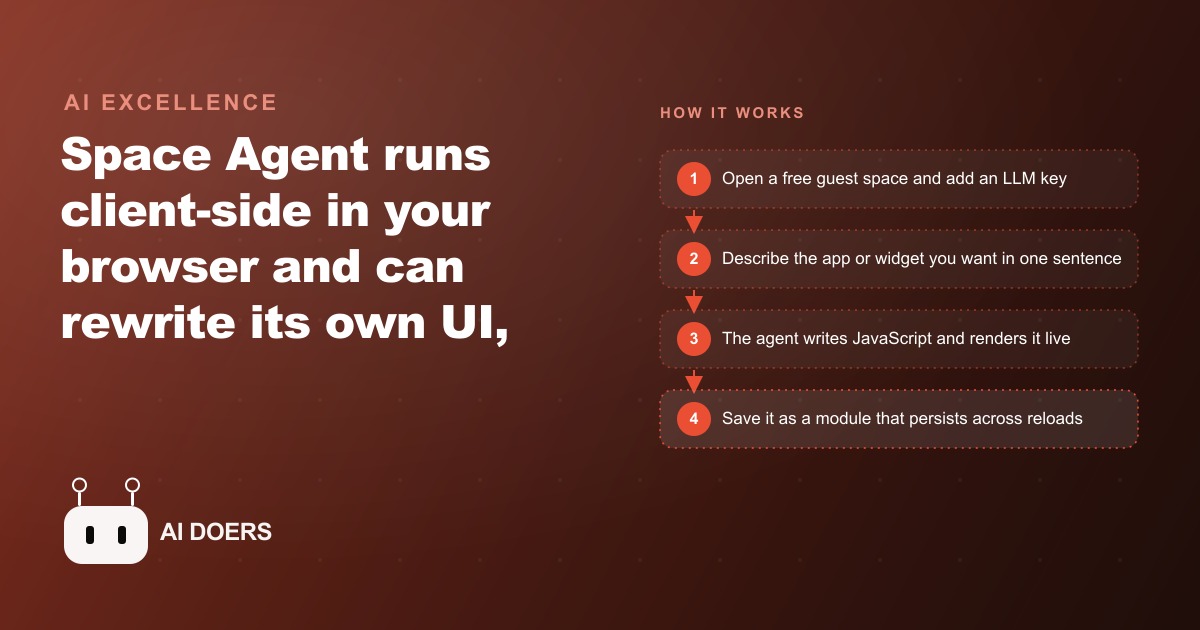
Space Agent can rewrite the page it lives on, and that is genuinely new
I am Madhuranjan Kumar, and I want to start with the specific claim that sets Space Agent apart from every browser tool that came before it, because once you understand it, everything else about the product follows from that one design decision. Most AI agents that interact with the web operate on a separate layer from what you see on screen. They edit files in the background, update database records, or call APIs, and then ask you to refresh a page to see the result. The agent and the interface are two different things, and you are the bridge between them.
Space Agent is different because it runs client-side in your browser and can mutate the exact page you are looking at. The interface is not a separate layer. The agent lives in it. When you ask it to build a widget, it writes JavaScript that runs immediately in the browser you are already using, and the result appears in the same window where the conversation is happening. You do not refresh. You do not switch tabs. You watch the page change.
That distinction sounds subtle until you see it in practice. A weather widget in the demo cost approximately 280 tokens from request to response, because there is no JSON schema for a tool call, no framework overhead, no server-side execution. The agent writes plain text for conversational replies and places executable code after a special marker that runs directly in the browser. A response to a plain question adds only the words in the answer and nothing structural. That efficiency is not an accident. It is the result of an architecture that put execution cost at the center of every design decision.
Browser-side execution sidesteps the bot-detection problem that kills most agents
One of the practical reasons server-side agents fail on so many tasks is that websites are increasingly hostile to automated traffic from data centers. A request coming from an AWS IP range looks like a scraper. Cloudflare blocks it. The site serves a challenge. The agent fails to navigate past it, and the task dies half-finished.
Space Agent avoids this entirely because the code runs in your browser. Requests to other websites look like ordinary browser traffic from your actual IP address and your actual session cookies. Because you are logged into those sites in your browser, the agent inherits your authentication. It is not pretending to be you on a remote server. It is literally using your browser, with your session, making requests that look exactly like the ones you would make manually. Sites do not block it because sites cannot distinguish it from you.
This matters for real business tasks. Competitive research, price monitoring, form submissions, and data gathering from platforms without APIs are all tasks where server-side agents hit detection walls within a few minutes. Browser-side agents using real logged-in sessions can run those same tasks without triggering detection, because from the site's perspective they look like the authenticated user doing normal things.
The second consequence of this architecture is privacy. Because the agent runs in your browser rather than on a third-party server, the data it accesses stays in your session rather than passing through vendor infrastructure. For a business handling customer information, competitive data, or internal documents, running the agent in a dedicated browser profile rather than a cloud platform changes the privacy calculus significantly. The agent is not a service that you grant access to your data. It is code running on your machine in your browser.
Token efficiency this low changes what it costs to run an agent all day
Most discussions of AI agent cost focus on the model tier, assuming that efficiency comes from choosing a cheaper model. Space Agent offers a different kind of efficiency: architectural efficiency at the execution layer that applies regardless of which model you choose.
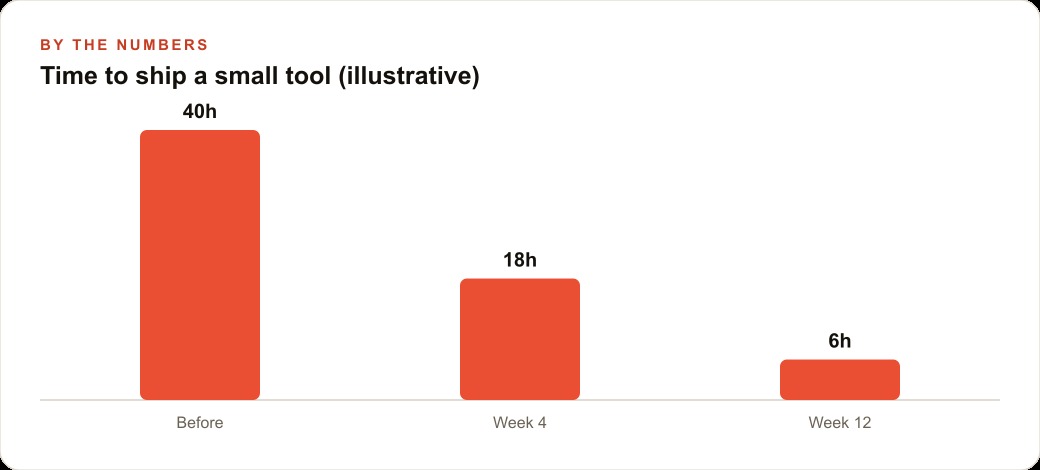
The 280-token weather widget in the demo is the example worth sitting with. At typical current pricing for a capable model, 280 tokens costs a fraction of a cent. Running a dozen such widgets throughout a workday costs less than a cup of coffee across the whole month. Contrast this with agents built on tool-calling frameworks where a single tool call carries schema overhead, JSON parsing costs, and multiple round trips. The same weather widget in a conventional framework might cost ten to twenty times more in tokens, not because the task is harder but because the architecture adds unavoidable overhead.
The page state management design amplifies this. Dynamic content, the parts of the space that change between requests, is placed after the last caching checkpoint in the conversation structure rather than accumulated in history. The agent does not carry a growing log of every intermediate state through every subsequent interaction. Context stays lean across a long working session, which means the token cost of the 50th interaction in a day is similar to the cost of the 5th, rather than escalating as the history grows.
For a business thinking about AI tool costs across a team and across a month of daily use, this is the number that matters. A tool that lets you run dozens of widgets and tasks all day at near-zero per-task cost is a categorically different spending decision than one where you ration agent use because each task carries meaningful cost. The architecture makes habitual, all-day use economically rational.
Small businesses are the obvious early winners of this architecture
There is a pattern in enterprise software where the tools small businesses most need are built for budgets small businesses do not have. The reasoning tools that could help a three-person agency build better client dashboards get launched at enterprise contract minimums. The automation platforms that could save a retailer ten hours a week require a dedicated ops person to configure and maintain.
Space Agent breaks from that pattern in two ways. It is open source and free to try. Two clicks give you a guest space. You add your own API key for whichever model you want to use, which means your data goes to the model provider you trust rather than through an opaque third-party platform. And the architecture that makes it cheap to run is not contingent on buying a specific tier. The token efficiency is structural, not a premium feature.
The kind of tools small businesses benefit from most are exactly what this architecture enables: lightweight dashboards tailored to specific workflows, lookup tools that pull from the sources that matter to that specific business, and quick internal apps that no off-the-shelf product covers precisely. A small architecture firm does not need an enterprise CRM dashboard. It needs a view of its six active projects, the status of each permit, and a quick lookup for contractor contacts. Building that through a conventional development path means a developer, a spec, a hosting decision, and maintenance. Space Agent builds it through a described requirement and a few minutes of generation, saving directly into a module that loads the next morning.
The most concrete illustration from the demo was a notes application with folder organization and image paste support that took about ten minutes of back-and-forth conversation to produce. For a small team that needs a shared note system that is not generic, that is not Google Docs, and that does not require paying for another SaaS seat, ten minutes is the entire development cycle. When the team's needs change, describing the change produces the update.
The one move to make this week if you want to test it honestly
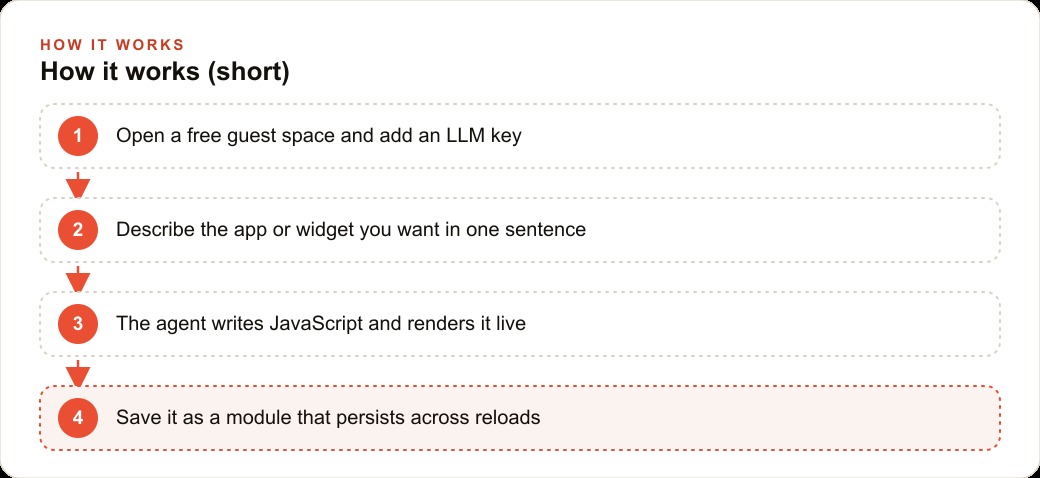
The test that reveals whether this tool is worth incorporating into your real work is simpler than most people expect. Open a free guest space, add your model key, and describe one operational dashboard you wish you had access to during a typical workday. Not a complex multi-step tool. Not something that requires authentication to external services. A single self-contained view: a structured note board for one project, a simple calculator that applies your margin rules to materials, a tracker for the handful of metrics you actually check each morning.
The goal of the test is not to evaluate the most impressive capability. It is to see whether the agent can build a self-contained tool for a real business need in under twenty minutes, whether the resulting module loads correctly the next time you open the space, and whether changing one requirement produces the updated version in a follow-up message. If those three things work for your specific use case, the platform earns a place in your weekly workflow. If one of them fails, you have a precise diagnosis of where the gap is and a clear question to search or ask the community about, rather than vague dissatisfaction with an expensive commitment.
For a retail store owner, the test tool might be a daily sales tracker that compares yesterday to the same day last week. For a consultant, it might be a structured client notes panel that organizes notes by project and date without requiring a separate app. For a property manager, it might be a unit status board that shows occupancy and upcoming lease ends in one glance. Each of those is a self-contained widget, well inside what this architecture handles reliably, and each of them has been built and maintained by multiple point-solution SaaS products charging separate monthly fees. The space builds the equivalent in ten minutes and keeps it in one place without an extra invoice.
The architecture also makes experimentation safe. Every user space is backed by a Git repository automatically. A change that breaks something is reversed in one click. A team member who modifies a widget and makes it worse does not lose the version that worked. The undo cost is zero, which means the experimentation cost is also close to zero. That safety net is what makes it reasonable for a non-technical person on the team to try building their own operational view without needing a developer on standby.
For any business owner who has been quietly maintaining a collection of browser tabs representing different data sources, or paying several small SaaS subscriptions for tools that each solve one narrow problem and never talk to each other, the most honest framing of Space Agent is this: it is the platform that replaces the collection of tabs and the stack of small subscriptions with one space that you own and that fits your actual workflow instead of forcing you to fit its template.
That is exactly what we do at AI DOERS. Book a private 30-minute call with Madhuranjan Kumar and we will map the fastest path to it for your specific business.
Book your call →
Madhuranjan Kumar
Madhuranjan Kumar brings 20 years of performance-marketing experience and has managed over $200 million in Facebook ad spend for brands across the United States and beyond. His expertise spans the full modern marketing stack: Meta, Google Ads, TikTok, email automation, CRM, and the websites that hold it together. At AI DOERS he turns that track record into lead-generation systems for businesses across every industry.