
6 Simple AI Agents Every Business Should Have
Six small automations quietly handle follow ups, expenses, outreach, and reminders so your hours go to higher value work. Here is what each one does and how I would set them up.

A chiropractic clinic with one doctor and one front-desk person was losing leads it had already paid to acquire, simply because nobody had time to chase them. Twelve weeks and three small AI agents later, the same clinic was recovering those leads automatically and had clawed back about ten hours a week of admin. I am Madhuranjan Kumar, and I have built hundreds of these little automations for people who just want the boring parts of their day to run themselves. Let me walk you through this one clinic's journey, chapter by chapter, because the sequence and the numbers show exactly how a normal small business adopts agents without a technical team.
The clinic that was drowning in small tasks
The clinic's problem was not dramatic, which is why it went unfixed for so long. Plenty of people would call or fill out a form asking about a first appointment, then go quiet, and nobody followed up because the front desk was busy with patients in the room. Receipts and supplier invoices piled up in an inbox until month-end, when someone had to sort them by hand for the accountant. And the owner kept meaning to build local referral relationships with nearby gyms and physiotherapists but never found the hours.
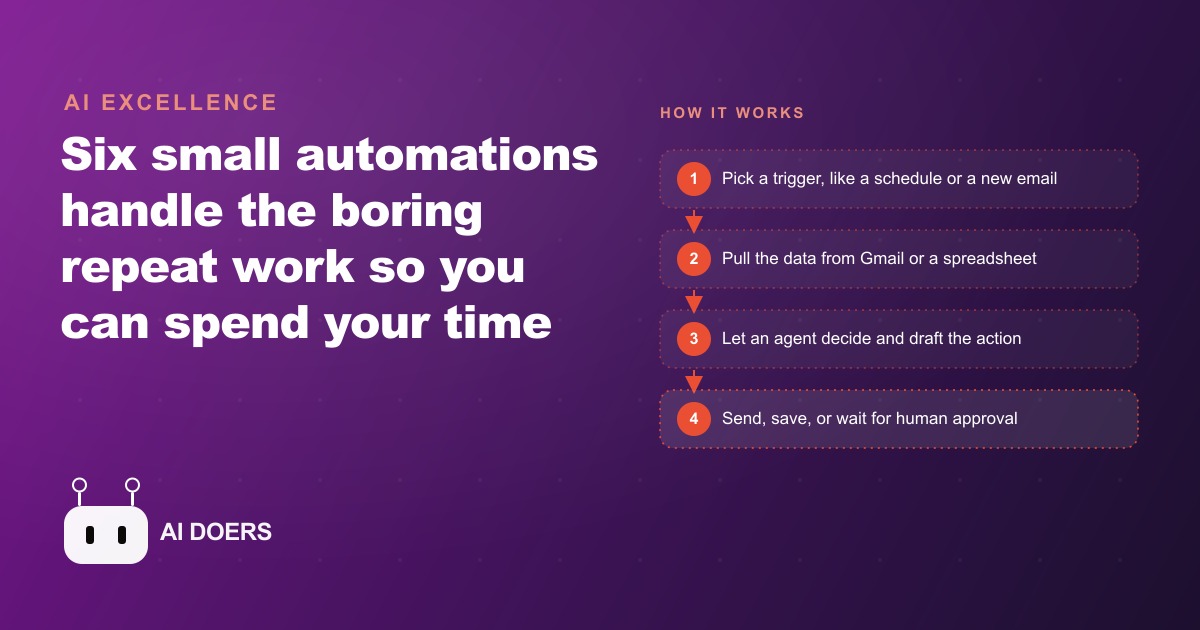
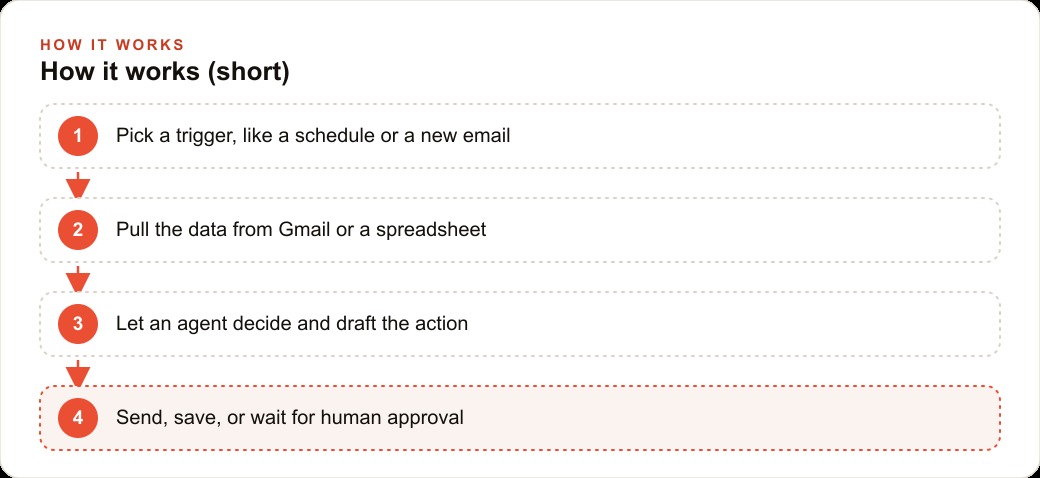
None of these were hard problems. They were repetitive ones, and repetitive is exactly what an agent handles well. The key thing to understand before we start is what an agent actually is. It is not a giant artificial brain. It is a small, focused automation with the same simple shape every time: a trigger, some data, a decision, and an action. The trigger might be a schedule or a new email. The data comes from an inbox or a spreadsheet. The decision is where a language model reads the situation and figures out what to do. The action is the visible result. Once you have built one, the rest reuse the same pieces, which is why the clinic's second and third agents came much faster than the first.
Agent one: the follow-up that stopped losing leads
The clinic started with a single agent, the lead follow-up agent, because that was its biggest, most expensive leak. Once a day this agent reads the clinic's sent messages, spots the inquiries that never booked, and drafts a warm, short nudge inviting them to schedule. It keeps gently following up until they reply, which turns forgotten leads into booked visits without anyone having to remember to chase.
Put illustrative numbers on why this mattered so much. Say the clinic got 40 new inquiries a month and, before the agent, booked about half of them, because the other half slipped through when the front desk got busy. If a new patient is worth 300 dollars in the first few visits, that is 20 lost leads a month, 6,000 dollars of potential revenue walking away. The follow-up agent does not need to recover all of it to be worth building. If it books even a quarter of those previously lost inquiries, that is five extra patients a month, about 1,500 dollars, from leads the clinic had already paid to generate through its Facebook and Instagram ad campaigns. This is the highest-leverage first agent for almost any business, because recovering a lead you already paid for is the cheapest revenue there is.
Week four: four hours back, and the expense agent
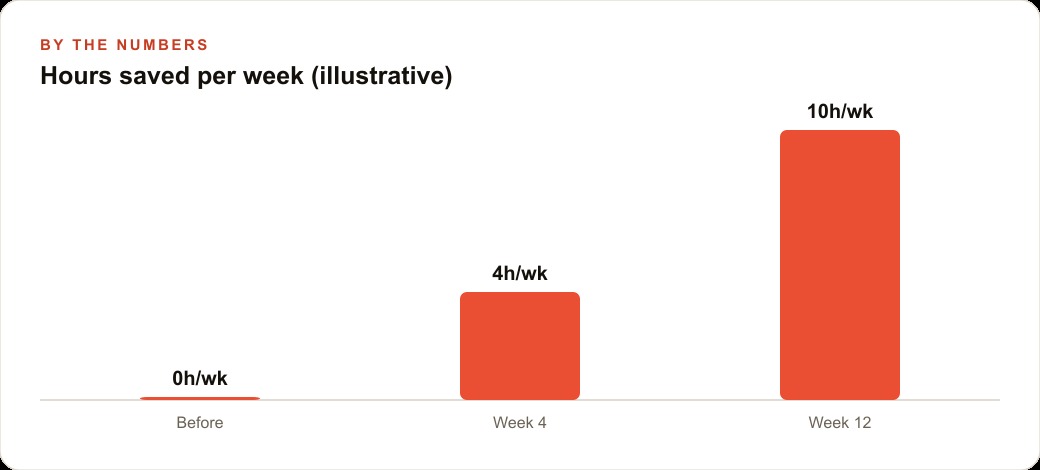
By week four the clinic layered in a second agent, the automatic expense logger, and its combined time savings hit roughly four hours a week. This agent watches the inbox, decides whether a message is a receipt or invoice, and appends the date, amount, and category to a clean spreadsheet, with a quick relevance score on each row.
The value here is not revenue, it is reclaimed time and sanity. The front desk used to spend an afternoon near month-end untangling a shoebox of emailed receipts. With the logger running daily, the bookkeeping is mostly done by the time the month closes, and the accountant gets a tidy sheet instead of a mess. Call it three hours a month recovered on sorting alone, plus the friction removed from every week. Notice the pattern building: the two agents so far reuse the exact same shape, a trigger, some data, a decision, an action, which is why the second one took the clinic under an hour to set up once the first had taught them the moves. The graph of hours saved went from zero before, to about four by week four, and it kept climbing as trust grew.
The outreach agent, with a human on the trigger
In the middle stretch the clinic added its third agent, the personalized outreach agent, to finally build those local referral relationships. This one does real research on a nearby physiotherapist or gym first, which genuinely needs a language model, then drafts a tailored note proposing a referral partnership. But it does not send on its own. The office manager approves each one before it goes out.
That human checkpoint is the most important design choice in the whole clinic build, and it is worth dwelling on. A model can still invent a detail, and one wrong fact in an outreach email costs you the relationship before it starts. So the smart pattern is to automate the parts that are safe to automate, the research and the drafting, and keep a human on the send button where a mistake is expensive. The clinic ran maybe ten of these a week, each taking the manager thirty seconds to approve instead of the twenty minutes it would have taken to research and write from scratch. Over a couple of months that outreach quietly built three steady referral sources, and the new patients it produced flowed into the CRM and website stack where follow-up reminders handled the next touches automatically.
The three agents the clinic chose to skip, and why
Part of this clinic's success was restraint. The original list has six agents: the lead follow-up, a realistic AI video generator, a channel performance tracker, the expense logger, the personalized outreach agent, and a birthday reminder that brainstorms gift ideas. The clinic deliberately skipped three of them, at least at first, and that judgment is as instructive as what it built.
This breakdown generator and the channel performance tracker are genuinely useful, but they serve a business that lives on content and social reach, which a local chiropractic clinic does not, at least not as its primary lever. The birthday reminder is a lovely touch for a relationship-driven sales business but was not where this clinic bled time. The lesson is to match the agent to your actual pain, not to build all six because a list says so. A busier content-driven business would have started with the tracker, which records views on day one, three, seven, and beyond and charts which posts are outliers so you know what to copy and drop, and it would happily use this breakdown generator to spin ad clips from a single idea in a spreadsheet. Different business, different first agents. Same underlying shape.
Week twelve: ten hours a week and the rule that kept costs down
By week twelve the clinic's three agents were saving about ten hours a week between them, and just as importantly, they were cheap to run. The reason they stayed cheap comes down to one rule the clinic followed from the start: use a language model only for judgment that genuinely needs judgment, and use plain code for everything else.
This rule saves people real money, and ignoring it is one of the most common expensive mistakes I see. Deciding whether an email is an expense or spam needs a model. Matching a keyword, formatting a date, or pulling a phone number out of text does not, and using a model for those is slow and wasteful. I have watched owners spend hundreds of dollars a month having a model do work that a few lines of plain code would do in milliseconds for almost nothing. The clinic reserved the intelligence for the decisions that earned it, the follow-up wording, the expense classification, the outreach research, and let cheap, reliable code handle the mechanical steps. That discipline is why ten hours of weekly savings did not come with a scary monthly bill, and it left more margin to reinvest in the clinic's Google Ads that were feeding the whole pipeline.
The other three agents, and the businesses they fit
Since the clinic skipped three of the six, it is worth walking through what those three do and who should build them first, because for a different business they would be chapter one, not an afterthought. The realistic video generator takes a single idea sitting in a spreadsheet, writes a prompt, generates a short video, and saves it to your drive, ready for ads, B-roll, or product clips. For an e-commerce store or a creator whose whole engine is a steady stream of visual content, this agent is transformative, because it collapses the cost and turnaround of producing video from days and hundreds of dollars to an afternoon at almost no marginal cost. The clinic did not need a video-a-day. A DTC brand running constant Facebook and Instagram ad campaigns absolutely does, and for them this would be the first agent to build.
The channel performance tracker records how each post performs on day one, three, seven, and beyond, then charts which pieces are outliers so you know exactly what to make more of and what to stop. This is the agent for any business whose growth depends on content reach, because it replaces guessing with evidence. Instead of a vague sense that some posts do better, you get a clear signal of which formats and topics are worth repeating, which compounds fast when you feed it back into what you produce next. A local clinic posting occasionally does not need this rigor. A media-driven business living or dying by its numbers cannot do without it.
The birthday reminder agent watches a list of dates, reminds you a week ahead, and even brainstorms gift ideas from each person's interests. It sounds trivial, and for the clinic it was not the priority, but for a relationship-driven sales business, a realtor, a wealth advisor, a high-touch B2B seller, a remembered birthday and a thoughtful small gift is real goodwill that closes and retains deals. The lesson across all three is the same one the clinic followed: the six agents are a menu, not a checklist. The right first agent is the one that maps to how your specific business actually makes and loses money, and that answer is different for a clinic, a store, and a dealmaker. Match the tool to the leak, and skip the rest without guilt until they earn their place.
What the clinic's run teaches
Step back and the clinic's twelve weeks tell a simple story. It started with one agent aimed at its biggest leak, added a second that reused the same setup, added a third with a human guarding the risky step, deliberately skipped the three that did not fit, and kept costs low by using code where code belongs. Nothing about it required a technical team. It required picking the right tasks and being willing to build one agent at a time.
That is the path I would put any small business on. Start with one agent, not six. Pick your single biggest time sink, usually lead follow-up or expenses, and build only that. Connect your inbox or sheet, wire up the trigger, write a clear instruction, and test it on real data before you trust it. The first connection is the hardest part, and once you push through it, every agent after reuses the same pieces and goes much faster. Then, and only then, add the next one that maps to a real pain. Match agents to your actual bottlenecks, keep a human on anything that would be costly to get wrong, and reserve the model for genuine judgment.
Honestly, a focused owner can stand up that first agent in an hour or two. The harder part is choosing the right task and writing the instructions so the agent behaves the way your business actually does, then deciding where a human still needs to approve. That judgment is where most people stall, and it is where the value really sits. You can follow the do-it-yourself path above, or you can bring in someone who has already built dozens of these and have the whole set handed over working. Either way, the boring parts of your week do not have to stay yours.
That is exactly what we do at AI DOERS. Book a private 30-minute call with Madhuranjan Kumar and we will map the fastest path to it for your specific business.
Book your call →
Madhuranjan Kumar
Madhuranjan Kumar brings 20 years of performance-marketing experience and has managed over $200 million in Facebook ad spend for brands across the United States and beyond. His expertise spans the full modern marketing stack: Meta, Google Ads, TikTok, email automation, CRM, and the websites that hold it together. At AI DOERS he turns that track record into lead-generation systems for businesses across every industry.