
The 6 Layers to Master AI, From Chat to Agents to Apps
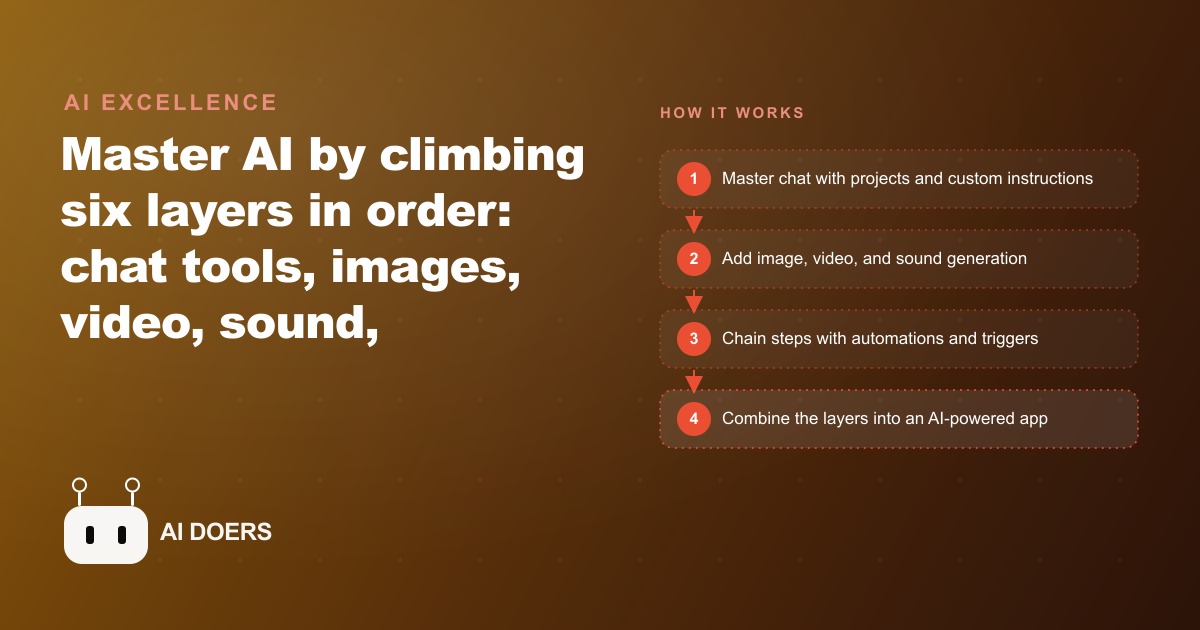
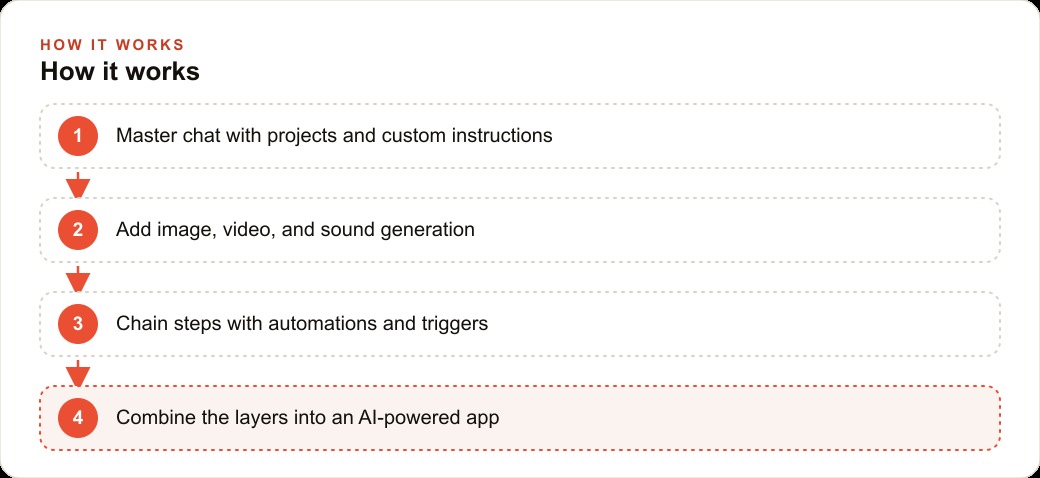
There is a simple ladder to mastering AI: chat, images, video, sound, automations, and agents, then combining them into apps. Here is each layer in plain terms and how I would stack them for a gym.

Six months ago the gym owner was writing every Instagram caption manually, chasing late membership payments herself, and still losing Saturday mornings to the booking inbox.
I am Madhuranjan Kumar, and I want to tell you the story of how she got from there to a place where social content, membership follow-ups, booking management, and competitive research all run without her direct involvement. The transformation did not happen because she had a technical background. She does not. It happened because she climbed the six layers of AI capability one at a time, in the right order, over six months. Each layer she added worked on top of the one before it. None of them required a developer until the final month. The total time she spent building the system across all six months was roughly the same as the time she used to spend in a single week on the tasks the system now handles.
I use this gym owner's story because it is specific enough to be instructive and representative enough to apply to almost any service business where the owner is the operational bottleneck.
The week the gym owner realized a chat tool was giving her generic fitness-industry copy
The first tool she used was a general AI assistant. She typed prompts asking for Instagram captions about her spin classes, and it gave her captions. They were grammatically fine and competently structured. They also sounded like they could have been written for any gym in any city by someone who had never been inside a fitness facility.
The output was generic because the input was generic. The tool had no information about her brand, her trainers, her members, the particular energy of her Saturday morning class, or the specific community her gym had built over four years. It was producing fitness-industry content, not her content. She recognized this after about two weeks and felt like she was wasting time: she was prompting, getting something close but wrong, and then manually rewriting almost everything the tool gave her until it sounded right.
This is the experience that leads most business owners to conclude that AI tools are not useful for their specific situation. The conclusion is wrong. The tool was not the problem. The missing layer was context, and context comes from custom instructions. Until the tool knows who you are, it will give you output for whoever the average person in your industry is, which is almost certainly not you.
Month one: custom instructions turn the assistant into someone who knows the brand
The shift that changed everything in the first month was spending one afternoon writing a detailed custom instruction document and loading it into the tool. The document covered the gym: its name, its neighborhood, the types of members it served, the trainers on staff by name and personality, the tone the owner used in her own posts, the classes that ran each week, and the specific reputation the gym had built over four years of being the neighborhood gym rather than the corporate-feeling franchise around the corner.
From that point, the captions stopped sounding like fitness-industry copy and started sounding like the gym. References to the neighborhood appeared naturally. The right trainer's name was attached to the class they actually taught. The tone that members recognized as distinctly hers came through without her editing it in. The output still needed reviewing, but it needed thirty seconds of light editing instead of a full rewrite. The time savings per caption shifted from negative, because editing generic output was slower than writing from scratch, to meaningful, because editing something that is eighty percent right is genuinely faster than starting from nothing.
This is the leverage point that most owners miss because it requires an investment before the payoff is visible. You spend an afternoon building the context document before you see any better output. That feels like delay. It is actually a one-time fixed cost that pays dividends on every single subsequent task. After the context is built, every prompt you give the tool produces output that is already calibrated to your brand rather than output you have to manually calibrate back to it.
Month two: on-brand class graphics appear without a designer or a brief
The second layer she added was image generation. She had been handling class promotion graphics two ways: paying a part-time designer for the important ones and using Canva templates for the rest. The designer cost money and required briefing time. The Canva templates took time and looked like Canva templates, which is to say they looked like everyone else's Canva templates.
With the image generation tools available in 2026, she began describing what she wanted and getting usable drafts within minutes. She referenced her brand colors, described the energy she wanted the image to communicate, and specified that she wanted real-looking gym environments rather than stock-photo aesthetics. The first-generation drafts were not always exactly right, but they were starting points she could respond to. She would describe what was not quite right about a draft, get a revised version, and reach something postable within two or three iterations.
She built a library of prompts that consistently produced the result she wanted for each class type: one prompt for spin, a different one for strength training, a different one for yoga. Reusing those prompts with small variations meant each week's graphics took thirty minutes instead of a half-day of designer coordination or Canva work. The graphics looked consistent across the week's posts, which made the feed look more professional without any additional investment.
Month three: fifteen-second trainer clips change what the social feed looks like
The third layer was short-form video. Her trainers were willing to record brief clips before or after classes, but there was no system for capturing those clips consistently or turning them into something postable quickly. Clips would sit in phone camera rolls, get delayed because nobody had time to edit them, and by the time anyone returned to them the class had happened three weeks ago and the content felt stale.
She built a simple process. Trainers sent clips to a shared folder the same day they recorded them. She used an AI video tool to add captions automatically from the audio and trim each clip to the fifteen to twenty seconds that worked best. The captions were accurate because they came from the actual speech, not from manual typing. She reviewed the trimmed clip in under a minute and posted it the same day.
The turnaround went from three weeks to same-day. The feed changed visibly. Real trainers in real classes, captured the same day the class ran, with accurate captions. Members started commenting on the clips because they recognized themselves in the background or recognized the trainer. Prospective members who visited the gym mentioned the social feed as something that had made the gym feel real and approachable before they came in. The content shifted from aspirational fitness imagery to actual community footage, which is what local service businesses should be showing.
Month four: membership signup stops requiring the owner to be at the desk
The fourth layer was automations. She had been handling new membership inquiries herself: answering the same seven questions about pricing, class schedules, trial options, and parking over and over through Instagram DMs, email, and the contact form. Every inquiry required her attention. If she was teaching a class or in a meeting, replies were delayed and potential members sometimes moved on before she got back to them.
She mapped the seven most common inquiry questions and built an automation workflow that captured new inquiry information, sent a pre-written response addressing all seven questions plus a link to book a trial class, added the contact to her CRM with the appropriate tags, and if the trial booking was completed, triggered a reminder message the day before the trial telling the new member what to bring and where to park.
None of that workflow required her attention. She checked the CRM dashboard once a day to see inquiry volume and trial booking completions. The response time to new inquiries dropped from an average of four hours to under two minutes because the automation ran immediately. Trial booking conversion improved because people were getting complete information instantly rather than waiting for a reply that might arrive after they had already booked something else. This is the layer where the time savings became concrete and measurable rather than approximate: she recovered roughly four hours per week just from this one automation.
Month five: a research agent starts filing weekly competitive intelligence reports
The fifth layer was agents. She set up a weekly research agent that monitored the social feeds and recent promotions of the four competing gyms in her area, noted any new class offerings or pricing changes, and delivered a structured one-page summary every Monday morning.
Before this, competitive intelligence came from what she happened to notice while scrolling or what a member occasionally mentioned. The agent made it systematic. She knew within a week if a competitor had introduced a new class format, changed their trial membership offer, or been running a promotion targeting new joiners. She could respond to those changes rather than discovering them three weeks after they had already affected her enrollment numbers.
The agent also tracked her own social engagement week over week: which posts had produced the most profile visits, which class types generated the most comments, which clips had been shared. Patterns that were invisible when she was just posting and hoping became visible in the weekly summary. She shifted her content mix based on what the data showed rather than what she felt like posting, and the engagement numbers improved consistently over the following two months.
Month six: a booking app built in three days closes the loop on every layer
The sixth layer was a small custom application. Before this month, she was using three tools that did not communicate with each other: a booking system, a payment processor, and a spreadsheet for membership tracking. When someone booked a class, the payment was in one place, the booking confirmation in another, and the membership status in a third. Reconciling them was a standing weekly task that took the better part of a Friday afternoon.
She described what she wanted: a single screen where she could see current active members, upcoming class bookings, overdue payments, and trial completions with a flag showing which ones had not yet converted to memberships. A developer used AI-assisted tools to build the first functional version in three days and spent two more days connecting it to her existing payment system and booking tool.
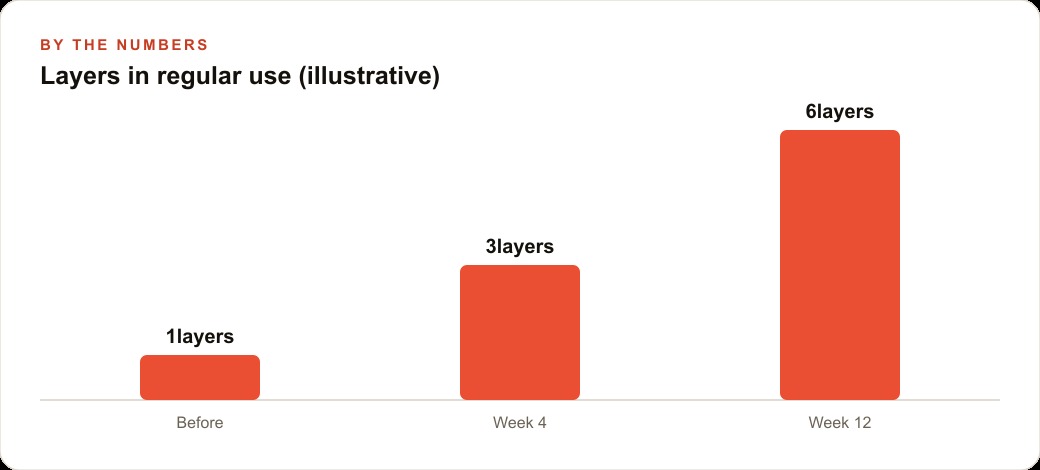
Before the six-month journey, she was spending roughly eight hours a week on social content, member communications, scheduling administration, and competitive tracking. After six months of layering, the same work runs in under two hours per week. Most of those two hours are review and judgment calls rather than production work. The production work, the writing, the scheduling, the responding, the research, runs automatically.
The sequence matters. Each layer she built depended on the layer before it. Custom instructions made the content work useful. Image generation extended the content output. Video created the community footage the automations then distributed more efficiently. The automations freed the attention that previously went to repetitive responses, and that freed attention was what made it possible to properly set up the research agents in month five. The app in month six made it possible to see the whole system at a glance. Start at any layer other than the first and the leverage is lower because the foundation is missing. Start at layer one and the compounding is real.
A service business that climbs these six layers over six months at the pace this gym owner did ends the year with a system that would have required two additional employees to replicate manually. The investment across all six months was time, not money, and most of that time was concentrated in the first month building the context and the first automation.
That is exactly what we do at AI DOERS. Book a private 30-minute call with Madhuranjan Kumar and we will map the fastest path to it for your specific business.
Book your call →
Madhuranjan Kumar
Madhuranjan Kumar brings 20 years of performance-marketing experience and has managed over $200 million in Facebook ad spend for brands across the United States and beyond. His expertise spans the full modern marketing stack: Meta, Google Ads, TikTok, email automation, CRM, and the websites that hold it together. At AI DOERS he turns that track record into lead-generation systems for businesses across every industry.