
You Do Not Need a Degree, You Need These Six AI Learning Tools
A practical guide to six ways of learning with AI and how to apply them in a real business. Includes a worked restaurant example you can copy.

Six AI tools crossed a threshold of reliability in 2025 and 2026 that made learning professional skills without formal education genuinely viable for working business owners, and the cost gap with formal training has now opened wide enough that the case for structured courses over AI-assisted learning by doing needs to be argued rather than assumed.
The tools themselves are not new in concept. Answer engines, creative generators, voice assistants, audio deep-dive converters, browser-based code builders, and visual diagramming platforms all existed in some form before this year. What changed is output quality. A year ago, the results from most of these tools required heavy correction before they were useful. The voice assistant gave plausible but imprecise guidance. The browser code tool produced shaky starting points that needed significant expert editing. The answer engine summarized well but struggled with the follow-up question that matters most when you are trying to understand something in depth. All of that has improved to the point where a working professional can genuinely learn and apply in the same session, without expert correction at each step.
Madhuranjan Kumar has watched this quality threshold change how quickly non-technical business owners build real skills. The pattern that was uncommon a year ago, an owner learning to manage their own local search presence or create their own marketing graphics or understand a workflow automation in an afternoon, is now routine. The tools made it possible. The reliability threshold made it practical.
The Gap Between Formal Training and AI-Assisted Learning Just Closed in a Way That Costs Almost Nothing
Formal training in the skills most business owners need today typically costs between two hundred and two thousand dollars per course, depending on the subject, the format, and the provider. A competent digital marketing course from a reputable provider runs around five hundred dollars. A video editing workshop with hands-on instruction is in the same range. A coding bootcamp covering basic app development starts at several thousand dollars for even the shortest intensive format.
The same skills, learned through AI-assisted doing on a real business project, cost between zero and forty dollars per month combined across all six tools described here. Most tools have usable free tiers. The full version of the stack, with unlimited access across all six, is under forty dollars monthly for a solo operator. That gap, between several hundred dollars for a single formal module and forty dollars per month for continuous access to a complete learning environment, has been growing for two years and crossed a tipping point this year when output quality stopped requiring expert correction at each step.
The more significant gap is in learning effectiveness, not cost. Formal training separates the learning phase from the application phase. You sit through the course, take notes, and then apply what you learned to real work days or weeks later, by which time the specific details that matter for your situation have faded and you are starting from a general principle rather than a concrete skill. AI-assisted learning by doing collapses that gap entirely. The learning and the application happen in the same session, which means the skills built are anchored to real business context from the first hour. They stick better because they were never abstract, and they transfer immediately because the first application was already a real output with real stakes attached.
Answer Engines Now Function as Personalized Textbooks Whose Curriculum Is Your Actual Business Problem
The most meaningful shift in the knowledge exploration category is that AI answer engines now behave less like search engines returning a ranked list of links and more like textbooks whose chapter headings are determined by whatever you asked. You get a detailed answer, then you follow up on the part that did not quite make sense, then you go deeper, and the depth keeps expanding without switching sources or guessing which result is most accurate for your specific situation.
For a business owner trying to learn a skill, this changes the shape of learning entirely. A traditional textbook or course is organized around the subject matter's logical structure, starting from the simplest concepts and building to the most complex. The curriculum was designed for a general audience, which means it covers things you already know before it gets to the things you need. An AI answer engine is organized around your actual confusion. You ask what you do not understand, and it answers that specific gap. Then you ask what you still do not understand after the first answer, and it answers that next gap. The curriculum is your particular situation rather than a pre-determined sequence that assumes a standard starting point.
The practical value is that a business owner does not need to sit through the parts they already know to get to the parts they need. An operator who already understands why local search matters but does not know how to optimize a specific listing can ask exactly that question and get exactly that answer, without completing prerequisite modules. The personalization is total, which is a level of efficiency that no course format, however well-designed, can fully match. You can also feed in your own documents, your own business data, and your own context, and get answers specific to your situation rather than generic to the topic. That capability alone represents a qualitative shift in what self-directed learning can produce in a single session.
Voice Immersion Is the Learning Mode Most Guides Have Not Yet Caught Up To
Most guides to AI-assisted learning focus on text-based tools because text-based tools are the most documented and the easiest to demonstrate in a written format. The voice learning category is underrepresented in the available guides relative to its practical value for skill acquisition, and that underrepresentation is creating a gap between what most people are using and what actually accelerates learning fastest for certain types of tasks.
Talking through a task out loud while doing it is how humans learn most physical and procedural skills. A mechanic who narrates the repair while a colleague watches and corrects learns the procedure more durably than one who reads the manual and then attempts the repair alone. The voice AI assistant applies the same mechanism to business tasks. You narrate what you are doing while you do it, the AI listens and responds with guidance, corrections, and explanations in real time, and the result is a learning experience that feels closer to having a knowledgeable colleague in the room than to consulting a static reference.
The application that produces the most durable skill gains is using voice immersion for tasks you have never done before where the steps are not obvious. Configuring a business listing for the first time, editing a social media graphic with unfamiliar tools, working through a spreadsheet formula that does not behave as expected: all are tasks where real-time audio guidance keeps the session moving and prevents the stall moments where most self-directed learners abandon the task and go watch a tutorial instead.
The audio deep-dive variant of this category is distinct but complementary. Rather than real-time guidance, you upload documents or articles and receive a spoken summary in conversational form that you can listen to during a walk, a commute, or any time away from a screen. Dense material on a topic relevant to your business becomes accessible during time that previously had no learning value. The combination of real-time voice guidance during work sessions and audio deep-dives during transit can double the effective learning hours in a week without adding any screen time, which is a meaningful practical advantage for an owner whose working day is already full.
Browser-Based Code Generation Turned "Build While You Learn" From an Aspiration Into an Afternoon
Code generation tools that run directly in a browser have made it possible for a business owner with no programming background to build a working, useful application in a single afternoon, which has changed the calculus on whether it is worth learning the basics of how software works. The answer is now unambiguously yes, because the barrier to building something real has dropped far enough that the first practical output is achievable before the enthusiasm for learning fades.
The learning mechanism in browser-based code generation is distinct from the other five tools because it is primarily experiential rather than instructional. You describe what you want to build, the tool generates a working starting version, and then you ask it to explain what it built. That sequence, build first, understand second, runs counter to how most people approach learning technical skills but produces better retention because the explanation is attached to something you created that works. The technical details are meaningful rather than abstract because they correspond to a specific thing you can modify and observe right in front of you.
A business owner who builds a small tool to automate a task their business already does, even a small and specific one, gains an experiential foundation for every subsequent technical conversation. When a vendor proposes a software integration, the owner who has built something small understands what integration actually means at a mechanical level. When a developer quotes a price for a feature, the owner who has built something understands roughly how complex that feature is. The value of the initial build extends well beyond the tool itself. It creates a reference point that makes every future technical decision more informed and less dependent on trusting claims that cannot be independently evaluated.
Visual Diagrams Are the Tool That Makes Complex Plans Survive Contact With a Busy Week
Every complex business project looks manageable on the day it is planned and overwhelming three days later when the original context has faded and a dozen new priorities have arrived. Visual diagrams are the tool that keeps the plan visible and editable under those conditions, and the AI-assisted versions of diagramming tools have improved to the point where generating a useful flowchart or project timeline takes minutes rather than the hours that manual diagramming sessions used to require.
The specific diagram types that matter most for business learning and planning are flowcharts for processes, timelines for projects with dependencies, and sequence diagrams for understanding how different systems or people hand off to each other. Each type makes a different kind of complexity visible. A marketing funnel that is confusing when described in a bullet list becomes immediately clear as a flowchart. A content calendar that looks overwhelming as a spreadsheet becomes manageable as a visual timeline where gaps and dependencies are obvious at a glance.
The learning application of visual diagrams is that complex subjects become navigable once the structure is visible as an image rather than held as text in working memory. A business owner learning a new framework can generate a diagram of the framework, annotate it with their own business's specifics, and then use the annotated version as a reference during implementation. The diagram externalizes the structure so the mental bandwidth that would have gone to keeping the framework organized in memory can go to executing the steps instead. That transfer of cognitive load from memory to the diagram is a meaningful productivity gain on any project complex enough to have more than four or five interdependent steps, which describes most real business initiatives.
The Restaurant That Put All Six Tools on One Real Marketing Project and Why That Matters
A restaurant marketing manager with no formal digital marketing training applied all six tools to a single real project: growing the restaurant's Google Business Profile presence and online order volume over a 30-day period. This worked example demonstrates why combining the tools on a real project produces faster and more durable skill building than using any single tool in isolation, and why a project with genuine stakes produces better learning than a practice exercise.
The project started with the answer engine. The manager asked which factors actually improve local search visibility for a restaurant, followed up on the specific actions that matter most, and within a few sessions understood the optimization landscape well enough to begin. For creative content, the generation tools produced social graphics, a short promotional video, and an updated profile image, all refined through iterations driven by the manager's direction rather than a designer's involvement. The total creative spend was zero.
Voice immersion drove the implementation sessions. While working through the profile settings for the first time, the manager talked through each step with the AI assistant, which caught errors in real time and explained the purpose of each field as it was configured. The audio deep-dive tool turned a long documentation article on local search best practices into a 15-minute conversational summary the manager listened to during the commute to work, which resolved several points of confusion before the next implementation session.
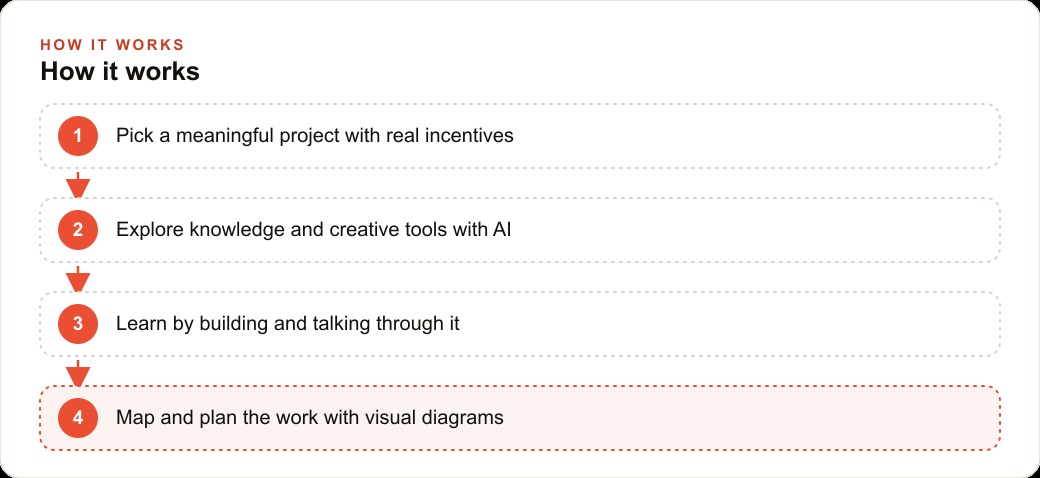
When the manager wanted a small tool to automatically format the weekly specials post, the browser code tool produced a working version in under two hours. The manager asked for explanations of each section, understood the structure well enough to make adjustments, and now maintains the tool independently. A visual timeline mapped the full 30-day content calendar with posting days, promotional dates, and review checkpoints visible together, updated freely as the schedule shifted during the month.
After 30 days of consistent posting and an optimized profile, local search visibility improved measurably and the owner reported a clear increase in customers citing the online listing as how they discovered the restaurant. Paying a digital marketing agency to produce the same outcomes would have cost three hundred dollars or more per month with no skill transfer to the team. The AI-tool stack cost under forty dollars per month and left behind a marketing manager who can now apply those skills to new projects without the same learning overhead. The difference is not just cost. It is the difference between renting outcomes and building permanent capability.
The Cost Case for AI Learning Over Formal Training Has Shifted Decisively This Year
The cost comparison no longer requires a detailed argument to resolve. Formal digital marketing training costs between two hundred and two thousand dollars per course, requires time away from the business during the learning phase, and transfers skills that are general rather than calibrated to the specific business's actual situation. AI-assisted learning by doing costs under forty dollars per month for a full tool stack, happens during real work on real business problems, and transfers skills that are immediately applicable because they were built on real applications with real output.
The quality gap that used to make formal training worth the premium, the gap between expert-corrected learning and self-directed learning that could go wrong in ways the learner would not recognize, has closed to the point where the AI tools produce reliable enough guidance that a motivated learner can identify and correct their own errors through iteration. A year ago, self-directed AI-assisted learning produced results that were sometimes correct and sometimes plausibly wrong in ways that required expert review to catch. That changed this year as output quality improved across all six tool categories. The exception cases where expert correction is genuinely necessary have become uncommon rather than the norm.
The business owner who commits to applying these six tools to one real project in the next 30 days will emerge with skills that a formal course sequence and a year of later application would have taken much longer to develop the same way. The skills will be applied rather than abstract, the cost will be under forty dollars rather than several thousand, and the learning will have produced real business output from the first session. The six tools together, pointed at one real project, in the hands of someone with genuine stakes in the outcome: that combination has crossed a threshold this year. The gap with formal training closed in a way that costs almost nothing to access and almost nothing to sustain over time.
That is exactly what we do at AI DOERS. Book a private 30-minute call with Madhuranjan Kumar and we will map the fastest path to it for your specific business.
Book your call →
Madhuranjan Kumar
Madhuranjan Kumar brings 20 years of performance-marketing experience and has managed over $200 million in Facebook ad spend for brands across the United States and beyond. His expertise spans the full modern marketing stack: Meta, Google Ads, TikTok, email automation, CRM, and the websites that hold it together. At AI DOERS he turns that track record into lead-generation systems for businesses across every industry.