
SIMA 2 Learns By Doing: What a Self Teaching AI Means for Knowledge Work
SIMA 2 is an agent that learns new tasks by doing them, carries skills from one job to the next, and explains its reasoning, which previews how the next wave of business agents will work.

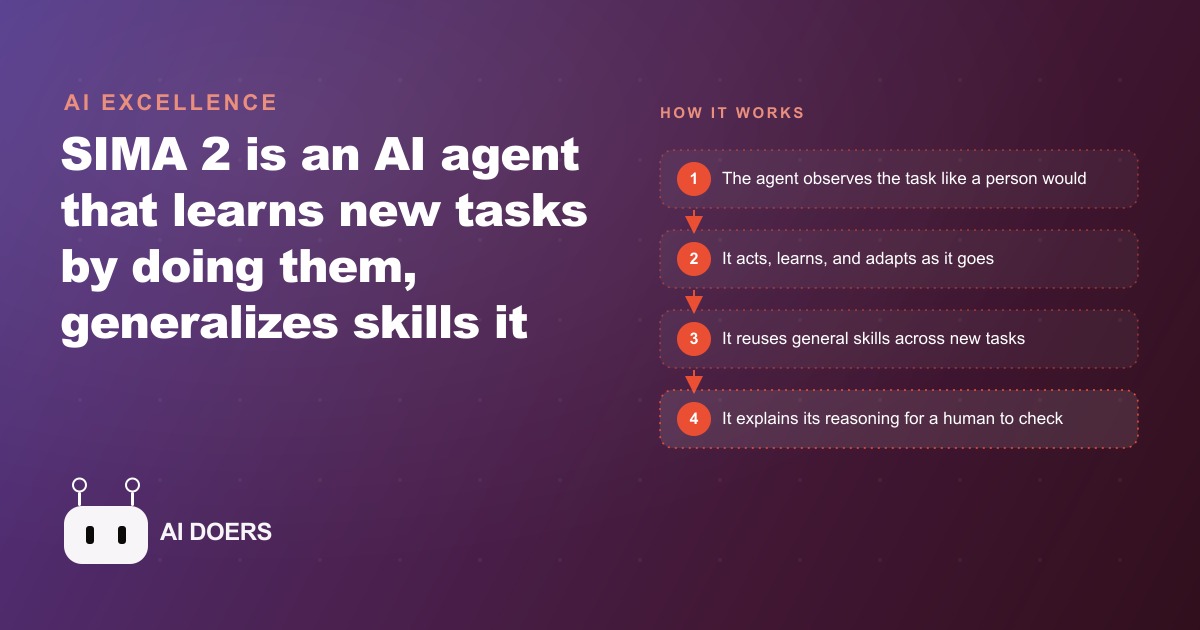
Google DeepMind just released an AI agent that plays video games by looking at the screen and using a keyboard and mouse, exactly the way you or I would, and the interesting part is not the games. It is what the design reveals about the agents that are about to start doing real business work. The system is called SIMA 2, it runs on Gemini, and DeepMind calls it a meaningful step toward general intelligence. I am Madhuranjan Kumar, and I want to take this one apart carefully, because buried inside a gaming demo are three properties that decide whether an AI agent is a toy or a teammate.
Pixels in, actions out, and why that framing matters
The first thing to understand is how SIMA 2 perceives its world. It does not read the game's underlying code or tap into some hidden data feed. It looks at the raw pixels on the screen and then acts through a virtual keyboard and mouse. When you tell it to go build a house or chop some wood in plain language, it has to interpret the instruction, look at what is actually on screen, and work out the sequence of clicks and moves that gets there.
This pixels in, actions out framing is the quiet breakthrough, and it is easy to skip past. A traditional game bot is wired directly into the game. It is fed the exact coordinates of every object and told the rules in advance. That bot is powerful inside its one game and completely useless everywhere else, because it was built to exploit one specific set of internal data. SIMA 2 works from what any human sees, which means it is not tied to any single environment. The same approach that reads a game screen can, in principle, read a spreadsheet, a web app, or a form, because to the model it is all just pixels arriving and actions going out. That generality is the whole reason this research matters to someone who will never play the games it was tested on.
The transfer trick that separates a skill from a script
Here is the facet that impressed me most. SIMA 2 organizes what it can do into broad categories like farming, building, and operating vehicles, with specific abilities underneath them such as look around, drive, kick, feed, equip, and activate. The critical detail is that these skills are not welded to one game. They transfer. An ability the agent learns in one world shows up, useful and intact, in a completely different one it was never trained on.
Think about what that means by analogy. A person who learns to drive one car can sit in almost any other car and drive it, because they learned the underlying skill of driving rather than memorizing the exact layout of one dashboard. SIMA 2 does the same thing. It learned the concept of operating a vehicle, not the button sequence for a single game, so it carries that competence forward. This is the difference between a skill and a script. A script is a fixed list of steps that breaks the moment anything changes. A skill is a general capability that adapts to new situations. Older automation was all scripts, which is why it shattered every time a website moved a button or a form added a field. An agent that holds skills instead of scripts is a fundamentally sturdier thing to build a business process on.
Reasoning you can actually hear
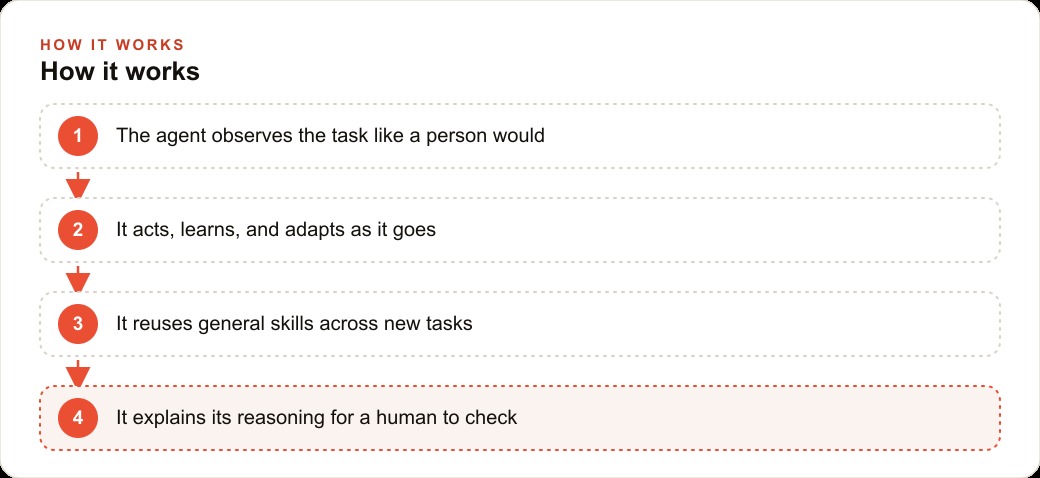
The third property is the one that turns a clever automaton into something you would trust near real work: SIMA 2 can explain itself. Unlike a silent bot that just clicks, it can hold a conversation about its goals, talk through its plan, and even explain the game back to you. It reasons about what it is doing rather than blindly reacting to what is on screen.
Do not underrate how important this is. An agent that acts silently is a black box. When it gets something wrong, you have no way to see where the thinking went sideways, and no way to catch a bad decision before it causes damage. An agent that narrates its plan is auditable. It can tell you this is what I am about to do and here is why, and a human can nod it through or stop it before anything happens. That single capability is what makes it safe to point one of these systems at work that carries consequences. The ability to explain is not a nice extra feature bolted on top. It is the load-bearing beam that lets a person stay responsible for the outcome while the agent does the grunt work underneath.
The jump from SIMA 1 to SIMA 2 tells you the pace
It helps to see the trajectory rather than a single snapshot. SIMA 1 arrived in March 2024, and it could manage basic actions, walking to a spaceship, driving a car, executing simple instructions in a game world. Capable, but narrow. SIMA 2 landed in November 2025, and the leap in that window is the part that should get your attention. It went from following simple commands to reasoning about goals, explaining its plans, and generalizing to tasks it was never specifically trained for, because it now runs on Gemini and inherits that model's broad competence.
That pace is the real signal for a business owner. The gap between a system that follows narrow orders and a system that reasons and explains closed in roughly a year and a half. If you are deciding whether to start learning how to fold agents into your operation, the honest answer is that the capability is arriving faster than most teams are preparing for it. The businesses that begin documenting their processes and experimenting with supervised agents now will be the ones ready to move when the fully reliable versions land, rather than scrambling to catch up after their competitors already have.
Why a game engine is a preview of your back office
Put those three properties together, generality from perceiving like a human, skills that transfer instead of scripts that shatter, and reasoning it can explain, and you have described the shape of the next wave of business agents. SIMA 2 itself is a research system aimed at games and, eventually, robotics, since a robot faces the same problem of looking at a messy real world and acting in it. But the design pattern is what you should watch, because the same pattern is coming for office work.
An enormous amount of knowledge work is exactly the kind of task this design suits. Sorting documents, pulling key facts out of files, routing requests to the right person, drafting first versions, and following a multi-step procedure are all jobs where a generalizing, self-explaining agent shines. Professional services, clinics, accounting practices, agencies, and any business drowning in paperwork are the natural early adopters, because their work is patterned enough to learn and important enough that they will pay to have it handled well. Crucially, the goal is not to replace the expert. It is to let an agent absorb the repetitive reasoning and present its work clearly so the expert spends their hours on judgment rather than on sorting.
A worked example: a claims desk that reads its own inbox
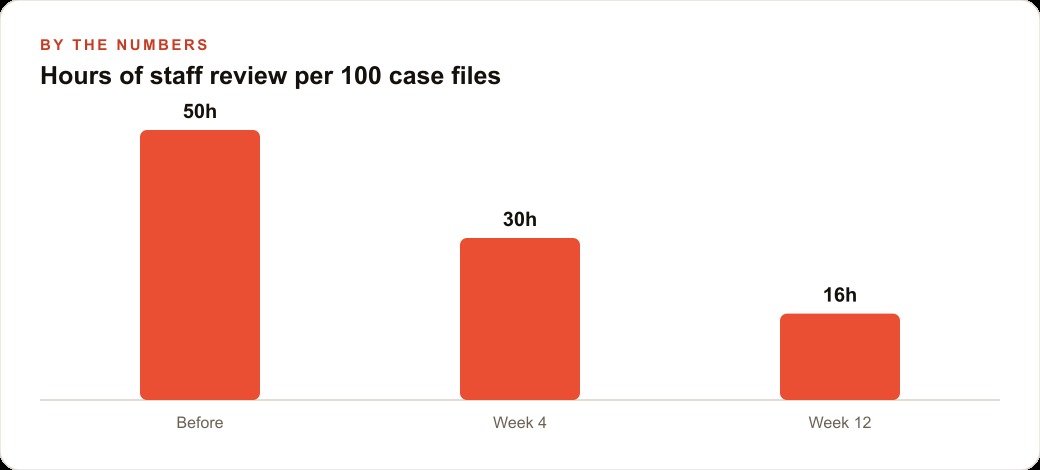
Let me make this concrete with an illustrative example. Picture the claims desk at a mid-sized insurance office. Every day, dozens of claim submissions land by email, each with attachments in different formats, some complete and some missing the one document that matters. Right now a staff member opens each one, figures out what type of claim it is, checks whether the required paperwork is attached, and routes it to the right adjuster. Say the desk handles 100 claims a week and each one eats about 30 minutes of reading and sorting before any real decision gets made. That is roughly 50 hours a week of pure triage.
Now imagine an agent built in the SIMA 2 mold aimed at that inbox. It reads each submission the way a person would, identifies the claim type, and instead of just declaring this is an auto claim, it explains its reasoning: I classified this as an auto claim because the attached form is a vehicle incident report and the description mentions a collision. It flags that a proof-of-loss document is missing and drafts a request for it. Because the classification skill it learned on one claim type transfers to the next, it gets more useful across the whole range of claims rather than needing a fresh rule for each one. A staff member reviews the agent's explained output, confirms in seconds instead of reading every page, and approves the routing.
As the agent settles into the work, that 30 minutes of triage per claim might drop toward 16 minutes of review, and the 50-hour week of sorting shrinks accordingly. The adjusters get clean, pre-organized files with the reasoning attached, so they start on judgment instead of on triage. None of it goes out the door without a qualified human signing off, because the agent explains rather than decides. Those recovered hours are not just a cost saving. They let the same office chase more business, and the leads that fill that pipeline flow in through Facebook and Instagram ad campaigns and land in the CRM and website stack where an organized team can actually follow up on them instead of drowning in the backlog.
The guardrail that makes any of this usable
The reason to lean on SIMA 2's design as a model is that it bakes in the one thing every serious deployment needs, which is a human in the loop. Because the agent can explain its reasoning, the correct setup has it prepare and explain the work while a qualified person approves anything that matters. That mirrors exactly how SIMA 2 talks through its plan rather than acting in silence. In a field with real consequences, the near-term win is not an agent that runs unsupervised. It is an agent that does the reading, sorting, and drafting, shows its work, and hands a human a clean decision to make.
That guardrail also happens to be where the value lives. A business that inserts an explaining agent into its highest-volume, lowest-judgment tasks gets faster turnaround, fewer missed details, and experts freed for the work only they can do, all without giving up control. The mistake to avoid is treating today's agents as fully autonomous employees. They are not there yet, especially where an error is costly. Treat them as tireless assistants that prepare and explain, and the technology fits real work today rather than in some hazy future.
What to take from a gaming milestone
So the headline is a game-playing AI, but the substance is a design pattern. SIMA 2 learns tasks by doing them rather than being hand-coded, it transfers skills across situations instead of shattering on change, and it explains its reasoning so a person can verify every important call. Those three traits are the checklist to hold up against any business agent someone tries to sell you. Does it learn the process or just follow a brittle script. Does what it learns carry to the next task. Can it tell you why it did what it did.
The way to get ready is not to wait for the fully autonomous version. It is to start finding the repetitive, pattern-based, low-stakes-first-draft tasks in your own operation, write down how you actually do them, and mark the exact points where a human must approve. Those are the places where the first generation of explaining agents will earn their keep. That same content and process foundation, once documented, also strengthens your SEO and organic search footprint, because a business that has mapped its own workflows clearly tends to communicate them clearly too. The gaming demo is the flashy version. The office version, quieter and far more profitable, is the one worth preparing for now.
That is exactly what we do at AI DOERS. Book a private 30-minute call with Madhuranjan Kumar and we will map the fastest path to it for your specific business.
Book your call →
Madhuranjan Kumar
Madhuranjan Kumar brings 20 years of performance-marketing experience and has managed over $200 million in Facebook ad spend for brands across the United States and beyond. His expertise spans the full modern marketing stack: Meta, Google Ads, TikTok, email automation, CRM, and the websites that hold it together. At AI DOERS he turns that track record into lead-generation systems for businesses across every industry.