
How to Sign Your First AI Automation Client in 7 Days
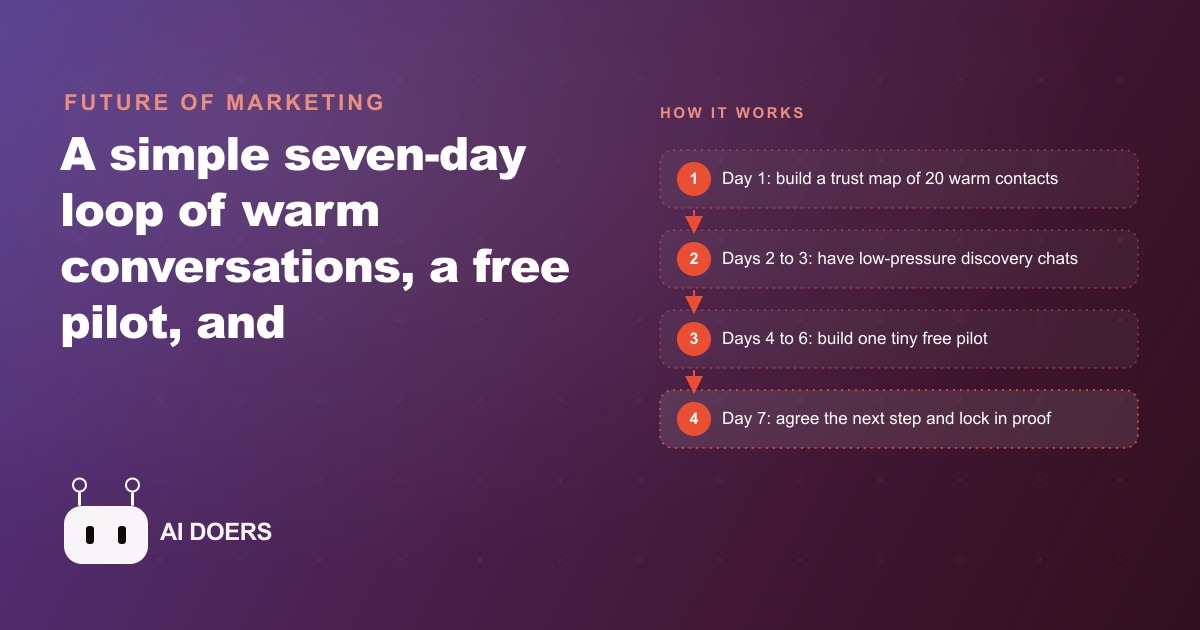
A simple seven-day loop of warm conversations, a free pilot, and outcome-led positioning can land your first AI automation client without any cold outreach. Here is the full plan and how it plays out for a real service business.

Most people who want their first AI automation client spend weeks building workflows, polishing a portfolio, and writing cold outreach sequences that go unanswered. I am Madhuranjan Kumar, and I want to take apart exactly why that approach fails and what actually works instead, because the mechanics of landing a first client in seven days are not about better emails or a slicker demo. They are about understanding where trust comes from and what a client is really agreeing to when they say yes.
The real problem is not outreach volume, it is the shape of the offer
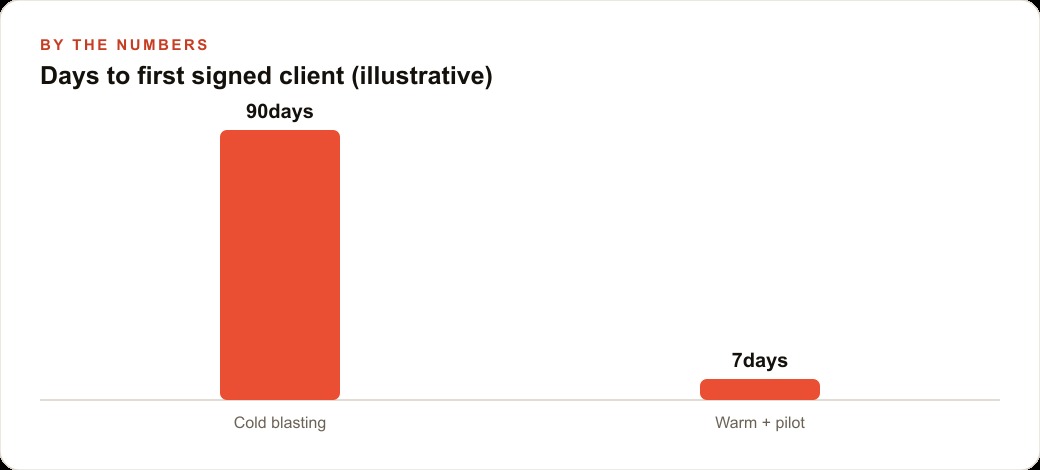
The reason high-volume cold outreach fails is not that the market does not want AI automation. It is that the offer has the wrong shape. When you write to a stranger and say I build AI automations and I can save your business time, you are asking them to believe three things simultaneously: that you know something they do not, that what you know applies to their specific situation, and that you will deliver it reliably despite the fact that they have no evidence of any of this. Cold outreach asks for trust before it has been established, and trust is not something people extend to strangers selling unfamiliar technology.
The shift that makes the seven-day timeline realistic is changing the shape of the offer from I can build you something to I noticed this specific pain in your business and I would like to try fixing it for free so we both find out if this works. The free pilot removes the trust barrier at the cost of one unit of your time. That is a very different trade than asking someone to hand over money based on a proposal they received from a stranger.
The positioning matters too. The frame that works is guide and diagnostician, not vendor. A vendor says here is what I sell and here is what it costs. A guide says here is what I noticed about how your business works, here is what I think is causing this specific friction, and here is what I would like to try. The guide asks questions and listens before proposing anything. That mode of engagement signals competence in a way that no portfolio can.
Trust is borrowed before it is earned
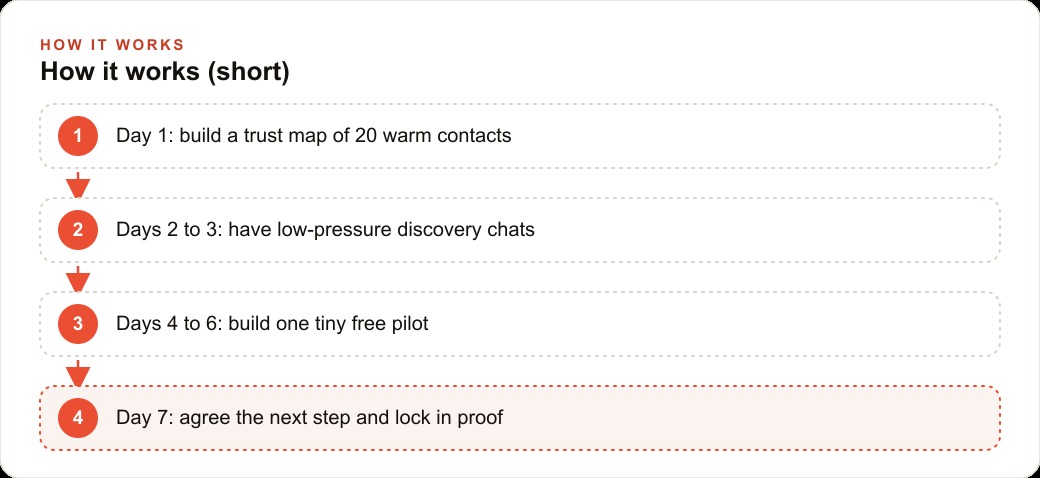
Day one of the seven-day approach is a trust map: a list of twenty people where trust already exists, not in your skill as an automation builder, but in you as a person. Friends who run businesses. Past coworkers and managers. People from communities and groups where you have spent time. For each contact, note the industry and how well you know them. This exercise is not networking; it is taking inventory of social capital you have already built and have not yet thought to apply.
The reason warm contacts convert far faster than cold outreach is not complicated. They already trust you as a person, and personal trust is transferable to professional contexts in ways that cold credibility is not. When a friend agrees to let you build something for their business, they are not evaluating your AI automation credentials. They are deciding whether they trust you enough to spend an afternoon letting you poke around their workflow. Most people who know you moderately well will say yes to that.
The referral extension of this is equally powerful and often underused. If your direct warm contacts do not have the right kind of business, ask whether they know someone who might benefit. You are borrowing trust one level removed, and that borrowed trust still dramatically outperforms cold contact. The first message to a referral already contains more credibility than ten cold emails to strangers.
Days two and three are five to ten short, low-pressure conversations. The explicit purpose is discovery, not pitch. You are asking where work feels manual or annoying, not proposing solutions. The most useful question is simply: what part of running this business takes the most time and feels the most repetitive? You listen, take notes, and say very little about what you can build. This discipline is harder than it sounds because the temptation to pitch is strong when someone describes a problem you can solve. Resist it. The conversation that ends with you listening gets a follow-up much more reliably than the one where you launched into a proposal.
A free pilot is cheap at any price
Days four through six turn the strongest conversation into a small piece of work. You pick the person whose pain was clearest and most obviously repetitive, and you propose something specific and limited: I want to build a small automation that handles exactly this task, and in exchange I just want honest feedback on whether it actually helps. The scope matters. Not I will automate your whole operation, but I will solve this one specific problem. Small scope means fast delivery and contained risk for both sides.
The build itself should be straightforward enough to complete in two days. The goal is to prove one thing: that the automation saves time on the specific task it was designed for. If it does that, the pilot succeeded. Everything else, the polish, the documentation, the edge cases, can come later. You are not building a finished product. You are building proof that you understand the problem and can deliver a working solution.
The metric you want to capture is specific. How many minutes per week did this task take before? How many minutes does it take now? That single comparison, honestly measured, is the entire business case for everything that follows. A client who saw their onboarding follow-ups go from two hours per week to fifteen minutes has a clear picture of what they received. That clarity is what makes the next conversation easy.
During the build, pay attention to the exact words the client uses to describe the problem and the solution. The language they reach for to explain a painful task, the phrase they use when something finally works right, these are the words that will make future conversations with similar businesses resonate immediately. Every client you work with is also a vocabulary lesson for the next one.
Rejection is a research instrument
Day seven is a relationship conversation, not a close. The question is what makes sense next based on what the pilot showed. Two options, presented simply: the system running reliably with occasional maintenance, or expansion to one or two related problems the build surfaced. The framing is always what would help you, not what would make this engagement bigger.
If they are happy but not ready to commit to anything, you ask for a testimonial and, only if the moment is natural, an introduction to someone else who faces similar friction. A testimonial is worth more than a retainer at this stage because it converts the pilot into a reference that makes the next warm conversation much shorter.
If the pilot did not land or the client says no to anything further, you treat that as data. What specifically did not work? Was the time savings too small to be noticeable? Was the problem less painful than it seemed in the conversation? Did the solution not fit how they actually work? Each answer sharpens how you pick the next pilot. The people who land clients consistently are not the ones who never get rejected. They are the ones who ask why they were rejected and change one specific thing before the next attempt.
The seven-day cycle repeats. Each loop gives you better language, sharper problem identification, faster builds, and clearer positioning. By the third or fourth loop you are no longer a beginner guessing in the dark. You have real examples, real testimonials, and a pattern recognition about which kinds of businesses have the clearest and most fixable pain. The CRM and workflow infrastructure you build for each client also gives you a clearer sense of where automation delivers the most obvious value, which makes each subsequent pilot better targeted.
The connection to paid acquisition also becomes clearer over time. A business that converts new customers well organically often needs better Google Ads or Facebook and Instagram ad campaigns to scale that conversion, and positioning yourself as someone who understands both the acquisition and the operational side makes you a more complete partner than someone who only builds workflows.
The full method is a trust map, five discovery conversations, one free pilot, and one honest day-seven debrief. That is what seven days actually looks like, and it is replicable with any warm contact list in any market. ## Running the loop a second and third time
The first loop of the seven-day method is almost always imperfect in some specific way. Maybe the pilot was technically successful but the business owner was not emotionally invested enough to convert. Maybe the pilot saved time on the wrong task, one that was a mild annoyance rather than a genuine pain point. Maybe the conversation on days two and three stayed too general and did not surface a specific enough problem to base a pilot on.
Each of these failures contains a specific fix. The pilot that landed technically but did not convert usually means the outcome was real but not visible enough to the client: they needed to see a specific before-and-after measurement, not just be told the automation was running. Build a simple dashboard for the next pilot that shows the metric moving. The pilot that targeted the wrong task usually means the discovery conversations were too short or too polite: the owner described minor friction, not genuine pain. The next iteration of days two and three starts with a different question: what is the one thing in your week that you genuinely dread doing or that you have been avoiding? The pilot that could not surface a specific problem means the trust level was not quite high enough: the owner talked about their business in general terms but did not reveal where it actually hurt. The fix is a longer, more patient discovery conversation, or asking the referral to make a personal introduction before the conversation rather than just providing a name.
Running the loop three times over three weeks produces a pattern. You will have found the type of business that surfaces the clearest pain points in two conversations, the type of pilot that delivers the most obvious measurable result, and the specific language that makes the outcome visible enough to convert. That pattern is your positioning, arrived at empirically rather than theorized from a marketing manual.
For businesses that become clients after the pilot, the natural follow-on conversation involves the broader operational context. A business owner who just saw their onboarding follow-ups automated is naturally curious about what else in their workflow could be handled similarly. That conversation often touches on the tools they already use: their CRM and website stack for tracking customers, the platforms they use for advertising, the reports they generate manually. Each of those is a potential next pilot, and each successful expansion deepens the relationship in a way that a new cold contact never produces.
The referral network that builds from this approach is also worth understanding. A business owner who saw a specific, measurable improvement from your work and felt the experience was honest and collaborative is a far better referral source than a generic satisfied customer. When they refer someone, they describe the specific outcome and the specific problem it solved, not just a positive general impression. That kind of referral converts at a much higher rate than any cold outreach, and each client you serve well generates several more of them over time. The seven-day loop, run consistently, compounds into a client base built entirely on demonstrated results and genuine relationships.
The seventh day ends with a clear answer: either the pilot landed and you have a client, or it did not and you have a specific, actionable understanding of what to adjust. In either case, the loop continues with the next referral and the next pilot. Every cycle that does not convert teaches you something that makes the next one more likely to. The businesses that build a sustainable client base through this approach do not do it through perfect execution on the first try. They do it through consistent, systematic iteration until the pattern that converts becomes clear. Then they run that pattern repeatedly.
That is exactly what we do at AI DOERS. Book a private 30-minute call with Madhuranjan Kumar and we will map the fastest path to it for your specific business.
Book your call →
Madhuranjan Kumar
Madhuranjan Kumar brings 20 years of performance-marketing experience and has managed over $200 million in Facebook ad spend for brands across the United States and beyond. His expertise spans the full modern marketing stack: Meta, Google Ads, TikTok, email automation, CRM, and the websites that hold it together. At AI DOERS he turns that track record into lead-generation systems for businesses across every industry.