
Should You Switch From ChatGPT or Claude to Gemini Right Now?
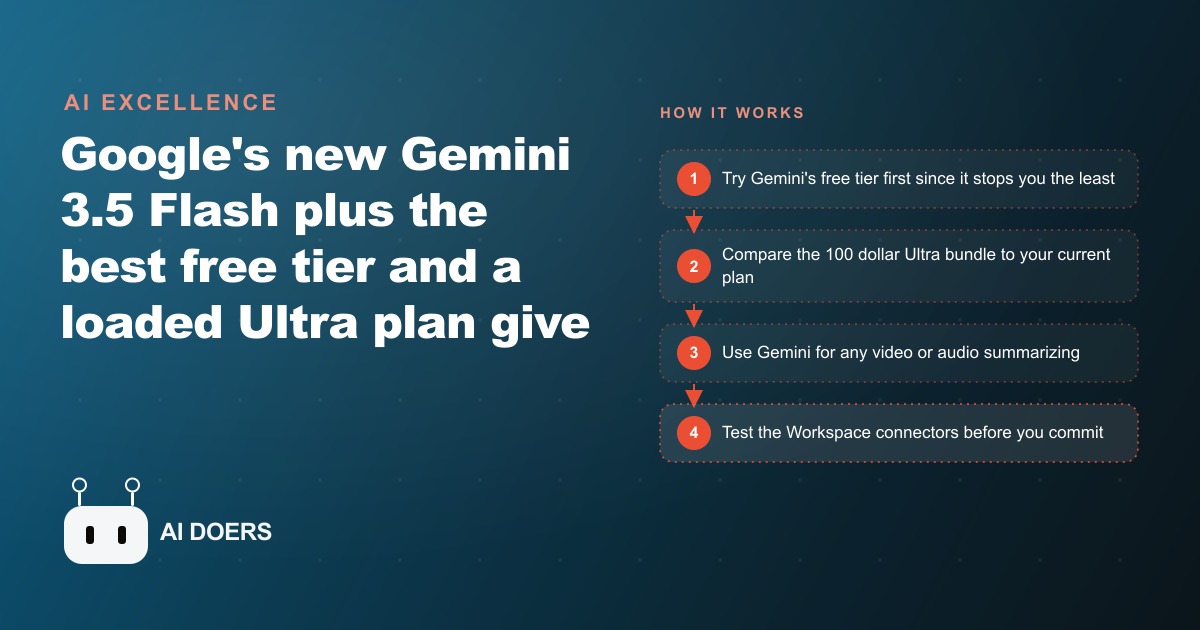
Switch if you want the most generous free tier, the strongest 100 dollar bundle, or real video and audio understanding, because Gemini 3.5 Flash benchmarks near the frontier models while running faster and cutting you off far less.

The free-tier gap that most people do not notice until they have hit a limit three times in one afternoon
I am Madhuranjan Kumar, and the question I hear most often from people switching between AI tools is not about quality. It is about friction. When you are mid-workflow and a tool cuts you off, the interruption is not just annoying; it breaks the context that made the next question possible. The free-tier comparison between the major AI providers has become a real operational consideration for anyone who uses these tools heavily throughout the day.
The gap here is significant and not evenly distributed. Claude offers the most capable models but also the most restrictive free access, often cutting users off after a handful of complex requests. ChatGPT sits in the middle: more generous than Claude on the free tier but still finite in ways that interrupt heavy users within a working session. Gemini's free access, especially inside Google Search AI mode, imposes far lighter restrictions, and for many everyday tasks it barely interrupts at all. For someone doing a large volume of writing, research, and drafting throughout a workday, the choice of which tool to use for routine tasks is partly determined by which one will still be available at 4 pm.
This matters operationally more than it matters philosophically. The best model in the world is less useful to a working professional than a slightly less capable model that is available when they need it. Gemini's free tier is designed around volume, not just capability. For businesses that need AI assistance continuously across a working day, that design decision translates into fewer interruptions and a different relationship with the tool.
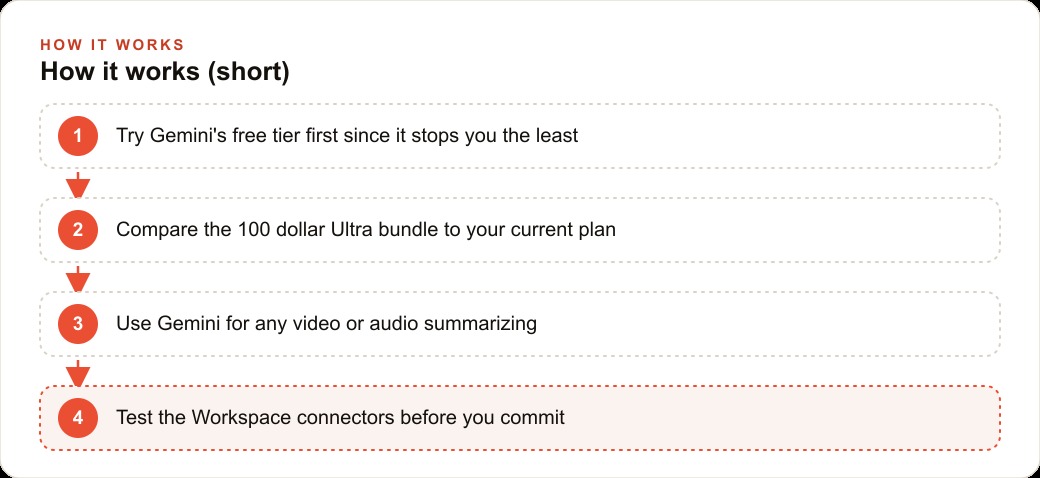
The practical test is to run a full morning's worth of routine work through Gemini's free tier before evaluating whether to switch or upgrade. Most users find the quality sufficient for the tasks that represent the majority of their daily AI use: drafting replies, summarizing documents, researching questions, generating content variations, and answering operational questions.
Speed as a productivity multiplier, not just a convenience
Gemini 3.5 Flash is the model now used by default across Google Search AI mode and the Gemini application, and the headline fact about it is speed. Benchmarks place its quality near the frontier models from other providers, but the experience in daily use is determined primarily by how fast the response arrives.
The psychology of tool adoption is closely tied to latency. When a tool makes you wait five to ten seconds, the brain fills that gap with second-guessing, distraction, or switching to something else. When the response arrives in under two seconds, the brain stays in the question-asking mode and immediately formulates the next question. That compounding of fast back-and-forth is how effective AI users actually think with these tools, and it requires a fast model to sustain.
The productivity implication of a consistently fast response across a full workday is meaningful. A tool that answers 30 questions per day at an average of eight seconds per response versus three seconds per response costs 2.5 minutes extra per day in pure wait time, which seems trivial. But each of those eight-second gaps is also a context-break opportunity. The user glances at email, picks up the phone, or loses the thread. The three-second tool keeps the thread intact. Across a month, the compounding effect of sustained context is worth far more than the raw time difference.
For tasks where quality is harder to distinguish between the top models, this speed advantage is the decisive factor. On most writing, research, and summarization tasks, Gemini 3.5 Flash produces output that is difficult to tell from the other frontier models. When quality is equivalent, speed determines which tool a team actually adopts and keeps using.
The nine-minute video gap and what multimodal advantage actually means in practice
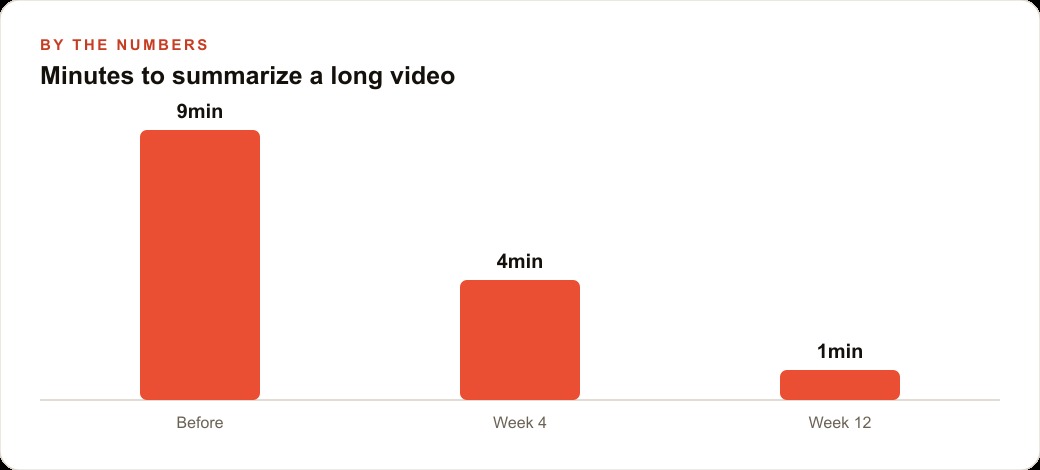
The most concrete demonstration of Gemini's current lead is video understanding. In a direct comparison, Gemini processed and summarized a 27-minute, half-gigabyte video in approximately one minute. ChatGPT took nine minutes and required additional tool use to complete the task. Claude could not process the file at all.
This is not a marginal difference. It is a gap that changes which tool you reach for when a job requires it. For any business that records meetings, training sessions, walkthroughs, site visits, or customer calls, video summarization is a recurring and time-consuming task. Turning a 30-minute recorded call into a structured brief with key points, action items, and follow-up questions is something that used to require either a human note-taker during the call or 20 to 30 minutes of post-call processing. Gemini does it in about one minute.
The practical workflow for a service business looks like this. Record the client call. Upload the recording to Gemini. Ask it to produce a brief with the client's stated priorities, open questions that were not resolved, and suggested next steps. Review and send. The total time from recording to sent brief is under five minutes. The quality of follow-up from the client's perspective is consistently higher because the brief is structured and nothing is missed.
The same capability applies to any video content the business produces or receives. Training footage from a certification or conference can be summarized for a team member who could not attend. Job site recordings from technicians can be processed into a preliminary assessment before the office writes the quote. Product demonstration videos from suppliers can be condensed into a one-paragraph summary before anyone watches them. The nine-minute-to-one-minute comparison understates the operational value because most businesses have this kind of video content sitting unprocessed.
Where Gemini's Workspace integration gives it structural advantage
Any provider can claim Gmail and Calendar connectors. The distinction that matters in practice is whether those connectors feel native or bolted-on. For a team that already lives inside Gmail, Google Calendar, Google Drive, and Google Docs, Gemini's connectors have a fluency that rivals built on top of these tools cannot fully replicate, because the model has structural access to the same data layer that the applications run on.
The daily brief feature in Gemini Spark, which aggregates the inbox, calendar, and task list into a morning summary, is a representative example of this structural advantage. A competing tool accessing Gmail through OAuth is working with the same data, but the roundtrip, the authentication, the API call, and the response formatting adds friction and latency that accumulates across a workday. When the model is part of the same ecosystem, the integration feels different in the way that integrated tools always feel different from connected tools.
For businesses already running on Google Workspace, the case for evaluating Gemini is partly about capability and partly about this integration quality. A team that uses Gmail heavily will notice the difference between asking a standalone AI tool to search their email and asking an AI that is already inside the email context. The latter returns results that are structured like the inbox rather than like a summary of it, which is a different user experience.
The honest caveat is that these integrations are still maturing. Gemini Spark's daily brief is strong but not perfect. The connectors occasionally miss recent data or return results that require a follow-up question to clarify. This is a first-generation feature behaving like a first-generation feature. The trajectory matters more than the current state, and the trajectory is clearly toward tighter integration.
The honest case for running both tools rather than picking one
The most effective approach for any business evaluating Gemini is not to make a binary switch but to run parallel experiments. Use Gemini for the tasks where its current advantages are most pronounced: anything involving video, anything that requires continuous access without hitting limits, anything inside the Google ecosystem, and any use case that benefits from the Ultra bundle's value stacking.
Continue using Claude or ChatGPT for tasks where they genuinely perform better on your actual work. Long-context reasoning, complex document drafting, and tasks that require the highest available reasoning quality may still favor Claude or GPT-5 in specific cases. The goal is not tool loyalty. It is matching the right tool to the right task.
The Ultra bundle math deserves a separate calculation. At 100 dollars per month, it includes YouTube Premium, 20 terabytes of Google One storage, 10,000 Flow credits, and the upgraded AI access. A business already paying separately for YouTube Premium at roughly 14 dollars per month and Google One storage at 10 to 30 dollars per month depending on tier is spending 24 to 44 dollars before the AI subscription. The marginal cost of the AI access in that context is 56 to 76 dollars per month, which is competitive with or cheaper than comparable offerings from other providers.
The evaluation that most businesses skip is this bundle comparison. They compare the 100-dollar Ultra price to the 20-dollar ChatGPT Plus or 20-dollar Claude Pro price, see a five-times difference, and stop. The comparison that reflects actual total spend is different, and for teams already paying for Google services, the arithmetic often favors the bundle.
The correct test is a real one: run two weeks of your actual daily workflow through Gemini's free tier, compare the interruption rate to what you experience on your current tool, test this breakdown summarization on a real recording, and then run the bundle calculation against your current tool spend. That test produces a decision based on evidence rather than on benchmark headlines.
The agent gap where nobody has won yet
The most honest assessment of the current Gemini release is that the agent features lag behind the demos. Even with settings configured to minimize confirmation prompts, both Omni and Flow interrupted workflows to ask for permission, stalled on credit limits mid-task, and failed to complete sequences that the demo suggested should run autonomously.
This is not a Gemini-specific failure. Every major AI provider's agent features are currently in the same state: impressive in controlled demos, unreliable in real autonomous use, and not yet suitable for any business workflow that depends on uninterrupted completion. The gap between agentic capability as demonstrated and as deployed is where the honest benchmark sits.
The recommendation is to evaluate Gemini today on what is live and working: speed, free tier generosity, video and audio understanding, the Ultra bundle value, and the Workspace integration quality. Judge the agents on what they ship in production, not on what the roadmap describes. A business that adopts Gemini for the features it does well today and revisits the agents in three to six months will get more value from the evaluation than one that decides based on features that are not yet stable enough to depend on.
Gemini's current strengths are real, consistent, and measurable. The multimodal lead, the free tier, the integration depth, and the bundle value are all reasons to test it seriously for a real use case this week. The agents are reasons to watch the trajectory but not to restructure your operations around yet.
The convergence trajectory that makes the comparison irrelevant within 18 months
The Gemini-versus-ChatGPT comparison is most useful as a snapshot of where the two products are today. Its usefulness declines as both products continue to ship improvements in the same directions. Both tools are adding multimodal capability. Both are deepening their integration with the ecosystems their parent companies control. Both are improving their reasoning layers. The gap on any specific capability that exists today will narrow or shift in the next two releases from each provider.
The more durable question for a practitioner or business making integration decisions is not which tool is better today but which ecosystem they are already more deeply integrated with. A business that has its calendar, email, documents, and CRM in Google Workspace will extract more compounding value from Gemini integrations than from equivalent ChatGPT integrations, regardless of which underlying model is currently better at a specific benchmark. A business that builds its AI workflows in OpenAI's ecosystem benefits from the distribution of integrations that have been built for ChatGPT first.
The ecosystem fit is the sustainable competitive consideration. The current benchmark comparison is the interesting-but-temporary one. Choose based on the ecosystem. Revisit the comparison when the ecosystem changes.
That is exactly what we do at AI DOERS. Book a private 30-minute call with Madhuranjan Kumar and we will map the fastest path to it for your specific business.
Book your call →
Madhuranjan Kumar
Madhuranjan Kumar brings 20 years of performance-marketing experience and has managed over $200 million in Facebook ad spend for brands across the United States and beyond. His expertise spans the full modern marketing stack: Meta, Google Ads, TikTok, email automation, CRM, and the websites that hold it together. At AI DOERS he turns that track record into lead-generation systems for businesses across every industry.