
Should Kids Still Go To College? An Honest Answer for the AI Era
There is no universal yes or no. Whether college makes sense depends on the path a kid wants, but the skills that matter most in an AI job market are a love of learning, the habit of building real things, and treating AI as a second opinion rather than the source of your ideas.

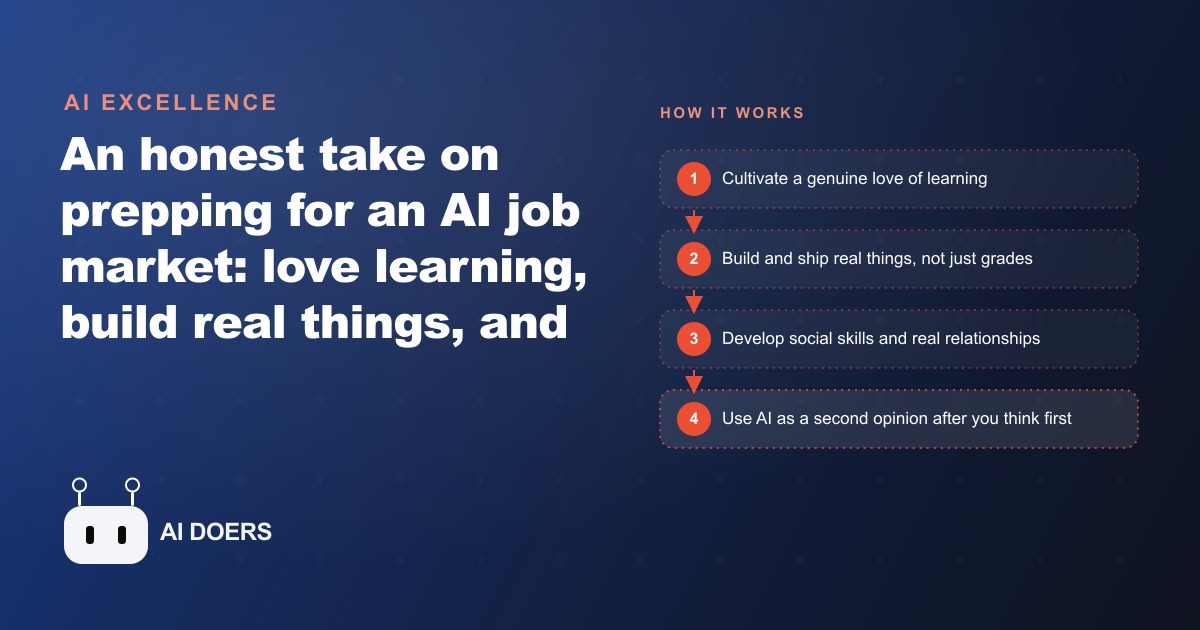
I am Madhuranjan Kumar, and I am going to take a position that annoys people on both sides of the college debate: the whole argument about whether kids should go to college is a distraction. Parents want a yes or no, and so do a lot of anxious young adults, but there is no clean universal answer and pretending there is one does real harm. The question that actually matters, the one that survives whatever the AI job market does next, is whether you are building three specific traits. A genuine love of learning, the habit of shipping real things, and the discipline to use AI as a second opinion rather than the source of your ideas. Get those right and the college decision becomes a logistics detail. Get them wrong and no degree saves you.
The debate is aimed at the wrong target
Here is my contrarian claim stated plainly. College is downstream of the person, not the other way around. Whether it makes sense is determined by the path someone actually wants, so fixating on the credential first is backwards. A person obsessed with learning will probably want college and thrive in it. A person obsessed with communicating and building can find other paths that suit them better. The decision follows the individual. When a parent asks me whether their kid should go, the honest response is that we are solving for the wrong variable. Point the energy at the engine underneath the decision, and the decision almost answers itself.
I understand why people resist this. A yes or no feels like control, and "it depends on who they are" feels like a dodge. But every time I have watched someone chase a credential without the underlying traits, they end up with the paper and none of the capability the paper was supposed to signal. And every time I have watched someone build the traits first, the credential question sorts itself out, because they either need college for their path or they clearly do not. The trait is the asset. The degree is at best a wrapper around it.
The one trait that quietly predicts everything
If I had to bet on a single quality, it would not be intelligence or a school name. Across a huge range of highly successful people, the thing that separated the truly successful from the rest was that they all loved to learn. They were endlessly fascinated, always wanting to understand how things work, never able to stop going down rabbit holes. That obsession outlasts any degree or job title, because the world keeps changing and the learner keeps adapting while everyone else waits to be retrained.
This is why I argue the love of learning should be treated as the actual goal, protected the way you would protect any asset, rather than a nice byproduct of schooling. A curious person handed a new tool figures it out. A credentialed but incurious person handed the same tool waits for a course. In a market where the tools change every few months, that difference compounds into everything. It is also, not coincidentally, the number one thing I look for when hiring, because a curious hire will teach themselves the next thing before I have even written the training doc.
Build real things, and do not outsource your thinking
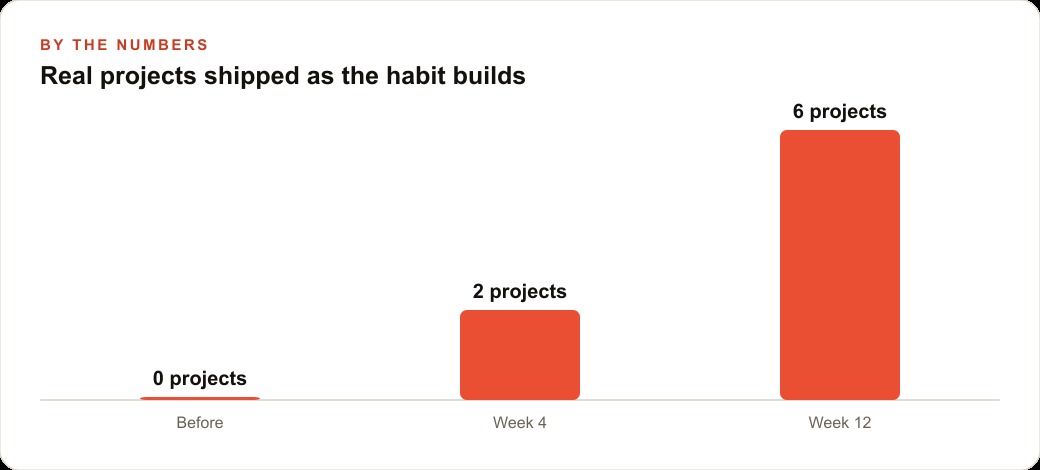
Book knowledge matters, but companies today want people who have actually built something, and this is the second trait. The advice I give anyone, young or not, is the same: build websites, learn enough code to understand what the AI wrote, write a newsletter, put real work into the world where people can see it. A track record of shipping beats a transcript of grades, because shipping proves you can finish, and finishing is rarer than talent.
AI belongs in this as an accelerant, and here is where I get most contrarian, because the popular framing has it exactly backwards. AI is often a bad originator of ideas but a strong second opinion. The crowd treats the model as the idea machine and themselves as the editor. I argue you should be the idea machine and the model the editor. Think first, then bring AI in to poke holes and surface blind spots, never to do your reasoning for you. A simple routine enforces it: journal the problem on paper daily and let solutions surface, then hand that entry to a model for a take and extra suggestions. If AI does too much of the work, your thinking muscle atrophies and it gets harder to reason at all, which is the opposite of what any person or any team wants. Keep zero loyalty to a single model too, switching between the leaders based on which is best in the moment, because the leader changes month to month. Loyalty to one tool is just another way of outsourcing your judgment.
There is a quieter third trait most people skip, which is social skill. As more people isolate behind screens, those who learn to network and build genuine relationships keep getting ahead, because opportunities flow through people, not through resumes sitting in a folder. That one is unfashionable to say in an AI conversation, which is exactly why it is an edge.
The same filter runs a business
This is not only parenting advice. It is a hiring and culture filter, and the traits worth building in a kid are the traits worth hiring for in a team: a love of learning, a track record of shipping, strong communication, and the judgment to use AI as a tool rather than a crutch. A team built on those adapts when the market shifts. A team that only memorized a process gets stuck the moment the process changes. So the argument scales cleanly from a single person to a whole company.
What it looks like: a dental practice
Take a dental practice owner who wants to grow without losing the human touch that keeps patients loyal. Here is how I would apply the same three traits. First, hire for curiosity and real skill, not just a resume. A front-desk hire who loves to learn and has actually built things, even small ones, will figure out new software and better patient flows on their own instead of waiting to be trained on every step. Second, build genuine relationships, since a dental practice lives on trust and referrals, and the doctor who knows patients by name and stays connected in the community wins over a slicker but colder competitor. Third, use AI as a second opinion across the practice. Draft a patient reminder or a new policy yourself first, then ask a model to find gaps, soften the tone, or flag what is unclear, rather than letting it write the whole thing blind and sound like everyone else.
Put illustrative numbers on it. Say the practice spends six hours a week on routine writing and scheduling admin. Using AI as a second opinion rather than a ghostwriter might cut that to two, freeing four hours, but the point is where those hours go. They go back into the human work that actually retains patients, the conversations and the relationships, not into producing more generic output faster. Keep zero loyalty to one model, switching between the leaders based on which is best for the task that week, and keep the real decisions, the diagnoses and the patient conversations, firmly human. The recurring questions patients ask, captured honestly, become the material for SEO and organic search that pulls in the right new patients, while the reminders and follow-ups the team drafts and the model refines live in the CRM and website stack that keeps the practice organized, and the trust the practice builds is what makes its Facebook and Instagram ad campaigns actually convert. That blend keeps the practice efficient and personal at the same time, which is the whole point.
The objection I hear most, and why it does not hold
Whenever I make this argument, someone pushes back with a fair objection, so let me answer it directly. The objection goes: this is easy for you to say, but plenty of good jobs still gate on a degree, so telling a kid to skip college and build things is reckless. It is a reasonable worry, and my answer is that I am not telling anyone to skip college. I am telling them to build the traits first and let the credential decision follow. If a kid loves learning and ships real work and can hold a conversation, and the path they want genuinely requires a degree, they should go, and they will get far more out of it than a peer who enrolled on autopilot. The traits do not replace college. They make college, or the decision to skip it, an informed one instead of a default.
The deeper reason the objection does not hold is that the credential itself is a decaying asset while the traits are appreciating ones. A degree signals a snapshot of who you were at graduation. A love of learning signals who you will keep becoming. In a market where the specific skills in demand change every couple of years, employers are increasingly reading for adaptability, for evidence you can teach yourself the next thing, and a portfolio of shipped work plus a track record of picking up new tools fast is often a stronger signal of that than a transcript. This is not hostility to education. It is a claim about what education is for. The point of learning to code, or write, or design, was never the certificate. It was the capability, and the capability is what the AI era rewards, because the tools now amplify a capable person and expose a merely credentialed one.
So the objection, properly answered, actually strengthens the position. Yes, some doors still ask for a degree, and for those doors the traits plus the degree beat the degree alone every time. And for the growing number of doors that ask for evidence you can build and adapt, the traits win outright. Either way, building the love of learning, the shipping habit, and the disciplined use of AI is the move that pays, and the college question resolves itself once those are in place. That is why I keep refusing to answer it head-on. Answering it head-on is optimizing the wrapper and ignoring the asset inside.
Where this leaves the college question
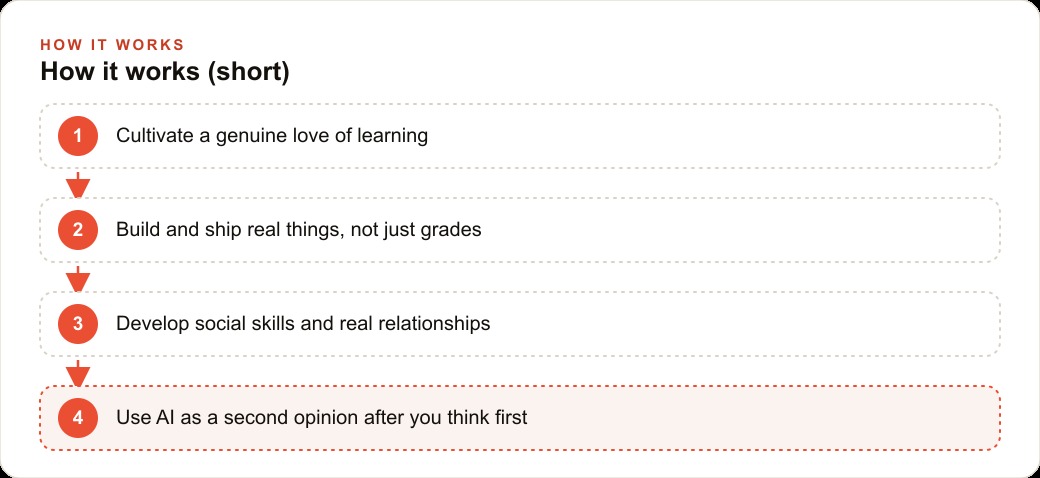
Make loving to learn the goal, not a single credential or test score, and protect that curiosity the way you would protect any asset. Ship one real thing this month, a site, a newsletter, or a small tool, so you have something to show rather than just describe. Journal the problem first and let solutions surface on the page, then bring it to AI for a second opinion on gaps and blind spots. Build social skills and real relationships on purpose, because they compound into opportunities over years. And keep zero loyalty to a single AI model, switching to whichever is best for the task in the moment.
And notice that the three traits reinforce each other rather than competing for the same hours. The love of learning fuels the building, because a curious person cannot help but pick up the skills a project demands. The building creates the relationships, because shipped work gives you something real to talk about and people to talk about it with. And the disciplined use of AI protects all of it, keeping your thinking sharp so the learning and the building stay genuinely yours rather than something a model did for you. Cultivate one and the other two grow easier, which is why I keep pointing at the traits instead of the credential. The credential is a single event. The traits are a compounding system.
None of these habits require a classroom, and all of them keep paying off long after any single course ends. Whether college is part of the path becomes a logistics detail once the traits are in place, which is exactly why I refuse to answer the college question directly. It is the wrong question. You can build these habits yourself, or you can bring in someone who has helped plenty of owners apply exactly this thinking to their own business and wants to get it right with you.
That is exactly what we do at AI DOERS. Book a private 30-minute call with Madhuranjan Kumar and we will map the fastest path to it for your specific business.
Book your call →
Madhuranjan Kumar
Madhuranjan Kumar brings 20 years of performance-marketing experience and has managed over $200 million in Facebook ad spend for brands across the United States and beyond. His expertise spans the full modern marketing stack: Meta, Google Ads, TikTok, email automation, CRM, and the websites that hold it together. At AI DOERS he turns that track record into lead-generation systems for businesses across every industry.