
The Shift From Drag-and-Drop Automations to Just Describing What You Want
Automation is moving from wiring nodes on a canvas to describing the outcome in plain English. Here is what is changing, why it matters, and how a real business can use it.

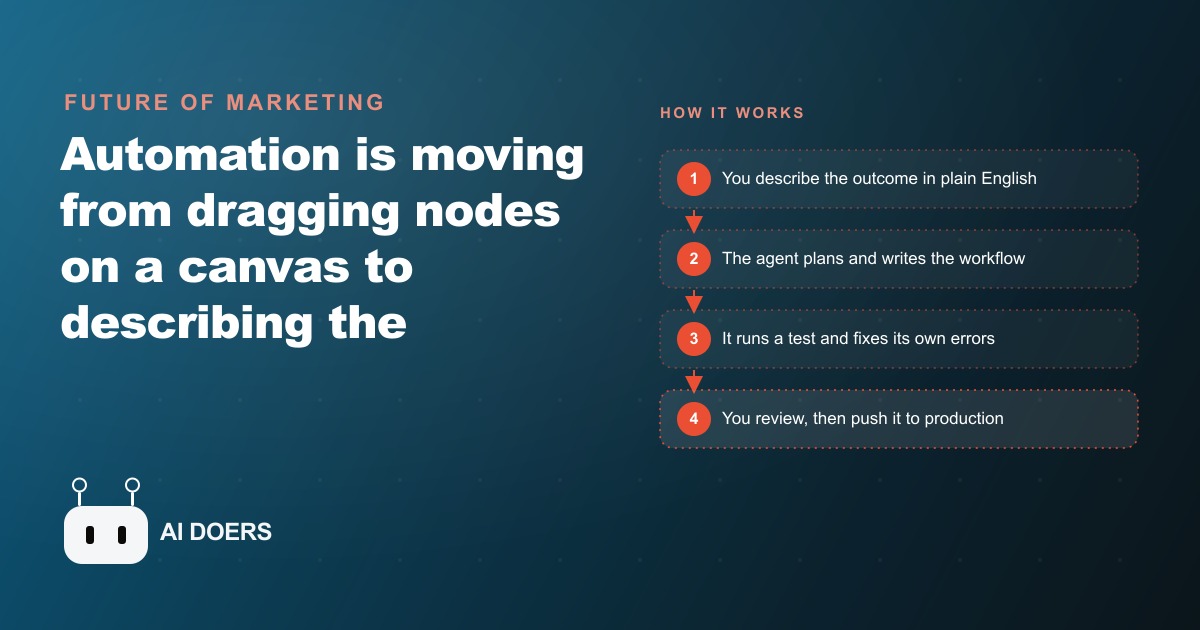
Describing outcomes instead of configuring nodes is the most significant shift in business automation since drag-and-drop tools replaced custom scripting, and the businesses that learn to direct an agent rather than configure tools will hold the same advantage that early drag-and-drop adopters had over the spreadsheet operators who refused to change. That is the argument I want to make here, and I want to make it through specifics rather than at the level of abstraction where it is easy to agree without actually changing how you build. I am Madhuranjan Kumar, and I have watched this transition play out in real client workflows over the past twelve months.
The node-wiring era was a massive leap that also set a ceiling
When drag-and-drop automation platforms arrived, they did something genuinely important. They made business automation accessible to people who understood their own workflows but could not write code. A marketing coordinator who knew exactly what should happen when a new lead submitted a form could now build that automation herself, without filing a development ticket and waiting weeks. A solo operator who understood the logic of their invoicing process could wire it up over a weekend. The ceiling for what a non-developer could build jumped dramatically, and a meaningful portion of operational work that had required developer time became self-service.
But the same drag-and-drop model that raised the floor also set a ceiling. Building an automation meant knowing in advance every step it would take. You defined the trigger, selected the action, mapped the data fields, chose the branch conditions, and handled the error paths explicitly, one node at a time. If you did not know in advance how to handle a deduplication problem or a retry loop, the automation either failed at that point or required a developer to fill the gap. The skill of using these platforms was the skill of translating a business workflow into a specific visual grammar, node by node, connection by connection.
That translation accumulated slowly. An experienced automation builder could look at a workflow and immediately identify which connectors to use, which data transformations were necessary, and where the common failure modes would appear. A beginner spent hours on configurations that an expert resolved in minutes. The gap between a beginner's automation and an expert's automation was wide and real, and closing it took time that many small business operators did not have.
The ceiling showed up most clearly at edge cases. Drag-and-drop automations handle the main path well but require explicit instruction for every exception. An automation that processes a standard invoice works cleanly until a vendor sends an invoice in a slightly different format, at which point it either fails or passes bad data downstream. Handling the edge case meant adding more nodes, which added more complexity, which required more expertise to maintain. The more sophisticated the automation became, the more fragile it became in the hands of anyone other than the person who built it.
The result was a class of business operators who understood their workflows well, could articulate exactly what a good automation would do, and yet remained dependent on someone with node-wiring expertise to build and maintain it. That dependency was the ceiling.
When you describe the destination, the implementation is someone else's problem
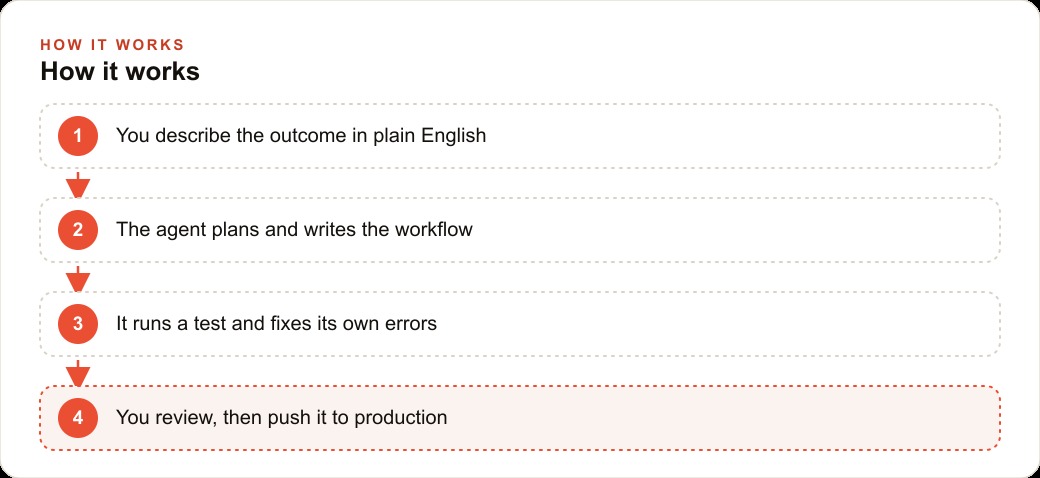
Agentic automation changes the construction model at the structural level. Instead of specifying each step, you describe the outcome and let the agent determine the route. You explain where the data comes from, what should happen to it, and where it should end up. The agent handles the implementation: selecting the right tools, writing the code that connects them, managing deduplication and storage and retry logic, and correcting errors when they occur.
The practical shift is that the premium moves. It used to sit on knowing how to configure every node. Now it sits on knowing how to describe what you want with enough specificity that the agent can build it reliably. The bottleneck shifts from implementation knowledge to outcome clarity.
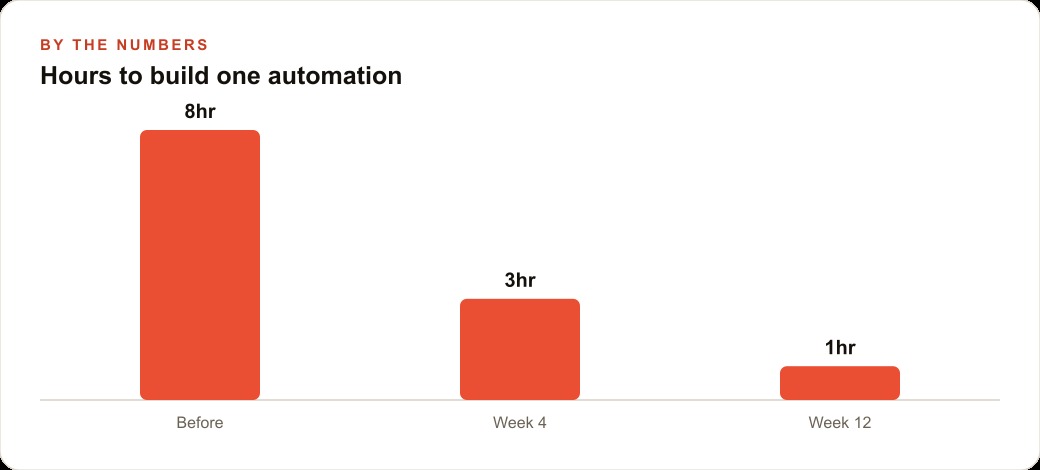
Consider a boutique retail store owner who wants a research-to-post-to-image workflow. Every week she wants to drop a topic into a task, and she wants an agent to research it, write a social post in the store's voice, generate a matching image, and place everything somewhere she can review it before anything goes live. In the old model, building that automation would have required selecting the right tool connectors, writing code to link them, and handling the image generation API's polling behavior, which often requires waiting until an image is ready before continuing downstream. A skilled automation builder, working carefully, would have spent roughly eight hours getting that workflow reliable across real inputs and edge cases.
Describing the same outcome to an agentic system took the store owner forty-five minutes. She described the task in plain language, including which tools to use, where the output should land, and what review step she wanted before anything went live. The agent asked two clarifying questions about tone and which source list to watch, then built the workflow. On the first test run it hit two errors: a data format mismatch in one of the tool connections and a polling gap where it tried to use the image before the generation had completed. It identified both errors, explained what had gone wrong, and fixed them without being asked. The second test run produced three campaign posts complete with copy and matched images, sitting in the review task ready to approve. No node configuration. No error path design. No connector debugging.
The posts were not published automatically. They sat in her review queue and she checked each one before anything went live. That review step is not a limitation of the agentic approach. It is the right production posture for any automation that creates content or takes action on behalf of the business. Speed of generation with human final judgment is the right combination for most small businesses, because the cost of a wrong post going live outweighs the benefit of removing the thirty-second review. Any agentic workflow that reaches customers should have a human review step as a design principle, not an afterthought.
There are three failure modes to understand in agentic systems, and recognizing them changes how you set up each project. The first is context drift: in a long session focused on a complex build, the agent can begin losing track of earlier instructions and start making choices inconsistent with the goals set at the start. The mitigation is to keep build sessions focused rather than running one very long session for a complex project. A brief project summary at the start of each new session maintains the context across sessions without requiring the agent to hold everything in a single window.
The second failure mode is hallucination. An agent can invent an API behavior, a field name, or a data structure that does not exist in the actual tool, and build the automation around that invention. The result fails when run on real data. The mitigation is to run every automation the agent builds before trusting it, and to include a review step that checks outputs against real expectations before anything goes to production.
The third failure mode is over-engineering. An agentic system asked to build an automation without clear scope tends to add capabilities that were not requested, increasing complexity and maintenance burden without adding value. The mitigation is to be specific about scope from the start, to use plan mode where available so the agent presents a plan before building, and to push back when the proposed plan includes elements outside the description. Clear boundaries produce better automations than open-ended requests.
Production still requires the same care it always has. Error notifications, visibility into what the automation is doing, and version control for the code it produces are requirements once a workflow runs for real. The agent can help set all of those up, but you have to ask for them explicitly.
The skills that made you good at wiring nodes make you better at directing agents
The most important counterintuitive point in the transition from drag-and-drop to agentic automation is that the skills developed in the node-wiring era are not obsolete. They are exactly what makes someone effective at directing an agent.
Understanding triggers means you can describe the starting condition of an automation precisely rather than vaguely, so the agent does not have to infer the trigger and potentially infer it incorrectly. Understanding data flow means you can specify what data needs to be available at each step and in what format, so the agent does not have to guess the data model. Understanding error handling means you can describe the edge cases up front and specify how each should be handled, rather than discovering them when the automation fails on real data in production.
The person who spent years configuring nodes comes into the agentic environment with a mental model of how automations work at a structural level. That mental model does not need to be discarded. It needs to be redirected from specifying implementations to specifying outcomes and constraints. The language of the job shifts from "add a filter node here that checks whether this field is empty" to "if the incoming data is missing the customer name field, skip that record and log it to an exceptions list." The logic is identical. The medium through which it is expressed has changed.
The businesses positioned to gain the most from agentic automation are not the ones with the most developer resources. They are the ones with the clearest view of their own workflows, the discipline to describe outcomes precisely, and the experience with prior automations to know which edge cases matter. Those are operator skills, not developer skills, and they are the skills that a decade of drag-and-drop automation has built in a large number of business owners and coordinators who are now, without necessarily realizing it, well-positioned for this transition.
The Facebook and Instagram ad campaigns a growing business runs generate leads. Those leads need automations that route, qualify, and follow up with them before they go cold. The shift to agentic tools means the operator who manages those campaigns can now also build the downstream handling automations herself, without a development engagement. The CRM and website stack that captures those leads can be wired faster and extended more easily when the automation layer is built by describing outcomes rather than by configuring nodes one at a time.
The ceiling that the drag-and-drop era set is gone. The businesses that learn to describe what they want clearly, review what the agent builds carefully, and apply the production discipline that real automations require are the ones that will build systems in a weekend that used to require a specialist, across every workflow where they have been putting it off because the node-wiring felt like too much.
That is the shift. And the people best prepared to take advantage of it are not the ones waiting for the tools to become simpler. They are the ones who already understand what good automation looks like, because they built the earlier version by hand.
The skill gap that used to separate businesses with automation from businesses without it was primarily a technical gap. Knowing how to wire nodes, configure connectors, and debug data-flow errors required either a developer on the team or a business owner willing to invest significant hours in learning a platform. That gap excluded a large number of small business operators from building the automations that would have compounded their operational leverage over time.
The new gap is different. It is a clarity gap. The businesses that build effective agentic automations are the ones that can describe what they want in specific, complete terms: here is the trigger, here is the input, here is the processing logic, here is the output format, here is the review step, here are the edge cases I know about. That description is the product of knowing the workflow deeply, which is an operator skill.
The node-wiring era selected for technical fluency. The agentic era selects for operational clarity. The people who will build the best automations in the next three years are not necessarily the people who built the best ones in the last three. They are the people who know their own operations well enough to describe them precisely, and who are willing to review what the agent builds with enough care to catch what it got wrong. Those people exist in every business. The tools have arrived to give them leverage they have not had before.
That is exactly what we do at AI DOERS. Book a private 30-minute call with Madhuranjan Kumar and we will map the fastest path to it for your specific business.
Book your call →
Madhuranjan Kumar
Madhuranjan Kumar brings 20 years of performance-marketing experience and has managed over $200 million in Facebook ad spend for brands across the United States and beyond. His expertise spans the full modern marketing stack: Meta, Google Ads, TikTok, email automation, CRM, and the websites that hold it together. At AI DOERS he turns that track record into lead-generation systems for businesses across every industry.