
The 7 Skills That Make AI Speed You Up Instead of Slowing You Down
A careful study found AI tools actually made seasoned developers slower, not faster. The reason was skill, not the tools. Here are the seven habits that flip the result, and how the same idea applies to running a real business.

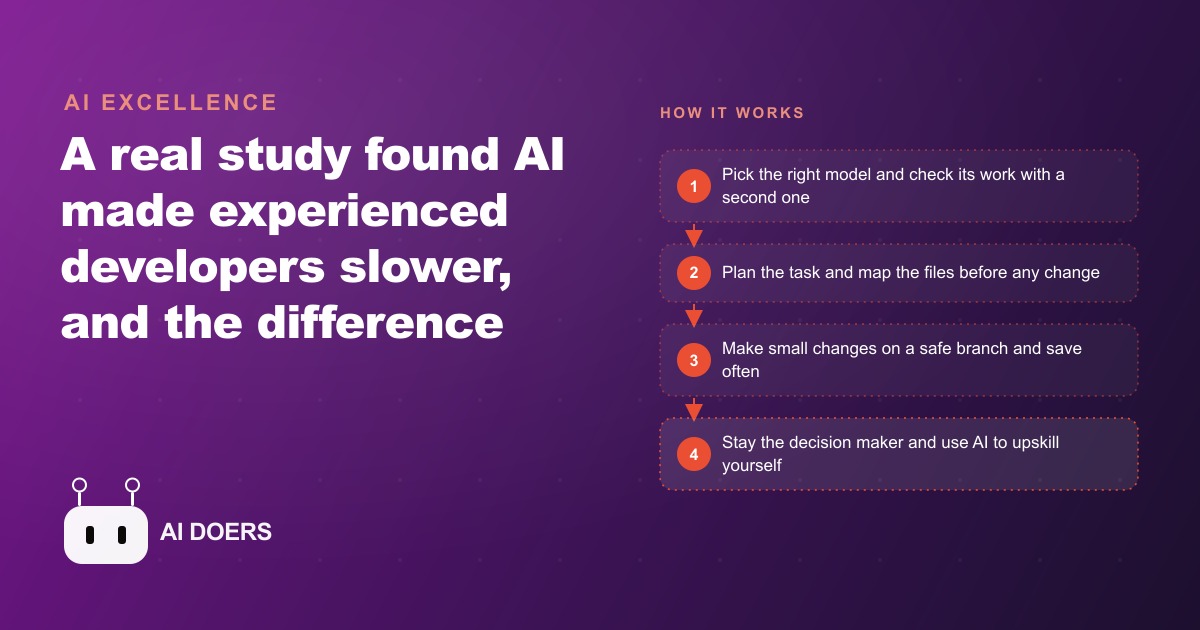
The electrician business in this story added AI tools with a straightforward expectation: faster estimates, faster customer replies, faster everything. What happened instead, for the first month, was that turnaround slowed. The owner spent extra time reviewing AI output before sending it, prompting the same things multiple ways trying to get reliable results, and managing errors that a clean manual process would not have produced. This is the story of what changed, and why the same seven habits that fixed it apply well outside of any technical context.
Before: adding AI and watching turnaround slow
The first tool the business added was a subscription AI assistant for drafting customer-facing communications: estimate summaries, follow-up emails, and service scope explanations. The owner gave it general instructions and started using it daily. For the first three weeks, the productivity gain that the marketing materials had promised did not materialize.
Instead, the owner was spending 15 minutes reviewing and editing every AI-drafted email that previously took 10 minutes to write manually. The AI drafts were technically correct but missed the specific voice of the business, used phrasing that felt generic, and occasionally included claims about timelines that did not match the business's actual scheduling reality. The review step was not optional. Customer-facing communication that goes out wrong creates service problems. So the time per email went up, not down.
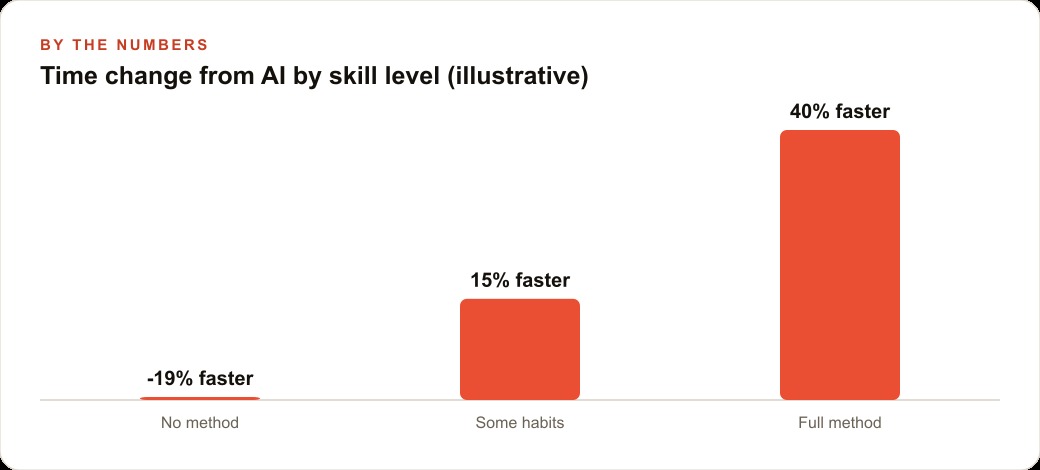
This matches what a research study on experienced developers found when examining AI coding tools: on average, the developers who used AI tools took about 19 percent longer on measured tasks than those who did not. The hidden costs were time spent reviewing output, writing prompts that produced usable results, and managing the additional layer of interaction the tool introduced into the workflow. The tool added work before it removed work, because no habits had been built for using it well.
The wake-up: a study's finding about skill, not tools
The turning point was recognizing that the problem was not the AI tool. The tool was capable. The problem was the method around it. A second study on the same question found the opposite result when examining users who had developed specific working habits around AI: productivity improved significantly, and more importantly, the scope of what those users were willing to attempt expanded. They took on more complex tasks because they trusted the system to handle them reliably.
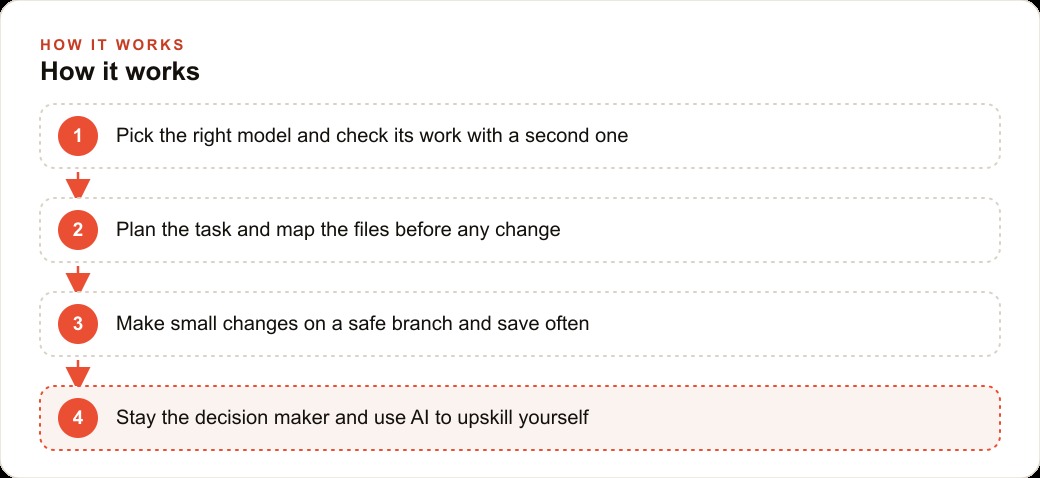
The difference between the two groups in the studies was not which tools they had access to. Both groups had the same tools. The difference was the habits around those tools. Seven specific habits showed up consistently in the group getting positive results. The electrician business implemented all seven over the following six weeks.
First fix: match the right model to the right task
The first habit was stopping the practice of using the same tool for every type of task. Not every AI model produces the same quality output on every kind of request. A fast, lightweight model that is excellent at drafting a short customer reply is often wrong for a technical scope document that requires careful reasoning about circuit load calculations and code compliance. And a powerful, expensive model that reasons deeply through technical questions is wasteful for the three-sentence follow-up email confirming an appointment time.
The business mapped its recurring tasks into two groups. Quick communications: appointment confirmations, follow-up emails after inspections, standard scope summaries for common jobs. These went to a fast, low-cost model. Complex documents: detailed scope for panel upgrades, technical explanations of code-compliance requirements for insurance purposes, proposals for commercial clients comparing multiple approaches. These went to a more capable, slower model.
One additional habit from the studies was checking any model's output by running the same question through a different model. The way this worked in practice for the business was: the main model drafts a scope document, a second model is asked to identify any claims in the document that seem inconsistent or that might mislead a customer about what the job includes. The second model catches things the first one normalized through its own patterns. Two models checking each other produces more reliable output than one model checking its own work.
Second fix: plan on paper before opening the AI tool
The single habit that produced the largest improvement in output quality was writing a brief planning note before any AI interaction. The note was not elaborate. For an estimate draft, it would read: job is panel upgrade from 100A to 200A, customer is replacing aging Federal Pacific panel for insurance reasons, timeline is three weeks out, include permit cost in scope, flag that the city inspection takes 2-4 weeks after rough-in. One paragraph, written before opening the AI tool.
That paragraph gave the AI specific inputs rather than requiring it to infer them from a generic description. The output from a specific prompt is materially better than the output from a vague prompt because the AI is not filling in unknown details with generic assumptions. When the AI has to assume, it assumes toward the most common case, which is rarely exactly right for the specific job being quoted.
The planning habit also reduced the review time per output. When the AI had specific inputs, its output was close enough to correct that reviewing it took five minutes rather than fifteen. The total time per estimate, including the planning note, the generation, and the review, dropped below the pre-AI baseline for the first time.
Third fix: make small changes and stay the decision maker
Two habits from the study group translated directly into the business's working method. The first was making small, focused changes rather than asking the AI to rewrite large sections of working documents. When an estimate was mostly right but needed the payment terms changed and one scope item clarified, the prompt described those two specific changes rather than asking for a full redraft. Small, focused prompts produce predictable output. Broad, sweeping prompts produce output that might improve some things while unintentionally changing others.
The second was working on a separate draft before anything touched the final version. For any document that would go to a customer, the AI output lived in a draft folder until it had been reviewed and approved. The final version was a separate document that received the approved content. This separation is structurally obvious but easy to skip under time pressure, and the cases where the business had sent unchecked AI output to customers all came from skipping this step.
Pricing, timeline commitments, safety-related language, and anything that created legal or contractual obligation stayed entirely in the owner's hands. The AI was never asked to make those decisions. It was asked to help communicate decisions that had already been made. That boundary, the owner deciding and the AI articulating, was the clearest habit separation in the whole system.
The turning point: using AI to upskill the whole team
Six weeks into the revised method, the owner identified a use case that produced more value than any time savings on documents: using the AI as a learning tool for the whole office team. When a service technician encountered an unfamiliar equipment specification, instead of calling the owner to ask or looking through multiple manuals, they asked the AI to explain it. The AI explained the specification in plain language, identified the relevant code section, and flagged any common installation mistakes to avoid.
Over three months, this pattern changed the team's baseline knowledge level noticeably. Questions that used to require the owner's attention, because only the owner had enough experience to answer them, increasingly got handled at the technician or dispatcher level. The AI was not replacing the owner's judgment on complex decisions. It was distributing a portion of the informational knowledge that previously lived only in the owner's head to people who previously lacked access to it.
The study that found AI made developers 19 percent slower did not measure this effect, because it measured only the speed of specific tasks. The compounding value of a team getting smarter about the work over time is harder to measure per task but significant over months and years. A dispatcher who understands enough about electrical load to give an accurate ballpark estimate on a first call closes more appointments. A technician who understands code requirements independently catches issues before the inspection rather than after. Both of those outcomes compound.
Six months in: a faster, smarter office the owner trusts
Six months after implementing the seven habits, the comparison between the pre-AI baseline and the current state was significant. Estimate drafts took a fraction of the original time. Customer communication was faster and more consistent because the template prompts were refined from months of use. Technical questions from the team were answered faster because the AI, connected to the right documentation and prompted correctly, produced reliable answers on routine questions.
The trust element is the one the owner named most frequently when describing the change. Before the revised method, AI output felt unreliable because the output was inconsistent relative to what the prompts were trying to produce. After the revised method, the output was predictable because the prompts were specific, the planning step was consistent, the model was matched to the task type, and the review step was standardized. Predictable output from a process is what produces trust, not impressive output from a lucky prompt.
The seven habits that produced this change are not specific to an electrician business or to any technical context. They are specific to the question of how to use an AI tool well rather than how to use an AI tool quickly. Quickly is where most people start, and it is why most people's first experience with AI tools is underwhelming. Well is where the productivity gains actually live, and it requires a method rather than just access to the tools.
That is exactly what we do at AI DOERS. Book a private 30-minute call with Madhuranjan Kumar and we will map the fastest path to it for your specific business.
Book your call →
Madhuranjan Kumar
Madhuranjan Kumar brings 20 years of performance-marketing experience and has managed over $200 million in Facebook ad spend for brands across the United States and beyond. His expertise spans the full modern marketing stack: Meta, Google Ads, TikTok, email automation, CRM, and the websites that hold it together. At AI DOERS he turns that track record into lead-generation systems for businesses across every industry.