
Self-Improving AI Is Here, and Your Business Can Borrow the Same Loop
A new model improved its own training process with almost no human input. The interesting part is that the exact loop works on marketing, operations, and offers too.

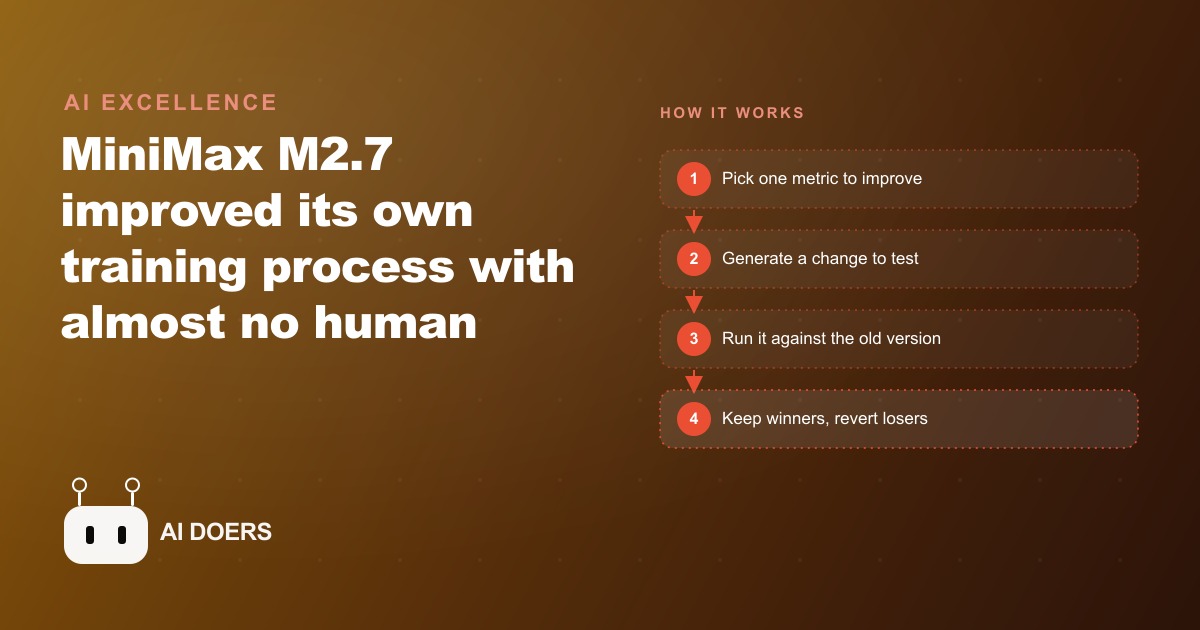
A Chinese AI lab just demonstrated that the scientific method, run on a continuous loop with almost no human in the chair, outperformed a human research team on the same task. MiniMax's M2.7 model completed more than a hundred rounds of hypothesis, experiment, compare to control, keep or revert, and improved its own training process faster than the researchers working alongside it; the model ran on a single mid-range GPU and matched a leading frontier benchmark, not because the architecture was larger, but because the scaffolding around it kept iterating without pause.
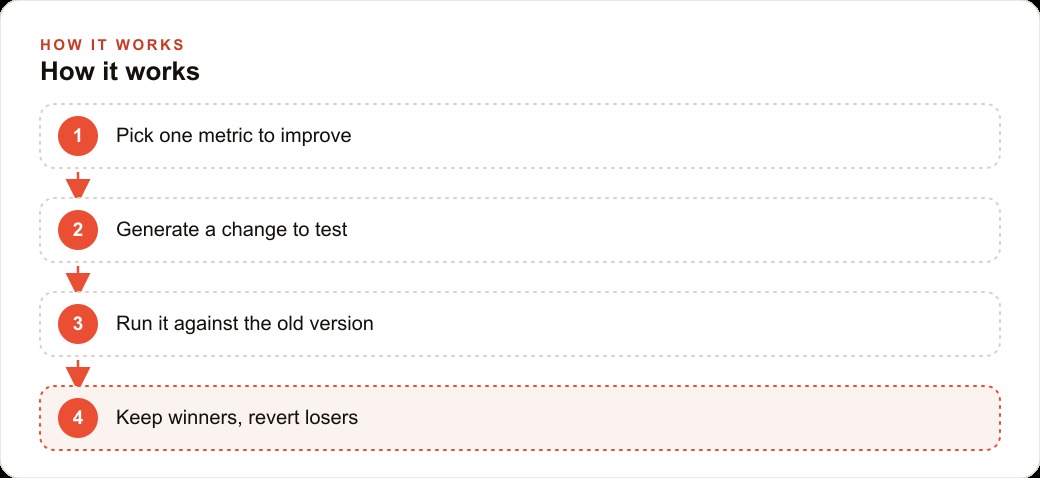
The real insight is what the loop itself reveals. The scientific method is not a property of AI labs. It is a general-purpose improvement machine, and if you can state a goal, measure it, and test one change against a prior version, the loop applies to your business. That maps directly onto the most expensive friction points in any local or service operation. MiniMax called their version self-evolution. The version available to any business owner is simpler: one metric, one variable, keep the winner, discard the loser, repeat. Below are the seven problems where that loop pays off fastest, with the specific metric for each and what one clean iteration looks like.
Problem 1: Cost Per Lead Is Drifting Upward on Paid Ads
The drift is gradual, which is what makes it expensive. An ad account generating leads at nine dollars in January may cost fourteen dollars by August without a single change in budget or targeting. The audience did not shift. The offer probably did not change. The creative fatigued, a competitor increased spend on the same audiences, or the headline that felt fresh in winter started blending into the feed by summer. The owner notices the cost has risen but is not sure which lever moved.
The self-evolution loop applies directly because every major ad platform already supports side-by-side testing. The formal version works like this: the agent reviews current cost per lead and examines which creative elements the best-performing ads share. It generates three headline variations that amplify those shared elements in a different format, runs each at a defined spend threshold, and compares results after 200 impressions per variant. The winning variant becomes the new control. Losers are retired. The next iteration begins.
The metric is cost per lead and the target is a defined ceiling, not an open-ended hope. One iteration at a time, one variable at a time, the account converges on what the audience responds to in the current moment rather than what worked in a prior season. A business running three test cycles per month builds a compound advantage over one that changes ads based on intuition twice a quarter. The mechanism is not clever; it is consistent.
Problem 2: Appointment No-Show Rate Is Eating Into Utilization
A service business losing 15 to 20 percent of booked appointments to no-shows is not just losing that hour. It is losing the ability to give that slot to a paying client who would have shown up, and the economic hit compounds because the lost revenue is invisible. The slot appears booked on the calendar; the owner only sees the gap when the client does not walk in. Most reminder workflows were set up once and never revisited: a message goes out 24 hours ahead, it states the time and address, and the practice hopes for the best.
The self-evolution loop tests two variables independently: timing and message wording. The metric is show rate, defined as clients who arrived divided by confirmed bookings. A single timing iteration works like this: split the next month's confirmed bookings into two groups and send reminders 48 hours ahead for one and 24 hours ahead for the other, keeping the message text identical. After 60 appointments per group, compare show rates. If the 48-hour group shows at a higher rate, that timing becomes the new default.
The next iteration tests wording: a message that includes a low-friction reschedule link against one without it. After another 60 appointments per group, the winner carries forward. Each round runs long enough to produce a clean comparison, and over a quarter the business converges on the timing and wording combination that its specific clients respond to, which no template could have predicted in advance. A five-point improvement in show rate, from 75 to 80 percent, on a calendar of 100 appointments per month recovers five additional revenue slots with no increase in bookings.
Problem 3: Landing Page Conversion Rate Is Below What the Ad Spend Deserves
Most landing pages are built once, reviewed for obvious errors, launched, and then left alone while traffic continues flowing through them. The assumption is that the page either works or that improving it requires a full redesign. Neither is usually accurate. High-leverage improvements typically come from three elements: the hero copy, the call-to-action wording, and the offer framing. None of those require touching the layout.
The self-evolution loop applied to a landing page looks like controlled A/B testing, with an agent proposing and managing the iterations rather than a human deciding ad hoc what to change. The metric is the consultation booking rate: appointments booked divided by unique page visitors.
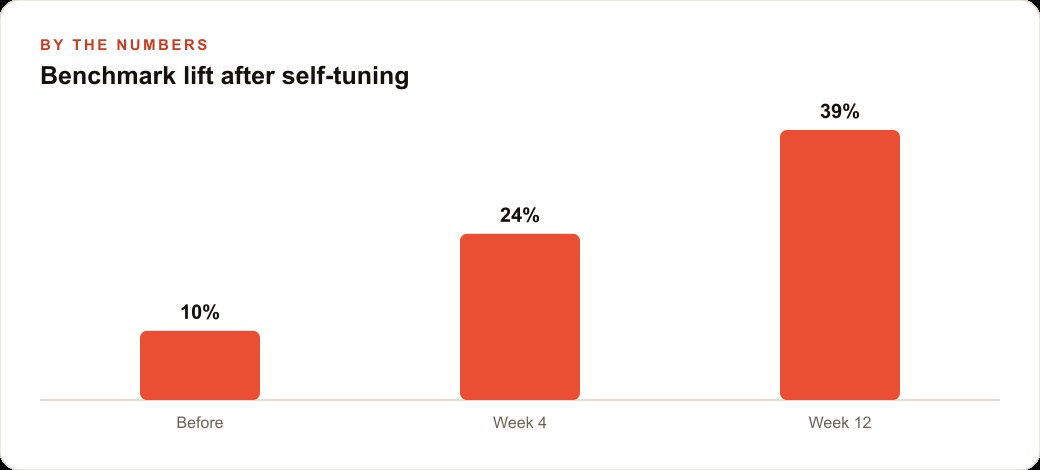
A med spa running this loop on its laser treatment page over a 90-day period provides a clear illustration. The page was receiving traffic from $3,200 per month in Meta ads and converting at 2.1 percent. In the first iteration, the hero headline changed from a service description to an outcome statement; the booking rate moved to 2.6 percent. In the second iteration, the call-to-action button changed from "Book Now" to "Get Your Free Skin Assessment"; the rate moved to 3.1 percent. In the third iteration, the operator added a note below the CTA showing a limited number of same-week slots available; the rate moved to 3.8 percent.
At 3.8 percent on the same $3,200 monthly budget, the spa was booking 81 percent more consultations per dollar of ad spend than it was at 2.1 percent. Against a consultation-to-treatment conversion rate of 60 percent and an average treatment value of $650, the change in page performance alone produced an additional $1,800 in monthly revenue without increasing ad spend by a dollar. The loop ran three rounds over 90 days. Each round changed one element, measured the result, and locked the winner as the new baseline.
Problem 4: Follow-Up Email Open Rate Has Plateaued
A follow-up email sequence written two years ago reflects what the team thought would work then. The audience has evolved, inboxes are more competitive, and subject lines that felt compelling when the sequence launched have become part of the background noise. Most service businesses that check their open rates find them sitting in the low to mid twenties and assume that is simply where the category performs.
The self-evolution loop tests subject lines and send timing as separate variables. The metric is open rate per send, tracked consistently week over week. A single timing iteration tests Tuesday morning against Thursday afternoon for the same email, holding the subject line identical across both groups. If Thursday afternoon produces a four-point lift in open rate, that becomes the new default for the sequence.
The next iteration tests subject line format: service-naming versus outcome-statement versus curiosity-gap. Each format runs for a minimum of four weeks across a list large enough to produce a clean comparison, and the winner carries into the next round. After six iterations across three months, the sequence reflects what the current audience actually opens rather than what someone predicted at setup. A service business that improves its email open rate from 24 to 34 percent is reaching an additional 200 contacts per send on a list of 2,000 people. Some fraction of those extra opens become booked appointments. The loop finds the answer through evidence, not estimation.
Problem 5: Average Order Value Is Flat Because Upsells Are Placed Wrong
Most businesses that offer complementary services present them either too early in the flow, before the customer has committed to the primary purchase, or too late, after payment is confirmed and the buying mindset has closed. The result is a low upsell acceptance rate and an average order value that stays flat even when customer satisfaction and repeat rates are healthy.
The self-evolution loop tests two variables separately: where the upsell appears in the checkout flow and how the offer is framed. The metric is average transaction value per completed order. A single placement iteration moves the upsell from the confirmation page after payment to a one-tap add-on displayed beside the order summary before submission. If average order value rises from $148 to $171 over 200 transactions in the test group, the pre-payment placement becomes the new default.
The next round tests framing. "Add a follow-up session" runs against "Most clients add this for the best result" and "Complete the result with a follow-up." The social-proof framing and the outcome-completion framing both outperform the neutral default, and a version combining both elements produces the highest average order value at $179. After four quarterly cycles running two upsell tests each, the business has found the placement and framing that its specific customers respond to. No consultant could have predicted that combination. The loop found it through repetition against real transaction data.
Problem 6: Staff Reply Consistency Varies by Who Is on Shift
When more than one person handles customer messages, the customer experiences different versions of the business depending on who picks up. One team member is warm and accurate. Another is overly formal. A third occasionally gives incorrect information about a policy because they are uncertain and do not want to say so. The customer cannot detect this from the outside; they simply notice that one interaction felt like talking to an expert and the next felt uncertain.
The self-evolution loop here tests instruction sets for the agent that assists the team, not the individuals themselves. The metric is the percentage of replies that pass a defined quality check: correct information, correct tone, required elements present. A single iteration reviews a week of outgoing replies, identifies the three most frequent gaps between what was sent and what the standard requires, and updates the instruction set to address each gap explicitly.
After a week under the updated instructions, the quality check runs again and the compliance rate rises. The iteration continues until the most common failure categories no longer appear in the weekly sample. A business whose reply quality runs at 88 percent consistency across all team members and all message types behaves like a business with trained, reliable staff. That consistency reduces rework, protects conversion rates, and earns better reviews because customers receive coherent information regardless of which team member is working. The loop treats the instruction set as the variable, not the people, which makes the improvement scalable and durable.
Problem 7: Happy Customers Are Not Leaving Reviews Because the Ask Arrives at the Wrong Moment
Most businesses with genuinely satisfied customers collect reviews at a fraction of the rate they could. The gap is not the quality of the service. It is the timing of the ask and the friction in the request. A review request sent three days after an appointment arrives when the emotional memory of the experience has faded and the customer is in a completely different context. The same request sent two hours after the appointment, while the experience is still vivid, converts at a meaningfully higher rate.
The self-evolution loop tests two variables independently: request timing and request wording. The metric is review conversion rate, calculated as reviews collected divided by review requests sent. A timing iteration sends requests at two hours post-appointment to one group and 48 hours post-appointment to another, holding the message text identical. After 150 requests per group, the two-hour group converts at 6.1 percent against 4.2 percent for the 48-hour group. The two-hour window becomes the new default.
The next round tests wording. A generic request to leave a quick review runs against a version naming the review platform specifically and a version framing the request around helping other people find the same quality care. The platform-specific framing and the help-others framing both outperform the generic version, and a message combining both elements produces a 7.8 percent conversion rate. Combined, the two iterations add roughly 14 additional reviews per month for a business sending 200 post-appointment requests. That compounding monthly addition becomes a discovery and conversion asset no single campaign could build as efficiently.
The loop does not stop at seven problems. Any metric that can be stated, measured, and tested against a prior version responds to the same pattern. The businesses running these cycles consistently are compounding their advantage week over week, while the ones relying on annual reviews and gut-feel adjustments start each quarter from roughly the same place they started the last one. The self-evolution principle is not complicated. It is disciplined, and the discipline is the entire edge.
That is exactly what we do at AI DOERS. Book a private 30-minute call with Madhuranjan Kumar and we will map the fastest path to it for your specific business.
Book your call →
Madhuranjan Kumar
Madhuranjan Kumar brings 20 years of performance-marketing experience and has managed over $200 million in Facebook ad spend for brands across the United States and beyond. His expertise spans the full modern marketing stack: Meta, Google Ads, TikTok, email automation, CRM, and the websites that hold it together. At AI DOERS he turns that track record into lead-generation systems for businesses across every industry.