
SeeDance 2.0 and a Week of AI Models That Got Faster, Cheaper, and Scarily Real
ByteDance's SeeDance 2.0 produces video so real people are freaked out, and the same week brought smarter, faster, and far cheaper models. Here is what changed and how a business should actually use it.

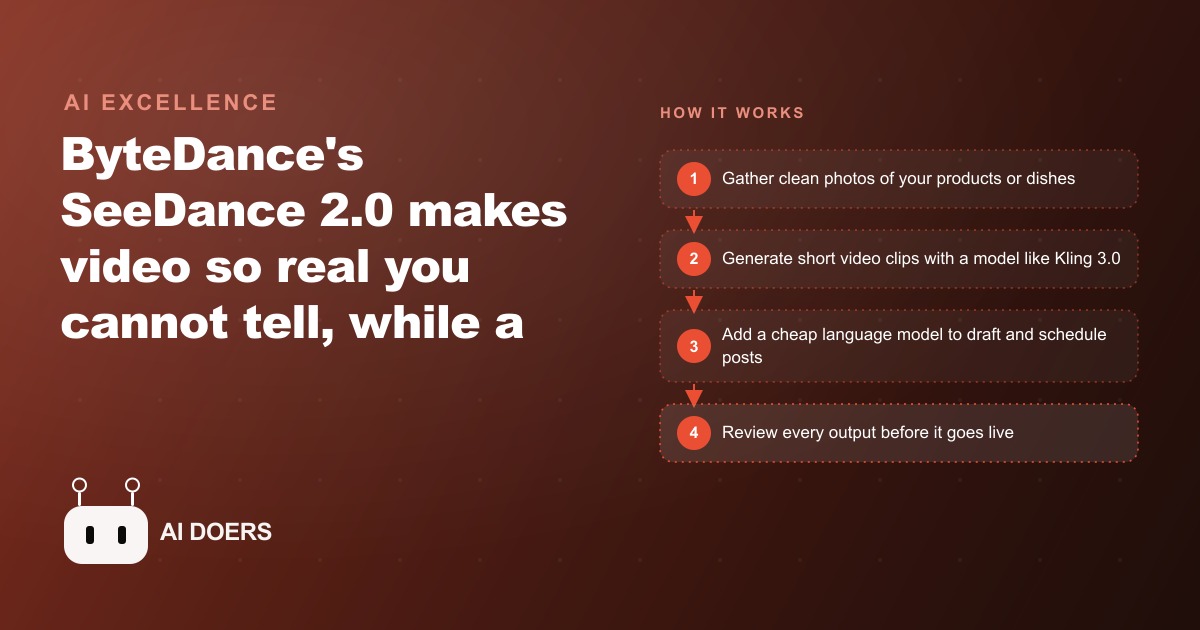
ByteDance just shipped a video model that generates 15-second clips so convincing that people watching them cannot reliably tell they are synthetic, and it landed in the same seven days that a wave of language models got dramatically faster and cheaper. I am Madhuranjan Kumar, and this was not a quiet week. It was the kind of week that quietly resets what a small marketing budget can produce, and most business owners will read past it because it arrived dressed as tech news instead of business news.
SeeDance 2.0 is the release that broke people's assumptions
The headline is video. SeeDance 2.0 accepts four kinds of input at once, text, image, audio, and video, which no other video model on the market currently does together. It outputs 15-second multi-shot clips with dual-channel audio and some of the most convincing lip-syncing anyone has demonstrated. The realism and character consistency sit at a level that, a year ago, would have required a crew, a shoot, and an edit bay.
That four-input design is the part that matters commercially, not the spectacle. When a model can take a product photo, a bit of reference audio, and a text description together, the workflow collapses. You feed in what you already have and a finished short clip comes out the other end. The distance between an asset on your phone and a publishable video shrinks from days to minutes, and it does so without a single line item for a videographer, a location, or an editor.
Part of why these models keep landing a step ahead of expectations is uncomfortable but worth stating plainly: several of the Chinese labs train and ship without gating around copyright the way the US labs do. ByteDance will let people generate trademarked characters that Sora and Google's tools refuse. That freedom, whatever you think of it, lets them iterate more aggressively and ship models that, on raw output quality, are arguably ahead. It is not the whole story, but it is a real part of why the frontier moved east this week, and it is worth understanding rather than ignoring, because it shapes which tools will keep pulling ahead.
The same week, language models got smarter, faster, and cheaper all at once
Around this breakdown news, three separate trends ran together, and it is the combination that matters more than any single benchmark.
Smarter: Google's Gemini 3 Deep Think topped the hardest reasoning tests, beating GPT 5.2 and Claude Opus 4.6 on Arc AGI-2 and Humanity's Last Exam, and reaching gold-medal level on the 2025 Physics and Chemistry Olympiads. Faster: GPT 5.3 Codex Spark, running on Cerebras chips, built a playable Vampire Survivors clone in about 50 seconds, roughly 20 times normal generation speed. Cheaper: MiniMax M2.5 matched state-of-the-art coding quality at 30 cents per million input tokens, cheap enough to run four instances continuously for a year for around ten thousand dollars.
The thread tying the best of these together is a shift in how you use them. You give the model a goal instead of a task, and it plans, executes, tests its own work, and keeps iterating. The open model GLM 5 made the point vividly by building a working Game Boy Advance emulator over 24 hours from nothing but a goal and a hardware document, planning and self-correcting with few nudges. It scored 50.4 on Humanity's Last Exam with tools, beating Opus 4.5, Gemini 3 Pro, and GPT 5.2, though running it locally still needs about twenty thousand dollars of hardware. The point is not the emulator. The point is that a model, given a destination and left alone, can now find its own way there, which is a different kind of tool than the chatbot most people still picture.
What actually changed for a business, and what did not
It is easy to read a week like this as noise. Ten model names, a dozen benchmarks, nothing you can act on. That reading is wrong, but so is the opposite reflex of chasing every release the moment it drops. Two concrete things changed for a business owner this week, and everything else is context.
First, video that used to require a crew, a shoot, and an editor can now come from a prompt and a few reference assets. That puts genuinely professional-looking content inside the reach of a one-person marketing team. Second, the cost of running agents all day dropped far enough that always-on automation stops being a luxury and becomes a line item you can actually afford. Those two shifts together mean the gap between what a solo operator can produce and what a funded competitor can produce just narrowed sharply.
The practical move is not to adopt the newest model on the leaderboard. It is to match the tool to the job. Reach for the new video models when you need content. Reach for a Cerebras-backed model when iteration speed decides your week. Move heavy, recurring workloads onto cheap open models to protect your margins. The winners this quarter will not be the businesses with access to some secret smarter model. They will be the ones who wired the right tool into the right task and left the leaderboard to the enthusiasts.
Two quieter signals from the same week are worth filing away, because they tell you where the ground is shifting. ChatGPT has officially started testing ads, which means the line between a paid placement and a genuine answer could blur over time, so treat any product an assistant recommends the way you would treat a search ad. And OpenAI's first hardware device slipped to early 2027, which means the viral Super Bowl earbud ad many people assumed was theirs was not. Neither changes your next move, but both remind you the platforms are still moving under your feet, which is exactly why owning a flexible content pipeline beats betting everything on one tool or one vendor.
A restaurant is where this week pays off first
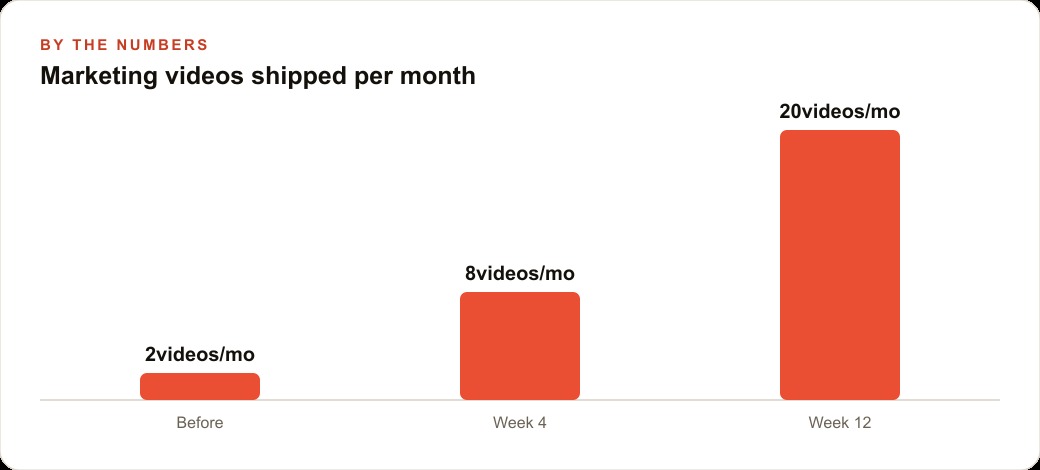
Let me ground all of this in one business, because the abstraction only matters if it changes a Tuesday. Picture a neighborhood restaurant with one owner handling everything, marketing included. The restaurant lives or dies on social content, and shooting that content has always been the expensive, slow part. A videographer for a menu shoot is a real invoice. So the owner posts twice a month, both times a flat photo, and engagement is flat to match.
Here is what this week's releases change for that owner. With a model like SeeDance 2.0 or Kling 3.0, a single good photo of a dish becomes a short, appetizing clip with sound, consistent lighting, and a clean look, the kind of thing that used to mean booking a shoot. Kling 3.0 is instructive on its own: it once took over an hour per generation and now runs inside a tool like Leonardo, producing video with audio in a couple of minutes while holding character consistency across shots. A week of menu highlights, a seasonal special teaser, a behind-the-counter clip, all generated from assets already sitting on the owner's phone, and all produced in an evening instead of a shoot day.
The cheaper, smarter language models cover everything around this breakdown. A low-cost agent can run all day drafting captions in the restaurant's voice, replying to reviews, and rebuilding the weekly specials post across platforms without burning the budget. The owner gives it the goal, on-brand posts that drive Friday reservations, and lets it plan and test which angles land. Even menu and pricing analysis fits the same pattern: point an agent at last month's sales and let it flag which dishes to promote and which to quietly retire. None of this was affordable to automate a year ago, and this week it became a rounding error on the monthly bills.
Now connect the content to the channels that actually move covers, because a good clip in a vacuum does nothing. Those generated videos become the creative that makes Facebook and Instagram ad campaigns cheaper to run, since better creative is the single biggest lever on cost per lead. The captions and menu pages the agent writes feed SEO and organic search, so the restaurant starts showing up when someone nearby searches for dinner. And the reservations and inquiries those posts generate flow into the CRM and website stack where a follow-up sequence turns a first visit into a regular. The owner who adopts this gets a marketing team's output from a phone and a few prompts, while the restaurant down the street is still deciding whether one videographer invoice is worth it this quarter.
The caution that keeps this credible
One warning belongs here, because the same realism that makes these tools powerful is also where they get businesses into trouble. A generated clip of a dish you do not actually serve, or one that misrepresents portion size or plating, is a fast way to disappoint a customer who walks in expecting what this breakdown promised. Use these models to show real food beautifully, not to invent food that does not exist. The realism is a gift when it flatters the truth and a liability when it stretches it. The same goes for the language agents replying to reviews: give them your real voice and real policies, and review anything sensitive before it posts, because an automated reply that gets a refund policy wrong in public is worse than no reply at all. Speed is only an advantage when the thing moving fast is also correct.
Why the cheap and the real matter more together than apart
It is worth pausing on why this particular week is more significant than a week with just one of these releases. A stunning video model on its own would be a novelty, something you try once and forget because producing content is only half the job. A batch of dirt-cheap language models on its own would be useful but invisible, the kind of thing that lowers a bill without changing what you can make. The reason this week matters is that both arrived together, which means you can now both produce professional content and run the automation that distributes and manages it, at a cost a solo operator can carry. That combination is what actually shifts competitive ground. The expensive part of marketing was never the idea, it was the production and the consistent execution, and both of those just got cheap in the same seven days. A business that pairs the new video output with an always-on, low-cost agent to schedule, caption, and respond is running a small marketing department for the price of a couple of software subscriptions, and that is the story hidden underneath all the benchmark noise.
The move to make this week
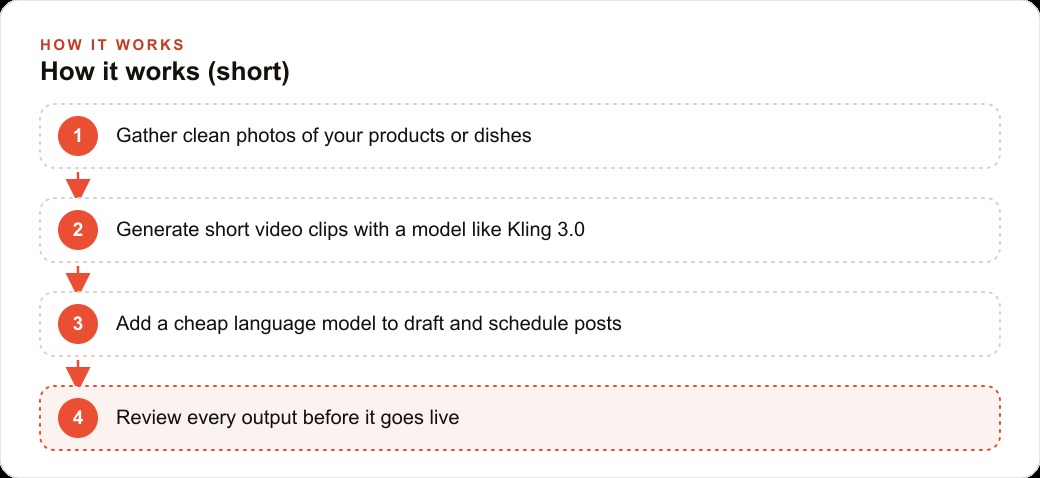
If you take one thing from a week this loud, make it this: start with one channel and one model, not ten. Pick your busiest platform. Gather a handful of clean photos, dishes, products, whatever your business sells. Test a video model like Kling 3.0 inside a tool such as Leonardo and turn those photos into short clips. If a model is region-locked or unavailable to you, reach for the one you can actually use rather than waiting for access.
Once this breakdown pipeline works, add a cheap language model to draft and schedule the surrounding posts against a goal, and review the output before it goes live. Keep the loop small until you trust it, then widen it. That sequence turns a chaotic news week into a concrete upgrade to how your business shows up online, and it costs you a weekend rather than a retainer.
You can run this yourself with a weekend of testing, and I would encourage any owner to try, because the first generated clip that actually looks good changes how you think about content forever. If you would rather have someone choose the right models for your situation, build the content pipeline, and wire up the low-cost agents that keep the marketing running, that is the kind of work I do for clients, and you can bring me in to handle it.
That is exactly what we do at AI DOERS. Book a private 30-minute call with Madhuranjan Kumar and we will map the fastest path to it for your specific business.
Book your call →
Madhuranjan Kumar
Madhuranjan Kumar brings 20 years of performance-marketing experience and has managed over $200 million in Facebook ad spend for brands across the United States and beyond. His expertise spans the full modern marketing stack: Meta, Google Ads, TikTok, email automation, CRM, and the websites that hold it together. At AI DOERS he turns that track record into lead-generation systems for businesses across every industry.