
How to Run a Location-Independent Business With AI Agents
A business that keeps running while you travel is not luck, it is a system of AI agents handling the routine work. Here is how I would build that system, and how it would work for a real local business.

AI agents crossed a specific quality threshold recently, and the threshold matters more than the general hype around the technology. I am Madhuranjan Kumar, and the shift I am describing is this: agent outputs are now worth reviewing rather than rewriting. Six months ago, an automated draft of a patient reminder message or a rescheduling offer required enough correction that doing it manually took the same time. Today, the draft is ninety percent of the way there on the first pass, and the review takes thirty seconds. That gap, from fifty percent to ninety percent on the first draft, is what separates a technology that is interesting from a technology that is operationally viable for a busy business owner who does not have time to babysit unreliable automation.
The practical consequence of that quality shift is that the location-independent business model is now within reach for local service businesses and professional practices, not just tech companies and remote-first consultancies. A dental practice, a law office, a trades business, or a clinic can now run a meaningful portion of its routine operations through agents that handle the administrative load while the owner is away from the desk, traveling, or simply focused on higher-value work. The agents are not replacing the skilled work. They are handling the repeatable admin that surrounds it, and they are handling it well enough to trust.
Agents Just Crossed the Quality Threshold That Makes Delegation Actually Work
The reason delegation fails is not usually a lack of trust in the person being delegated to. It is a lack of confidence that the output will meet a standard high enough to avoid creating more work than it saves. When you delegate a task and the result requires significant correction, you have added a review step and a revision step to a process that would have been faster to handle yourself. Net time cost: negative. That dynamic is why busy professionals keep doing tasks that should have been delegated long ago.
Agent outputs have been in that negative-net-time-cost zone for most of the history of AI automation. The outputs were plausible but inaccurate, or technically correct but tonally wrong, or complete but formatted in a way that required manual reformatting before use. Any of those gaps made the automation a time cost rather than a time saving, which is why most early adopters built demos and abandoned them.
The quality jump that changed this is not a single model release. It is an accumulation of improvements in instruction following, context retention, and output formatting that happened across several model generations over the past twelve months. Models now follow specific formatting instructions reliably. They maintain appropriate tone across a full message rather than drifting at the end. They handle conditional logic in a template, such as inserting the correct appointment time or the correct patient name, without hallucinating substitutions. Those specific improvements are what made agent outputs reviewable rather than rewritable.
The business implication is a fundamental change in the calculation. A task that previously required thirty minutes of skilled staff time now requires five minutes of review time. That change does not just save time. It changes what is economically possible for a small operation to handle without adding headcount. A two-person dental practice can now run the appointment reminder and rescheduling workflow for three hundred patients without hiring a third front desk person, because the agent handles the volume and a person handles the judgment calls.
The Location-Independent Business Is a System, Not a Lifestyle Choice
The phrase location-independent business gets associated with a specific aesthetic: a laptop on a beach, a Zoom call from a different time zone every week. That framing misrepresents what actually makes a business location-independent and creates unrealistic expectations about how it is achieved.
A business is location-independent when the routine operations do not require the owner's constant presence to keep running. That is a structural property of the business, not a lifestyle property of the owner. The beach laptop is possible because the system runs without the owner, not because the owner is working from a more scenic location. The distinction matters because building toward location independence requires operational discipline, not travel enthusiasm.
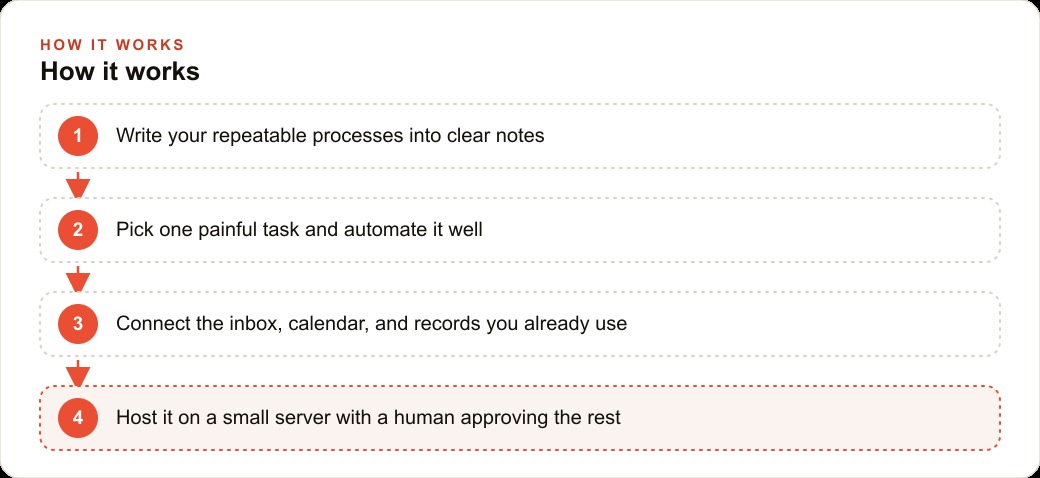
Building that structure requires three things. First, the routine operations need to be documented clearly enough that something other than the owner's memory can run them. Second, the most time-intensive routine tasks need to be automated with sufficient reliability that the automation can be trusted to run without constant supervision. Third, the exceptions, the situations that require real judgment, need a clear escalation path that routes them to a human quickly and cleanly.
Agents handle the second part well when the first part is done. An agent can run a well-documented process reliably. It cannot run a process that only exists in the owner's head, because there is nothing to run. Documentation is not a prerequisite that gets in the way of automation. Documentation is the automation, in the sense that a written process is the specification the agent executes.
For local service businesses, this is the critical insight that separates owners who successfully build working automation from owners who try agents and abandon them. The agent failed not because the technology was insufficient. The process was never written down, so the agent had no reliable instructions to follow. Write the process first. The automation follows immediately and works immediately. Skip the writing and the automation will drift within weeks.
Documentation First: Agents Cannot Run What Nobody Wrote Down
The documentation step is where most automation projects stall, not because it is difficult but because it is unsexy. Writing down how you handle appointment reminders feels like administrative busywork when you could be setting up an AI tool instead. The temptation is to skip it and configure the agent on the fly, trusting that you can describe the process in the moment.
The problem with that approach is that processes described in the moment are incomplete. The variations and edge cases, the things you handle automatically from experience without conscious thought, do not make it into the prompt. The agent then produces outputs that are correct for the common case and wrong for the uncommon one, and the owner spends more time correcting exceptions than they would have spent handling the process manually.
The documentation that makes agents reliable is not elaborate. It is specific. A good process document for appointment reminders contains: what triggers the reminder (how many days before the appointment), what the message should contain (patient name, date, time, location, any prep instructions specific to the appointment type), what the response options are (confirm, reschedule, cancel), how each response should be handled, and what counts as a non-response and what to do about it. That is a short document. Writing it takes thirty minutes. Running it through an agent for three hundred patients per month saves hours of staff time every week and does not require the owner's attention.
The same documentation principle applies to every task that gets automated subsequently. Write the process, including the edge cases you know from experience, before building the automation. Review the first week of outputs and add any edge cases the documentation missed. Tighten the instructions. By the end of the first month, the automation is running reliably on a documented process that also serves as training material for any staff member who needs to handle exceptions or take over the workflow.
The Dental Practice That Recovered Thirty Hours a Month Without Hiring
Let me walk through a concrete example. A dental practice with three hundred active patients and a two-person front desk team spends a significant portion of front desk capacity on the following recurring tasks: appointment reminders, rescheduling requests, answers to common scheduling questions, and follow-up with patients overdue for their next cleaning.
Before automation, the reminder workflow looks like this: the front desk pulls the next week's schedule, calls or texts each patient, logs the confirmation or requests a callback for rescheduling, handles the callbacks, updates the schedule, and repeats for patients who did not respond. At four minutes per patient contact on average across a three-hundred-patient active base, the reminder and rescheduling loop consumes roughly twelve hours of front desk time per month. That is before handling inbound inquiries and check-in.
After documentation and agent setup, the workflow changes. The agent checks the schedule nightly, identifies patients with appointments in the next forty-eight and seventy-two hours, and sends a personalized reminder via the practice's messaging system. The reminder includes the patient name, appointment time, location, and any prep instructions specific to the appointment type. Patients who confirm trigger a logged confirmation. Patients who respond with a reschedule request trigger a message offering the next three available slots. The front desk receives a daily summary of who confirmed, who rescheduled, and who has not responded.
The front desk's role changes from making and logging individual contacts to reviewing the summary, approving reschedule offers that the agent flagged as needing human judgment, and handling the small percentage of patients who call in directly. The illustrative time savings: the reminder and rescheduling workflow drops from twelve hours per month of front desk time to three hours of review time. Nine hours per month recovered, which at an average front desk rate of twenty-two dollars per hour represents roughly two hundred dollars per month in recovered capacity.
The more valuable impact is on appointment no-show rates. A practice that sends reminders manually gets around them to maybe sixty percent of patients in a given week. An automated system that runs every night, sends at the right interval before the appointment, and follows up with non-responders reaches a substantially higher percentage consistently. A meaningful reduction in no-show rate, even a few percentage points at an average appointment value of two hundred dollars, recovers far more revenue than the time saving does.
The lapsed patient follow-up is the second automation, and it is the one that compounds most clearly over time. The agent checks the patient records weekly, identifies anyone who is past their recommended return interval and has not scheduled, and sends a personalized outreach message. The message does not feel like a broadcast. It references the patient's name, their last appointment, and a specific reason to come back now. That specificity is the difference between a message that gets deleted and one that generates a booking.
A practice with three hundred active patients might have fifty to eighty lapsed patients at any given time who are overdue and unscheduled. If the automated follow-up recovers even three additional appointments per month at two hundred dollars each, that is six hundred dollars per month in revenue from a process that runs without any staff time once it is set up. For businesses that also run Facebook and Instagram ad campaigns for new patient acquisition, the automated lapsed patient recovery from the existing database is typically a far better return on time invested than any paid acquisition campaign, because the relationship already exists.
Keeping a Human in the Loop Is the Feature, Not a Limitation
A question that comes up whenever AI agents are proposed for customer-facing work is where the human stays in the process. The answer for a local service business is straightforward: the human stays in the loop for anything that involves money, clinical judgment, or a complex customer relationship. Everything else the agent handles.
This is not a concession to the technology's limitations. It is the right operational design. Billing disputes, treatment decisions, contract conversations, and any situation where a patient or client is upset require human judgment and human accountability. Routing those situations to an agent does not save time. It compounds a problem. The agent is for volume. The human is for judgment.
The practical implementation is an escalation threshold in the agent's instructions. Anything that matches a set of exception conditions, such as a response mentioning a billing concern, a message that expresses frustration, or a scheduling request for a specific provider outside the automated system's knowledge, gets flagged and routed to a staff member for handling. The agent does not try to resolve it. It surfaces it. That distinction keeps the automation reliable and keeps the exceptions visible.
For businesses with a CRM and website stack that already has inbox and calendar integrations, the escalation routing is straightforward to configure because the tools already know where to send messages and how to tag them. The agent works inside the existing system rather than beside it, which means the staff member sees escalations in the same inbox they already check rather than in a separate tool they need to remember to monitor.
Weekly Review Is What Keeps the System From Quietly Drifting Into Bad Outputs
Automations drift. A reminder template that was accurate when it was written may no longer match the current schedule format three months later. A categorization rule that was correct at launch may produce wrong outputs after the practice changed a policy. An outreach message that felt appropriate when patient volume was lower may feel intrusive when volume increased and patients are receiving contacts more frequently.
Drift is not a failure of the technology. It is a natural property of any process that runs without regular review. The weekly review is what keeps drift from accumulating into something that damages customer relationships or produces operational errors. Fifteen minutes per week, reviewing what the agents handled, where they flagged exceptions, and what the output quality looked like across a sample, is enough to catch most drift before it compounds.
The review also generates the specific feedback that improves the instructions over time. When the agent flags an exception incorrectly, the review shows what the instruction said and what it should have said. When the output is correct but the tone is slightly off, the review provides the specific example to use when adjusting the prompt. That cycle of output review and instruction tightening is what the Cursor story from earlier illustrates at a technical level: targeted feedback on the specific point of failure produces faster improvement than a vague sense that things are not quite right.
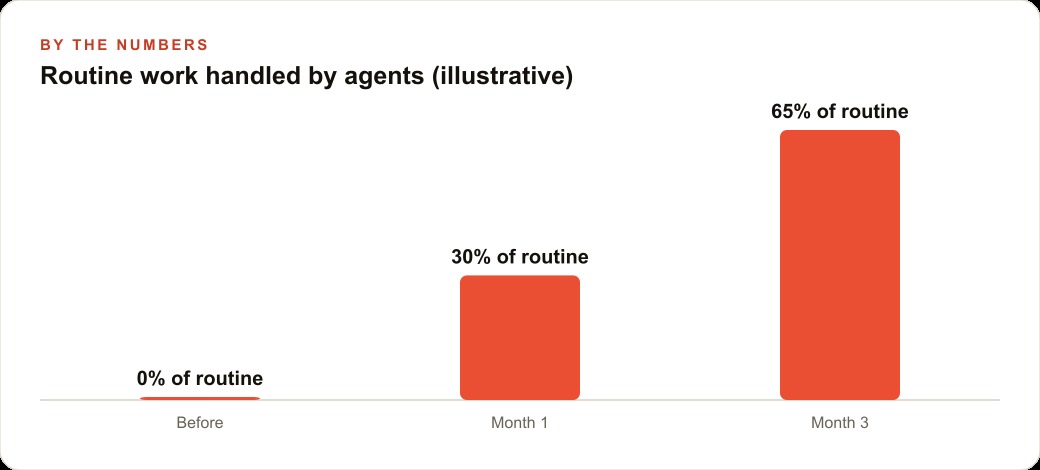
At month three of consistent operation, with documentation maintained and weekly reviews in place, the dental practice in this example has sixty-five percent of its routine administrative volume handled by agents. The remaining thirty-five percent is exceptions, clinical coordination, and direct patient relationships that belong with humans. The front desk team has recovered roughly thirty hours per month of capacity. The owner can take a week away from the practice without the administrative functions stopping, because the agents keep the routine running on schedule.
That is the location-independent business, built from the inside out: not a product of travel enthusiasm but a product of documented processes, reliable automation, and the operational discipline to review and improve the system every week. It is available to any local service business right now, at low cost, using the quality of agent outputs that became trustworthy in the last twelve months. The question is not whether the tools are ready. They are. The question is whether the process documentation that makes those tools reliable is going to get written this week or deferred until next quarter.
That is exactly what we do at AI DOERS. Book a private 30-minute call with Madhuranjan Kumar and we will map the fastest path to it for your specific business.
Book your call →
Madhuranjan Kumar
Madhuranjan Kumar brings 20 years of performance-marketing experience and has managed over $200 million in Facebook ad spend for brands across the United States and beyond. His expertise spans the full modern marketing stack: Meta, Google Ads, TikTok, email automation, CRM, and the websites that hold it together. At AI DOERS he turns that track record into lead-generation systems for businesses across every industry.